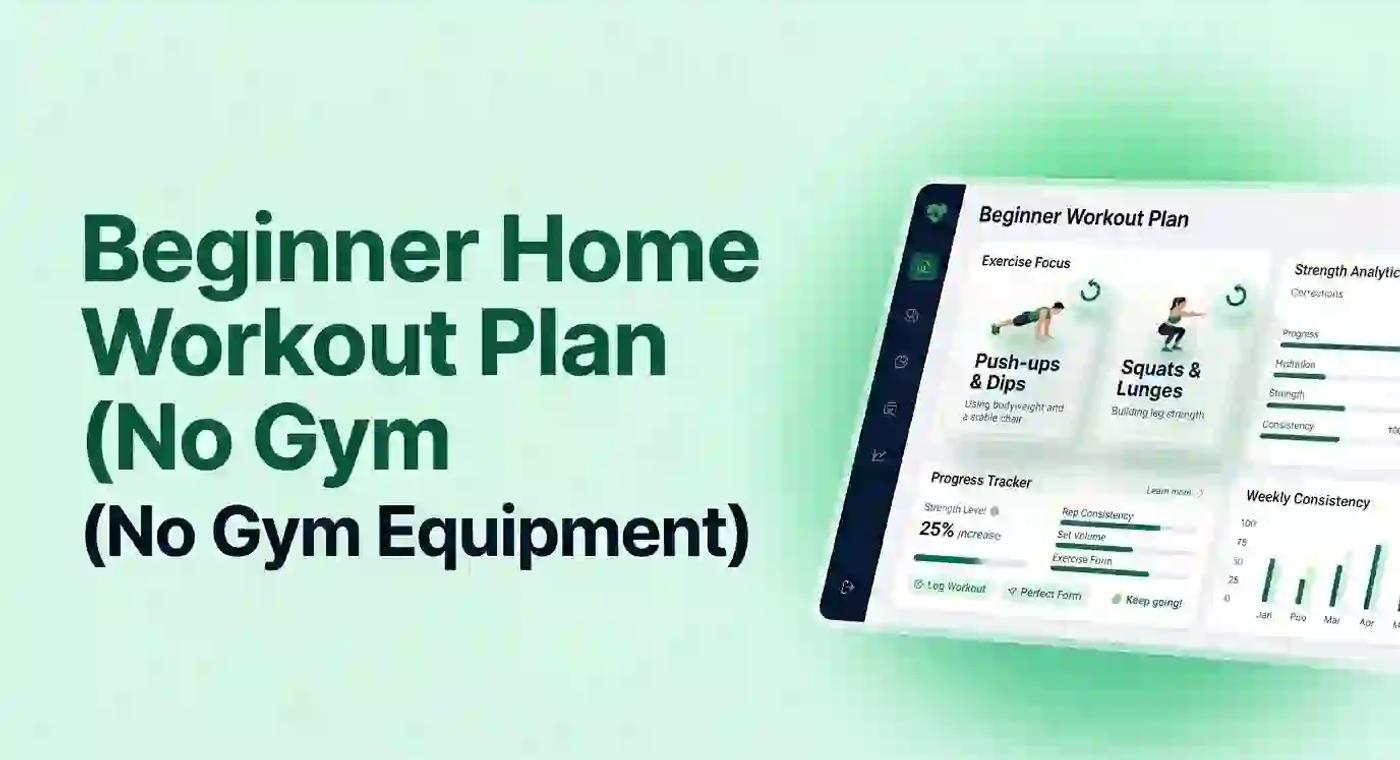
Beginner Home Workout Plan (No Gym Equipment Needed)
Start strong with this beginner home workout plan — no gym equipment needed. Get a weekly schedule, exercise tips, and beginner-friendly guidance.
Starting a fitness journey doesn't require an expensive gym membership or a garage full of equipment. A good beginner home workout plan uses simple bodyweight exercises like squats, push-ups, planks, and lunges, performed 2–3 times a week in a full-body format, with rest days in between for recovery. Over time, you progress by increasing reps, sets, or exercise difficulty — not by adding external weight.
If you've been putting off exercise because you don't own dumbbells or can't afford a gym, this guide is for you. Below, you'll find a complete no-equipment workout plan, proper form tips, a sample weekly schedule, and answers to the most common beginner questions — all designed to help you build strength, confidence, and consistency from your living room.
Why a Home Workout Plan Works for Beginners
Bodyweight training isn't a "lesser" version of gym workouts — it's a legitimate, science-backed training method known as calisthenics. It builds real strength by using your own body as resistance, and it comes with a few unique advantages for beginners:
- No cost barrier. You skip gym fees and equipment purchases entirely.
- Lower intimidation factor. Many beginners feel self-conscious in a gym; home workouts remove that pressure.
- Flexible scheduling. You can train whenever it fits your day, even in short 20–30 minute sessions.
- Functional strength. Bodyweight movements mimic real-life motions — squatting, pushing, pulling, and bending — which improves everyday mobility.
- Scalable difficulty. Nearly every bodyweight exercise has an easier and harder variation, so the same move can grow with you for months.
According to the World Health Organization, adults should aim for at least 150–300 minutes of moderate-intensity activity per week, along with muscle-strengthening activities on two or more days — and bodyweight training checks both boxes at once.
What Muscle Groups Can You Really Work at Home?
A common misconception is that you need weights to train your whole body. In reality, a well-designed home workout routine with no equipment can hit every major muscle group:
Chest & Triceps — Push-ups, incline push-ups, dips using a chair
Back & Biceps — Superman holds, reverse snow angels, towel rows
Legs & Glutes — Squats, lunges, glute bridges, step-ups
Core — Planks, dead bugs, bicycle crunches
Shoulders — Pike push-ups, arm circles, wall walks
Cardio/Conditioning — Jumping jacks, mountain climbers, high knees
This is why a no-equipment workout plan is genuinely enough for beginners — the limiting factor isn't your equipment, it's your consistency and progression.
Beginner Bodyweight Exercises: Mastering the Basics
Before jumping into a schedule, it helps to understand the foundational movements. Getting the form right early prevents injury and builds a base you can progress from.
1. Squats
Stand with feet shoulder-width apart, chest up, and lower your hips back and down as if sitting in a chair. Keep your knees tracking over your toes and your weight in your heels. Squats build your quads, glutes, and hamstrings — arguably the most important lower-body movement to master.
2. Push-Ups
Start in a plank position with hands slightly wider than shoulder-width. Lower your chest toward the floor while keeping your body in a straight line, then push back up. If a full push-up is too hard at first, drop to your knees or push against a wall or countertop — this is a completely valid push-up variation for beginners, not a shortcut.
3. Plank
Hold a forearm or straight-arm plank position, keeping your hips level (not sagging or piking up). This plank progression builds core stability, which protects your lower back in almost every other exercise.
4. Lunges
Step forward, lowering your back knee toward the floor while keeping your front knee behind your toes. Lunges challenge balance and single-leg strength, which squats alone don't fully address.
5. Glute Bridges
Lie on your back, knees bent, feet flat on the floor. Push through your heels to lift your hips, squeezing your glutes at the top. This is a low-impact, joint-friendly way to strengthen your posterior chain.
Mastering these five movements gives you nearly everything you need for a full body workout at home for beginners.
Sample Beginner Home Workout Schedule (No Equipment)
Here's a realistic weekly structure that balances effort with recovery — a common approach for beginners easing into consistent training.
Monday — Full Body Strength: Squats, push-ups, plank, glute bridges (3 sets of 10–12 reps)
Tuesday — Rest or Light Walk: Stretching, mobility work, 20-minute walk
Wednesday — Full Body Strength: Lunges, incline push-ups, superman holds, bicycle crunches
Thursday — Rest or Light Cardio: Light yoga, easy cycling, or a walk
Friday — Full Body + Light Cardio: Squats, push-ups, mountain climbers, plank, jumping jacks
Saturday — Optional Active Recovery: Stretching or a leisurely walk
Sunday — Full Rest: Complete recovery
This structure gives you three focused strength sessions a week — enough to build noticeable strength and endurance without risking burnout or overtraining, which is especially important when you're new to exercise.
How Many Reps and Sets Should a Beginner Do?
A common starting point is 2–3 sets of 8–12 reps per exercise, resting 30–60 seconds between sets. As the movements start to feel easy, you can increase reps, slow down the tempo, or move to a harder variation — this is called progressive overload without weights, and it's the key principle behind building strength over time.
Warming Up and Cooling Down
Skipping a warm-up is one of the most common beginner mistakes. A proper home workout warm-up should take 5–8 minutes and include:
- Arm circles and shoulder rolls
- Bodyweight squats (slow, controlled)
- Hip circles and leg swings
- Light jogging in place or jumping jacks
After your workout, spend 5 minutes on a home workout cool-down: static stretches for your hamstrings, quads, chest, and shoulders. This improves flexibility over time and reduces next-day soreness.
Building Cardio Into Your Routine
You don't need a treadmill for beginner cardio at home. Simple options include:
- Jumping jacks (30–60 seconds)
- High knees
- Mountain climbers
- Marching or jogging in place
- Stair climbing, if you have stairs at home
Adding 10–15 minutes of this style of movement two or three times a week supports both weight management and cardiovascular health, complementing your strength sessions well.
Can You Build Muscle at Home With No Equipment?
Yes — within limits. Bodyweight training can absolutely build muscle, especially for beginners whose muscles aren't yet adapted to resistance of any kind. The key is progression: as basic movements get easier, you increase difficulty through variations (like moving from knee push-ups to full push-ups to decline push-ups), slower tempos, or higher rep ranges. Advanced lifters eventually need added resistance to keep progressing, but for the first several months — sometimes longer — bodyweight training alone can build meaningful strength and muscle definition.
Home Workout Plan for Weight Loss
If fat loss is your main goal, your home workout plan for weight loss should combine:
- Strength training (3x/week) to preserve and build lean muscle, which supports a healthy metabolism.
- Cardio bursts (jumping jacks, mountain climbers, high knees) mixed into or after strength sessions.
- Consistency over intensity — showing up reliably for 20–30 minutes matters more than occasional brutal workouts.
- Nutrition awareness — exercise alone rarely creates a fat-loss result without attention to overall eating habits.
The Centers for Disease Control and Prevention notes that combining regular physical activity with a balanced diet is one of the most effective approaches for healthy, sustainable weight management.
Home Workout Tips for Small Spaces or Apartments
Worried about space? Most beginner bodyweight exercises need only a 6x6-foot area. Tips for small-space training:
- Use a yoga mat or towel to define your workout zone and cushion joints.
- Choose exercises like planks, push-ups, and squats that don't require lateral movement.
- If you're in an apartment with neighbors below, skip high-impact jumping moves and substitute slower tempo versions (e.g., reverse lunges instead of jump lunges).
- A wall and a sturdy chair are the only "equipment" you'll ever really need for incline push-ups or step-ups.
Staying Motivated and Consistent
Motivation fades — consistency is what actually produces results. A few practical home workout consistency tips:
- Schedule it like an appointment. Put your workout time on your calendar.
- Track your progress. Note reps, sets, or how a movement felt each week; small wins add up.
- Start smaller than you think you need to. A 15-minute workout you actually complete beats a 45-minute one you skip.
- Pair it with something you enjoy, like a favorite playlist or podcast.
- Expect plateaus. Progress isn't linear, and that's normal, not failure.
Injury Prevention for Beginners
Because home workouts often mean no coach watching your form, injury prevention deserves extra attention:
- Prioritize form over speed or reps, especially in your first few weeks.
- Don't skip the warm-up, even on days you feel short on time.
- Progress gradually — resist the urge to jump straight into advanced variations.
- Stop if you feel sharp pain (different from normal muscle fatigue).
- If you have an existing health condition, joint issue, or you're new to exercise after a long break, check with a physician before starting a new program, as individual fitness levels and mobility vary.
Frequently Asked Questions
What is a good beginner workout plan with no equipment? A good plan combines full-body bodyweight exercises like squats, push-ups, lunges, and planks, done 2–3 times weekly with rest days between sessions, and progresses over time through added reps, sets, or harder exercise variations.
How many days a week should a beginner work out at home? Most beginners do well with 2–3 strength sessions per week, leaving rest or light-activity days in between. This allows muscles to recover while still building a consistent habit.
Can you build muscle with just bodyweight exercises? Yes, especially early on. Bodyweight training provides enough resistance to build noticeable muscle and strength for beginners, though very advanced trainees eventually benefit from added external resistance.
How long should a beginner's home workout be? A 20–30 minute session is typically enough, especially when combining strength moves with short cardio bursts. Consistency matters more than duration for beginners.
What equipment-free exercises work the whole body? Squats, push-ups, lunges, planks, and glute bridges together train your legs, chest, back, shoulders, and core, making them a solid foundation for a full-body no-equipment routine.
Do I need rest days if I'm just starting out? Yes. Rest days allow muscles to repair and grow stronger, and they help prevent burnout or injury, which is especially important when your body is adapting to a new routine.
Getting Started the Right Way
The best beginner home workout plan is the one you'll actually stick with. Start with the fundamentals — squats, push-ups, planks, and lunges — build a simple 2–3 day weekly schedule, and let your body adapt before chasing intensity. Progress will come naturally through consistency, not perfection.
If you want to personalize your plan further, tools like a workout planner or a calorie intake planner can help you tailor your routine and nutrition to your specific goals. You can also read more on building sustainable habits in our guide to a beginner weekly workout plan or explore a 30-minute workout plan for busy people if time is your biggest obstacle.
Ready to take the next step? Explore more free tools at Smart Health Calculators to plan your fitness journey with confidence — no gym required.
Medical Disclaimer
This article is for general education only. It is not medical advice, diagnosis, treatment, prescription guidance, or a replacement for professional healthcare. Speak with a qualified healthcare professional for personal medical concerns, symptoms, pregnancy concerns, mental health crisis, medication questions, or before making major health changes.