BMI vs Body Fat Percentage: Which Matters More?
BMI vs body fat percentage — which one actually reflects your health? Compare accuracy, cost & accessibility to see which metric matters more.
You step on a scale, calculate your BMI, and get a number that says "overweight" — but you look and feel fit. Meanwhile, someone with a "normal" BMI might be carrying dangerous levels of visceral fat without knowing it. So which measurement should you actually trust?
Here's the direct answer: body fat percentage is generally more accurate for assessing individual health, since it directly measures what BMI can only estimate — how much of your body is actually fat versus muscle, bone, and water. BMI remains useful as a quick, free, population-level screening tool, but it has real limitations for individuals, particularly athletes and muscular people. In this guide, we'll break down exactly how each measurement works, where they diverge, and which one you should actually be tracking for your specific goals.
What Is BMI, and How Is It Calculated?
Body Mass Index (BMI) is a simple formula that divides your weight in kilograms by your height in meters squared. Created by Belgian mathematician Adolphe Quetelet in the 1830s — originally as a population statistics tool, not an individual health metric — BMI has since become the default screening measurement used by doctors, insurers, and health organizations worldwide because it's fast, free, and requires nothing more than a scale and a tape measure.
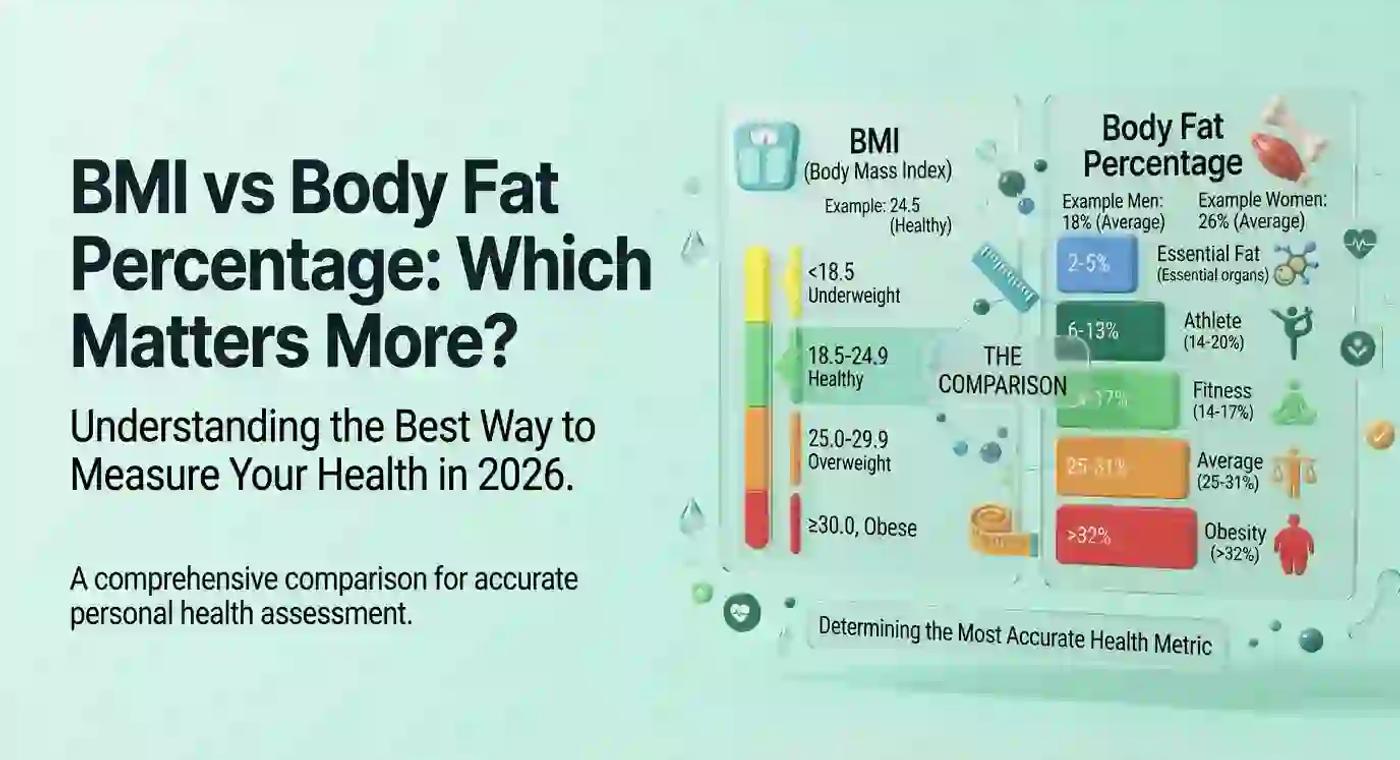
The World Health Organization (WHO) classifies BMI into standard categories: below 18.5 is underweight, 18.5–24.9 is normal weight, 25–29.9 is overweight, and 30+ is classified as obese. These categories apply broadly across populations, though some countries, including several in South Asia, use adjusted thresholds due to different body composition patterns at equivalent BMI levels.
What Is Body Fat Percentage, and How Is It Measured?
Body fat percentage measures exactly what it sounds like — the proportion of your total body mass that's made up of fat tissue, as opposed to muscle, bone, organs, and water. Unlike BMI, which is a mathematical estimate based on just two numbers, body fat percentage attempts to measure body composition more directly.
Several methods exist, each with different accuracy levels and accessibility:
- Bioelectrical Impedance Analysis (BIA) — Used in most home body fat scales; sends a small electrical current through the body to estimate fat based on resistance. Convenient but sensitive to hydration levels, which can skew results.
- Skinfold calipers — A trained professional pinches skin at specific sites to estimate subcutaneous fat. Reasonably accurate when performed correctly, but highly dependent on the tester's skill.
- DEXA scan (dual-energy X-ray absorptiometry) — Considered the clinical gold standard, using X-ray technology to precisely measure fat, muscle, and bone mass separately. Highly accurate but requires specialized equipment and isn't typically available outside medical or research settings.
- Waist-to-hip ratio — Not a direct body fat measurement, but a useful proxy for fat distribution, particularly relevant since visceral fat vs subcutaneous fat carries different health risk profiles.
BMI vs Body Fat Percentage: Comparison Table
BMI vs Body Fat Percentage: Quick Comparison
What It Measures — BMI: Weight relative to height | Body Fat %: Actual proportion of body fat
Accessibility — BMI: Instant, free, needs only height/weight | Body Fat %: Varies — home scales are easy; DEXA requires a facility
Accuracy for Individuals — BMI: Limited, especially for muscular people | Body Fat %: Generally more accurate, depending on method used
Accounts for Muscle Mass — BMI: No | Body Fat %: Yes (directly measures fat vs lean mass)
Cost — BMI: Free | Body Fat %: Free (BIA scale) to $100+ (DEXA scan)
Best Use Case — BMI: Quick population-level screening | Body Fat %: Personalized fitness and health tracking
Why Doesn't BMI Account for Muscle Mass?
This is BMI's most significant limitation, and it comes down to the math itself. BMI only factors in total weight and height — it has no way of distinguishing whether that weight comes from muscle, fat, or bone. Since muscle is denser than fat, a muscular person weighs more per unit of volume than someone with a higher fat percentage at the same height, causing BMI to systematically misclassify lean, muscular individuals as "overweight" or even "obese."
This is exactly why athlete BMI misclassification is such a well-documented issue. A bodybuilder with 8% body fat and significant muscle mass can easily score a BMI in the "overweight" or "obese" range, despite being in excellent physical condition by virtually every other health measure.
Can You Have a Normal BMI but High Body Fat?
Yes — and this scenario, sometimes called "skinny fat" or normal-weight obesity, is arguably more concerning than the reverse muscular-athlete scenario. Someone with a normal BMI but low muscle mass and high body fat percentage can still carry significant metabolic health risks, including elevated visceral fat around organs, despite their weight-to-height ratio appearing perfectly normal on paper.
This is precisely why relying on BMI alone can create a false sense of security. Two people with identical BMI scores can have completely different health profiles depending on their actual body composition — one might have healthy muscle-to-fat ratios, while the other carries excess fat with minimal lean mass.
Why Is BMI Still Used If It Has These Limitations?
Despite its flaws, BMI remains widely used for a few practical reasons. It's essentially free and instant, requiring no special equipment beyond a scale and a height measurement, making it useful for large-scale population health screening and epidemiological research where efficiency matters more than individual precision. Major health organizations, including the CDC and WHO, continue to use BMI as an initial screening tool specifically because it correlates reasonably well with health risk at the population level, even though it's a poor tool for assessing any single individual's actual body composition.
Think of BMI as a first-pass filter, not a diagnosis. It flags people who might need closer assessment, but it was never designed to be the final word on anyone's individual health status.
What Is a Healthy Body Fat Percentage?
General reference ranges from the American Council on Exercise (ACE) suggest:
- Men: 14–17% (fitness), 18–24% (average/healthy)
- Women: 21–24% (fitness), 25–31% (average/healthy)
Essential fat — the minimum needed for basic physiological function — sits around 2–5% for men and 10–13% for women. Athletes often fall below the general "healthy" range while remaining in excellent health, which is itself another example of why context matters more than any single number.
If you want an accurate, personalized starting point rather than relying on a generic chart, our free Body Fat Estimator gives you a calculated estimate based on your actual measurements.
Which Measurement Should You Track for Fitness Goals?
This depends on what you're actually trying to achieve, but for most people focused on genuine body composition changes — losing fat while maintaining or building muscle — body fat percentage is the more useful metric to track over time.
Here's why: if you're strength training consistently while in a calorie deficit, your weight (and therefore your BMI) might stay relatively stable or even increase slightly as you build muscle while losing fat. Someone tracking only their BMI or scale weight in this scenario might feel discouraged by a stagnant or rising number, even though their actual body composition — and health — is improving significantly. Body fat percentage tracking captures that progress in a way BMI simply cannot.
That said, BMI still has a place as a quick, zero-cost check-in, particularly for people who aren't engaged in serious strength training and whose weight changes are more likely to reflect genuine fat gain or loss rather than muscle fluctuation.
BMI vs DEXA Scan: The Accuracy Gap
If you want to understand just how far apart these methods can be, a DEXA scan comparison makes it obvious. DEXA scans can precisely separate fat mass, lean mass, and bone density, offering research-grade accuracy that BMI's simple height-weight formula can't approach. The tradeoff is accessibility — DEXA scans require specialized equipment typically found only in medical centers, sports science facilities, or specialized body composition clinics, and usually come with a cost per scan.
For most people, a home BIA scale or the general BMI calculation offers a reasonable, free starting point, while a periodic DEXA scan (if accessible) provides a more precise benchmark for tracking genuine progress over months or years.
Should Doctors Stop Using BMI?
This is an active debate in the medical community, and it's worth understanding both sides. Critics rightly point out that BMI's individual-level limitations — particularly its blindness to muscle mass and fat distribution — mean it shouldn't be used as a standalone diagnostic tool. However, defenders note that BMI remains a useful, cost-free first screening step, especially in resource-limited healthcare settings where more precise body composition tools simply aren't available or practical for routine checkups.
The most balanced approach many health professionals now recommend is using BMI as an initial flag, then following up with additional context — waist circumference, body fat percentage, or other metabolic markers — before drawing conclusions about an individual's actual health status.
Waist-to-Hip Ratio: A Useful Third Metric
Beyond BMI and body fat percentage, waist-to-hip ratio deserves mention as a complementary measurement, since it specifically captures fat distribution rather than total fat amount. Because visceral fat carries more metabolic risk than fat stored elsewhere on the body, two people with identical body fat percentages but different fat distribution patterns can have meaningfully different health risk profiles — something neither BMI nor overall body fat percentage alone fully captures.
Building a Complete Health Picture
The smartest approach doesn't pit these metrics against each other — it uses them together for context. Consider combining:
- BMI — A free, instant starting reference point
- Body fat percentage — A more accurate picture of actual body composition
- Waist circumference — An indicator of fat distribution and related health risk
- Progress photos and how clothes fit — Practical, real-world indicators that numbers alone can miss
If you're building a broader fitness routine and want your training to reflect real body composition goals rather than just a scale number, our Workout Planner can help you structure a program that supports genuine fat loss and muscle preservation — the exact combination that makes tracking body fat percentage more meaningful than BMI alone.
For a deeper look at how body fat and weight relate specifically to your height, our guide on normal weight range by height breaks down realistic weight expectations alongside these body composition considerations.
Why Choose Smart Health Calculators
Understanding your body composition shouldn't require choosing between an oversimplified number and an expensive clinical scan. At Smart Health Calculators, our tools are built around evidence-based formulas that give you a genuinely useful, personalized starting point — not a one-size-fits-all chart that ignores your actual muscle mass and body composition.
Explore our full collection of free health and fitness tools, including our BMI Calculator and Body Fat Estimator, to get a more complete picture of your health than either metric alone can provide.
FAQs About BMI vs Body Fat Percentage
Is body fat percentage more accurate than BMI? Yes, generally. Body fat percentage directly measures the proportion of fat versus lean mass in your body, while BMI only estimates based on height and weight, making it blind to muscle mass and fat distribution.
Can you have a normal BMI but still have high body fat? Yes. This is known as "normal-weight obesity" or being "skinny fat" — someone can have a healthy BMI while carrying high body fat and low muscle mass, which can still pose real metabolic health risks.
What is a healthy body fat percentage? For men, 18–24% is considered average/healthy, with 14–17% reflecting fitness-level leanness. For women, 25–31% is average/healthy, with 21–24% reflecting fitness-level leanness, according to general ACE guidelines.
Why is BMI considered inaccurate for athletes? BMI can't distinguish between muscle and fat mass. Since muscle is denser than fat, muscular athletes often weigh more relative to their height, causing BMI to misclassify them as overweight or obese despite low body fat and excellent fitness.
Does BMI account for muscle mass? No. BMI is calculated purely from height and weight, with no measurement of body composition at all, which is precisely why it can misclassify both very muscular and very lean-but-low-muscle individuals.
Is BMI still used by doctors despite its limitations? Yes, primarily as a free, quick initial screening tool. Many health professionals now recommend pairing BMI with additional context, like body fat percentage or waist circumference, rather than relying on it as a standalone health indicator.
Final Thoughts
BMI and body fat percentage aren't really competing metrics — they're tools built for different purposes. BMI offers a fast, free, population-level screening number, while body fat percentage gives you a far more accurate picture of your actual body composition, particularly if you're strength training or tracking genuine fitness progress. For most people focused on real health and fitness outcomes, body fat percentage matters more — but understanding both, alongside practical indicators like waist circumference and how your clothes fit, gives you the fullest picture of all.
Ready to get a more accurate picture of your body composition? Try our free Body Fat Estimator alongside our BMI Calculator to compare both metrics side by side and see the full picture for yourself.
For further authoritative reference, the CDC's guidance on body composition and health assessment provides evidence-based context worth reviewing.
Medical Disclaimer
This article is for general education only. It is not medical advice, diagnosis, treatment, prescription guidance, or a replacement for professional healthcare. Speak with a qualified healthcare professional for personal medical concerns, symptoms, pregnancy concerns, mental health crisis, medication questions, or before making major health changes.