Dietary Fiber Intake: How Much Fiber Do You Need Daily?
Learn how much dietary fiber you actually need per day by age and sex, backed by FDA and NIH guidelines, plus tips to increase intake safely.
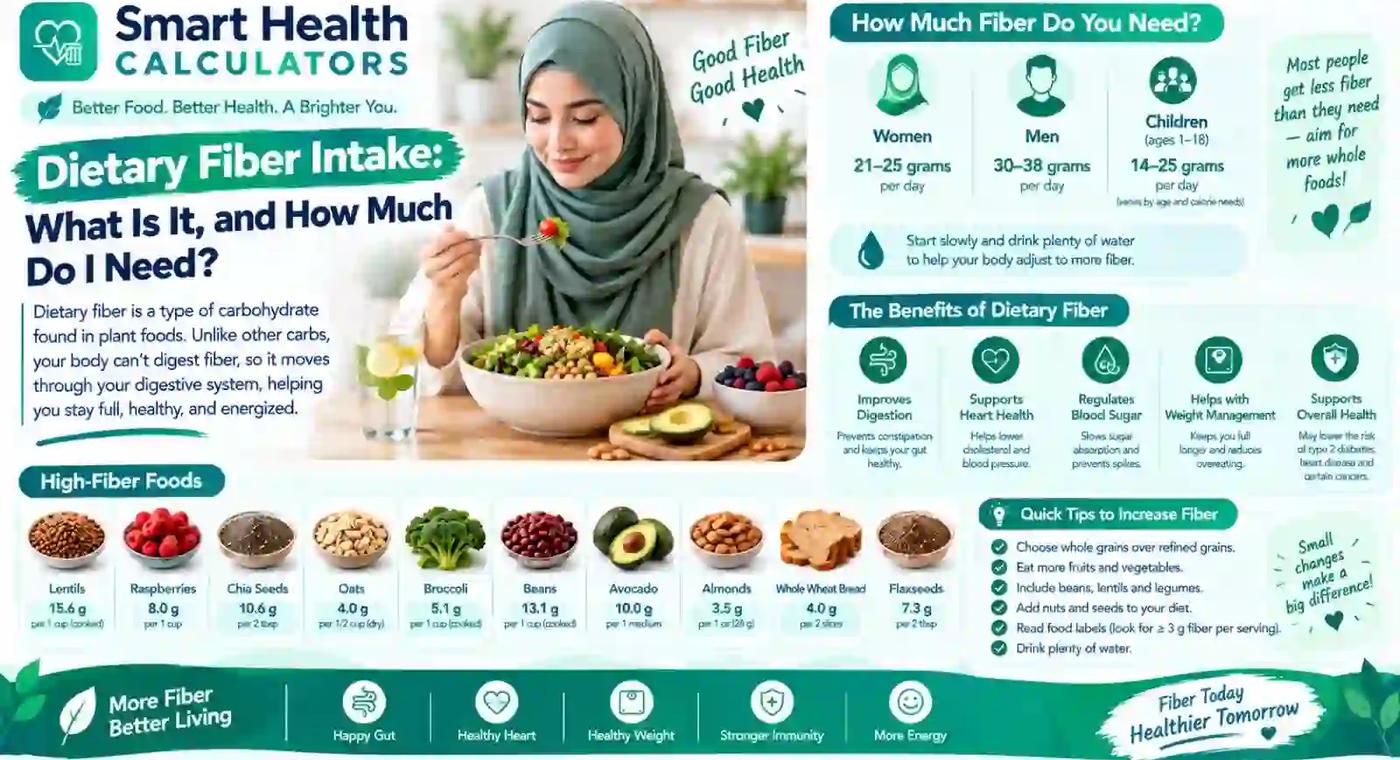
Most adults need roughly 14 grams of fiber for every 1,000 calories they eat. For a typical adult, that works out to about 25 grams a day for women and 38 grams for men under 50, dropping to 21 grams and 30 grams respectively after 50. Yet data from recent national nutrition surveys shows the average American adult eats only around 17 grams a day — roughly half the recommended amount, and one of the most consistent shortfalls in the American diet.
If that gap surprises you, you're not alone. Fiber gets mentioned constantly in health advice, but rarely explained clearly — what it actually is, why the recommended number changes by age and sex, and what happens if you try to fix a fiber deficit too fast. This guide covers all of that, sourced against the frameworks used by the FDA, the National Academies, and NIDDK, so you walk away with a number that's actually right for you rather than a vague "eat more fiber" instruction.
What Is Dietary Fiber, Exactly?
Dietary fiber is the part of plant foods your body can't fully digest or absorb. Unlike other carbohydrates, which get broken down into glucose for energy, fiber passes largely intact through your digestive system, adding bulk to stool and feeding bacteria in your gut along the way.
This "indigestible" quality isn't a flaw — it's exactly what makes fiber useful. Because your body doesn't break it down the way it breaks down sugar or starch, fiber doesn't raise blood glucose the way other carbohydrates do, and it plays a mechanical role in digestion that no other nutrient really replicates.
It's worth being precise about terminology here, since a lot of general health content blurs this distinction:
- Dietary fiber refers to naturally occurring, intrinsic fiber found in whole foods — the fiber already present in an apple, a lentil, or a stalk of broccoli.
- Functional fiber refers to isolated or synthesized non-digestible carbohydrates that have been extracted or manufactured and added to foods or supplements for a beneficial physiological effect — think psyllium husk added to a supplement, or inulin added to a protein bar.
- Total fiber is simply dietary fiber plus functional fiber combined, which is the figure most official recommendations are actually built around.
Soluble vs. Insoluble Fiber: The Two Main Types
Fiber isn't one uniform substance — it behaves differently depending on its structure, and most foods contain a mix of both major types.
Soluble fiber dissolves in water, forming a gel-like substance in your digestive tract. This type is specifically associated with helping manage cholesterol and blood sugar levels, since the gel it forms can slow digestion and nutrient absorption in ways that moderate post-meal blood sugar spikes. Oats, beans, apples, and psyllium are classic soluble fiber sources.
Insoluble fiber doesn't dissolve in water and instead adds bulk to stool, helping food move more efficiently through your digestive tract. This type is most closely associated with preventing constipation and supporting regular bowel movements. Whole wheat, nuts, and the skins of many fruits and vegetables are rich in insoluble fiber.
It's worth noting that soluble versus insoluble isn't the only meaningful way scientists classify fiber — modern nutrition research also considers characteristics like fermentability (how readily gut bacteria can break a fiber down) and viscosity (how thick a gel it forms), both of which affect a fiber's specific physiological effects. But for practical, everyday purposes, understanding the soluble/insoluble distinction covers most of what matters for building a balanced diet.
How Much Fiber Do You Actually Need? The Real Numbers
This is where most generic fiber content falls short — it either gives you one flat number for everyone, or throws around a handful of inconsistent figures without explaining why they differ. Here's the clear picture.
The Core Formula: 14 Grams Per 1,000 Calories
The foundational framework, established through the National Academies' Dietary Reference Intakes, sets fiber's Adequate Intake at 14 grams per 1,000 calories consumed. This calorie-based approach is why fiber recommendations differ by age, sex, and activity level — they're all downstream of how many calories a person typically needs.
Age and Sex-Specific Targets
Based on typical calorie needs for each group, this formula translates into the following commonly cited daily targets:
| Group | Recommended Daily Fiber |
|---|---|
| Women, 19–50 | 25 grams |
| Men, 19–50 | 38 grams |
| Women, 51+ | 21 grams |
| Men, 51+ | 30 grams |
The lower targets for adults over 50 reflect the fact that estimated calorie needs generally decline with age, not that older adults need proportionally less fiber for its own sake.
The FDA Daily Value: A Different (But Related) Number
If you've seen "28g" listed as a fiber target on a Nutrition Facts label, that's a separate reference point: the FDA's Daily Value for dietary fiber, based on a standard 2,000-calorie diet. This isn't a contradiction of the age/sex-based Adequate Intake figures above — it's simply a single, standardized reference number used specifically for food labeling purposes, since Nutrition Facts labels need one consistent baseline rather than dozens of age- and sex-specific versions.
In short: if you want your personalized target, use the 14g/1,000 kcal formula against your own calorie intake. If you're just reading a food label's "% Daily Value" for fiber, that figure is calculated against the flat 28g reference.
A Wider Practical Range
NIDDK's guidance frames adult fiber needs more broadly as 22–34 grams per day, depending on age and sex — a range that captures the same underlying logic as the table above without requiring you to calculate an exact figure. If you're not interested in precise calorie-based math, aiming somewhere in this range is a reasonable practical target for most adults.
If you want your fiber target calculated alongside your personalized calorie needs rather than estimating from a general table, our Calorie Intake Planner gives you the calorie side of that equation directly, which you can then multiply by 0.014 to get your specific gram target.
Why Most People Fall Short — And What Happens When You Do
Recent national nutrition data shows a striking pattern: roughly 90% of women and 97% of men in the U.S. fail to meet fiber recommendations, based on 2020–2025 Dietary Guidelines analysis. This isn't a niche problem — it's one of the most consistent nutritional gaps in the American diet, largely driven by low intake of whole fruits, vegetables, legumes, and whole grains relative to processed foods.
When fiber intake stays consistently low, the effects show up in a few predictable ways:
- Constipation and irregular bowel movements, since insoluble fiber's bulking effect is largely missing from the diet
- Less stable blood sugar responses, since soluble fiber's moderating effect on glucose absorption isn't present
- Reduced satiety, meaning meals feel less filling and hunger returns faster, which can complicate weight management efforts
- Less favorable cholesterol patterns, since soluble fiber specifically supports healthy LDL cholesterol levels
None of this means fiber alone determines these outcomes — diet, genetics, activity level, and overall eating pattern all play a role. But fiber's contribution here is well-established enough that it's one of the more consistently recommended dietary changes across major health authorities.
Best Food Sources of Dietary Fiber
Since dietary fiber (as opposed to functional fiber from supplements) comes exclusively from plant foods, building your intake around whole foods naturally covers most of what you need.
High-fiber legumes: Lentils, black beans, chickpeas, and split peas are among the most fiber-dense foods available, often delivering 7–9 grams per half-cup cooked serving alongside a meaningful amount of protein.
Whole grains: Oats, barley, quinoa, and whole wheat products provide both soluble and insoluble fiber, in contrast to refined grains, which have much of their natural fiber content removed during processing.
Fruits with edible skins: Apples, pears, and berries carry much of their fiber content in and just beneath the skin, which is why peeling fruit before eating it noticeably reduces its fiber contribution.
Vegetables, especially cruciferous varieties: Broccoli, Brussels sprouts, and similar vegetables are fiber-rich while remaining relatively low in calories, making them efficient sources for hitting a daily target without excess energy intake.
Nuts and seeds: Chia seeds, flaxseed, and almonds pack meaningful fiber into small serving sizes, useful for boosting intake without needing to eat large food volumes.
A practical target worth remembering: aiming for at least 5 grams of fiber per meal, spread across three meals plus a snack or two, is a straightforward way to reach 25–30+ grams across a full day without needing to track every gram precisely.
Can You Eat Too Much Fiber?
Yes, and this deserves honest coverage rather than the usual "more fiber is always better" oversimplification. Increasing fiber intake too quickly — particularly for someone accustomed to a low-fiber diet — commonly triggers gas, bloating, abdominal cramping, and either constipation or diarrhea, depending on the type of fiber and how much water accompanies it.
CDC guidance specifically recommends increasing fiber gradually rather than making a dramatic jump overnight, alongside ensuring adequate fluid intake as fiber intake rises. A practical approach:
- Increase fiber intake incrementally — adding roughly 5 grams every few days rather than doubling your intake in a single day
- Increase water intake alongside fiber, since fiber (particularly insoluble fiber) needs adequate fluid to move through the digestive tract effectively without causing discomfort
- Spread fiber-rich foods across meals rather than front-loading a single large fiber-heavy meal
- Pay attention to your body's response and slow down the increase if you notice persistent bloating or digestive discomfort
If you're increasing your fiber intake alongside broader dietary changes, our daily water intake guide and the Water Intake Calculator can help make sure your fluid intake keeps pace with your fiber increase, since the two genuinely work together.
Fiber From Food vs. Fiber Supplements
This is a common decision point, and the honest answer is: whole foods generally offer more than fiber supplements can replicate, even though supplements have a legitimate role in specific situations.
Whole, fiber-rich foods deliver their fiber alongside a broader nutritional package — vitamins, minerals, antioxidants, and in many cases protein — that an isolated fiber supplement simply doesn't provide. A cup of lentils contributes fiber, protein, iron, and folate simultaneously; a fiber supplement contributes fiber and little else.
That said, supplements (psyllium husk, methylcellulose, and similar functional fiber products) can be genuinely useful for people who struggle to reach their target through diet alone, or who need a more concentrated, predictable dose for a specific digestive concern. If you're considering a fiber supplement, it's worth discussing the specific type and dose with a healthcare provider rather than assuming any supplement is interchangeable with dietary fiber from whole foods.
Fiber and Specific Health Goals
Fiber and weight management: Because fiber increases satiety and slows digestion, it can help support a sense of fullness that makes calorie management feel less restrictive. If weight management is your primary goal, pairing adequate fiber intake with an appropriate calorie target — rather than treating fiber as a standalone solution — tends to be the more effective approach. Our guide on calorie intake for weight loss covers how to build that fuller picture.
Fiber and blood sugar: Soluble fiber specifically slows carbohydrate absorption, which can help moderate post-meal blood sugar spikes. This is one of the more consistently supported connections in fiber research, though it's not a substitute for medical management of diagnosed blood sugar conditions.
Fiber and heart health: Soluble fiber's cholesterol-lowering association is well-documented enough that it underpins part of the original rationale for current fiber intake recommendations, since the National Academies' framework was built partly around evidence protecting against cardiovascular disease.
Fiber during pregnancy: Fiber needs during pregnancy are generally higher than typical adult recommendations, and constipation is a common pregnancy-related digestive concern that adequate fiber intake can help manage. Anyone pregnant should confirm their specific fiber and overall nutrition targets with their healthcare provider rather than relying solely on general adult guidelines.
Common Misconceptions Worth Clearing Up
"28 grams is the correct target for everyone." This figure is the FDA's standardized food-label Daily Value based on a 2,000-calorie diet — it's a useful reference point, not a universal biological requirement that overrides the age- and sex-specific Adequate Intake figures.
"More fiber is always better." Fiber intake substantially above recommended levels doesn't necessarily provide proportional additional benefit and can cause digestive discomfort, particularly if increased too quickly.
"Fiber supplements are equivalent to fiber from food." Supplements can help close a gap, but whole foods deliver fiber alongside a broader nutritional profile that isolated supplements don't replicate.
"Soluble and insoluble fiber are the only distinction that matters." These categories are useful starting points, but modern nutrition science also considers fermentability and viscosity, which affect how a specific fiber behaves in your digestive system.
Frequently Asked Questions
How much fiber should I eat every day?
Most adults should aim for roughly 14 grams of fiber per 1,000 calories consumed, which translates to about 25 grams daily for women and 38 grams for men under 50, dropping to 21 and 30 grams respectively after age 50.
How much fiber does a woman need?
Women aged 19–50 generally need about 25 grams of fiber daily, decreasing to around 21 grams after age 50, based on typical calorie needs for each age group.
How much fiber does a man need?
Men aged 19–50 generally need about 38 grams of fiber daily, decreasing to around 30 grams after age 50.
What foods contain the most fiber?
Legumes (lentils, black beans, chickpeas), whole grains (oats, barley, quinoa), fruits with edible skins, cruciferous vegetables, and nuts and seeds like chia and flaxseed are among the richest natural fiber sources.
Can you eat too much fiber?
Yes. A rapid increase in fiber intake, particularly without adequate water, commonly causes gas, bloating, cramping, and digestive discomfort. Increasing fiber gradually and staying well hydrated helps avoid these effects.
Should I get fiber from food or supplements?
Whole foods are generally the better primary source, since they deliver fiber alongside other nutrients that supplements don't provide. Supplements can play a legitimate supporting role for specific needs, ideally discussed with a healthcare provider.
How quickly should I increase my fiber intake?
Gradually — a common approach is increasing intake by roughly 5 grams every few days rather than making a large jump at once, paired with increased water intake to avoid digestive discomfort.
The Bottom Line
Dietary fiber's recommended intake isn't one flat number — it scales with your calorie needs, which is why the 14g-per-1,000-calorie framework produces different targets by age and sex, typically landing between 21 and 38 grams daily for most adults. Given that the vast majority of people fall well short of this target, the most practical starting point isn't chasing a perfect number but building consistent, whole-food sources of fiber into each meal and increasing gradually if you're currently eating well below your target.
To find your personalized fiber target based on your actual calorie needs rather than a generic average, use the Calorie Intake Planner to establish your daily calories, then apply the 14g-per-1,000-calorie formula directly. And if fiber is part of a broader effort to improve your overall diet, our Diet Plan Generator can help you build a full eating plan that accounts for fiber alongside your protein, calorie, and other nutritional targets together.
Medical Disclaimer
This article is for general education only. It is not medical advice, diagnosis, treatment, prescription guidance, or a replacement for professional healthcare. Speak with a qualified healthcare professional for personal medical concerns, symptoms, pregnancy concerns, mental health crisis, medication questions, or before making major health changes.