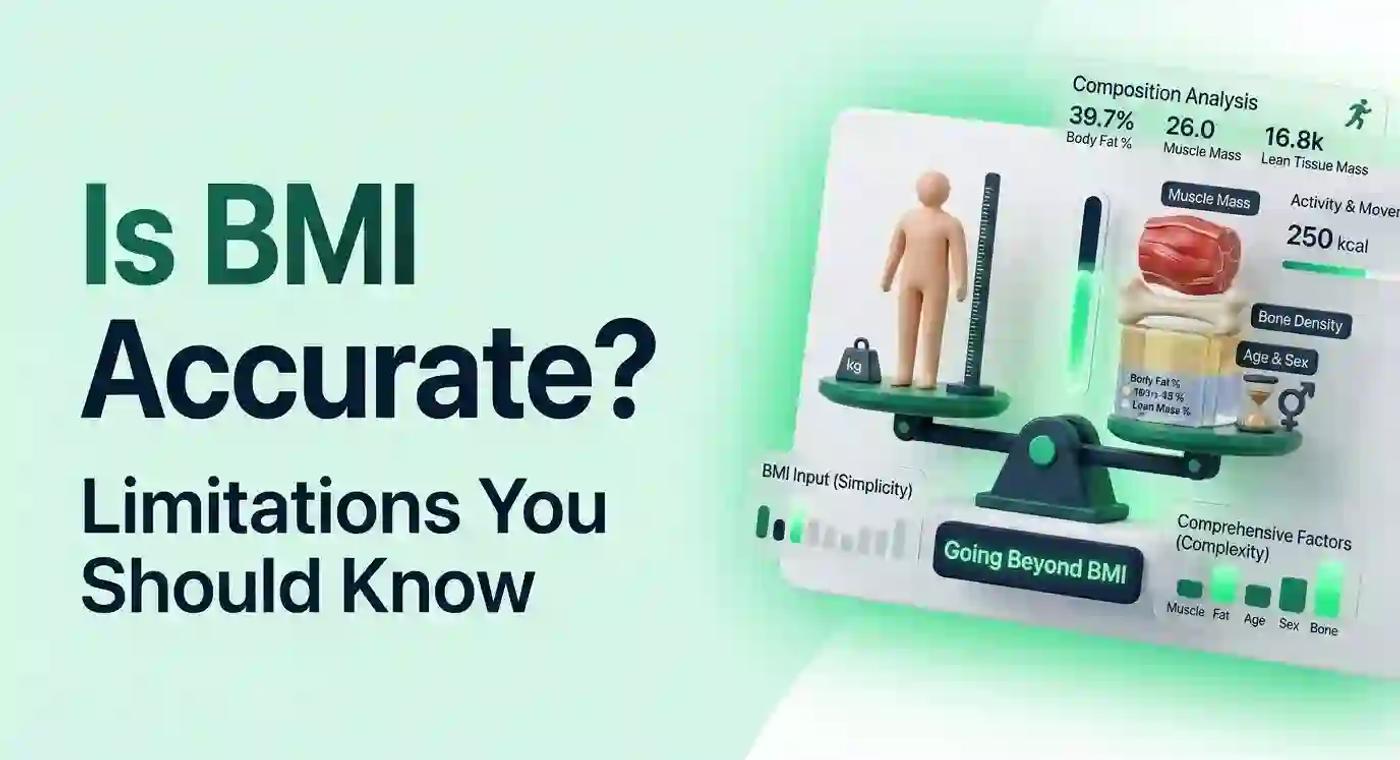
Is BMI Accurate? Limitations You Should Know
Is BMI accurate? Discover its key limitations — from muscle vs fat confusion to fat distribution blind spots — and what to use alongside it.
BMI is a useful starting point for health screening, but it's not a fully accurate individual health measure. It doesn't distinguish between muscle and fat, doesn't account for where fat is stored in the body, and doesn't adjust for age, sex, or ethnicity by default. That's why doctors increasingly treat it as one data point among several, rather than a standalone verdict on someone's health.
If you've ever looked at your BMI result and thought, "that doesn't feel right," you're not alone. Athletes get flagged as "overweight." People with a "normal" BMI turn out to have concerning levels of internal fat. And in recent years, even major medical bodies have publicly acknowledged that BMI has real, measurable blind spots.
So is BMI accurate, or is it time to stop trusting the number on the screen? The honest answer sits somewhere in the middle. In this guide, we'll walk through exactly where BMI works, where it fails, and what smarter alternatives are gaining traction in 2026.
What Is BMI, Quickly Recapped
Before diving into limitations, a quick refresher: BMI (Body Mass Index) is calculated by dividing your weight in kilograms by your height in meters squared. It sorts people into four broad categories — underweight, normal weight, overweight, and obese — based on that single number.
It was never designed as a precise individual diagnostic tool. It was created in the 1830s by Adolphe Quetelet as a way to study average body proportions across large populations, not to assess any one person's health. That distinction matters enormously, and it's the root of most of the criticism BMI receives today. If you want the full breakdown of the formula and categories, our guide on what BMI is and why it matters covers that in detail.
The Core Problem: BMI Can't Tell Muscle From Fat
This is the single most cited limitation of BMI, and for good reason. BMI only measures weight relative to height — it has no way of knowing what that weight is actually made of.
Muscle is denser than fat. So a muscular person and a person carrying excess body fat can weigh the exact same amount and have identical height, yet have completely different body compositions and health profiles. BMI treats them identically.
This is why:
- Athletes and bodybuilders frequently register as "overweight" or even "obese" on BMI despite having very low body fat percentages.
- Older adults who've lost muscle mass through natural aging (a process called sarcopenia) can have a "normal" BMI while carrying a higher percentage of body fat than the number suggests.
- "Skinny fat" individuals — people with a normal BMI but low muscle mass and high relative body fat — can fly under the radar entirely, since their BMI looks perfectly fine.
This is sometimes referred to as "normal weight obesity," a pattern where someone's BMI sits in the healthy range, but their actual body composition carries metabolic risk factors typically associated with obesity.
If you want to see how your BMI compares to your actual body composition, pairing your result with our body fat estimator gives a much clearer picture than BMI alone.
BMI Doesn't Know Where Your Fat Is Stored
Here's a limitation that surprises a lot of people: two people can have the exact same BMI and still face very different health risks, depending on where their fat is distributed.
Fat stored around the abdomen — known as visceral fat — surrounds internal organs and is far more strongly linked to metabolic disease, insulin resistance, and cardiovascular risk than fat stored elsewhere, like the hips or thighs. BMI has absolutely no way of detecting this difference. It only sees total weight relative to height.
This blind spot is exactly why alternative measures have been gaining attention:
- Waist-to-height ratio directly measures abdominal fat by comparing waist circumference to height.
- Body Roundness Index (BRI) incorporates waist circumference and height together to estimate visceral fat more directly than BMI can.
- A Body Shape Index (ABSI) attempts something similar, factoring in waist circumference relative to both height and weight.
None of these have replaced BMI in mainstream clinical practice, but they're increasingly discussed as useful companion metrics precisely because they address this specific gap.
BMI Doesn't Fully Account for Age, Sex, or Ethnicity
Standard BMI categories were built using data that doesn't reflect how body composition naturally varies across different groups.
Age matters. Muscle mass naturally declines with age, and fat tends to redistribute toward the abdomen even without significant weight change. This means an older adult and a younger adult with the identical BMI may have meaningfully different body compositions and health risks.
Sex matters. Women naturally carry a higher percentage of body fat than men at the same BMI, largely due to biological and hormonal differences. Standard BMI categories don't adjust for this.
Ethnicity matters. Research has consistently shown that certain populations, including South Asian populations, tend to have higher body fat percentages and greater cardiometabolic risk at lower BMI values compared to Western populations. Because of this, several health organizations have recommended lower BMI cutoff points for overweight and obesity classification in South Asian populations specifically — a meaningful example of why a single global cutoff doesn't serve everyone equally well.
Can You Have a "Normal" BMI and Still Be Unhealthy?
Yes — and this is one of the more important, less-discussed limitations of BMI. Someone can have a BMI squarely in the "normal" range while still carrying elevated visceral fat, poor cardiovascular markers, or reduced muscle mass. This pattern is sometimes described online using the term "skinny fat," though the more clinical term is normal weight obesity.
On the flip side, someone can have a BMI in the "overweight" or even "obese" range while being metabolically healthy — good blood pressure, healthy cholesterol, strong cardiovascular fitness, and stable blood sugar. This is sometimes referred to as the "fat but fit" pattern in research literature, and while it doesn't apply to everyone in higher BMI categories, it illustrates why BMI alone can't capture the full health picture for any single individual.
Why Do Doctors Still Use BMI If It's Flawed?
Given everything above, it's fair to ask why BMI hasn't been dropped entirely. The honest answer is practicality.
BMI remains widely used because it is:
- Fast and free — no special equipment beyond a scale and measuring tape is needed.
- Consistent across large populations — it remains a genuinely useful screening tool at a population level, even if it's imperfect for any single individual.
- Backed by decades of research — there's an enormous body of population-level data linking BMI categories to health outcomes, which newer alternatives haven't yet matched in volume.
- A useful starting point — a BMI flag doesn't diagnose anything on its own, but it can prompt a doctor to look deeper through bloodwork, body composition analysis, or a fuller health conversation.
In recent years, this conversation has become more prominent in mainstream medicine. Notably, the American Medical Association has acknowledged limitations in BMI as a standalone measure and encouraged clinicians to use it alongside other measures rather than as the sole determinant of a patient's health status. This shift reflects a broader move in the medical community toward more nuanced, multi-metric health assessment rather than abandoning BMI altogether.
BMI vs Other Health Metrics: A Side-by-Side Look
Here's how BMI stacks up against some of the alternatives currently gaining attention:
Here's the data in quote form:
BMI vs Other Health Metrics: Comparison
BMI — Measures: Weight relative to height | Limitation: Can't distinguish muscle from fat; ignores fat distribution
Body fat percentage — Measures: Actual proportion of fat vs lean mass | Limitation: Requires more specialized measurement methods for high accuracy
Waist-to-height ratio — Measures: Abdominal fat relative to height | Limitation: Doesn't capture overall body composition
Body Roundness Index (BRI) — Measures: Estimates visceral fat using waist and height | Limitation: Still relatively new; less long-term research than BMI
A Body Shape Index (ABSI) — Measures: Waist circumference relative to height and weight | Limitation: Not yet widely adopted clinically
DEXA scan — Measures: Precise body composition (fat, muscle, bone) | Limitation: Requires specialized equipment; not accessible for daily use
None of these alternatives are perfect replacements — each has its own tradeoffs. But used together with BMI, they can offer a far more complete picture than any single number alone. If you want a quick comparison point, running your BMI calculator result alongside our body fat estimator is a practical, accessible way to cross-check your results without needing clinical equipment.
Is BMI Outdated in 2026?
This is a genuinely active conversation in medicine right now, not just an internet talking point. Several respected health bodies and researchers have publicly discussed redefining how obesity is diagnosed, moving away from relying on BMI as the sole criterion and toward incorporating additional measures like waist circumference or direct body composition data.
That said, "outdated" doesn't mean "abandoned." BMI still serves as the standard first-line screening tool in the vast majority of clinical settings worldwide, largely because no single alternative has yet matched its combination of simplicity, cost, and research backing. What's changing is less about replacing BMI entirely and more about not treating it as the final word on anyone's health.
Practical Takeaways: How to Use BMI the Right Way
Given everything above, here's how to actually use your BMI number in a way that's genuinely useful rather than misleading:
- Treat it as a starting point, not a verdict. A BMI outside the "normal" range is a reason to look closer, not a diagnosis in itself.
- Pair it with other measures. Body fat percentage, waist circumference, and general fitness markers all add context BMI can't provide alone.
- Consider your personal context. Age, muscle mass, ethnicity, and life stage all affect how meaningful your BMI number really is for you specifically.
- Talk to a healthcare provider about the full picture. Bloodwork, blood pressure, and lifestyle factors matter far more for actual health outcomes than a single ratio.
- Don't panic over small BMI shifts. Day-to-day fluctuations in weight are normal and don't necessarily reflect meaningful health changes.
If you're building a broader picture of your health beyond a single number, tools like our BMR calculator, health age calculator, and calorie intake planner can help round out your understanding of where you actually stand.
Why Choose Smart Health Calculators
At Smart Health Calculators, we believe a single number should never be the whole story. That's why we built our tools to work together — helping you look at BMI alongside body composition, metabolic rate, and lifestyle factors, rather than in isolation.
Explore Advanced Tools at Smart Health Calculators to build a fuller, more honest picture of your health. Whether you're checking your ideal weight or tracking your progress with our step counter goal planner, our goal is context — not just a number.
Frequently Asked Questions
Is BMI accurate? BMI is a reasonably useful population-level screening tool, but it's not fully accurate for individuals. It can't distinguish muscle from fat and doesn't account for fat distribution, age, sex, or ethnicity, which limits its accuracy for any single person.
What are the biggest limitations of BMI? The main limitations include its inability to differentiate muscle mass from fat mass, its failure to account for where fat is stored in the body, and its lack of adjustment for age, sex, and ethnic differences in body composition.
Can BMI be misleading for muscular people? Yes. Athletes and bodybuilders often register as "overweight" or "obese" on BMI despite having low body fat percentages, because BMI can't distinguish dense muscle tissue from fat.
Can you have a normal BMI and still be unhealthy? Yes. It's possible to have a BMI in the normal range while still carrying elevated visceral fat or reduced muscle mass, a pattern sometimes referred to as normal weight obesity.
Why do doctors still use BMI if it has flaws? BMI remains fast, free, and backed by decades of population-level research, making it a practical first-line screening tool. Most healthcare providers now use it alongside other measures rather than as a standalone diagnosis.
Is BMI accurate for all ethnicities? Not uniformly. Research shows certain populations, including South Asian groups, can face elevated health risks at lower BMI values than standard categories suggest, which is why some regions use adjusted BMI cutoffs.
Final Thoughts
BMI isn't useless, but it isn't the full story either. It's a quick, accessible screening tool that works reasonably well across large populations, while falling short for muscular individuals, older adults, and anyone whose fat distribution or body composition doesn't match the "average" body the formula was originally built around.
The smartest approach isn't to throw BMI out entirely, but to stop treating it as a final answer. Pair it with body composition data, waist measurements, and a conversation with a healthcare provider who knows your full context. For a deeper look at how major medical organizations are approaching this shift, the American Medical Association's policy statement on BMI offers useful, research-backed context.
Ready to look beyond the number? Check your BMI with our free BMI calculator, and book a seat at Advance Free Tools offered by Smart Health Calculators to build a complete, honest picture of your health — not just a single score.
Medical Disclaimer
This article is for general education only. It is not medical advice, diagnosis, treatment, prescription guidance, or a replacement for professional healthcare. Speak with a qualified healthcare professional for personal medical concerns, symptoms, pregnancy concerns, mental health crisis, medication questions, or before making major health changes.