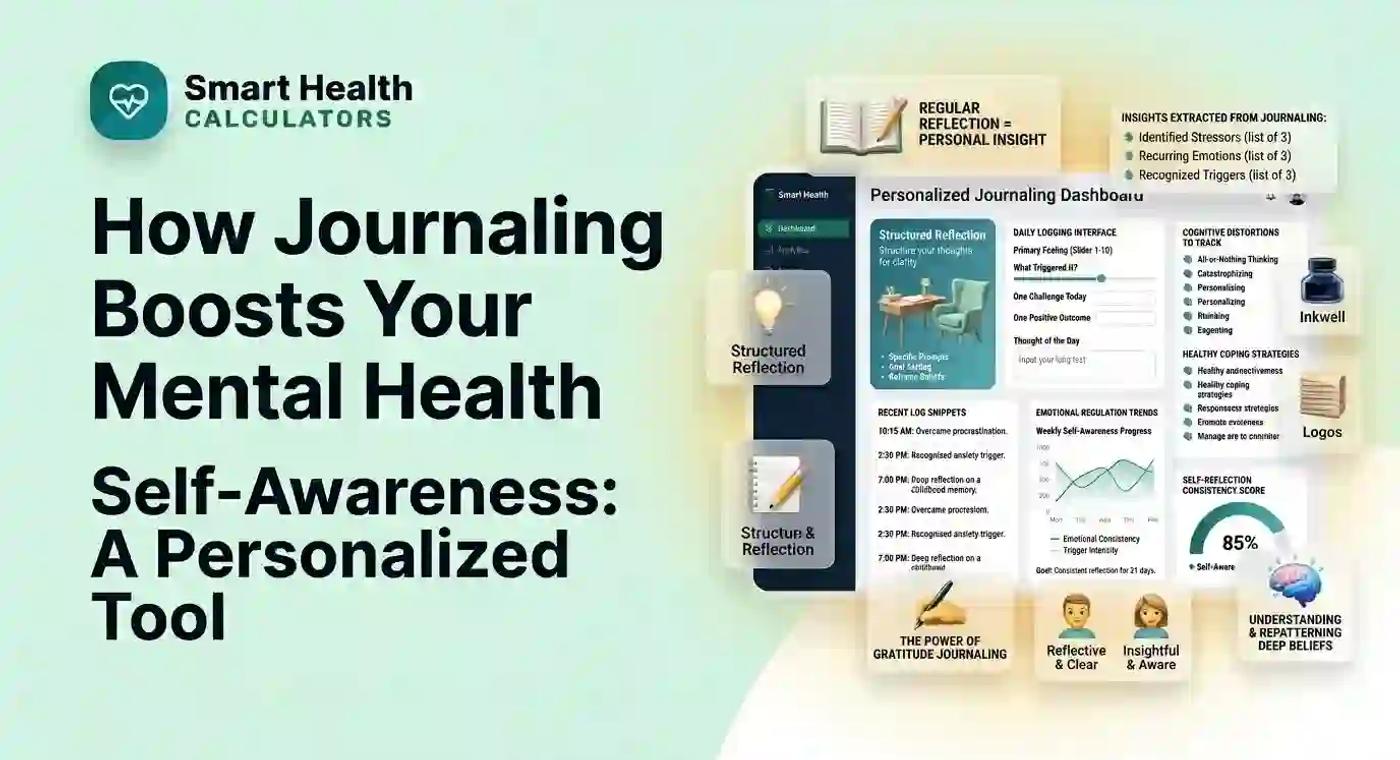
How Journaling Builds Mental Health Self-Awareness
how journaling supports mental health and self-awareness, plus track your progress with free tools from Smart Health Calculators.
Most people carry around a constant stream of thoughts they never actually look at. Worries loop, emotions build up, and by the end of the day it's hard to even pinpoint why you feel off. Journaling interrupts that cycle. It gives your thoughts somewhere to go, and in doing so, it teaches you to notice patterns in your own mind that you'd otherwise miss completely.
This article explains how journaling supports mental health and self-awareness, the psychology behind why it works, and practical ways to start a journaling habit that actually sticks. We'll also look at different journaling techniques, how often you should write, and when journaling alone isn't enough.
What Is Journaling for Mental Health?
Journaling for mental health is the practice of regularly writing down your thoughts, feelings, and experiences as a way to process emotions and build self-awareness. Unlike a traditional diary, which often just records events, mental health journaling focuses on reflection: what you felt, why you felt it, and what patterns keep showing up.
This distinction matters. Journaling and self-awareness are connected because the act of writing forces you to slow down and translate vague feelings into specific words. That translation process is where the psychological benefit actually happens.
Why Journaling Matters for Self-Awareness
Self-awareness is the ability to recognize your own emotions, thoughts, and behavioral patterns as they happen, rather than reacting on autopilot. Most people think they're self-aware, but research in emotional intelligence suggests genuine self-awareness is rarer than assumed, largely because we rarely pause long enough to examine our own reactions.
Journaling creates that pause. When you write about a frustrating conversation or a moment of anxiety, you're forced to slow your thinking down to the speed of your hand or your typing. This slower pace activates cognitive processing in a way that simply thinking about the event doesn't.
Several things happen when you journal consistently:
- You start noticing recurring emotional triggers
- You separate facts from assumptions in stressful situations
- You build a written record of your own thought patterns over time
- You create distance between yourself and your emotions, making them easier to examine objectively
- You strengthen your inner dialogue, becoming more honest with yourself
This is part of why journaling for emotional wellbeing is widely recommended by therapists and counselors, not as a replacement for treatment, but as a tool that complements it.
The Psychology Behind Why Journaling Works
The benefits of journaling aren't just anecdotal. Psychologist James Pennebaker's research on expressive writing, conducted over several decades, found that writing about emotional experiences for just 15 to 20 minutes a day, several days in a row, was linked to measurable improvements in both physical and psychological wellbeing.
Here's what's happening on a biological and cognitive level:
Emotional regulation improves. Putting feelings into words, a process researchers call "affect labeling," has been shown to reduce activity in the amygdala, the brain's threat-detection center. Essentially, naming an emotion makes it less overwhelming.
Cognitive processing organizes chaos. Unprocessed thoughts tend to feel tangled and repetitive. Writing them down forces a sequence, a beginning, middle, and end, which helps the brain make sense of experiences instead of looping on them.
Mindfulness practice happens naturally. Journaling pulls your attention to the present moment, similar to meditation, because you're focused on accurately describing what you're feeling right now.
Stress reduction follows. Multiple studies link expressive writing to reduced cortisol levels and lower self-reported stress, particularly when writing focuses on both the emotional and factual details of a stressful event.
Journaling for Stress Relief and Anxiety
Journaling for stress relief works because it gives anxious or racing thoughts a place to land outside your head. When you're anxious, your mind often replays the same worry repeatedly, partly because unresolved thoughts demand attention until they're addressed in some way.
Writing those thoughts down satisfies that demand. It's a similar principle to making a to-do list before bed: once the thought exists somewhere outside your mind, your brain doesn't need to keep holding onto it.
For journaling for anxiety specifically, a few approaches tend to work especially well:
- Worry dumps: Setting a timer for five to ten minutes and writing every anxious thought without editing or judging it
- Fact vs. feeling separation: Writing down what actually happened, then separately writing what you felt and assumed
- Gratitude journaling: Listing three specific things you're grateful for, which has been shown to shift attention away from threat-focused thinking
- Reframing prompts: Writing the same worry from a more balanced, realistic perspective
If anxiety or low mood is a frequent pattern for you, it can help to track it over time. Using a mental health checker alongside journaling gives you a clearer, more objective view of how your mood shifts week to week.
Different Journaling Techniques for Self-Awareness
Not all journaling looks the same, and different techniques serve different purposes. Here are some of the most effective styles for building self-awareness.
Morning Pages
Popularized by author Julia Cameron, this technique involves writing three pages of unfiltered, stream-of-consciousness thoughts first thing in the morning. The goal isn't quality writing; it's clearing mental clutter before the day begins.
Gratitude Journaling
This involves regularly noting things you're thankful for. Research in positive psychology consistently links gratitude journaling to improved mood and reduced symptoms of depression over time.
Bullet Journaling for Mental Health
A more structured approach that combines habit tracking, mood logging, and brief reflective notes. This works well for people who find open-ended writing intimidating but still want the self-awareness benefits.
Prompt-Based Journaling
Using specific journaling prompts (such as "What emotion did I feel most today, and why?") removes the blank-page problem and guides you toward more focused self-reflection.
Shadow Work Journaling
A deeper, more introspective style focused on examining uncomfortable emotions, past patterns, and parts of yourself you might normally avoid. This technique can surface meaningful insights but may be more intense, so it's often best paired with professional support if difficult material comes up.
How to Start a Journaling Habit That Actually Sticks
Starting is easy. Staying consistent is where most people struggle. Here's a realistic approach to building a sustainable journaling habit.
Start Small
Five minutes a day is enough to begin. Trying to write three pages immediately often leads to burnout within a week.
Pick a Consistent Time
Attach journaling to an existing habit, like right after your morning coffee or before bed. This kind of habit stacking makes it far easier to remember.
Don't Worry About Grammar or Structure
This isn't an English assignment. Journaling for self-discovery works best when it's honest and unfiltered, not polished.
Use Prompts When You're Stuck
Keep a short list of go-to questions, such as:
- What's one thing I'm avoiding right now?
- What emotion showed up most today?
- What would I tell a friend in my situation?
Track Patterns Over Time
Periodically reread old entries. This is often where the real self-awareness payoff happens, since patterns are much easier to spot in hindsight than in the moment.
Pair It With Other Wellness Habits
Journaling works even better alongside other supportive routines, like consistent sleep and stress management. If sleep issues are affecting your mood, it may help to also check in with a sleep quality checker, since poor sleep and emotional regulation are closely connected.
How Long Should You Journal Each Day?
Research suggests that even 15 to 20 minutes of expressive writing, several times a week, is enough to produce measurable benefits. That said, consistency matters more than duration. A focused five-minute entry every day will likely build self-awareness faster than an occasional 45-minute session once a month.
Can Journaling Replace Therapy?
No, journaling is not a replacement for therapy, but it works well as a complementary tool. Many therapists, particularly those using cognitive behavioral therapy (CBT) approaches, actively encourage clients to journal between sessions to track thought patterns, triggers, and progress. Journaling gives you raw material to bring into therapy, while a therapist provides professional guidance, perspective, and clinical support that writing alone can't replicate.
Why Choose Smart Health Calculators
Building genuine self-awareness takes more than good intentions; it helps to have tools that make your patterns visible. Why Choose Smart Health Calculators comes down to offering simple, science-based tools that turn vague feelings into trackable data, whether that's your mood, your sleep, or your daily stress levels.
Pairing a journaling habit with a mental health checker gives you both the qualitative insight (your own words) and the quantitative insight (tracked patterns), which together build a much clearer picture of your mental wellbeing over time.
Real-World Example: Turning Insight Into Change
Consider someone who keeps feeling unexplainably exhausted by Thursday each week. After a few weeks of brief evening journaling, they begin noticing a pattern: their entries consistently mention back-to-back meetings on Wednesdays with no breaks. What initially felt like random fatigue turns out to be a predictable, identifiable cause.
This is the core value of journaling for self-awareness. It's not about having profound revelations every day; it's about accumulating enough honest data on yourself to notice patterns that were always there, just invisible until written down.
When Journaling Isn't Enough
Journaling is a genuinely useful self-awareness tool, but it has limits. Consider seeking professional support if:
- Journaling brings up distressing memories you can't process alone
- Low mood or anxiety persists despite consistent journaling
- You notice patterns of self-criticism that feel difficult to challenge on your own
- Sleep, appetite, or daily functioning are significantly affected
- You feel stuck rather than gaining clarity over time
According to the American Psychological Association, expressive writing is best used as a self-help tool alongside, not instead of, professional mental health care when symptoms are significant or persistent.
Frequently Asked Questions
Does journaling really help mental health? Yes, research consistently links regular journaling, particularly expressive writing, to reduced stress, improved emotional regulation, and better overall psychological wellbeing.
How does journaling increase self-awareness? Journaling slows down your thinking and forces you to put vague feelings into specific words, which helps you notice emotional patterns and triggers you might otherwise overlook.
What should I write in a journal for mental health? Focus on what you felt, what triggered it, and what you noticed about your reaction. Both facts and emotions matter; writing only events without feelings tends to produce fewer benefits.
How long should you journal each day? Fifteen to twenty minutes several times a week is supported by research, though even five minutes daily can build meaningful self-awareness over time.
Can journaling replace therapy? No, journaling complements therapy by providing raw material and self-insight, but it doesn't replace the clinical guidance and support a trained therapist provides.
What type of journaling is best for anxiety? Worry dumps, gratitude journaling, and fact-versus-feeling separation tend to be particularly effective for managing anxious thoughts.
Is gratitude journaling effective for mental health? Yes, studies in positive psychology link consistent gratitude journaling to improved mood and reduced depressive symptoms over time.
Conclusion:
Start Writing, Start Noticing
Journaling won't fix everything overnight, but it does something few other habits can: it makes your own mind visible to you. Over weeks and months, those small entries add up to real self-awareness, the kind that helps you recognize stress before it builds, understand your emotional triggers, and respond to life with more intention instead of reaction.
If you're ready to start, keep it simple. Write five honest minutes today, then check in with yourself using a mental health checker to track how your mood shifts as the habit builds. Book a seat at the advanced free tools offered by Smart Health Calculators to start turning everyday reflection into real, measurable self-awareness.
Medical Disclaimer
This article is for general education only. It is not medical advice, diagnosis, treatment, prescription guidance, or a replacement for professional healthcare. Speak with a qualified healthcare professional for personal medical concerns, symptoms, pregnancy concerns, mental health crisis, medication questions, or before making major health changes.