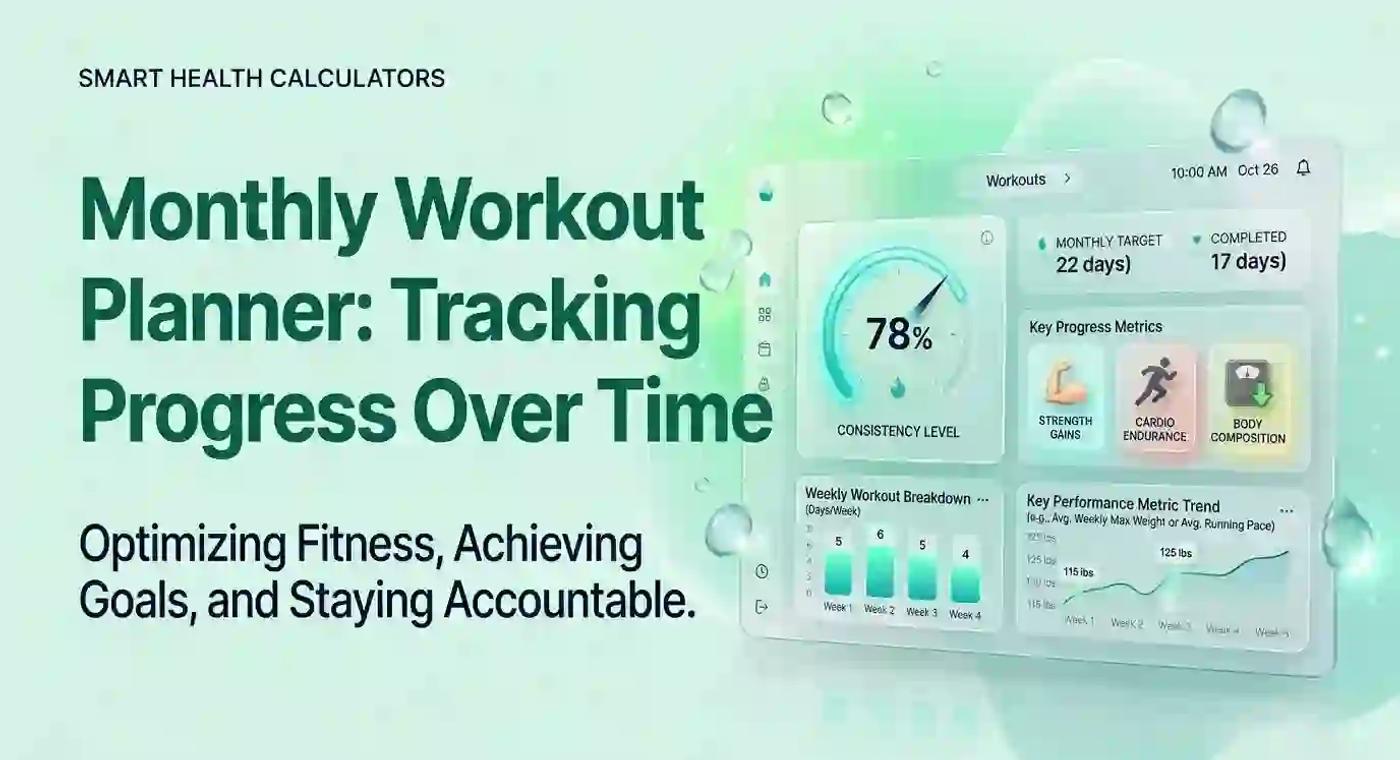
Monthly Workout Planner: Track Progress Over Time
Stop guessing if your workouts are working. This monthly workout planner guide shows exactly what to track and how to review your progress.
Most people don't fail at fitness because they lack motivation. They fail because they have no way to see whether their effort is actually working. A monthly workout planner solves that problem. It gives you a structured, repeatable way to track workout progress over time, so you always know what to adjust, what to keep, and what to celebrate.
In this guide, you'll learn what a monthly workout planner is, why it matters more than daily willpower, what to track, and how to build one that actually keeps you consistent. Whether you're a beginner or someone getting back into training after a break, this article will show you exactly how to turn a blank calendar into a progress-tracking system that works.
What Is a Monthly Workout Planner?
A monthly workout planner is a structured fitness tool used to schedule, log, and review your exercise routine across a four-to-five-week period. Unlike a simple to-do list, it combines a workout schedule with a progress tracker, capturing metrics like reps, weight lifted, body measurements, and consistency so you can see real change over time instead of guessing.
Think of it as the difference between a daily diary and a monthly report. A daily workout log tells you what happened today. A monthly fitness tracker template tells you the story of your entire month — whether your strength is climbing, whether your consistency is slipping, and whether it's time to change your approach.
Why Tracking Progress Over Time Matters More Than Daily Effort
Daily motivation is unreliable. Some days you'll feel unstoppable; other days you won't want to see a dumbbell. What separates people who reach their goals from people who don't isn't discipline alone — it's visibility into their own progress.
Here's why a monthly view beats a day-by-day mindset:
- Trends matter more than single sessions. One bad workout means nothing. A month of declining energy or missed sessions means something.
- It removes emotional bias. When you're tired or discouraged, your memory of "how it's going" is unreliable. Data isn't.
- It builds long-term habit formation. Research on behavior change consistently shows that people who track progress are more likely to sustain new habits, because tracking itself reinforces the behavior.
- It prevents training plateaus. If your numbers haven't moved in three weeks, a monthly workout planner flags it before you waste another month spinning your wheels.
According to the Centers for Disease Control and Prevention, adults need at least 150 minutes of moderate-intensity activity per week for meaningful health benefits — a target that's far easier to hit and measure when it's tracked monthly rather than left to memory (source: cdc.gov, Physical Activity Basics).
What Should Be Included in a Workout Tracker?
A workout tracker earns its place in your routine only if it captures the right data. At minimum, your monthly workout planner should include:
- Workout schedule – which days you train and which muscle groups or activities you focus on
- Reps, sets, and weight – the core numbers behind strength training progress
- Cardio log – duration, distance, or intensity for cardio sessions
- Body measurements – waist, hips, arms, and other key areas, logged every 2–4 weeks
- Progress photos – visual evidence that often shows changes before the scale does
- Personal records (PRs) – your best lifts, fastest times, or longest sessions
- Recovery and rest days – tracking rest is just as important as tracking effort
- Energy and mood notes – a simple 1–5 rating can reveal overtraining or under-recovery
- Workout consistency score – the percentage of planned sessions actually completed
You don't need every single metric from day one. Start with three or four, then expand once tracking becomes a habit rather than a chore. Our own Workout Planner tool at Smart Health Calculators is built to make this exact process simple, letting you log sessions and see your monthly trend without juggling spreadsheets.
How to Track Workout Progress Over a Month: Step-by-Step
If you're wondering how to make a workout planner that actually gets used, follow this simple five-step framework.
Step 1: Set a SMART Fitness Goal
Vague goals like "get fit" don't give you anything to track. Instead, use a SMART goal: Specific, Measurable, Achievable, Relevant, Time-bound. For example: "Increase my squat by 10 pounds and complete 16 workouts in the next 4 weeks."
Step 2: Choose Your Format
Decide between a digital vs printable workout planner. Digital trackers (like an app or the Smart Health Calculators Workout Planner) automatically calculate trends and save history. Printable planners work well for people who prefer writing things down and enjoy the physical act of checking boxes.
A printable workout planner is ready the instant you print it — no setup, no login, just pen and paper."
A digital workout planner takes a few minutes to set up, but pays you back with automatic calculations and progress charts."
If you're a visual, tactile tracker, printable wins. If you're a data-driven tracker, digital wins."
Step 3: Build Your Weekly Workout Split
Break your month into a repeatable weekly workout breakdown — for example, push/pull/legs, upper/lower splits, or full-body sessions three times a week. Consistency in structure makes it far easier to compare week 1 to week 4.
Step 4: Log Every Session Immediately
Don't rely on memory. Log reps, weights, and how the session felt right after you train. The Mayo Clinic notes that self-monitoring is one of the most consistently effective strategies for sustaining exercise habits and preventing relapse into inactivity (source: mayoclinic.org).
Step 5: Review at the End of Each Month
This is the step most people skip — and it's the most important one. At the end of each month, sit down and ask:
- Did I hit my consistency target?
- Which lifts or activities improved?
- Where did I plateau?
- What will I change next month?
This single review turns a month of scattered data into a clear action plan.
How Often Should I Update My Workout Log?
Update your workout log after every single session for accuracy, but review your monthly fitness tracker as a whole once every two weeks and once at month's end. Daily logging captures the details; biweekly and monthly reviews reveal the trends. Skipping the review step is the most common reason people stop trusting — and using — their planner.
Monthly Workout Planner for Different Goals
A generic template rarely fits everyone. Here's how to adapt your planner based on your primary goal.
Monthly Workout Planner for Weight Loss
Pair your workout log with a calorie awareness practice, since exercise alone rarely drives significant fat loss without a matching nutrition plan. Track weekly weight trends (not daily fluctuations), waist measurements, and total active minutes. Tools like the Calorie Intake Planner and Body Fat Estimator pair naturally with a workout tracker to give you the full picture. If you're unsure why the scale isn't moving despite consistent training, this breakdown on why your diet might not be working is worth reading alongside your monthly review.
Monthly Workout Planner for Strength Training
Focus heavily on progressive overload — the gradual increase of weight, reps, or intensity over time. Track your top set for each major lift weekly, and log personal records the moment they happen. A strength-focused monthly workout planner should show a clear upward line across at least three of your four weeks.
Monthly Workout Planner for Beginners
If you're new to structured training, don't overcomplicate your tracker. Focus on three things only: attendance (did I show up?), effort (how hard did it feel?), and one measurable number (weight, reps, or time). For a gentler starting point, our guide on a beginner weekly workout plan walks through exactly how to structure your first month without overwhelming yourself.
Monthly Workout Planner for Busy Schedules
If your calendar is packed, consistency beats duration. A well-tracked 20–30 minute session logged reliably will outperform an ambitious 90-minute plan you only manage twice a month. See our 30-minute workout plan for busy people for a format built specifically for tight schedules.
Is a Monthly or Weekly Workout Planner Better?
Neither replaces the other — they serve different purposes. A weekly workout planner manages your immediate schedule and daily decisions, while a monthly workout planner reveals trends, plateaus, and long-term progress that a single week can't show. The most effective approach combines both: plan weekly, review monthly.
How Do I Know If My Workouts Are Working?
Your workouts are working if you see improvement in at least two of these areas over a month: strength numbers (weight or reps), consistency (sessions completed vs. planned), body measurements, energy levels, or recovery time. The scale alone is a poor indicator — body composition and performance metrics are far more reliable proof of progress.
This is exactly why relying on a single number, like body weight, misleads so many people. Someone gaining muscle while losing fat may see almost no change on the scale for weeks, even while their strength and measurements improve dramatically. This is a well-documented phenomenon in exercise physiology, and it's precisely why a monthly, multi-metric tracker beats a daily scale check.
Fitness App Integration and Wearable Trackers
If you already use a wearable device — Fitbit, Garmin, Apple Watch, or similar — sync that data into your monthly review rather than starting from scratch. Most wearables automatically log:
- Steps and active minutes
- Heart rate zones during workouts
- Sleep quality (a major factor in recovery)
- Calories burned per session
Combining wearable data with manual strength logs gives you the most complete monthly fitness tracker template possible. If step count is part of your goal, our Step Counter Goal Planner can help you set and track a realistic daily target that complements your structured workouts.
Common Mistakes That Break Workout Consistency Tracking
Even motivated people abandon their trackers. Here's what usually goes wrong, and how to avoid it:
- Tracking too many metrics at once. Start simple; add complexity later.
- Only logging "good" workouts. Skipped or weak sessions are the most valuable data points — they show you patterns, not just wins.
- No monthly review. Data without reflection is just noise.
- Comparing week 1 to week 2 instead of month to month. Short-term fluctuations are normal; monthly trends tell the real story.
- Choosing a format you won't actually use. A beautifully designed printable planner is useless if you're the type who forgets a pen. Choose the format that matches your actual habits, not the one that looks best on Pinterest.
Sample Monthly Workout Planner Structure
Here's a simple structure you can copy directly into a notebook, spreadsheet, or the Smart Health Calculators Workout Planner:
Week 1–4 Header: Goal for the month, starting measurements, starting weight
Daily Entry Fields: Date, workout type, exercises with sets/reps/weight, duration, energy level (1–5), notes
Weekly Summary: Sessions completed vs. planned, total active minutes, one win, one challenge
Monthly Summary: Starting vs. ending measurements, PR list, consistency percentage, next month's focus area
This layout works whether you prefer pen and paper or a digital dashboard, and it directly supports every metric mentioned earlier in this guide.
Frequently Asked Questions
What is a monthly workout planner? A monthly workout planner is a tool that schedules and tracks your exercise routine, strength numbers, and body metrics over a four-to-five-week period, helping you spot real trends instead of relying on daily impressions.
How do I track my workout progress over time? Log every session immediately, capture key metrics like reps, weight, and measurements, and review your data weekly and monthly to identify trends, plateaus, and wins.
What should be included in a workout tracker? A solid workout tracker includes your training schedule, reps and sets, cardio log, body measurements, progress photos, personal records, and a consistency score.
How often should I update a workout log? Update it after every session for accuracy, and step back to review the full picture every two weeks and at the end of each month.
Can a workout planner help with weight loss? Yes. A workout planner supports weight loss by keeping training consistent and revealing whether your effort is translating into results, especially when paired with a calorie and nutrition tracker.
What's the difference between a workout log and a workout planner? A workout log records what already happened, while a workout planner also schedules what's coming next — combining both gives you a complete tracking and planning system.
Final Thoughts: Make Progress Visible
A monthly workout planner isn't just paperwork — it's the difference between guessing and knowing. When you can see your consistency, your strength gains, and your body changes laid out clearly across four weeks, staying motivated stops depending on how you feel on any given day.
Start simple. Pick three metrics. Commit to one month. Then review, adjust, and repeat.
Ready to make tracking effortless? Explore the free Workout Planner at Smart Health Calculators and start logging your first month of progress today — no spreadsheets, no guesswork, just a clear picture of how far you've come.
Medical Disclaimer
This article is for general education only. It is not medical advice, diagnosis, treatment, prescription guidance, or a replacement for professional healthcare. Speak with a qualified healthcare professional for personal medical concerns, symptoms, pregnancy concerns, mental health crisis, medication questions, or before making major health changes.