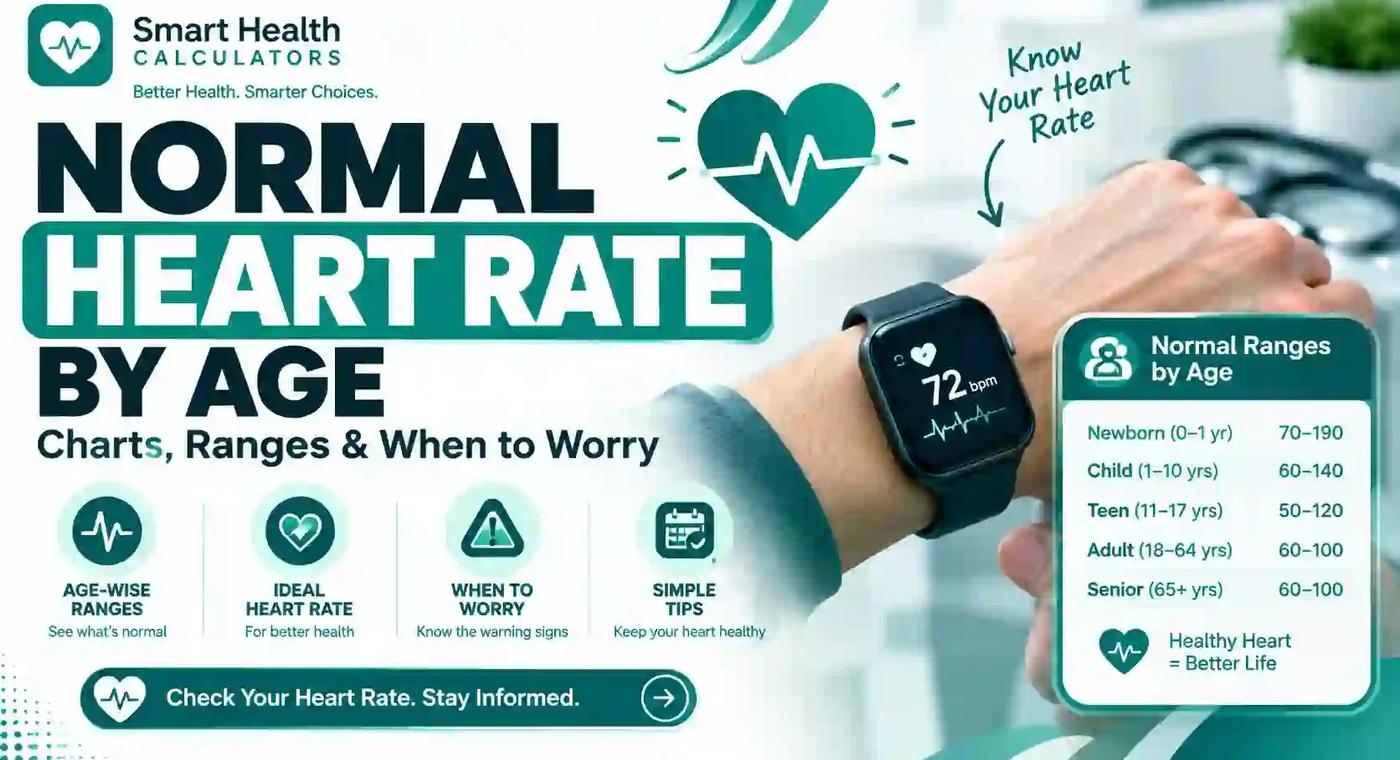
Normal Heart Rate by Age: Charts, Ranges & When to Worry
What's a normal heart rate for your age? See BPM charts for adults, kids & exercise zones, plus signs that mean it's time to see a doctor.
For most adults, a normal resting heart rate falls between 60 and 100 beats per minute (BPM), according to the American Heart Association. That said, heart rate isn't a single fixed number — it shifts constantly based on your age, fitness level, activity, stress, medications, and even the time of day you check it.
This guide breaks down exactly what counts as normal across different ages and activity levels, how to measure your own pulse correctly, and the specific warning signs that warrant seeing a doctor rather than just monitoring at home.
What Is a Normal Resting Heart Rate for Adults?
A resting heart rate between 60 and 100 BPM is considered typical for most adults, based on current American Heart Association guidance. The best time to check this number is in the morning, before you get out of bed or have your first cup of coffee, since this gives you your body's true baseline before daily activity, caffeine, or stress start influencing the reading.
Within that 60-100 range, lower generally indicates better cardiovascular fitness — a heart that's stronger and more efficient doesn't need to beat as often to circulate blood effectively. A higher resting heart rate, meanwhile, has been associated in research with lower physical fitness, higher blood pressure, and higher body weight, though a single reading in the upper part of the normal range isn't automatically a red flag on its own.
Normal Heart Rate by Age: Complete Reference
Heart rate ranges look completely different in childhood than they do in adulthood, and this table reflects the general pattern seen across pediatric medical references:
| Age Group | Typical Resting Heart Rate |
|---|---|
| Newborn (0-1 month) | 100-160 BPM |
| Infant (1-12 months) | 80-160 BPM |
| Toddler (1-3 years) | 80-130 BPM |
| Preschool (4-5 years) | 80-120 BPM |
| School-age (6-14 years) | 70-100 BPM |
| Adults and seniors (15+) | 60-100 BPM |
Notice that seniors fall into the same 60-100 BPM range as younger adults, rather than a separate lower category — age alone doesn't lower the "normal" range once you're past adolescence, contrary to a common assumption. Pediatric ranges vary somewhat between different medical references, so this table reflects general, widely-cited patterns rather than one single universal source.
What Is a Normal Heart Rate During Exercise?
Your target heart rate during exercise is calculated as a percentage of your estimated maximum heart rate, which is commonly estimated using the formula 220 minus your age. From there, the American Heart Association recommends the following intensity zones:
| Exercise Intensity | Target Zone (% of Max HR) |
|---|---|
| Moderate-intensity | 50-70% of max heart rate |
| Vigorous-intensity | 70-85% of max heart rate |
Worked example: For a 40-year-old, estimated max heart rate is 220 − 40 = 180 BPM. Moderate exercise would target roughly 90-126 BPM (50-70% of 180), while vigorous exercise would target roughly 126-153 BPM (70-85% of 180).
This 220-minus-age formula is a widely used general estimate rather than an exact individual measurement — actual maximum heart rate varies between people of the same age, so treat the resulting number as a useful training guide rather than a precise physiological limit. If you want your specific target zones calculated automatically, our Heart Rate Zone Calculator does this instantly based on your age.
Why Do Athletes Have Lower Resting Heart Rates?
Well-trained athletes and highly physically active people commonly have resting heart rates well below the standard adult range — sometimes as low as 40 BPM, according to the American Heart Association and Johns Hopkins Medicine. This happens because consistent cardiovascular training makes the heart muscle stronger and more efficient, allowing it to pump more blood per beat, which means it needs to beat less frequently to circulate the same amount of blood.
This is an important distinction: a low resting heart rate in a physically fit, asymptomatic person is generally a sign of good cardiovascular conditioning, not cause for concern — a completely different context than the same low number appearing alongside dizziness or fatigue in someone who isn't an athlete.
Is 80 BPM a Normal Resting Heart Rate? Is 90? Is 100?
All of these numbers — 70, 80, 90, and 100 BPM — fall within the standard 60-100 BPM normal adult range, so none of them are inherently concerning as an isolated reading. Where it becomes worth paying attention is in the trend over time: if your resting heart rate has been consistently around 65-70 BPM for years and suddenly shifts to a consistent 95-100 BPM without a clear explanation (like starting a new medication, significant weight change, or increased stress), that pattern shift is more meaningful than any single number in isolation.
What Is Considered Tachycardia and Bradycardia?
These are the clinical terms for heart rates outside the standard resting range:
- Tachycardia generally refers to a resting heart rate above 100 BPM in adults
- Bradycardia generally refers to a resting heart rate below 60 BPM in adults
Neither term automatically means something is medically wrong. Bradycardia is completely normal and even expected in trained athletes and during sleep, when heart rate naturally drops further below your waking resting rate. Tachycardia can result from something as simple as recent physical activity, caffeine, stress, or anxiety, rather than a cardiac problem. These terms describe a number relative to a population range — they're a starting point for context, not a diagnosis on their own.
How to Check Your Pulse Correctly
- Find your pulse on the inside of your wrist, on the thumb side (radial pulse), using your first two fingers — not your thumb, which has its own pulse that can cause confusion
- Press lightly over the artery until you feel a steady beat
- Count the beats for 30 seconds, then multiply by 2 for your beats per minute — or count for a full 60 seconds for the most accurate reading
- For the most accurate resting reading, measure first thing in the morning before getting out of bed, before caffeine, and while completely calm
Wearable devices and fitness trackers offer a convenient alternative, though wrist-based sensors can be less accurate during high-intensity movement compared to a manual check or a chest strap monitor.
What Factors Can Temporarily Raise or Lower Heart Rate?
Heart rate is genuinely sensitive to short-term influences, which is exactly why a single unusual reading rarely means much on its own:
- Caffeine can temporarily elevate heart rate for several hours
- Stress and anxiety activate your sympathetic nervous system, increasing heart rate
- Dehydration can cause your heart to work harder, raising resting rate
- Heat exposure typically increases heart rate as your body works to regulate temperature
- Certain medications, including beta-blockers, can lower both resting and maximum heart rate
- Illness and fever commonly raise heart rate, with each degree of fever adding roughly 10 additional beats per minute in general patterns
If your heart rate readings feel inconsistent day to day, checking whether you've recently had caffeine, feel stressed, or are mildly dehydrated often explains the variation before assuming anything more serious is happening. Our guide on how stress affects sleep quality touches on this same stress-driven physiological response in more depth.
When Should I See a Doctor About My Heart Rate?
A single unusual reading, taken in isolation, rarely warrants panic. However, certain accompanying symptoms warrant prompt medical evaluation regardless of the specific number on the monitor:
- Chest pain or discomfort
- Shortness of breath, particularly at rest
- Dizziness, lightheadedness, or fainting
- A persistently irregular or noticeably erratic heartbeat pattern
- Palpitations that feel severe, prolonged, or are accompanied by other symptoms
If you experience any of these alongside an unusual heart rate reading, seek medical evaluation rather than trying to interpret the situation yourself. Heart rate should be understood as one data point among several, not a standalone diagnostic tool for self-assessment.
Heart Rate vs. Pulse Rate: Is There a Difference?
In practical, everyday terms, no — heart rate and pulse rate refer to the same measurement (the number of times your heart beats per minute) and are used interchangeably in most health contexts. Technically, "pulse" refers to the rhythmic expansion of an artery you feel when checking your wrist or neck, which reflects your heart rate, while "heart rate" refers to the cardiac activity itself — but for practical purposes, they describe the same number.
Frequently Asked Questions
What is considered a normal heart rate?
For most adults, a resting heart rate between 60 and 100 beats per minute is considered normal, according to the American Heart Association.
Is 80 beats per minute normal at rest?
Yes, 80 BPM falls comfortably within the standard 60-100 BPM adult resting range.
Is a heart rate below 60 always abnormal?
No. Resting heart rates below 60 BPM (bradycardia) are common and expected in trained athletes and during sleep, and aren't automatically concerning without accompanying symptoms.
Is a heart rate over 100 always dangerous?
Not necessarily. A resting rate above 100 BPM (tachycardia) can result from recent activity, caffeine, stress, or anxiety, though a persistent elevated rate without an obvious cause is worth discussing with a doctor.
What is a normal heart rate for a child?
This varies significantly by age — newborns typically range from 100-160 BPM, while children 15 and older fall into the same 60-100 BPM range used for adults.
What should my heart rate be during exercise?
Target zones are calculated from your estimated maximum heart rate (220 minus your age), with moderate exercise at 50-70% of that maximum and vigorous exercise at 70-85%.
Can athletes have a resting heart rate below 60?
Yes, well-trained athletes commonly have resting heart rates as low as 40 BPM due to increased cardiovascular efficiency from consistent training.
When should I see a doctor about my heart rate?
Seek medical evaluation if unusual heart rate readings are accompanied by chest pain, shortness of breath, dizziness, fainting, or a persistently irregular heartbeat.
Final Takeaway
A normal heart rate isn't one universal number — it's a range that shifts meaningfully with age, fitness level, and activity, and the 60-100 BPM adult resting range is a starting reference point rather than a rigid rule. Pay more attention to genuine trends and accompanying symptoms than to any single reading, and use the 220-minus-age formula as a general training guide for exercise intensity rather than an exact physiological ceiling.
To calculate your specific exercise target zones based on your age, try our free Heart Rate Zone Calculator, and explore our full range of free health calculators if you want to check other health metrics alongside your heart rate.
Medical Disclaimer
This article is for general education only. It is not medical advice, diagnosis, treatment, prescription guidance, or a replacement for professional healthcare. Speak with a qualified healthcare professional for personal medical concerns, symptoms, pregnancy concerns, mental health crisis, medication questions, or before making major health changes.