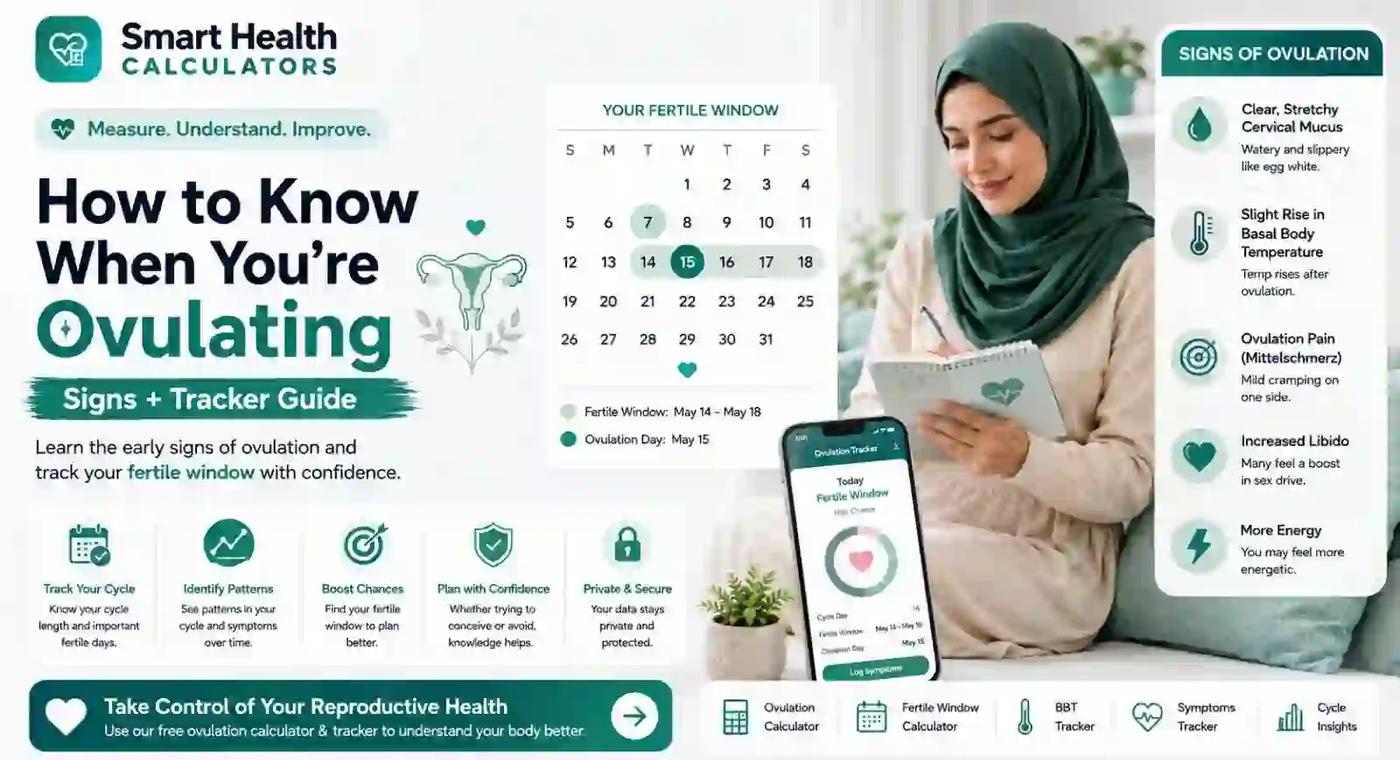
Ovulation Signs: 10 Symptoms & How to Track Ovulation
Learn the most reliable signs of ovulation, including cervical mucus, BBT, LH tests, ovulation pain, and how to track your fertile window accurately.
Understanding your ovulation signs can help you get pregnant, avoid pregnancy naturally, or simply understand your body's rhythm. Common signs include a change in cervical mucus to a clear, stretchy, egg-white texture, a slight rise in basal body temperature, mild one-sided pelvic pain, and a positive result on an ovulation predictor kit. Ovulation typically happens around the midpoint of a regular cycle, though the exact day varies from person to person.
Whether you're trying to conceive, avoiding pregnancy, or just curious about your cycle, learning to read your body's signals is one of the most useful things you can do for your reproductive health. This guide walks through every reliable sign of ovulation, how to track it accurately, and what to do if your cycle doesn't follow a "textbook" pattern.
What Is Ovulation, Exactly?
Ovulation is the point in your menstrual cycle when a mature egg is released from one of your ovaries. It's triggered by a surge in luteinizing hormone (LH), which causes the dominant follicle to rupture and release the egg into the fallopian tube.
The egg survives for roughly 12 to 24 hours after release. Sperm, on the other hand, can live inside the reproductive tract for up to five days. That's why the "fertile window" — the days when pregnancy is possible — actually starts several days before ovulation, not just on the day itself.
A typical menstrual cycle has three main phases:
- Follicular phase — from the first day of your period until ovulation, when follicles develop in the ovary
- Ovulation — the release of the egg, usually a single day
- Luteal phase — from ovulation until your next period begins, typically lasting 12–14 days regardless of cycle length
The luteal phase is fairly consistent from person to person, which is actually why tracking ovulation matters more than just counting from day one of your period. If your cycle is 35 days instead of 28, ovulation isn't still happening on day 14 — it's shifted later, closer to day 21, because the follicular phase is what varies, not the luteal phase.
The Most Reliable Signs of Ovulation
1. Cervical Mucus Changes
This is one of the most consistent physical signs your body gives you. As estrogen rises before ovulation, cervical mucus shifts:
- Early cycle: dry or minimal mucus
- Approaching ovulation: creamy, whitish mucus
- Peak fertility: clear, slippery, stretchy — often compared to raw egg whites
That egg-white texture is a strong indicator ovulation is near or happening. Many people learn to check this daily by simply noting the texture on toilet paper or with clean fingers.
2. Basal Body Temperature (BBT) Shift
Your basal body temperature — your resting temperature first thing in the morning — rises slightly (about 0.5–1°F) after ovulation due to increased progesterone. This isn't a predictive sign; it confirms ovulation has already happened, since the temperature only rises after the egg is released.
To use this method effectively:
- Take your temperature at the same time every morning, before getting out of bed
- Use a basal thermometer (more precise than a standard one)
- Track for at least two to three full cycles to spot your pattern
A sustained temperature rise lasting three or more days usually confirms ovulation occurred.
3. Ovulation Predictor Kits (LH Surge Tests)
Ovulation predictor kits (OPKs) detect the LH surge in urine, which happens roughly 24–36 hours before ovulation. This makes them one of the more reliable predictive tools, especially compared to calendar-only methods.
- Start testing a few days before your expected fertile window
- Test around the same time daily, avoiding first-morning urine (LH tends to be more concentrated later in the day)
- A positive result means ovulation is likely within the next 1–2 days
Digital kits and test strips work on the same principle; digital versions simply remove the guesswork of reading faint lines.
4. Mittelschmerz (Ovulation Pain)
Some people feel a mild, one-sided cramp or twinge near the ovary during ovulation, known as mittelschmerz — German for "middle pain." It can last a few minutes to a couple of days and typically switches sides depending on which ovary released the egg that cycle.
Not everyone experiences this, and its absence doesn't mean ovulation isn't happening.
5. Other Supporting Symptoms
These are less reliable on their own but often show up alongside the signs above:
- Mild breast tenderness
- A slight increase in libido
- Light spotting
- Subtle bloating
- Heightened sense of smell (reported anecdotally, not universally proven)
None of these should be used in isolation to determine ovulation — they're most useful as supporting evidence alongside cervical mucus or LH testing.
Signs and Methods Comparison Table
| Sign / Method | What to Look For | Reliability |
|---|---|---|
| Cervical mucus | Clear, stretchy, egg-white texture | Good — real-time indicator |
| Basal body temperature | Sustained 0.5–1°F rise | Good — confirms after the fact |
| Ovulation predictor kit | Positive LH surge result | Very good — predictive, 1–2 days ahead |
| Mittelschmerz | One-sided pelvic twinge | Moderate — not everyone feels it |
| Calendar/app tracking | Cycle length averages | Fair — best for regular cycles only |
| Fertility monitor (combined) | BBT + LH + sometimes estrogen | Very good — most comprehensive |
For the most accurate picture, combine at least two methods — for example, cervical mucus tracking alongside an OPK, or BBT charting alongside a period-tracking app.
How to Track Ovulation Step by Step
- Record your cycle length for two to three months. Note day one as the first day of full flow bleeding.
- Check cervical mucus daily, ideally at the same time, and jot down the texture.
- Start OPK testing a few days before your expected fertile window (roughly cycle length minus 17 days).
- Take your BBT every morning before getting up, and log it in a chart or app.
- Watch for a temperature rise that holds for three-plus days — this confirms ovulation happened.
- Cross-reference all three data points (mucus, LH surge, temperature rise) to build a personal pattern over a few cycles.
A pregnancy and cycle-related calculator can help you estimate your fertile window based on your average cycle length once you have a few months of data logged. Many people also find it useful to compare due-date and gestation timing once they've identified their fertile window — something covered in more detail in this piece on pregnancy symptoms by trimester.
Tracking Ovulation With Irregular Cycles
Irregular cycles make calendar-based predictions unreliable, since the follicular phase — not the luteal phase — is what shifts. In these cases:
- Lean more heavily on cervical mucus and OPK testing rather than day-counting
- Consider a fertility monitor that tracks multiple hormones (estrogen and LH), since a single LH test might miss a shorter or unpredictable surge
- Track for longer — three to six cycles — before drawing conclusions about your pattern
- If cycles are consistently under 21 days or over 35 days, or ovulation signs are absent for several months, it's worth discussing this with a healthcare provider, since conditions like PCOS or thyroid imbalances can affect ovulation
If general health habits are part of what you're trying to manage alongside cycle tracking, related reads like natural ways to reduce stress and how stress affects sleep quality touch on factors that can indirectly influence hormonal regularity.
Tracking Ovulation for Different Goals
If you're trying to conceive: Focus on the days leading up to and including ovulation — this is your highest-probability window. Combine OPK testing with cervical mucus checks for the clearest picture, and consider timing intercourse every 1–2 days during the fertile window rather than only on the predicted peak day.
If you're avoiding pregnancy naturally: This requires more caution and consistency. Fertility awareness methods used for contraception typically require combining BBT, cervical mucus, and calendar data together, and even then, they carry a higher typical-use failure rate than hormonal or barrier methods. This approach works best with proper training from a certified fertility awareness educator rather than app-based tracking alone.
If you're tracking after stopping birth control: Ovulation can take a few cycles to normalize after stopping hormonal contraception, so don't be alarmed if your first cycle or two looks irregular. Give your body two to three cycles before assuming something is off.
If you have PCOS: Ovulation may be infrequent or absent some months. Standard OPKs can sometimes give misleading results due to naturally elevated LH levels in some PCOS cases, so cervical mucus tracking and, where needed, medical guidance (like ultrasound monitoring) may be more reliable.
Frequently Asked Questions
What are the earliest signs of ovulation? The earliest reliable sign is a shift in cervical mucus from dry or sticky to a clearer, more stretchy consistency, usually a few days before the egg is released. A positive OPK typically follows shortly after.
How many days after my period do I ovulate? It depends on your total cycle length, not a fixed number. In a 28-day cycle, ovulation often falls around day 14, but in longer or shorter cycles, it shifts earlier or later since the luteal phase stays fairly constant.
Can you feel yourself ovulating? Some people notice mittelschmerz (mild one-sided pelvic pain), breast tenderness, or a subtle increase in libido, but many feel nothing at all. Not feeling anything doesn't mean ovulation isn't occurring.
How accurate are ovulation predictor kits? OPKs are generally reliable for detecting the LH surge, especially with consistent daily testing, though they can be less accurate for people with PCOS or naturally fluctuating LH levels.
What does ovulation discharge look like? At peak fertility, cervical mucus typically becomes clear, slippery, and stretchy, similar in texture to raw egg whites — a sign that conditions are optimal for sperm survival.
How long does the fertile window last? Around six days total — the five days before ovulation (due to sperm survival time) plus the day of ovulation itself, with the two days before ovulation being the highest-probability days.
When to See a Doctor
Tracking your own signs is useful, but certain patterns are worth flagging to a healthcare provider:
- Cycles consistently shorter than 21 days or longer than 35 days
- No clear ovulation signs across several consecutive cycles
- Severe pelvic pain that doesn't resemble mild mittelschmerz
- Trying to conceive for 12 months (or 6 months if you're over 35) without success
Organizations like the American College of Obstetricians and Gynecologists and Mayo Clinic both note that occasional cycle irregularity is common, but persistent absence of ovulation signs deserves a clinical evaluation rather than continued self-tracking alone.
Final Takeaway
No single sign tells the whole story — cervical mucus, basal body temperature, and LH testing each capture a different piece of the puzzle, and combining them gives you the clearest, most personalized picture of your cycle. Give yourself two to three months of consistent tracking before expecting a reliable pattern, and don't hesitate to loop in a doctor if something feels consistently off.
If you're building out a fuller picture of your reproductive and overall health, tools like a pregnancy calculator or a broader look at realistic health goals and tracking can help you connect ovulation tracking to the rest of your health routine.
Medical Disclaimer
This article is for general education only. It is not medical advice, diagnosis, treatment, prescription guidance, or a replacement for professional healthcare. Speak with a qualified healthcare professional for personal medical concerns, symptoms, pregnancy concerns, mental health crisis, medication questions, or before making major health changes.