Pregnancy Calculator: Due Date & Trimesters Explained
Find your due date and see what happens in each trimester. Learn how pregnancy calculators work, from LMP to IVF dating, plus a free calculator tool.
Finding out you're pregnant comes with an immediate question: when will the baby arrive? A due date is typically calculated by adding 280 days, or 40 weeks, to the first day of your last menstrual period. This is known as Naegele's rule, and it remains the standard starting point doctors use, even though ultrasound dating in early pregnancy is often considered more precise. From there, your pregnancy is divided into three trimesters, each lasting roughly 13 weeks, with its own set of developments and symptoms.
This guide walks through exactly how due dates are calculated, why they sometimes shift after an ultrasound, and what actually happens in each trimester, so you know what to expect at every stage.
What Is a Pregnancy Due Date Calculator?
A pregnancy due date calculator is a tool that estimates your baby's expected date of delivery (EDD) based on the information you provide, typically the first day of your last menstrual period, your average cycle length, or your conception date if you know it. If you conceived through IVF, the calculator can also work backward from your embryo transfer date, since that timeline is far more precise than a natural conception estimate.
It's worth being clear about one thing upfront: a due date is an estimate, not a guarantee. According to the American College of Obstetricians and Gynecologists (ACOG), only a small percentage of babies are actually born on their exact due date. Most arrive within a window of a couple of weeks before or after, which is completely normal.
How Is a Due Date Calculated?
There are three common methods used to estimate a due date, and each has its own level of accuracy.
1. Last Menstrual Period (LMP) Method
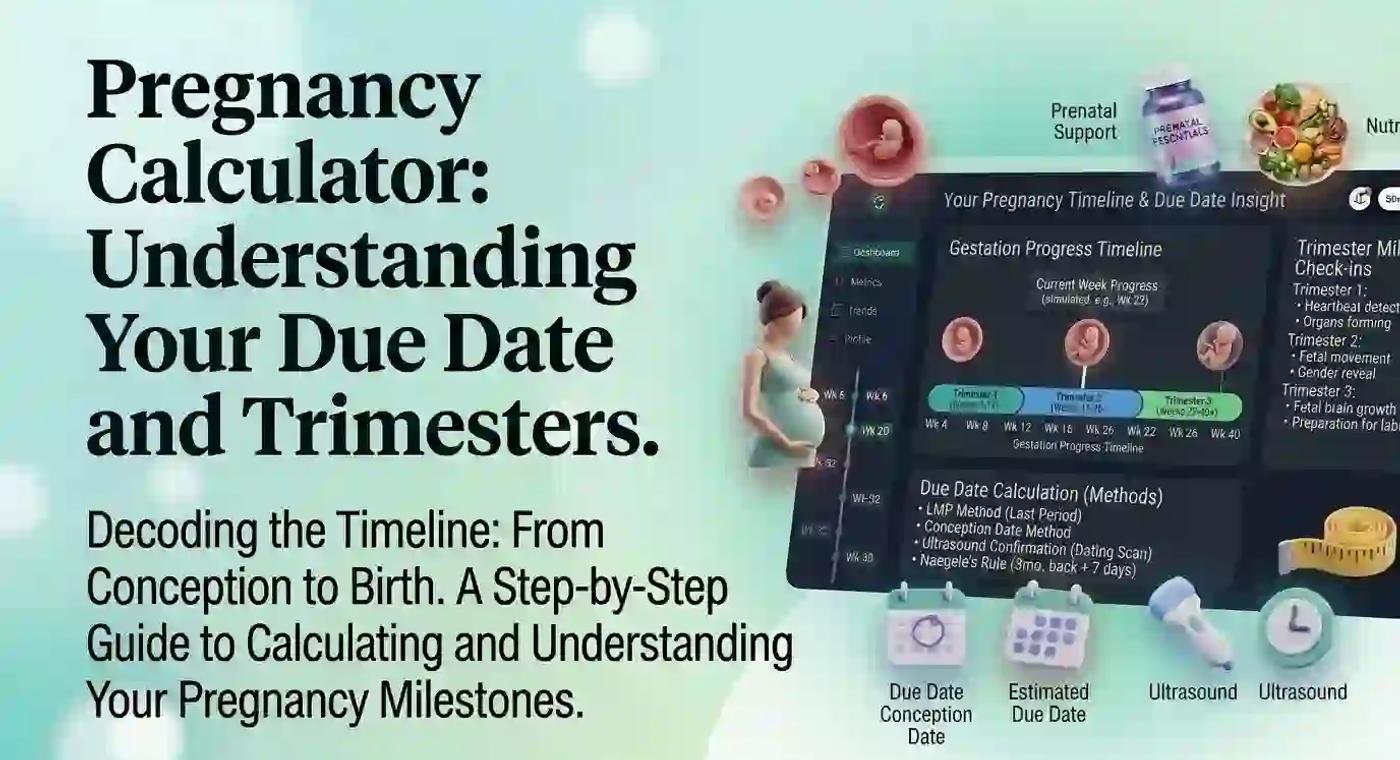
This is the most widely used approach and follows Naegele's rule: take the first day of your last period, add seven days, subtract three months, and add one year. In practice, most calculators simply add 280 days to your LMP date.
This method assumes a standard 28-day cycle with ovulation occurring on day 14. If your cycle is longer or shorter than 28 days, your actual conception date, and therefore your due date, may shift slightly. This is why doctors often ask about your typical cycle length when calculating your dates.
2. Conception Date Method
If you know roughly when you conceived, perhaps through ovulation tracking or a specific point in your cycle, you can calculate your due date by adding 266 days (38 weeks) to that date instead. This method tends to be more accurate for people with irregular cycles, since it doesn't rely on assuming a standard 28-day cycle.
3. Ultrasound Dating
An early ultrasound, typically performed in the first trimester, measures the fetus and estimates gestational age based on its size. This method is generally considered the most accurate, particularly in the first 13 weeks, because fetal growth is remarkably consistent during this window. If your ultrasound dating differs from your LMP-based due date by more than about a week, your provider may adjust your due date to match the ultrasound estimate.
Gestational Age vs. Fetal Age: What's the Difference?
This is one of the most common points of confusion in early pregnancy. Gestational age is counted from the first day of your last menstrual period, which is roughly two weeks before you actually conceived. Fetal age (or conception age) is counted from the actual date of conception.
In practical terms, this means that when your doctor says you're "6 weeks pregnant," your baby has actually only been developing for about 4 weeks. Nearly all pregnancy tracking, due date calculators, and medical appointments use gestational age, so it's the number you'll see most often, but it helps to understand why the two figures don't match.
How Is a Due Date Calculated for IVF Pregnancies?
If you conceived through IVF, your due date calculation is based on your embryo transfer date rather than your last menstrual period, since IVF timelines are precisely tracked. For a day-5 embryo transfer (blastocyst), your due date is typically calculated as 261 days from the transfer date. For a day-3 embryo transfer, it's 263 days. This method tends to be highly accurate since the exact conception timeline is already known, removing the guesswork involved in LMP-based calculations.
Understanding Pregnancy Trimesters
Pregnancy is divided into three trimesters, each spanning roughly 13 to 14 weeks. Here's how they break down.
Trimester: First
Weeks: Weeks 1–13
Key Developments: Major organs and body systems begin forming; heartbeat becomes detectable
Common Symptoms: Nausea, fatigue, breast tenderness, frequent urination
Trimester: Second
Weeks: Weeks 14–27
Key Developments: Bones harden, movement becomes noticeable, sex can often be determined
Common Symptoms: Increased energy, visible bump, mild back pain, fetal movement ("quickening")
Trimester: Third
Weeks: Weeks 28–40+
Key Developments: Rapid weight gain, lungs and brain continue maturing, baby moves into position for birth
Common Symptoms: Back pain, swelling, shortness of breath, Braxton Hicks contractions
First Trimester (Weeks 1–13)
The first trimester is when the foundation of your baby's body forms, even though there's often little to see on the outside. By the end of this trimester, all major organs have begun developing, and the heartbeat is typically detectable on ultrasound.
This is also usually the trimester with the most noticeable symptoms: nausea (commonly called morning sickness, though it can strike any time of day), fatigue, breast tenderness, and frequent urination are all common. Symptoms vary significantly from person to person, and some people experience very few.
Second Trimester (Weeks 14–27)
Often called the "honeymoon trimester," many people find their energy returns and early symptoms like nausea ease up during this stretch. Your baby's bones begin to harden, movement becomes strong enough to feel, often called "quickening," and depending on positioning, an anatomy scan around 18-20 weeks can often reveal the baby's sex.
This is generally considered the most comfortable trimester for many pregnant people, though a growing bump can bring on mild back pain and changes in balance.
Third Trimester (Weeks 28–40+)
The final stretch is defined by rapid growth. Your baby gains most of their birth weight during this period, and the lungs and brain continue maturing right up until birth. Physically, this trimester tends to bring the most discomfort: back pain, swelling in the hands and feet, shortness of breath as the baby takes up more room, and Braxton Hicks contractions, which are your body's way of "practicing" for labor.
What Counts as Full Term?
Not all pregnancies that reach 40 weeks are treated the same in medical terms. ACOG defines the following categories:
- Early term: 37 weeks 0 days to 38 weeks 6 days
- Full term: 39 weeks 0 days to 40 weeks 6 days
- Late term: 41 weeks 0 days to 41 weeks 6 days
- Post-term: 42 weeks and beyond
Babies born before 37 weeks are considered preterm. This distinction matters because outcomes and development can differ even within a few weeks, which is part of why providers avoid scheduling non-medically necessary early deliveries before 39 weeks whenever possible.
Can My Due Date Change?
Yes, and it's more common than people expect. The most frequent reason is a first-trimester ultrasound showing a different gestational age than your LMP-based calculation suggested. Since ultrasound measurements are highly consistent in early pregnancy, providers will often adjust your due date if the discrepancy is significant, typically more than 5-7 days in the first trimester.
Other reasons a due date might shift include irregular cycles that made the original LMP-based estimate less reliable, or updated information about your conception timeline. Once you're past the first trimester, due dates are adjusted far less often, since later ultrasounds are less precise for dating purposes.
Why Due Date Accuracy Matters
While it's tempting to treat your due date as a fixed deadline, its real value is as a planning tool. It helps your healthcare provider:
- Schedule prenatal screenings and tests at the right gestational windows
- Monitor whether your baby's growth is on track
- Determine whether labor is happening preterm, full term, or post-term
- Decide whether induction may be medically appropriate if a pregnancy goes significantly past term
Knowing your estimated due date, even with its built-in uncertainty, gives you and your care team a shared reference point throughout pregnancy.
Tracking Your Pregnancy Beyond the Due Date
A due date calculator is a great starting point, but pregnancy tracking works best alongside a broader look at your overall health. Nutrition, hydration, and steady weight gain all play a role in how your pregnancy progresses. If you're looking to build healthier daily habits during pregnancy, our guide on building a healthy morning routine offers practical, low-effort changes that support energy levels throughout the day, and our breakdown of daily water intake is especially relevant, since hydration needs increase during pregnancy.
If you're also thinking about weight and nutrition planning during this time, our calorie intake guide by age and gender can help you understand baseline needs, which your provider can then adjust for pregnancy-specific requirements.
Try the Pregnancy Calculator
Ready to estimate your own due date? Our Pregnancy Calculator lets you calculate your estimated delivery date using your last menstrual period, conception date, or IVF transfer date, whichever applies to you. It also shows you which trimester you're currently in and how many weeks along you are, all in one simple tool.
Frequently Asked Questions
How is my due date calculated? Most commonly, by adding 280 days to the first day of your last menstrual period (Naegele's rule). If you know your conception date, 266 days is added instead. Early ultrasound measurements are generally considered the most accurate method.
How accurate are pregnancy due date calculators? They provide a solid estimate, but only a small percentage of babies are born on their exact due date. Most arrive within about two weeks before or after, which is entirely normal.
What are the three trimesters of pregnancy? The first trimester spans weeks 1-13, the second spans weeks 14-27, and the third spans weeks 28 through birth, typically around week 40.
Can my due date change after an ultrasound? Yes. If a first-trimester ultrasound shows a gestational age that differs meaningfully from your LMP-based estimate, your provider may adjust your due date to match the ultrasound, since it's typically more precise at this stage.
What is considered full term in pregnancy? Full term is defined as 39 weeks 0 days through 40 weeks 6 days. Babies born from 37 to 38 weeks 6 days are considered early term, and those born at 42 weeks or beyond are post-term.
How is due date calculated for IVF pregnancies? It's based on the embryo transfer date: 261 days for a day-5 transfer, or 263 days for a day-3 transfer, since the conception timeline is precisely known.
Final Thoughts
Your due date is best understood as an estimate, not a fixed appointment. Whether it's calculated from your last period, a known conception date, or an IVF transfer, it gives you and your healthcare provider a useful timeline to track your baby's growth and plan prenatal care, even though the actual birth date will likely fall somewhere within a two-week window around it. Understanding your trimesters, and what's actually happening in each one, can make the whole nine months feel a lot less uncertain.
Want a quick, accurate estimate of your own dates? Try our Pregnancy Calculator to find your due date and current trimester in seconds, or explore more free tools at Smart Health Calculators to support your health throughout pregnancy and beyond.
This article is for general informational purposes and does not replace personalized medical advice. Due dates, trimester timing, and full-term definitions referenced above follow guidelines from the American College of Obstetricians and Gynecologists (ACOG). Always consult your healthcare provider for guidance specific to your pregnancy.
Medical Disclaimer
This article is for general education only. It is not medical advice, diagnosis, treatment, prescription guidance, or a replacement for professional healthcare. Speak with a qualified healthcare professional for personal medical concerns, symptoms, pregnancy concerns, mental health crisis, medication questions, or before making major health changes.