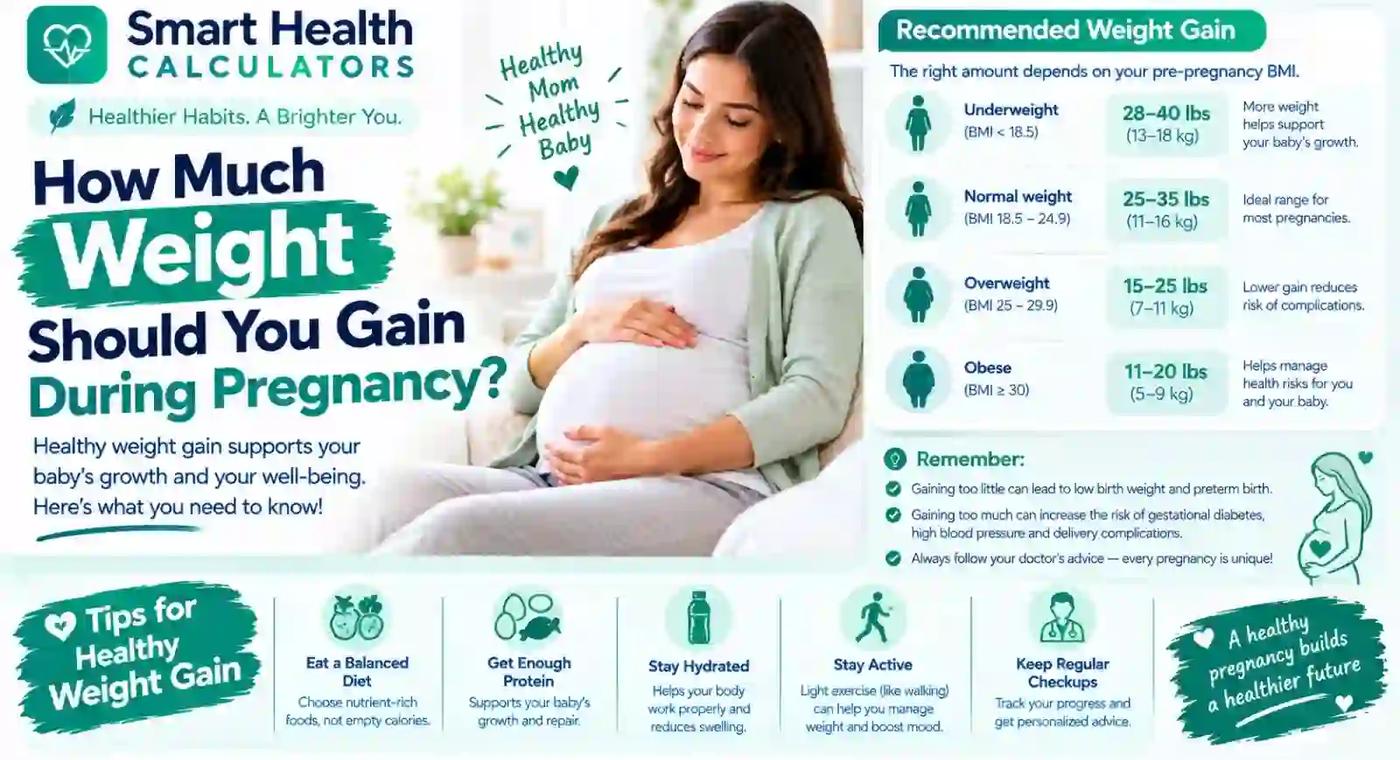
How Much Weight Should You Gain During Pregnancy?
Learn how much weight to gain during pregnancy by pre-pregnancy BMI, trimester, and twins, plus healthy ranges and risks of gaining too much or too little.
How much weight you should gain during pregnancy depends almost entirely on your pre-pregnancy BMI — there's no single universal number that applies to everyone. The Institute of Medicine's guidelines, still the standard most OB-GYNs reference today, recommend anywhere from 11 to 40 pounds total, depending on which BMI category you started in.
This guide breaks down the exact ranges by BMI, how that weight should be distributed across trimesters, what happens if you gain too much or too little, and where all that weight actually goes.
How Much Weight Should You Gain? By BMI Category
This is the single most important table in this article, since generic "gain 25-35 pounds" advice you'll see everywhere online only applies to one specific BMI category, not everyone.
| Pre-Pregnancy BMI Category | BMI Range | Recommended Total Weight Gain |
|---|---|---|
| Underweight | Below 18.5 | 28–40 lbs (12.5–18 kg) |
| Normal weight | 18.5–24.9 | 25–35 lbs (11.5–16 kg) |
| Overweight | 25.0–29.9 | 15–25 lbs (7–11.5 kg) |
| Obese | 30.0 and above | 11–20 lbs (5–9 kg) |
These figures come from the Institute of Medicine's 2009 guidelines, which remain endorsed by the American College of Obstetricians and Gynecologists (ACOG) as the current standard of care. The underlying logic is straightforward: someone starting pregnancy at a lower weight has more room to gain safely, while someone starting at a higher weight needs less additional weight to support a healthy pregnancy.
If you don't already know your pre-pregnancy BMI category, our BMI calculator can help you determine it using your height and pre-pregnancy weight before you check these ranges against your own numbers.
How Much Weight Should You Gain With Twins?
Twin pregnancies carry higher recommended ranges across every BMI category, since you're supporting the growth of two babies rather than one:
| Pre-Pregnancy BMI Category | Recommended Weight Gain (Twins) |
|---|---|
| Normal weight | 37–54 lbs (16.8–24.5 kg) |
| Overweight | 31–50 lbs (14.1–22.7 kg) |
| Obese | 25–42 lbs (11.3–19.1 kg) |
Notice there's no separate underweight category listed here — this is because the evidence base for underweight twin pregnancies specifically is more limited, and individualized guidance from your OB-GYN matters even more in this scenario.
How Much Weight Gain Is Normal by Trimester?
Total weight gain matters, but so does the rate at which you gain it — steady, gradual gain is generally considered healthier than rapid gain concentrated in a short window.
| Trimester | Typical Pattern |
|---|---|
| First trimester | Modest total gain, roughly 1–4.4 lbs for the entire trimester, regardless of BMI category |
| Second trimester | Steadier, more consistent weekly gain begins |
| Third trimester | Continued steady gain, often the period where most total weight accumulates |
For the second and third trimesters specifically, a commonly cited pattern is roughly 1 pound per week for those in the normal-weight category, with somewhat less per week for overweight and obese categories, and somewhat more for underweight individuals — though this varies enough between individuals that it's a general pattern rather than a strict rule.
Where Does Pregnancy Weight Actually Go?
A question with genuine, satisfying specificity behind it: pregnancy weight isn't just "fat," and understanding the breakdown helps explain why the recommended ranges exist at all.
- Baby: typically around 7–8 lbs at full term
- Placenta: roughly 1–2 lbs
- Amniotic fluid: roughly 2 lbs
- Increased blood volume: roughly 3–4 lbs
- Uterus growth: roughly 2 lbs
- Breast tissue changes: roughly 1–2 lbs
- Maternal fat and nutrient stores: the remaining portion, which serves as an energy reserve for late pregnancy and breastfeeding
Add these up, and a substantial portion of total pregnancy weight gain isn't fat at all — it's the physical infrastructure your body builds to support the pregnancy itself.
What Happens If You Gain Too Much Weight During Pregnancy?
Excessive gestational weight gain has been associated with several increased risks in research, including higher likelihood of gestational diabetes, higher birth weight (macrosomia), increased likelihood of needing a cesarean delivery, and greater postpartum weight retention. National data has found that a substantial share of pregnant individuals gain more than the recommended amount — this is common, not rare, which is exactly why steady monitoring throughout pregnancy matters rather than only checking in at the end.
What Happens If You Don't Gain Enough Weight During Pregnancy?
Inadequate gestational weight gain has been associated with increased risk of lower birth weight, which itself carries its own set of potential health considerations for the baby. This is why "just don't gain too much" isn't the right goal either — the recommended ranges exist specifically to balance risks on both ends, not just to prevent excessive gain.
Is It Normal to Lose Weight in Early Pregnancy?
Yes, this is common and generally not a cause for alarm on its own. Early pregnancy nausea (sometimes called morning sickness, though it can occur at any time of day) frequently reduces appetite and food intake enough to cause a small amount of weight loss or a plateau in the first trimester, before weight gain typically picks up in the second trimester. If nausea is severe enough to prevent adequate hydration or is causing significant weight loss beyond a few pounds, that's worth discussing with your provider directly.
Can I Diet to Lose Weight While Pregnant?
Intentional dieting for weight loss during pregnancy is not generally recommended, even for individuals in the overweight or obese BMI categories, since pregnancy is not the appropriate time to restrict calories for weight loss purposes — the focus during pregnancy is on appropriate nutrient intake to support the baby's development, with weight gain (even if modest for higher BMI categories) still generally expected rather than avoided. Any specific concerns about weight management during pregnancy should be discussed directly with your OB-GYN, who can account for your individual health profile.
Does Pregnancy Weight Gain Differ for a Second Pregnancy?
The same BMI-based IOM guidelines apply regardless of which pregnancy number you're on, since they're based on your BMI at the start of this specific pregnancy rather than any pattern from a previous one. That said, many people find their body responds somewhat differently in subsequent pregnancies, which is a normal individual variation rather than a sign that something is wrong.
How Long Does It Take to Lose Pregnancy Weight After Birth?
This varies significantly between individuals and isn't governed by a fixed timeline. Postpartum weight loss depends on factors including how much weight was gained, breastfeeding status, activity level, and individual metabolism, and it's generally healthier to view this as a gradual process over months rather than something to rush in the initial postpartum weeks, when your body is still recovering. If you're tracking your progress against a target once you're cleared for exercise, our ideal weight calculator can help establish a reasonable general reference point.
How Often Should I Weigh Myself During Pregnancy?
Most OB-GYN appointments include a weight check as a standard part of prenatal monitoring, which is generally sufficient for tracking purposes without needing frequent self-monitoring at home. If your provider has specifically asked you to track weight more closely due to individual health factors, follow their specific guidance rather than a generic schedule.
A Note on Individual Guidance
These IOM ranges are broad, population-level public health recommendations, not personalized medical prescriptions. They don't account for individual health conditions, pregnancy complications, or your specific medical history. Your OB-GYN or midwife may recommend a different target range based on your individual circumstances, and that individualized guidance should always take priority over these general guidelines.
Frequently Asked Questions
How much weight should I gain during pregnancy?
It depends on your pre-pregnancy BMI: 28-40 lbs if underweight, 25-35 lbs if normal weight, 15-25 lbs if overweight, and 11-20 lbs if obese, according to IOM guidelines endorsed by ACOG.
How much weight gain is normal by trimester?
Roughly 1-4.4 lbs total in the first trimester regardless of BMI category, followed by steadier ongoing weekly gain through the second and third trimesters that varies by BMI category.
What happens if I gain too much weight while pregnant?
Excessive gestational weight gain has been associated with increased risk of gestational diabetes, higher birth weight, greater likelihood of cesarean delivery, and increased postpartum weight retention.
What happens if I don't gain enough weight during pregnancy?
Inadequate weight gain has been associated with increased risk of lower birth weight in research.
How much weight should I gain with twins?
Higher ranges than singleton pregnancies apply: 37-54 lbs for normal weight, 31-50 lbs for overweight, and 25-42 lbs for obese pre-pregnancy BMI categories.
Is it normal to lose weight in early pregnancy?
Yes, this is common, typically related to reduced appetite from nausea, and generally not concerning unless it involves significant weight loss or prevents adequate hydration.
How much of the weight gained is actually the baby?
The baby itself typically accounts for roughly 7-8 lbs at full term, with the remaining weight distributed across the placenta, amniotic fluid, increased blood volume, uterus growth, breast tissue, and maternal fat and nutrient stores.
Can I diet to lose weight while pregnant?
Intentional dieting for weight loss is not generally recommended during pregnancy, even for higher BMI categories — any weight management concerns should be discussed directly with your OB-GYN.
Final Takeaway
The right amount of pregnancy weight gain isn't one number — it's a range determined by your pre-pregnancy BMI, and both gaining too much and too little carry their own associated risks worth taking seriously rather than dismissing either direction. Use the BMI-based table above as your starting reference point, but treat your OB-GYN's individualized guidance as the final word, since they can account for factors these general population guidelines simply can't.
To check where you currently stand, start with our BMI calculator to confirm your pre-pregnancy category, and explore our broader pregnancy symptoms by trimester guide for what else to expect as your pregnancy progresses.
Medical Disclaimer
This article is for general education only. It is not medical advice, diagnosis, treatment, prescription guidance, or a replacement for professional healthcare. Speak with a qualified healthcare professional for personal medical concerns, symptoms, pregnancy concerns, mental health crisis, medication questions, or before making major health changes.