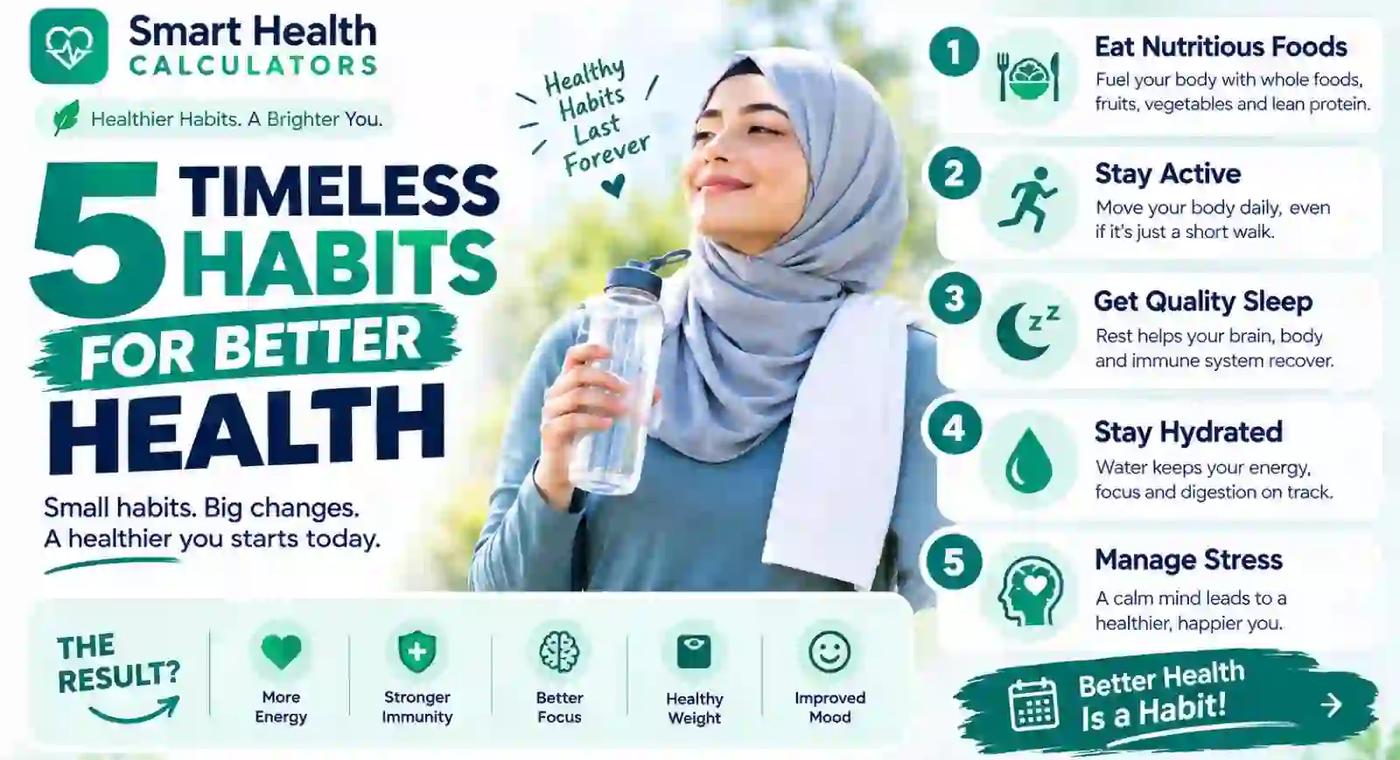
5 Healthy Habits for Better Health: A Practical Guide
Discover 5 healthy habits for better health: quality sleep, regular exercise, balanced nutrition, stress management, and proper hydration.
Good health rarely comes down to one dramatic change. It comes from five things done consistently: sleeping enough, moving your body, eating real food, managing stress, and staying hydrated. None of these are new or trendy — they're the same habits doctors have recommended for decades because the research keeps confirming they work.
This guide breaks down each of these five habits specifically, with the actual guidelines behind them, why they matter physiologically, and a practical way to actually build each one rather than just knowing you should.
Why These 5 Habits (and Not a Dozen Others)
Health advice is everywhere, and most of it is noise layered on top of a much smaller set of fundamentals. Sleep, movement, nutrition, stress management, and hydration show up in some form across virtually every major health authority's guidelines — the World Health Organization, the CDC, Harvard Health, and the Mayo Clinic all circle back to these same five pillars, even when their specific recommendations differ in the details.
That consistency across independent sources is exactly why these habits are "timeless" rather than trendy. They don't expire when a new diet trend appears, because they're addressing the basic physiological systems — sleep architecture, cardiovascular function, metabolic health, the stress response, and cellular hydration — that haven't changed regardless of how nutrition science fashions shift.
Habit 1: Prioritize Consistent, Quality Sleep
Why It Matters
Sleep isn't downtime — it's when your body repairs tissue, consolidates memory, and regulates the hormones that control hunger, stress, and immune function. The CDC recommends adults get at least 7 hours of sleep per night, and consistently falling short of this is associated with increased risk of heart disease, type 2 diabetes, and impaired immune response.
Beyond total hours, sleep quality matters just as much — waking up in the middle of a sleep cycle, particularly during deep sleep, causes grogginess regardless of how many hours you technically slept. If you've ever slept 8 hours and still felt exhausted, timing within your sleep cycles is likely part of the explanation, not just duration.
How to Actually Build This Habit
- Keep a consistent bedtime and wake time, even on weekends, since irregular schedules disrupt your circadian rhythm
- Avoid screens for 30-60 minutes before bed, since blue light delays natural melatonin release
- Track how you actually feel, not just hours slept, and adjust your bedtime based on real results rather than a generic number
If you want to dial in your exact bedtime based on sleep cycle timing rather than guessing, our detailed breakdown on sleep latency and falling asleep faster covers the mechanics in more depth, and our Sleep Quality Checker can help you identify what's actually disrupting your rest.
Habit 2: Move Your Body Regularly
Why It Matters
The World Health Organization recommends adults get at least 150-300 minutes of moderate-intensity aerobic activity per week, plus muscle-strengthening activities on two or more days. This isn't about training for a marathon — it's about giving your cardiovascular system, muscles, and metabolic function the regular stimulus they need to function well.
Regular physical activity is associated with reduced risk of cardiovascular disease and type 2 diabetes, along with measurable benefits for mood and cognitive function. The relationship works in both directions too: better cardiovascular fitness supports better sleep, and better sleep supports the energy needed to stay active — these five habits reinforce each other rather than operating in isolation.
How to Actually Build This Habit
- Break the weekly target into daily chunks (roughly 20-40 minutes most days) rather than treating it as one intimidating number
- Combine cardio and strength training rather than doing only one, since they support different aspects of long-term health
- Start with whatever you'll actually repeat — a structured gym program only works if you show up
For a practical breakdown of how to balance these two training types without one undermining the other, see our guide on cardio and strength training. If you're just getting started, our beginner home workout plan requiring no equipment removes the most common excuse — lack of a gym.
Habit 3: Eat Real, Balanced Food Consistently
Why It Matters
Nutrition science argues endlessly about specific diets, but the foundational guidance from bodies like Harvard Health and the WHO converges on the same basic pattern: plenty of vegetables and fruits, adequate protein, whole grains over heavily processed ones, and limited added sugar and sodium. This isn't a restrictive diet — it's simply what a body needs to run its basic systems well.
Balanced nutrition supports everything else on this list. It affects sleep quality, provides the fuel for physical activity, and plays a direct role in metabolic health and chronic disease prevention. Poor nutrition, on the other hand, tends to compound — it makes you more tired, which makes exercise harder, which affects sleep quality, and the cycle continues.
How to Actually Build This Habit
- Focus on adding vegetables and protein to meals rather than starting with restriction, since addition is easier to sustain than elimination
- Plan meals loosely for the week rather than deciding from scratch each time hunger hits, which is when poor choices happen most
- Track patterns over weeks, not individual meals, since one imperfect day doesn't undo consistent habits
Our guide on why your diet might not be working covers the most common reasons nutrition efforts stall out even when someone is genuinely trying, and our calorie intake planner can help establish a realistic baseline for your specific body and goals.
Habit 4: Manage Stress Deliberately
Why It Matters
Chronic stress keeps cortisol elevated for extended periods, and sustained high cortisol is linked to disrupted sleep, impaired immune function, and increased cardiovascular strain. Unlike acute stress — which is a normal, even useful, short-term response — chronic unmanaged stress affects nearly every other habit on this list simultaneously.
This is why stress management often gets underrated compared to diet and exercise: it's less visible, but it directly undermines your ability to sleep well, make good food choices, and stay consistent with exercise. Someone under constant unmanaged stress is fighting an uphill battle on every other health front.
How to Actually Build This Habit
- Build in short, deliberate breaks during the day rather than waiting until you're overwhelmed to address stress
- Practice simple breathing techniques, which have measurable effects on activating the parasympathetic nervous system
- Identify your specific stress triggers rather than treating "stress" as one vague, unmanageable thing
Our guide on 5-minute breathing exercises to lower your stress score offers a genuinely quick starting point, and our broader piece on natural ways to reduce stress covers additional approaches if breathing techniques alone aren't enough for your situation.
Habit 5: Stay Consistently Hydrated
Why It Matters
Water is involved in nearly every bodily function — regulating temperature, transporting nutrients, supporting cognitive function, and maintaining joint lubrication. Even mild dehydration, well before the point of feeling obviously thirsty, is associated with reduced concentration and increased perceived fatigue.
General hydration guidelines suggest roughly 8 cups (about 2 liters) daily for many adults as a starting reference point, though actual needs vary based on activity level, climate, and body size — there's no single number that applies universally, despite how often that oversimplified figure gets repeated.
How to Actually Build This Habit
- Keep water visibly accessible throughout the day, since visibility is one of the strongest predictors of consistent intake
- Increase intake around exercise and in hot climates, when needs genuinely rise above baseline
- Pay attention to urine color as a simple, practical daily indicator rather than obsessively tracking exact ounces
For a more precise, personalized target based on your body weight and activity level, our Water Intake Calculator removes the guesswork, and our guide on how climate affects your water needs is worth reading if you live somewhere with significant seasonal temperature swings.
How These 5 Habits Work Together
None of these habits function in true isolation — they form a reinforcing system rather than five separate checkboxes:
| Habit | Reinforces | Undermined By |
|---|---|---|
| Sleep | Energy for exercise, appetite regulation | Chronic stress, poor evening habits |
| Exercise | Sleep quality, stress reduction | Poor sleep, chronic fatigue |
| Nutrition | Energy, mood stability | Poor sleep, high stress eating |
| Stress management | Sleep quality, better food choices | Poor sleep, sedentary lifestyle |
| Hydration | Energy, cognitive function, exercise performance | Forgetting, inconsistent routine |
This is a big part of why isolated advice ("just exercise more") often fails — if sleep and stress are both poorly managed, exercise becomes much harder to sustain. Building these habits as a connected system, even imperfectly, tends to outperform obsessing over just one.
How to Build Any of These Habits Without Feeling Overwhelmed
Trying to overhaul all five simultaneously is a common reason people abandon healthy changes within weeks. A more sustainable approach:
- Pick one habit — typically sleep or hydration, since both have immediate, noticeable effects and require the least daily willpower
- Attach it to an existing routine (habit stacking), such as drinking a glass of water immediately after brushing your teeth
- Track consistency, not perfection — missing one day doesn't reset progress, but two weeks of skipped days signals the approach needs adjusting
- Add the next habit only once the first feels automatic, typically after several consistent weeks rather than a fixed universal number of days
Frequently Asked Questions
What are the 5 most important habits for better health? Consistent quality sleep, regular physical activity, balanced nutrition, deliberate stress management, and adequate hydration form the foundational set most health authorities consistently recommend.
How long does it take to form a healthy habit? This varies significantly by person and habit complexity — simpler habits like hydration tend to feel automatic sooner than more complex ones like a full exercise routine, and consistency over time matters more than hitting any specific day count.
What is the single most important habit for good health? No single habit outranks the others definitively, since they reinforce each other — but sleep is often considered foundational because poor sleep directly undermines your ability to maintain the other four.
Can small daily habits really improve long-term health? Yes. Research consistently associates sustained small habits — not dramatic short-term changes — with better long-term health outcomes, since consistency compounds over months and years.
How much sleep is needed for good health? The CDC recommends adults get at least 7 hours per night, though individual needs can vary somewhat based on age and activity level.
What habits help prevent chronic disease? Regular physical activity, balanced nutrition, and adequate sleep are each independently associated with reduced risk of conditions like cardiovascular disease and type 2 diabetes, according to major health authorities.
How often should you exercise for good health? The WHO recommends 150-300 minutes of moderate-intensity activity weekly, plus strength training on two or more days.
Do healthy habits need to be followed every single day? No. Consistency over weeks and months matters far more than daily perfection — occasional missed days don't undo an otherwise consistent pattern.
Final Takeaway
These five habits have stayed relevant for decades not because they're exciting, but because they address the actual physiological systems your body depends on daily. Start with one — sleep or hydration are usually the easiest entry points — build it into an existing routine, and layer in the next habit only once the first feels automatic rather than effortful.
If you want to track where you currently stand across these areas rather than guessing, explore the full range of free health calculators available, from sleep quality to hydration to workout planning, all designed to turn general advice into numbers specific to you.
For official guidance referenced in this article, see the CDC's sleep recommendations and the WHO's physical activity guidelines.
Medical Disclaimer
This article is for general education only. It is not medical advice, diagnosis, treatment, prescription guidance, or a replacement for professional healthcare. Speak with a qualified healthcare professional for personal medical concerns, symptoms, pregnancy concerns, mental health crisis, medication questions, or before making major health changes.