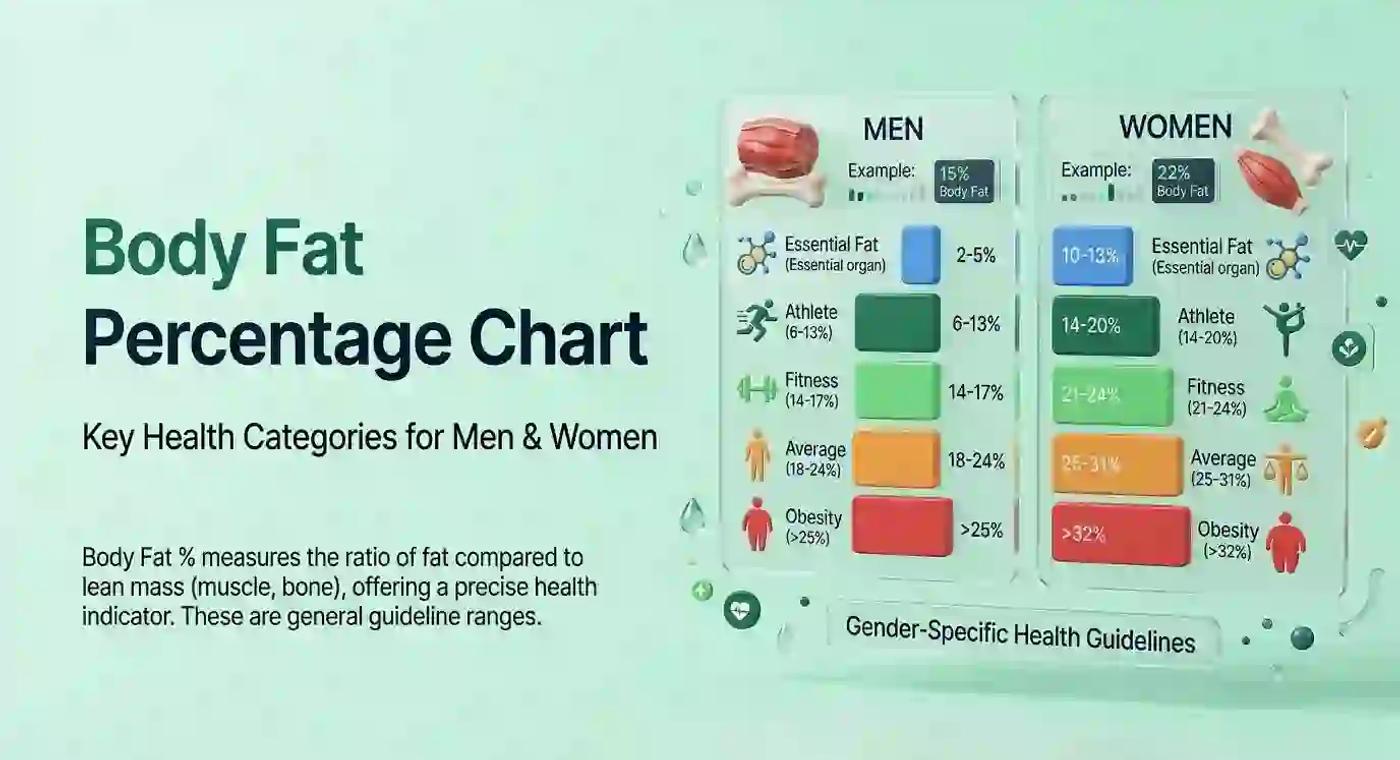
Body Fat Percentage Chart for Men and Women
See healthy body fat percentage ranges for men and women by category — essential, athletic, fitness, and average — plus how to measure yours accurately.
If you've ever looked at your BMI result and thought "that doesn't seem right," you're not imagining things. BMI can't tell the difference between muscle and fat, which is exactly why body fat percentage has become the more meaningful number for understanding your actual body composition. This guide breaks down healthy body fat ranges for men and women by category, how to measure it accurately, and what the numbers actually mean for your health — not just how you look.
What Is Body Fat Percentage?
Body fat percentage is the proportion of your total body weight that comes from fat, as opposed to muscle, bone, water, and organs. It's a more direct measure of body composition than BMI, which only factors in height and weight without distinguishing what that weight is made of.
Body fat itself isn't inherently bad — your body needs a baseline amount, called essential fat, to function properly. This supports hormone production, organ protection, and cell function. Beyond essential fat, the body stores additional fat (storage fat) as an energy reserve, and it's this storage fat that varies most based on lifestyle, diet, and activity level.
If you want a quick starting estimate before reading further, our body fat estimator gives you a fast, free calculation based on your own measurements.
Body Fat Percentage Chart for Men
Essential Fat — Body Fat Percentage: 2–5%
Athletes — Body Fat Percentage: 6–13%
Fitness — Body Fat Percentage: 14–17%
Average — Body Fat Percentage: 18–24%
Obese — Body Fat Percentage: 25% and above
Body Fat Percentage Chart for Women
Essential Fat — Body Fat Percentage: 10–13%
Athletes — Body Fat Percentage: 14–20%
Fitness — Body Fat Percentage: 21–24%
Average — Body Fat Percentage: 25–31%
Obese — Body Fat Percentage: 32% and above
These ranges are widely referenced from classifications used by organizations like the American Council on Exercise (ACE). Note that women naturally carry a higher percentage of essential fat than men, largely due to reproductive and hormonal function — this is normal biology, not a discrepancy in fitness levels between sexes.
Body Fat Percentage by Age
Body fat tends to gradually increase with age, even without significant weight gain, partly due to natural muscle loss over time. General ranges often shift upward by roughly 2-4 percentage points per decade past the 20s, which is why comparing yourself only to a single flat "ideal" number across all ages can be misleading. If you're in your 40s or 50s, a slightly higher body fat percentage than a 25-year-old's "average" range isn't automatically a cause for concern — it's a reasonably expected part of aging, especially when strength training isn't part of your routine.
How to Measure Body Fat Percentage
There's no single "perfect" method — each comes with a tradeoff between accuracy, cost, and accessibility.
Skinfold Calipers
A trained professional (or a careful DIY approach) pinches skin at specific body sites and measures thickness with a caliper, then applies a formula to estimate body fat. It's affordable and widely used, though accuracy depends heavily on technique consistency.
Bioelectrical Impedance Analysis (BIA)
Common in smart scales and handheld devices, BIA sends a small electrical current through the body to estimate fat based on resistance. It's convenient but can be affected by hydration levels, meaning results can shift noticeably based on when you last drank water or exercised. If hydration is something you don't track closely, this guide on signs you're not drinking enough water is worth a look, since it can genuinely skew a BIA reading.
DEXA Scan
A DEXA (Dual-Energy X-ray Absorptiometry) scan is generally considered one of the most accurate methods available, distinguishing fat, muscle, and bone density with genuine precision. It's typically only available through medical or specialized fitness facilities, and comes at a higher cost than at-home methods.
The Navy Method
Using a tape measure and a formula based on waist, neck, and (for women) hip circumference, the U.S. Navy method offers a reasonably accessible estimate without special equipment, though it's less precise than DEXA or professional caliper measurement.
Body Fat Percentage vs. BMI: What's the Real Difference?
This comparison comes up constantly, and for good reason. BMI is calculated purely from height and weight, making it fast and easy but blind to body composition. A muscular athlete and a sedentary individual of the same height and weight can have identical BMI scores while having dramatically different body fat percentages and health profiles. If you haven't checked your BMI recently, our BMI calculator takes seconds and pairs well with a body fat reading for a fuller picture.
Body fat percentage directly measures what your weight is made of, offering a more accurate picture of health risk — particularly for people who are more muscular than average, where BMI tends to overestimate "excess" weight, or for people with normal BMI but higher fat mass (sometimes called "skinny fat"), where BMI can understate health risk.
Neither measurement is perfect on its own. Many health professionals recommend looking at body fat percentage alongside waist-to-hip ratio and general fitness markers for a fuller picture, rather than relying on any single number in isolation.
At What Body Fat Percentage Can You See Abs?
This is one of the most commonly asked questions, and the honest answer varies by individual due to genetics and where the body tends to store fat. Generally, visible abdominal definition tends to appear around 10-14% body fat for men and 16-20% for women, though this varies enough between individuals that it shouldn't be treated as a strict target — some people show definition at slightly higher percentages, others need to go lower, based on natural fat distribution patterns.
Is Lower Always Better?
No, and this is an important distinction. Dropping below essential fat levels (roughly under 2-5% for men, under 10-13% for women) isn't a marker of superior fitness — it's associated with genuine health risks, including hormonal disruption, weakened immune function, and in women specifically, loss of menstrual cycle regularity. The healthiest target for most people sits within the "fitness" to "average" range, not at the extreme low end of the chart.
How to Lower Body Fat Percentage Naturally
If your results place you above your target range and you're looking to make sustainable changes:
- Prioritize protein intake to support muscle retention during fat loss — our diet plan generator can help you structure this around your own numbers.
- Incorporate strength training, not just cardio, since muscle mass supports a healthier metabolic rate. A beginner weekly workout plan is a solid starting point if you're new to lifting.
- Create a modest, sustainable calorie deficit rather than an aggressive one, which tends to cause muscle loss alongside fat loss. Our calorie intake planner can help you find a realistic target.
- Track trends over weeks, not days, since body fat measurement — especially with BIA scales — can fluctuate daily based on hydration alone.
Frequently Asked Questions
What is a healthy body fat percentage? For men, a generally healthy range falls between 14-24%, and for women, between 21-31%, depending on activity level and age. Athletes often fall below these ranges without it indicating a health concern.
What body fat percentage is considered overweight? Body fat above roughly 25% for men and 32% for women is generally classified as the "obese" category on most standard charts, though this should be considered alongside other health markers, not in isolation.
How is body fat percentage different from BMI? BMI is calculated from height and weight alone and can't distinguish muscle from fat, while body fat percentage directly measures what proportion of body weight is fat, offering a more accurate picture of body composition.
What is the most accurate way to measure body fat? DEXA scans are generally considered the most accurate widely available method, followed by professional skinfold caliper measurement, with at-home BIA scales being the most convenient but least precise option.
Does body fat percentage differ significantly between men and women? Yes. Women naturally carry higher essential fat levels than men due to reproductive and hormonal needs, which is reflected across every category on the standard body fat percentage charts.
Can you have a normal BMI but a high body fat percentage? Yes, this is sometimes referred to as "skinny fat," where someone falls within a normal BMI range but has a higher proportion of body fat and lower muscle mass than ideal — another reason body fat percentage often gives a clearer picture than BMI alone.
Final Thoughts
Body fat percentage offers a genuinely more useful window into your health and fitness than weight or BMI alone, but like any single measurement, it's most meaningful when tracked consistently over time rather than judged against one perfect number. Whether you're an athlete monitoring performance or simply curious where you stand, choosing a consistent measurement method and checking in periodically will tell you far more than a single one-off reading ever could.
Ready to see where you stand? Try our free body fat estimator alongside the BMI calculator for a fuller picture, and explore more free tools at Smart Health Calculators to support your fitness goals. If body composition or weight changes have been a source of stress rather than simple curiosity, it's always worth discussing with a doctor or qualified professional who can look at your full picture, not just a chart.
Medical Disclaimer
This article is for general education only. It is not medical advice, diagnosis, treatment, prescription guidance, or a replacement for professional healthcare. Speak with a qualified healthcare professional for personal medical concerns, symptoms, pregnancy concerns, mental health crisis, medication questions, or before making major health changes.