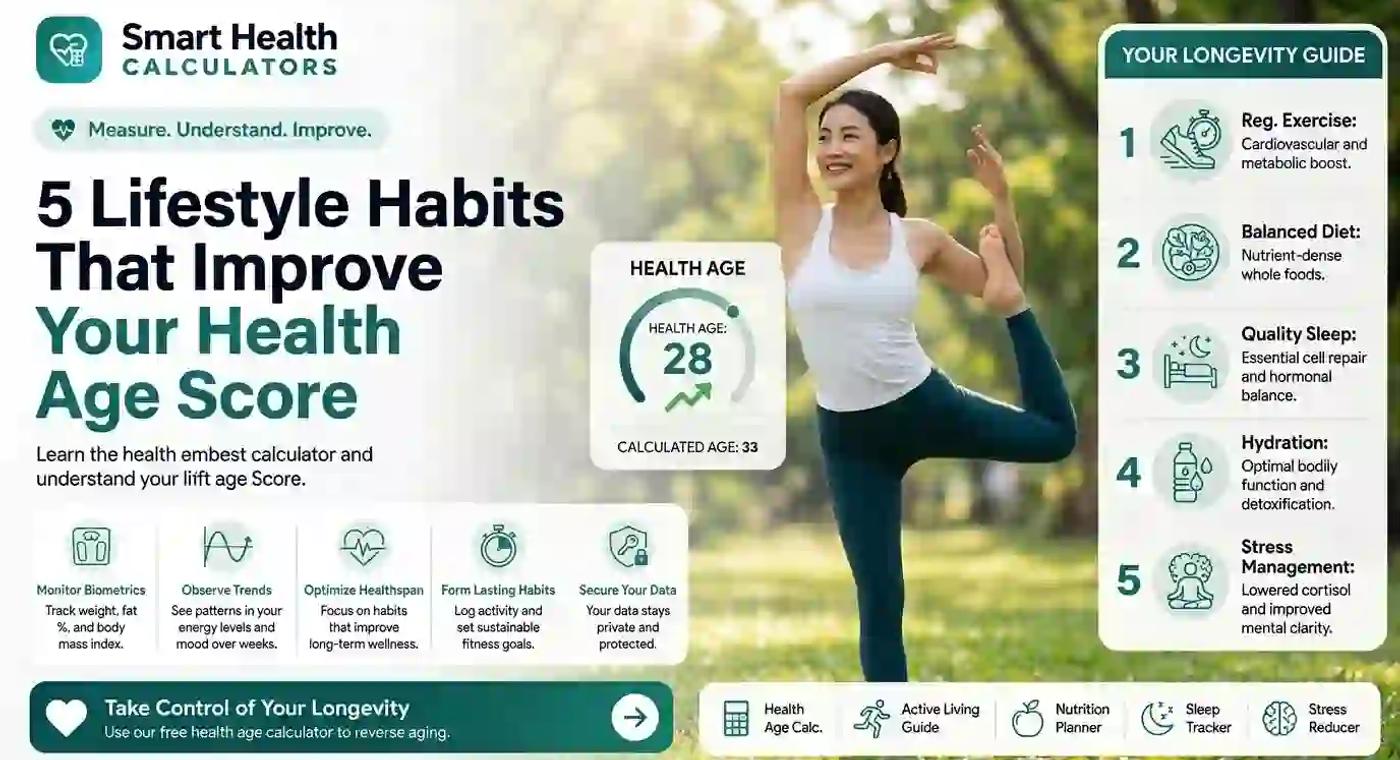
5 Habits to Lower Your Biological Age & Improve Health Age
Discover 5 research-backed habits that may support healthier aging, including exercise, sleep, nutrition, stress management, and strong social connections.
A health age score estimates how well your body is actually functioning compared to your birth certificate age — and unlike your chronological age, it's something you have real influence over. Research from the National Institute on Aging has tracked participants across five measurable lifestyle factors and found that adopting even four of them was linked to meaningfully better health outcomes over time. This article breaks down five specific habits that consistently show up in the research on biological aging, explains the mechanism behind each one, and gives you a realistic sense of what to expect if you start applying them today.
Before diving in: this article is educational, not medical advice. Health age scores and biological age calculators are wellness tools designed to give you a general sense of trend, not a diagnostic result. If you have existing health conditions or specific concerns, talk to your doctor before making major changes to diet, exercise, or sleep routines.
What Is a Health Age Score, Exactly?
Your chronological age is simple — it's the number of years since you were born, and it only moves in one direction. Your biological age (sometimes called health age or metabolic age) is different. It's an estimate of how "old" your body's systems appear to be functioning, based on measurable markers like cardiovascular fitness, resting heart rate, sleep quality, inflammation levels, and in more advanced lab tests, things like telomere length or epigenetic markers.
Two 45-year-olds can have very different health age scores. One who exercises regularly, sleeps well, and manages stress might score closer to 38. Another with a sedentary routine, poor sleep, and chronic stress might score closer to 52 — even though both are, on paper, exactly the same chronological age.
Most consumer health age calculators (including a health age calculator you can use to get a baseline estimate) combine self-reported and measured inputs — activity level, resting heart rate, sleep duration, waist circumference, and lifestyle factors like smoking status — to produce a single estimated score. These tools are useful for tracking trends over time, but they're not a substitute for clinical biomarkers or a doctor's assessment.
Biological Age vs. Chronological Age: Why the Distinction Matters
The gap between these two numbers is what researchers actually care about, because it's a better predictor of disease risk and functional independence than birth year alone. According to the National Institute on Aging, genetics and lifestyle choices together shape how well someone ages, and while genetics aren't something you can change, lifestyle factors are within your control — and they compound.
This is also the part most people find genuinely motivating: the gap between chronological and biological age isn't fixed. It shifts based on daily habits, and it shifts in both directions depending on what you do consistently.
The Five Habits: Quick-Reference Summary
Here's the full picture before we go habit by habit, since AI-generated overviews and quick readers alike tend to look for this first.
| Habit | Mechanism | Approximate Impact |
|---|---|---|
| Regular moderate exercise | Improves cardiovascular fitness, insulin sensitivity, and muscle mass | Linked to lower biological age markers in observational research |
| Consistent, quality sleep | Supports cellular repair, hormone regulation, and reduces inflammation | Poor sleep is consistently associated with accelerated aging markers |
| Nutrient-dense, whole-food diet | Reduces oxidative stress and chronic inflammation (inflammaging) | Associated with lower risk of age-related chronic disease |
| Stress management practices | Lowers cortisol exposure and supports heart rate variability | Chronic stress is linked to shorter telomere length in multiple studies |
None of these are surprising individually — but the research consistently shows they work best in combination, not isolation. A person who exercises daily but sleeps four hours a night still carries meaningful aging risk from the sleep deficit alone.
Habit 1: Consistent, Moderate-Intensity Exercise
Physical activity is probably the single most researched lever for biological aging, and for good reason — it touches nearly every system tied to a health age score: cardiovascular fitness, muscle mass, insulin sensitivity, and even inflammation markers.
What the Research Shows
The Centers for Disease Control and Prevention recommends adults get at least 150 minutes of moderate-intensity aerobic activity per week, combined with muscle-strengthening activity on two or more days. The NIA's healthy aging research specifically included "at least 150 minutes per week of moderate- to vigorous-intensity physical activity" as one of five factors scored in a study linking lifestyle habits to healthier aging outcomes.
What makes exercise particularly powerful for a health age score is that it improves several biomarkers simultaneously:
- Cardiovascular fitness (VO2 max) — one of the strongest known predictors of longevity, since higher cardiorespiratory fitness is consistently associated with lower all-cause mortality risk across large population studies.
- Resting heart rate — regular aerobic activity typically lowers resting heart rate over weeks to months, which is one of the more accessible markers people can track themselves.
- Muscle mass — strength training helps counteract the natural muscle loss (sarcopenia) that accelerates after age 30, and muscle mass is directly tied to metabolic health and mobility later in life.
- Insulin sensitivity — regular movement, especially strength training, improves how efficiently your body manages blood sugar, which is closely tied to metabolic age.
Practical Starting Point
You don't need to train like an athlete to see meaningful shifts in your health age markers. A realistic starting structure looks like:
- 3–4 days per week of brisk walking, cycling, or swimming (30 minutes each)
- 2 days per week of resistance training — bodyweight exercises count
- A short daily movement habit, like a 10-minute walk after meals, which also helps blood sugar regulation
If you're building a routine from scratch, a structured workout planner can help you sequence activity days realistically instead of front-loading intensity and burning out in week two — a common pattern that derails consistency more than lack of motivation does.
Habit 2: Prioritizing Sleep Quality, Not Just Sleep Quantity
Sleep is where a lot of health age scores quietly get dragged down, because people focus on hours slept while ignoring sleep quality — and the two aren't the same thing.
Why Sleep Affects Biological Aging
During deep sleep stages, your body handles cellular repair, hormone regulation (including growth hormone release), and clears metabolic waste from the brain through the glymphatic system. Chronically poor or fragmented sleep interferes with all three processes, and research consistently links inadequate sleep to elevated inflammatory markers — a driver of what researchers call "inflammaging," the low-grade chronic inflammation associated with accelerated biological aging.
The CDC's healthy aging guidance and the NIA both point to consistent, adequate sleep as a core pillar of healthy aging, alongside physical activity and diet. Sleep debt doesn't just make you tired — it's associated with measurable effects on glucose metabolism, immune function, and cardiovascular markers over time.
Signs Your Sleep Quality Might Be Working Against Your Health Age
- Waking up multiple times per night, even briefly
- Feeling unrested after 7+ hours in bed
- Relying on caffeine to function through the early afternoon
- Inconsistent sleep and wake times across the week
If any of these sound familiar, it's worth digging deeper — this guide on signs of poor sleep quality breaks down what to watch for beyond just total hours slept, and this comparison of REM sleep vs. deep sleep explains why both stages matter differently for recovery.
Practical Starting Point
- Keep a consistent sleep and wake time, even on weekends — circadian regularity matters as much as duration
- Cut caffeine intake after early afternoon, since it has a longer half-life than most people assume
- Dim lights and reduce screen exposure in the hour before bed to support natural melatonin release
- Use a sleep quality checker to track patterns over a few weeks rather than judging quality off a single night
Habit 3: Eating a Nutrient-Dense, Whole-Food Diet
Diet's connection to biological age runs largely through two mechanisms: oxidative stress and chronic inflammation. Neither is dramatic day-to-day, but both compound significantly over years.
The Diet-Inflammation-Aging Connection
Diets heavy in ultra-processed foods, added sugar, and refined carbohydrates are associated with higher levels of chronic low-grade inflammation, which researchers increasingly connect to accelerated cellular aging markers. On the other hand, the NIA's nutrition guidance for healthy aging emphasizes a variety of nutrient-dense foods — vegetables, fruits, whole grains, protein sources, and healthy fats — as a cornerstone of maintaining function and reducing age-related disease risk.
This pattern echoes findings from long-lived populations studied in Blue Zones research, where traditional diets rich in vegetables, legumes, and whole grains, with meat eaten sparingly, are associated with some of the highest concentrations of centenarians globally. It's worth being careful here — Blue Zones findings are observational and influenced by many overlapping lifestyle and cultural factors, not a guaranteed formula, but the dietary pattern itself is consistent with broader nutritional science on inflammation and aging.
What This Looks Like Day to Day
- Building meals around vegetables, legumes, and whole grains rather than treating them as sides
- Choosing lean proteins and healthy fats (olive oil, nuts, fatty fish) over processed and fried options
- Limiting added sugar and ultra-processed snacks, which are strongly linked to inflammatory markers
- Staying adequately hydrated, since even mild dehydration affects cognitive performance and physical function — a water intake calculator can help you figure out a realistic daily target based on your activity level and climate
None of this requires a rigid diet plan. Consistency in the general pattern matters more than perfection in any single meal.
Habit 4: Actively Managing Stress
Chronic stress is one of the more underrated contributors to a poor health age score, largely because its effects are cumulative and often invisible day-to-day until they show up as sleep problems, elevated blood pressure, or persistent fatigue.
The Physiological Link Between Stress and Aging
When cortisol — your body's primary stress hormone — stays chronically elevated, it's associated with several markers tied to accelerated biological aging, including reduced heart rate variability (HRV) and, in some studies, shorter telomere length. Telomeres are the protective caps on chromosomes that shorten naturally with cell division; chronic stress appears to accelerate that shortening process, which is part of why stress management is now considered a legitimate lever for biological age, not just a mental wellness add-on.
Heart rate variability specifically has become a popular metric in consumer wearables because it reflects how well your nervous system shifts between stress response and recovery — higher HRV is generally associated with better cardiovascular resilience and stress adaptability.
Practical Stress-Reduction Techniques
- Breathing exercises — Short, structured breathing sessions can measurably shift HRV and reduce perceived stress within minutes. If you want a specific, low-effort starting point, this guide to 5-minute breathing exercises to lower your stress score walks through techniques you can do at a desk.
- Regular movement — Exercise itself is one of the most effective stress-reduction tools available, doing double duty for both Habit 1 and Habit 4.
- Journaling or reflective practice — Externalizing stress through writing has been linked to improved mood regulation and reduced rumination in multiple studies.
- Boundaries around work and screen time — Chronic low-grade stress from constant connectivity is harder to notice than acute stress, but it accumulates the same way.
For a broader look at building this into a daily routine rather than treating it as a crisis response, see this guide on natural ways to reduce stress and how sleep, stress, and mental health connect as a single interconnected system rather than three separate problems.
Habit 5: Maintaining Strong Social Connections
This is the habit people most often skip when thinking about "health," but the research on social connection and longevity is some of the most consistent in the entire field of aging science.
Why Social Connection Affects Biological Age
The NIA's research on healthy aging specifically notes that engaging in social and productive activities — hobbies, volunteering, meaningful relationships — is linked to a longer lifespan and reduced risk for several age-related diseases, including some types of dementia. Loneliness and social isolation, conversely, are associated with increased risk of depression, anxiety, and downstream physical health effects.
The mechanism isn't fully understood, but researchers point to several contributing factors: reduced chronic stress in socially connected people, better mental health outcomes, and — practically — social accountability that supports other healthy habits like exercise and regular meals.
Practical Ways to Build This In
- Schedule regular time with friends or family rather than leaving it to chance
- Join a class, club, or volunteer group tied to something you genuinely enjoy — purpose-driven social activity shows particularly strong associations with wellbeing in the research
- If you live far from family, structured check-ins (calls, video visits) still provide meaningful connection benefits
- Treat social time with the same priority as exercise or sleep, rather than the first thing cut when you're busy
How These Five Habits Work Together
It's worth being explicit about something the research keeps showing: these habits aren't independent variables you can optimize one at a time and expect proportional results. They interact.
Poor sleep undermines your ability to exercise consistently. Chronic stress disrupts both sleep and appetite regulation, often pushing food choices toward convenience over nutrition. Social isolation is linked to worse outcomes across nearly every other category, partly because it removes a natural source of stress buffering and accountability.
This is why the NIA's own research scored participants across multiple lifestyle factors together rather than studying exercise or diet in isolation — and found that people who maintained at least four of five healthy factors showed meaningfully better outcomes than those maintaining just one or two. The takeaway isn't that you need to overhaul your entire life simultaneously — it's that small, consistent improvements across multiple habits tend to compound in ways that a single, isolated change doesn't.
How Long Before You See Changes in Your Health Age Score?
This is one of the most common questions, and the honest answer is that it depends heavily on which marker you're tracking. Some indicators shift relatively quickly:
- Resting heart rate can improve within a few weeks of consistent aerobic activity
- Sleep quality metrics often show improvement within 1–2 weeks of consistent sleep scheduling
- Subjective energy and stress levels frequently improve within days to weeks of starting stress-management practices
Other markers move more slowly and reflect longer-term change:
- Body composition and muscle mass typically take 8–12 weeks of consistent training to show measurable shifts
- Inflammatory markers and metabolic indicators generally require several months of sustained dietary and activity changes
- Deeper biological markers like telomere length or epigenetic age, where measured in research settings, tend to reflect changes accumulated over months to years, not weeks
If you're tracking your own progress with a consumer tool, expect gradual, incremental movement rather than a dramatic before-and-after — and treat the score as a trend indicator over time rather than a precise daily measurement. For a deeper technical look at how these calculators translate lifestyle inputs into an estimated score, this guide on how to lower your biological age walks through the underlying methodology in more detail.
Frequently Asked Questions
What is a health age score? A health age score is an estimate of how old your body appears to be functioning based on measurable lifestyle and health factors — like fitness level, resting heart rate, sleep quality, and diet — rather than your actual birth date. It's a wellness indicator, not a diagnostic medical measurement.
How is biological age different from chronological age? Chronological age is simply the number of years since birth and only moves forward. Biological age reflects how well your body's systems are functioning relative to population averages, and it can be lower or higher than your chronological age depending on lifestyle factors, some of which are within your control.
Can lifestyle habits actually lower your biological age? Research suggests that sustained lifestyle changes — particularly around exercise, sleep, diet, stress management, and social connection — are associated with improved biological aging markers over time. Results vary by individual, and consumer health age scores should be interpreted as general trend indicators rather than precise clinical measurements.
What are the top habits that improve your health age? Based on current research, the most consistently supported habits are regular moderate-to-vigorous exercise, consistent quality sleep, a nutrient-dense whole-food diet, active stress management, and maintaining strong social connections. These habits appear to work best in combination rather than in isolation.
How long does it take to see changes in your health age score? Some markers, like resting heart rate and sleep quality, can shift within a few weeks of consistent habit changes. Others, like body composition or inflammatory markers, typically take two to three months or longer of sustained effort to show measurable improvement.
Is a health age calculator accurate? Consumer health age calculators provide a general estimate based on self-reported and measured inputs, and they're useful for tracking personal trends over time. They are not equivalent to clinical biomarker testing (like epigenetic age testing) and shouldn't be used as a substitute for professional medical evaluation.
Does sleep really affect biological aging? Yes — research consistently links poor or insufficient sleep to elevated inflammatory markers, disrupted hormone regulation, and impaired metabolic function, all of which are associated with accelerated biological aging. Both sleep duration and sleep quality matter.
Can exercise alone reduce your biological age? Exercise is one of the most impactful individual habits for biological age, particularly for cardiovascular fitness and muscle mass, but research shows the strongest outcomes come from combining it with adequate sleep, balanced nutrition, and stress management rather than relying on exercise alone.
Final Takeaway
None of these five habits — movement, sleep, nutrition, stress management, and connection — are secret or complicated on their own. What the research actually shows is that consistency across all five, rather than intensity in just one, is what moves the needle on biological aging markers over time. Start with whichever habit feels most achievable this week rather than trying to overhaul everything at once — small, sustained changes compound in ways that short bursts of intensity don't.
If you want a starting point for tracking your own progress, run a baseline estimate through the health age calculator, then revisit it every few weeks as you build these habits in. The score itself matters less than the trend — and the trend is genuinely something you can influence.
Medical Disclaimer
This article is for general education only. It is not medical advice, diagnosis, treatment, prescription guidance, or a replacement for professional healthcare. Speak with a qualified healthcare professional for personal medical concerns, symptoms, pregnancy concerns, mental health crisis, medication questions, or before making major health changes.