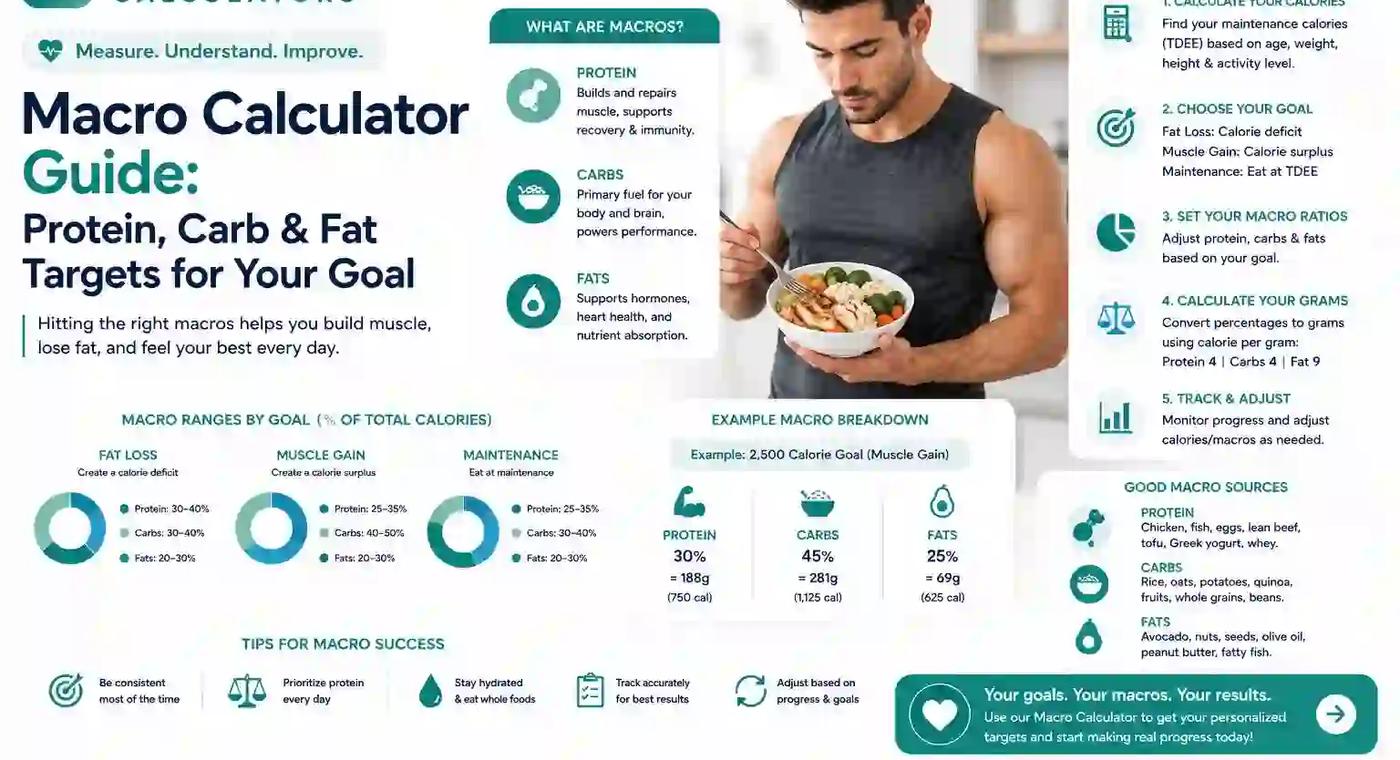
Macro Calculator Guide: Protein, Carb & Fat Targets
Learn how to calculate your macros with our free guide. Find the right protein, carb, and fat targets for fat loss, muscle gain, or maintenance.
Counting calories tells you how much to eat. Macros tell you what that food is actually made of — and that distinction is why two people eating the same 1,800 calories can get completely different results depending on how those calories break down between protein, carbs, and fat.
A macro calculator takes your calorie target and splits it into specific gram amounts for each macronutrient based on your goal — fat loss, muscle gain, or maintenance. This guide walks through exactly how that math works, what ratios actually make sense for different goals, and how to adjust your numbers when progress stalls.
What Is a Macro Calculator?
A macro calculator is a tool that converts your daily calorie target into specific gram targets for protein, carbohydrates, and fat based on your body weight, activity level, and fitness goal. Rather than just telling you to eat "1,800 calories," it tells you something actionable: 150g protein, 180g carbs, and 55g fat, for example.
This matters because calories alone don't determine body composition outcomes the way people often assume. Protein in particular plays a distinct role in preserving muscle during a deficit and supporting muscle growth during a surplus — a role that simply hitting a calorie number doesn't guarantee.
Macros vs. Calories: What's the Real Difference?
Calories measure total energy. Macros measure the composition of that energy — specifically, how much comes from protein (4 calories per gram), carbohydrates (4 calories per gram), and fat (9 calories per gram).
Two people can eat identical calorie totals with very different macro splits, and end up with meaningfully different results in terms of muscle retention, hunger levels, and energy throughout the day. This is why serious fitness tracking has largely moved beyond "just count calories" toward tracking macros specifically — a practice often referred to as IIFYM (If It Fits Your Macros).
Macro Split Reference Table by Goal
This is the most practical starting point for anyone new to macro tracking — a breakdown of typical percentage ranges by goal:
| Goal | Protein | Carbs | Fat |
|---|---|---|---|
| Fat Loss | 35–40% | 30–35% | 25–30% |
| Maintenance | 25–30% | 40–45% | 25–30% |
| Muscle Gain (Bulk) | 25–30% | 45–50% | 20–25% |
| Body Recomposition | 35–40% | 30–35% | 25–30% |
These ranges fall within the Acceptable Macronutrient Distribution Range (AMDR) established by the Dietary Reference Intakes, which generally recommends 10–35% of calories from protein, 45–65% from carbohydrates, and 20–35% from fat for the general population — though fitness-specific goals often push protein higher than the general population range for good reason, which we'll cover next.
How to Calculate Your Macros: Step-by-Step
Step 1: Determine Your Total Daily Energy Expenditure (TDEE)
Before you can split macros, you need a calorie target, and that starts with knowing your TDEE — the total calories your body burns in a day including activity. This is calculated from your Basal Metabolic Rate (BMR) multiplied by an activity factor.
Step 2: Set Your Calorie Target Based on Your Goal
- Fat loss: TDEE minus 300–500 calories
- Muscle gain: TDEE plus 200–300 calories
- Maintenance: Equal to TDEE
Step 3: Set Protein First (Not Last)
Protein should be calculated based on body weight, not just a percentage of calories, since this is the macro most directly tied to muscle preservation and growth. A well-supported range is 0.7–1 gram of protein per pound of body weight (roughly 1.6–2.2g per kg), particularly during a calorie deficit when protecting muscle mass matters most.
Step 4: Set Fat Based on a Minimum Threshold
Fat shouldn't drop below roughly 20% of total calories, since it plays an essential role in hormone production. A common starting point is 0.3–0.4 grams of fat per pound of body weight.
Step 5: Fill the Remainder with Carbohydrates
Once protein and fat are set in grams, whatever calories remain get allocated to carbohydrates. This is usually the macro that flexes most based on activity level and personal preference.
Worked Example: 150 lb Person on 1,800 Calories
Let's make this concrete. For a 150 lb person targeting 1,800 calories for fat loss:
- Protein: 150 lbs × 0.9g = 135g protein (540 calories)
- Fat: 150 lbs × 0.35g = 52g fat (468 calories)
- Remaining calories for carbs: 1,800 − 540 − 468 = 792 calories ÷ 4 = 198g carbs
Final macro targets: 135g protein / 198g carbs / 52g fat on 1,800 calories. This is exactly the kind of concrete breakdown a macro calculator produces automatically, but understanding the math behind it makes it much easier to adjust manually when your weight or goals change.
How Many Grams of Protein Do I Need Per Day?
For most active adults pursuing fat loss or muscle gain, 0.7 to 1 gram of protein per pound of body weight is a well-supported target range, translating to roughly 1.6–2.2 grams per kilogram. This is notably higher than the general population's minimum recommendation, reflecting protein's specific role in preserving and building muscle tissue during training. Our dedicated guide on how much protein you actually need per day breaks this down further by activity level and training goal if you want a deeper look at the research behind these numbers.
What Macro Split Is Best for Fat Loss?
For fat loss, a higher protein percentage (35–40% of calories) tends to outperform lower-protein approaches at the same calorie deficit, primarily because protein preserves lean muscle mass while you're losing weight and keeps hunger more manageable than an equivalent amount of carbs or fat. Carbs and fat can flex somewhat based on personal preference and training style, but protein staying elevated is the most consistent finding across fat-loss research.
What's a Good Macro Ratio for Muscle Gain?
For muscle gain, carbohydrates typically take priority (45–50% of calories) since they fuel the higher training volume needed to stimulate growth, while protein stays in a similar 25–30% range as fat-loss phases — the gram target doesn't change much, but the percentage shifts because total calories are higher. Fat generally sits slightly lower during a bulk simply because carbs and protein are prioritized for training performance and recovery.
Is Counting Macros Better Than Counting Calories?
Neither approach is universally "better" — macro tracking is simply a more detailed version of calorie tracking that accounts for composition, not just total energy. For pure weight loss with no concern about muscle retention, calorie counting alone can work. For body composition goals — building muscle, preserving muscle in a deficit, or optimizing performance — macro tracking provides meaningfully more useful information than calories alone.
Macros for Keto: A Different Split Entirely
Ketogenic diets use a fundamentally different macro distribution, prioritizing very low carbohydrate intake to shift the body into ketosis:
| Macro | Standard Split | Keto Split |
|---|---|---|
| Protein | 25–40% | 20–25% |
| Carbs | 30–50% | 5–10% |
| Fat | 20–30% | 70–75% |
If you're specifically pursuing a ketogenic approach, standard macro calculator percentages don't apply — carb intake needs to stay low enough (typically under 50g total, sometimes lower) to maintain ketosis, which is a different calculation entirely from the fat-loss or muscle-gain splits covered above.
How Often Should I Adjust My Macros?
Macros should generally be reassessed every 2–4 weeks, or whenever body weight changes by roughly 5–10 pounds, since your calorie needs shift as your body weight changes. A macro set that worked at 180 lbs won't be accurate anymore once you've dropped to 165 lbs — your TDEE decreases as body weight decreases, which is one of the most common reasons weight loss plateaus even when someone hasn't consciously changed their eating habits.
If you've hit a plateau despite consistent tracking, it's worth reviewing our broader guide on why your diet might not be working before assuming macros are the only variable at play — sleep, stress, and activity tracking accuracy all factor in too.
Can I Lose Weight Without Tracking Macros?
Yes — weight loss fundamentally comes down to a calorie deficit, and that's achievable without tracking macros at all. However, without paying attention to protein specifically, a meaningful portion of the weight lost during a deficit tends to come from muscle rather than fat, which is why macro-aware approaches are generally recommended for anyone concerned with body composition rather than just the number on the scale.
How Accurate Are Online Macro Calculators?
Online macro calculators provide a solid starting estimate, typically within 10–15% accuracy of your true needs, since they rely on population-based formulas (like the Mifflin-St Jeor equation) rather than direct measurement of your individual metabolism. This is exactly why the 2–4 week reassessment period matters — the calculator gets you close, and real-world tracking over a few weeks tells you whether an adjustment is needed based on actual results rather than just the initial estimate.
Common Mistakes When Setting Macros
- Setting protein too low — treating it as equal to carbs and fat rather than prioritizing it first based on body weight
- Ignoring fiber — fiber is technically part of total carbohydrates but doesn't provide the same 4 calories per gram, and adequate fiber intake matters for digestion and satiety regardless of macro goals
- Never reassessing — using the same macro numbers for months despite significant weight changes
- Copying someone else's macros — macro needs are individual to body weight, activity level, and goal; a friend's numbers rarely translate directly
- Treating macros as moral categories — carbs and fat aren't "bad," they're functional categories serving different roles in energy and hormone production
Frequently Asked Questions
What is a macro calculator? A macro calculator converts your daily calorie target into specific gram amounts of protein, carbohydrates, and fat based on your body weight, activity level, and fitness goal.
How do I calculate my macros? Start with your TDEE, adjust calories based on your goal (deficit for fat loss, surplus for muscle gain), set protein based on body weight (0.7–1g per pound), set a minimum fat threshold (roughly 0.3–0.4g per pound), then fill remaining calories with carbohydrates.
What macro split is best for weight loss? A higher-protein split (35–40% of calories) tends to work best for fat loss, since it helps preserve muscle mass and manage hunger more effectively than lower-protein approaches at the same calorie deficit.
How many grams of protein do I need per day? Most active adults benefit from 0.7 to 1 gram of protein per pound of body weight, particularly during a calorie deficit when muscle preservation is a priority.
Is counting macros better than counting calories? For pure weight loss, calorie counting alone can work. For body composition goals like preserving or building muscle, macro tracking provides more actionable detail than calories alone.
What's a good macro ratio for muscle gain? A muscle-gain split typically prioritizes carbohydrates (45–50%) to fuel training volume, while protein stays around 25–30% and fat around 20–25%.
Do macros matter more than total calories? Total calories still determine whether you gain, lose, or maintain weight — macros determine the composition of that change, particularly how much comes from muscle versus fat.
How often should I adjust my macros? Reassess every 2–4 weeks or after a 5–10 pound weight change, since your calorie and macro needs shift as your body weight changes.
Final Takeaway
Macros give you a level of control that calorie counting alone simply can't — the difference between losing fat while preserving muscle versus losing weight that's a mix of both usually comes down to whether protein was prioritized correctly. Start with the worked example above as a template, adjust based on your own body weight and goal, and reassess every few weeks rather than setting your numbers once and forgetting them.
If you haven't calculated your baseline calorie needs yet, start with our calorie intake planner to establish your TDEE before setting macro targets, and explore why choose Smart Health Calculators for a full suite of free, evidence-based tools covering everything from body fat estimation to workout planning.
For the official Acceptable Macronutrient Distribution Ranges referenced in this guide, see the Dietary Guidelines for Americans, 2020–2025.
Medical Disclaimer
This article is for general education only. It is not medical advice, diagnosis, treatment, prescription guidance, or a replacement for professional healthcare. Speak with a qualified healthcare professional for personal medical concerns, symptoms, pregnancy concerns, mental health crisis, medication questions, or before making major health changes.