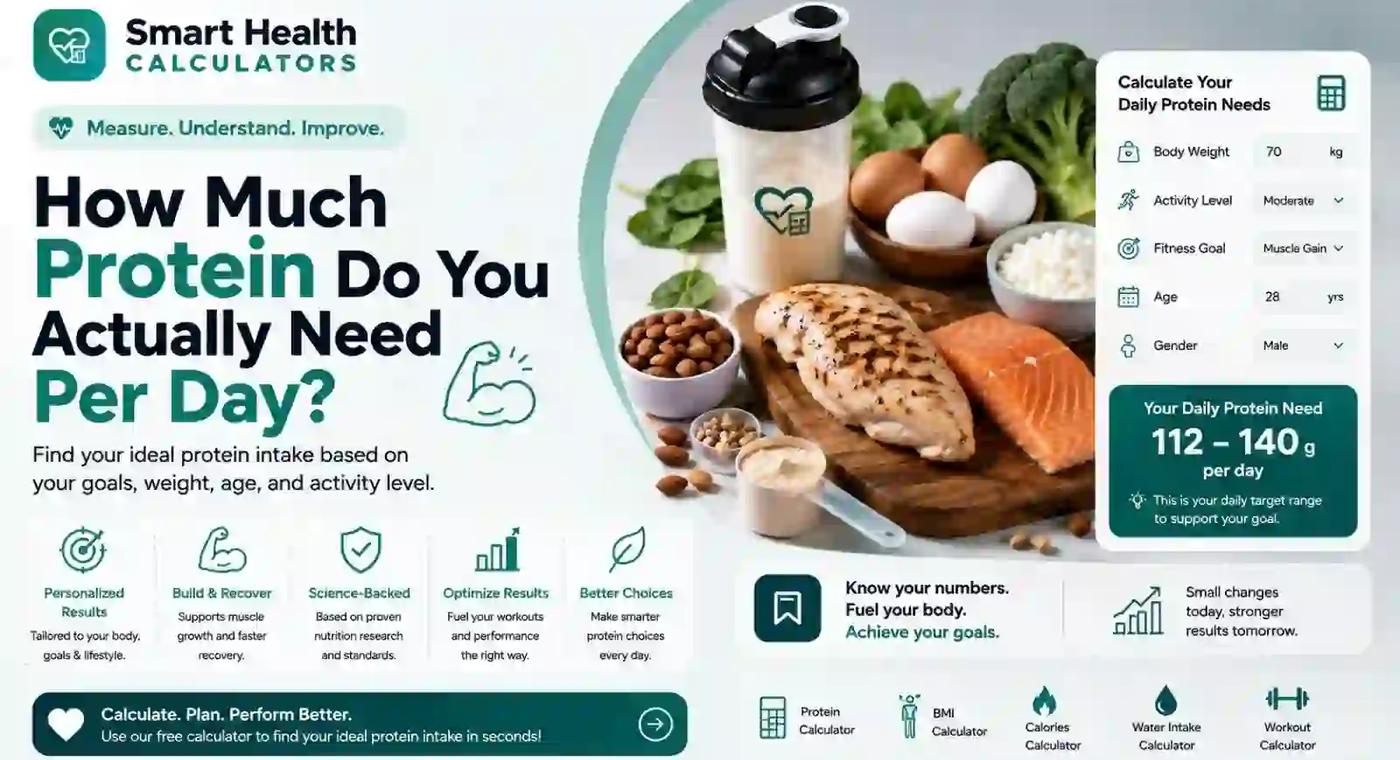
How Much Protein Do I Need Per Day? Calculator & Guide
Find out how much protein you need per day based on your weight, activity level, and goals. See protein needs for muscle gain, weight loss, and general health.
Most people either wildly overestimate or badly underestimate their protein needs — and both mistakes come from the same source: treating protein like it's one-size-fits-all. The honest, evidence-based answer is that a sedentary adult needs roughly 0.8 grams of protein per kilogram of body weight per day just to avoid deficiency, while someone actively building muscle or recovering from intense training needs closer to 1.6–2.2 grams per kilogram. For a 70 kg person, that's the difference between 56 grams and up to 154 grams a day — a gap wide enough to explain why so much conflicting advice exists online. This guide breaks down exactly where you fall on that spectrum, based on your body weight, activity level, and goals.
What "Protein Requirement" Actually Means
The RDA (Recommended Dietary Allowance) of 0.8g/kg, set by the USDA and the National Academy of Medicine, is a minimum threshold — it's the amount needed to prevent deficiency in a sedentary adult, not the amount needed to optimize muscle growth, recovery, or body composition. This distinction gets lost constantly. People see "0.8g/kg is the RDA" and either assume that's all they need regardless of how much they train, or dismiss it entirely because it seems too low for anyone hitting the gym.
The more useful framing, which sports nutrition research has converged on over the past two decades, separates protein needs into three tiers: a baseline for general health, a moderate range for active individuals, and a higher range for those actively building muscle or in a calorie deficit trying to preserve lean mass. If you're not sure which tier applies to you, running your numbers through a BMR calculator first gives you a clearer picture of your overall energy needs, which protein targets should build on top of.
Daily Protein Requirement by Goal
| Goal | Grams per kg body weight | Grams per lb body weight | Example: 70kg (154 lb) person |
|---|---|---|---|
| Sedentary adult (RDA minimum) | 0.8 g/kg | 0.36 g/lb | 56 g/day |
| General health & light activity | 1.0–1.2 g/kg | 0.45–0.54 g/lb | 70–84 g/day |
| Regular exercise / active adults | 1.2–1.6 g/kg | 0.54–0.73 g/lb | 84–112 g/day |
| Muscle building (resistance training) | 1.6–2.2 g/kg | 0.73–1.0 g/lb | 112–154 g/day |
| Weight loss / calorie deficit (preserve muscle) | 1.6–2.4 g/kg | 0.73–1.1 g/lb | 112–168 g/day |
| Endurance athletes | 1.2–1.6 g/kg | 0.54–0.73 g/lb | 84–112 g/day |
| Older adults (60+) | 1.0–1.2 g/kg | 0.45–0.54 g/lb | 70–84 g/day |
These ranges reflect position stands published by the International Society of Sports Nutrition (ISSN), which has reviewed decades of controlled trials on protein intake and muscle protein synthesis. The takeaway that matters most: beyond roughly 2.2g/kg, additional protein doesn't appear to produce meaningfully more muscle growth in most people — it's simply excess intake the body processes and excretes.
How Much Protein Per Day for Muscle Gain
If your goal is building muscle, the research points to a range of 1.6 to 2.2 grams per kilogram of body weight daily. A well-cited meta-analysis of resistance-trained individuals found that intakes above roughly 1.6g/kg showed diminishing returns for muscle mass gains — meaning the popular idea that "more protein always equals more muscle" isn't well supported past a certain point.
Practical numbers for common body weights:
- 60 kg person: 96–132 g/day
- 70 kg person: 112–154 g/day
- 80 kg person: 128–176 g/day
- 90 kg person: 144–198 g/day
What matters just as much as the daily total is distribution. Studies on muscle protein synthesis suggest spreading intake across 3–4 meals, with roughly 20–40 grams of protein per meal, stimulates muscle building more effectively than consuming the same total in one or two large meals. This is why a bodybuilder eating 150g of protein spread across four meals of 35–40g each tends to see better results than someone eating the same total in a single sitting.
If you're building a training routine around this, pairing your protein target with a structured workout planner makes it much easier to time meals around training sessions, and our guide on structuring a workout plan from beginner to advanced covers how training intensity itself should scale alongside your protein intake as you progress.
How Much Protein Per Day for Weight Loss
Protein plays a different but equally important role when you're in a calorie deficit — it helps preserve lean muscle mass while you lose fat, and it's the most satiating macronutrient, which makes sticking to a lower-calorie diet considerably easier.
For weight loss, aim for 1.6–2.4 g/kg of body weight, on the higher end if you're also resistance training during the cut. This is actually higher than the muscle-gain range for many people, because being in a calorie deficit increases the risk of losing muscle alongside fat, and higher protein intake specifically counteracts that.
A practical example: a 75 kg person aiming to lose weight while preserving muscle would target roughly 120–180 grams of protein daily, timed around workouts and spread across meals to manage hunger throughout the day. Pairing this with a calorie intake planner makes it much easier to hit both your calorie deficit and protein target simultaneously, rather than guessing at portion sizes. If you've been struggling to see results despite eating "healthy," it's worth checking our breakdown of why your diet might not be working — low protein intake relative to calorie deficit is one of the most common, and most fixable, culprits.
It's also worth tracking body composition rather than just the number on the scale, since a high-protein deficit is specifically designed to preserve muscle while losing fat. A body fat estimator gives you a much more accurate read on progress than weight alone, and our body fat percentage chart helps you interpret where that number actually places you.
Protein Needs for Sedentary Adults and Older Adults
Not everyone is training for a physique goal, and that's fine — the RDA of 0.8g/kg genuinely is sufficient for a sedentary adult with no specific fitness goals, based on the nitrogen balance studies used to establish the recommendation. If you're mostly sedentary and just want a general health baseline, a calorie intake planner combined with the RDA figure is usually all you need — no need to chase bodybuilder-level protein numbers.
Older adults are the one major exception to the "sedentary = lower needs" rule. Research on sarcopenia — the age-related loss of muscle mass — consistently shows that adults over 60 benefit from higher protein intake than the standard RDA, typically 1.0–1.2 g/kg, even without increased activity. This happens because aging reduces the body's efficiency at using dietary protein for muscle maintenance, a phenomenon researchers call "anabolic resistance." Practically, this means a 70-year-old and a 25-year-old with identical activity levels don't have identical protein needs — the older adult typically needs more, not less. This ties closely into biological aging more broadly; our guide on lowering your biological age through lifestyle habits covers where protein intake fits alongside sleep, stress, and activity as a modifiable factor.
Is There Such a Thing as Too Much Protein?
This is one of the most searched questions on this topic, and the honest answer is nuanced. For healthy individuals with normal kidney function, research hasn't found solid evidence that high protein intake (even up to 2.5–3 g/kg) causes kidney damage. The kidney-damage concern largely stems from studies on people who already have chronic kidney disease, where protein restriction is genuinely medically necessary — that guidance doesn't extrapolate to healthy individuals.
That said, "no harm" doesn't mean "no diminishing returns." Above roughly 2.2 g/kg for muscle building or 2.4 g/kg for fat loss, additional protein mostly just adds calories without added benefit, and very high intakes can crowd out the carbohydrates and fats needed for training performance and hormone production. If you have pre-existing kidney disease, liver issues, or are pregnant, protein needs should be discussed with a doctor rather than followed from a generic online calculator — those situations follow separate medical guidelines.
Animal vs Plant Protein: Does the Source Matter?
Not all protein is created equal, and this affects how much you actually need to hit your targets. Protein quality is typically measured using DIAAS (Digestible Indispensable Amino Acid Score) or the older PDCAAS system, both of which score protein sources based on their essential amino acid content and digestibility.
Complete proteins — containing all nine essential amino acids in adequate amounts — include most animal sources (eggs, chicken, fish, dairy, beef) plus a handful of plant sources like soy, quinoa, and buckwheat.
Incomplete proteins, common in most plant foods (beans, rice, nuts, most grains), are individually low in one or more essential amino acids but can be combined across the day — think rice and beans, or hummus and pita — to form a complete amino acid profile.
For vegetarians and vegans, this doesn't mean protein targets should be pushed higher across the board, but it does mean paying closer attention to variety and total daily intake. A useful practical adjustment: vegetarians and vegans often benefit from aiming 10–15% above the standard target range for their goal, simply to account for slightly lower digestibility in some plant sources compared to animal protein.
How to Calculate Your Own Daily Protein Target
The math is simpler than most calculators make it look:
- Find your body weight in kilograms. (Divide pounds by 2.2 if needed.)
- Identify your goal category from the table above — general health, active, muscle building, or fat loss.
- Multiply your weight by the gram range for that goal.
- Split the total across 3–4 meals, aiming for roughly even distribution rather than back-loading it into one meal.
For example, a 65 kg woman training three times a week for general fitness and muscle tone would fall into the 1.2–1.6 g/kg range, landing at roughly 78–104 grams per day, split into servings of about 20–26 grams per meal. Cross-checking this against your total daily calorie needs — using a BMR calculator alongside your activity level — ensures your protein target actually fits within a sustainable calorie budget rather than existing in isolation.
Common Protein-Rich Foods and Their Gram Counts
Rather than obsessing over percentages, it helps to know what your target actually looks like on a plate:
- Chicken breast (100g cooked): ~31g protein
- Eggs (1 large): ~6g protein
- Greek yogurt (200g): ~20g protein
- Lentils (1 cup cooked): ~18g protein
- Salmon (100g): ~25g protein
- Cottage cheese (100g): ~11g protein
- Whey protein powder (1 scoop, ~30g): ~24g protein
- Tofu (100g): ~8g protein
- Chickpeas (1 cup cooked): ~15g protein
Hitting 120–150 grams a day through whole food alone is entirely achievable — it typically takes three solid protein-containing meals plus one snack, without needing to rely heavily on supplements.
Frequently Asked Questions
How much protein do I need per day? It depends on your goal and body weight. Sedentary adults need about 0.8g per kg of body weight, active individuals need 1.2–1.6g/kg, and those building muscle or in a calorie deficit typically need 1.6–2.4g/kg for best results.
Is 100 grams of protein a day enough? For a sedentary adult weighing up to about 125 kg, yes — 100g comfortably covers the RDA. For someone actively building muscle or losing weight while training, 100g is likely below the optimal range unless their body weight is on the lower end (around 45-60 kg).
Can you eat too much protein? For healthy individuals with normal kidney function, high protein intake hasn't been shown to cause harm, though intakes above roughly 2.2–2.4g/kg offer little additional benefit. People with existing kidney or liver conditions should follow medical guidance rather than general targets.
Do I need more protein if I exercise regularly? Yes. Regular exercise, especially resistance training, increases protein needs to support muscle repair and growth, typically pushing requirements from the 0.8g/kg baseline up to 1.2–2.2g/kg depending on training intensity and goals.
How much protein do vegetarians need? Vegetarians generally follow the same gram-per-kilogram targets as anyone else, though aiming 10–15% higher can help offset the slightly lower digestibility of some plant proteins, alongside eating a variety of protein sources to cover all essential amino acids.
What happens if you don't eat enough protein? Chronic low protein intake can lead to muscle loss, slower recovery from exercise or illness, weaker immune function, and in more severe deficiency, hair thinning and skin issues, since the body has no dedicated protein storage and pulls from muscle when intake falls short.
Bottom Line
Your actual protein number isn't a fixed figure you can copy from a headline — it's a range that shifts with your body weight, activity level, and specific goal, from roughly 0.8g/kg for basic health up to 2.2–2.4g/kg for muscle building or fat loss while training. The most reliable way to apply this is to calculate your own target using your current weight and goal, then check it against your total daily calorie needs so protein fits into a sustainable, realistic diet rather than an isolated number you're chasing.
To put this into practice, start with a BMR calculator to establish your baseline energy needs, then use the calorie intake planner to build a full day's plan around your protein target. For official dietary reference intakes, the USDA Dietary Guidelines for Americans remain the most authoritative public source to cross-check your numbers against.
Medical Disclaimer
This article is for general education only. It is not medical advice, diagnosis, treatment, prescription guidance, or a replacement for professional healthcare. Speak with a qualified healthcare professional for personal medical concerns, symptoms, pregnancy concerns, mental health crisis, medication questions, or before making major health changes.