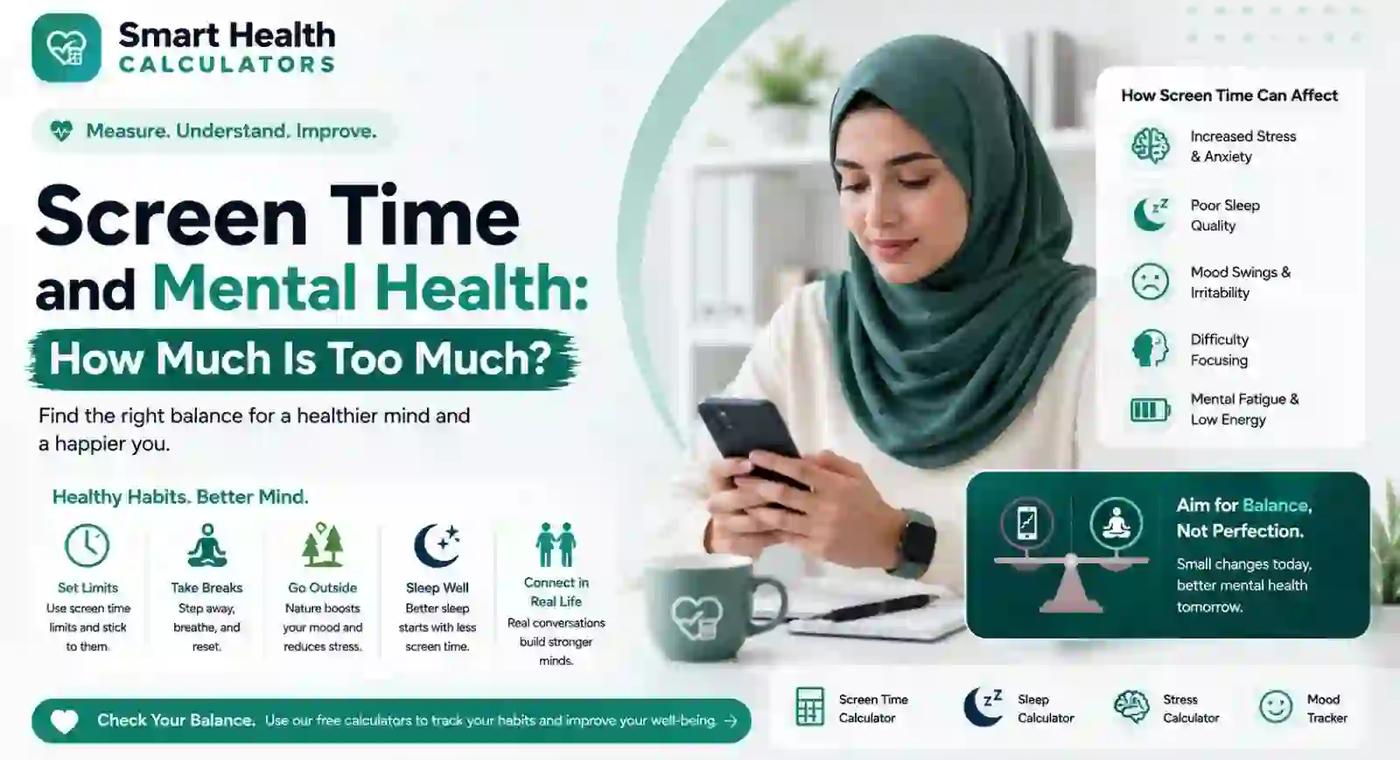
Screen Time and Mental Health: Effects, Risks & Healthy Limits
Learn how screen time affects mental health, anxiety, depression, sleep, and attention. Discover healthy screen habits and practical ways to reduce screen time.
Most people don't need a study to tell them something feels off after three hours of scrolling — that flat, slightly anxious, "where did my evening go" feeling is familiar to almost everyone with a smartphone. The research backs up that instinct: excessive passive screen use, especially social media scrolling, is consistently linked to higher rates of anxiety, depression, and disrupted sleep, though the picture is more nuanced than "screens bad." What matters isn't just the number on your daily screen time report — it's how you're using that time, and what it's replacing.
This guide breaks down what current research actually says about screen time and mental health, what the updated 2026 pediatric guidelines look like, and how to tell the difference between screen use that's harmless and screen use that's quietly draining you.
What Does "Screen Time" Actually Mean?
Before getting into limits and effects, it's worth being specific about what counts. Screen time isn't one uniform activity — a video call with your mom, a Duolingo streak, and two hours of doom-scrolling through outrage content all register as "screen time," but they affect your brain in completely different ways.
Researchers generally split screen use into two categories:
- Passive screen time — scrolling feeds, watching autoplay videos, consuming content without interaction. This is the category most strongly linked to negative mental health outcomes.
- Active screen time — video calls, interactive learning apps, creative work, messaging friends you're actually close to. This tends to be far more neutral, and in some cases genuinely beneficial.
This distinction matters more than raw hours. Someone who spends two hours a day on a language-learning app and video calls with family isn't in the same position as someone spending two hours passively scrolling short-form video before bed, even though both would show "2 hours" on a screen time report.
How Screen Time Affects Mental Health: What the Research Shows
Screen Time and Anxiety
The relationship between screen time and anxiety isn't a simple straight line, but several consistent patterns show up across studies. Heavy passive social media use is associated with higher self-reported anxiety, particularly among teens and young adults. Part of this seems tied to constant social comparison — seeing curated highlight reels of other people's lives activates the same comparison circuitry that drives real-world social anxiety, except it runs continuously instead of occasionally.
Notification overload plays a role too. A phone that buzzes every few minutes keeps your nervous system in a low-grade state of alert, even when you're not actively looking at it. Over time, that constant low-level vigilance contributes to the free-floating, hard-to-pin-down anxiety a lot of people report feeling but can't quite explain.
Screen Time and Depression
The link between screen time and depressive symptoms tends to be strongest for passive social media use specifically, rather than screen time as a broad category. Research points to a few mechanisms:
- Displacement of protective activities. Time spent scrolling is time not spent on exercise, in-person socializing, or sleep — all of which have well-established protective effects against depression.
- Social comparison. Repeated exposure to idealized versions of other people's lives is linked to lower self-esteem and mood, especially among teens still forming their sense of identity.
- Doomscrolling. Continuously consuming negative news content, particularly during periods of collective crisis, is associated with elevated stress and depressive symptoms — a pattern that got significant research attention during and after the pandemic.
If you're noticing a pattern where low mood tracks closely with your scrolling habits, a simple mental health self check-in can help you spot the connection more clearly than just going on a general feeling.
Screen Time and Sleep Disruption
This is one of the most well-established connections in the research, and it's mechanical as much as psychological. Screens emit blue-enriched light that suppresses melatonin production, the hormone that signals to your body it's time to sleep. Using a phone or tablet in the hour before bed delays sleep onset and reduces overall sleep quality, even when total sleep duration doesn't change much.
There's also a behavioral piece separate from the light itself: engaging content — an argument in the comments, an anxiety-inducing headline, an addictive short-video feed — activates your brain right when it should be winding down. That's a very different starting point than reading a physical book or listening to a podcast.
Given how tightly screen use before bed and sleep quality are linked, it's worth checking your own patterns directly. Our sleep quality checker can help you see whether your evening screen habits are actually showing up in how well you're sleeping, and our guide on how stress affects sleep quality digs into the two-way relationship — poor sleep increases stress, and stress makes screens more tempting as a coping mechanism, which then disrupts sleep further.
Doomscrolling and Attention
Beyond mood, heavy passive screen use is associated with measurable changes in attention span and the ability to sit with boredom. Short-form content platforms are specifically engineered to maximize watch time through rapid reward cycles — each swipe delivers a small dopamine hit, training your brain to expect constant novelty. Over time, this can make slower, less stimulating tasks (reading, deep work, even conversation) feel harder to sustain than they used to.
This isn't about willpower. It's a genuine neurological adaptation to an environment engineered for engagement, and recognizing that removes some of the self-blame that often comes with feeling "unable to focus" anymore.
How Much Screen Time Is Too Much? By Age Group
This is the question everyone actually wants answered, and the honest answer has gotten more nuanced recently. The American Academy of Pediatrics and World Health Organization remain the most commonly cited sources for screen time guidance, but the AAP significantly updated its approach in early 2026.
| Age Group | Guidance | Key Consideration |
|---|---|---|
| Under 18 months | Avoid screen media except video chatting | Virtually universal agreement among pediatric bodies on this point |
| 18–24 months | Introduce high-quality content slowly, with a caregiver present | Co-viewing matters more than the content alone |
| Ages 2–5 | About one hour per day of high-quality content | Educational, slow-paced content differs meaningfully from fast-cut entertainment |
| Ages 6–12 | No fixed hour limit under the new framework; family-agreed limits recommended | Quality, context, and what screens are displacing matter more than a flat number |
| Teens | Family Media Plan approach rather than a universal cap | Sleep protection and in-person social time are the priorities to safeguar |
| Adults | No official numeric guideline, but research supports minimizing passive scrolling, especially before bed | Track patterns rather than chasing a specific hour target |
The shift away from strict hour-based rules reflects something researchers have been saying for years: a video call with a grandparent and three hours of algorithmically optimized short-form video are both "screen time," but they are not remotely equivalent in their effects. The new pediatric framework asks about quality, context, and what the screen use is crowding out, rather than counting minutes alone.
That said, for younger children specifically, concrete numbers still hold up as a reasonable starting point — the shift toward context-based guidance applies most meaningfully to school-age kids and teens, where a single number was always going to be a blunt instrument anyway.
Signs Your Screen Time Has Become a Problem
Numeric guidelines aside, there are more personal signals worth paying attention to. None of these alone is diagnostic, but a pattern across several is worth taking seriously:
- You reach for your phone automatically, without a specific reason, especially during quiet moments or brief pauses in activity
- You feel anxious or irritable when separated from your phone, even briefly
- Scrolling replaces sleep on a regular basis, not just occasionally
- You've noticed your mood consistently dipping after specific types of scrolling, particularly social media comparison content
- You struggle to focus on slower tasks that didn't used to feel difficult
- You use screens to avoid dealing with stress, boredom, or difficult emotions, rather than as one of several coping tools
If several of these sound familiar, it's less about counting hours and more about examining the role screens have started playing in how you regulate your emotions day to day.
Passive vs. Active Screen Time: Why the Distinction Matters More Than Hours
It's worth returning to this point because it reframes the entire conversation. If you're mentally sorting your screen time into "passive" and "active" buckets, you'll get a far more useful read on your habits than any total-hours number can give you.
Passive scrolling — algorithmic feeds, autoplay video, content you didn't choose and aren't really absorbing — is the category most consistently tied to anxiety, low mood, and poor sleep. It's also, not coincidentally, the category most engineered to be hard to stop.
Active, intentional use — a specific show you sat down to watch, a video call, creative or productive work, messaging people you're actually close to — shows much weaker or even neutral associations with mental health outcomes in research. Some active uses, like maintaining long-distance friendships or family relationships, are genuinely protective.
A practical way to apply this: before opening an app, ask whether you're going in with a specific purpose or just filling a gap. That single habit does more to protect your mental health than any hour-based limit.
How to Reduce Screen Time Without Feeling Disconnected
Cutting screen time doesn't have to mean an all-or-nothing digital detox — for most people, that approach doesn't stick anyway. A few more sustainable strategies:
- Build a screen-free wind-down routine. Even 30 minutes without screens before bed noticeably improves sleep onset. Reading, stretching, or journaling are common substitutes — our guide on journaling for mental health and self-awareness covers how this specific habit can double as a screen-time replacement and a mood-tracking tool.
- Turn off non-essential notifications. This single change reduces the number of times per day your attention gets pulled without your consent, which meaningfully lowers background stress.
- Move passive apps off your home screen. Adding friction — even just an extra tap — measurably reduces automatic, mindless opening of the apps most associated with doomscrolling.
- Replace, don't just remove. Cutting screen time without filling that time with something else usually backfires. Pairing reduced scrolling with a short walk, a breathing exercise, or a specific hobby gives your brain somewhere else to go.
- Protect the last hour before bed specifically. If you can't reduce screen time across the whole day, this is the single highest-leverage window to protect, given how directly it affects sleep quality.
Screen Time, Sleep, and Stress: A Connected System
It's worth zooming out here, because screen time rarely operates in isolation. Poor sleep increases next-day stress and anxiety; increased stress makes passive scrolling more tempting as an escape; that scrolling, especially near bedtime, further disrupts sleep — and the cycle continues. Our breakdown of the sleep, stress, and mental health connection walks through this loop in more depth, and understanding it can make screen time reduction feel less like willpower and more like breaking one link in a chain that's reinforcing itself.
If sleep quality specifically feels like the piece you're struggling with, our guide on signs of poor sleep quality and the difference between REM and deep sleep can help you figure out exactly where screen use might be interfering.
Frequently Asked Questions
How much screen time is too much? There's no single universal number anymore — current pediatric guidance has moved away from strict hour limits toward evaluating quality, context, and what screen time is displacing. For adults, a more useful marker than hours is whether screen use is disrupting sleep, mood, or in-person relationships on a regular basis.
Does screen time cause anxiety or depression? Research shows a consistent association, particularly with passive social media scrolling, rather than definitive proof that screens directly cause these conditions. Mechanisms like social comparison, notification-driven stress, and displaced sleep all appear to contribute.
What is a healthy amount of screen time per day? For children under 18 months, the guidance is essentially none except video calls. For ages 2–5, about one hour of high-quality content is the benchmark. Beyond that, current guidelines emphasize context and quality over a fixed number, though minimizing passive scrolling, especially before bed, remains broadly beneficial at any age.
How does screen time affect sleep? Screens emit light that suppresses melatonin production, delaying sleep onset, while engaging or stressful content keeps the brain alert right when it should be winding down. Both effects combine to reduce overall sleep quality, even when total sleep duration stays the same.
Is all screen time equally harmful? No. Passive, algorithm-driven scrolling shows the strongest links to negative mental health outcomes, while active, intentional use — video calls, specific shows, creative work — tends to be far more neutral and sometimes genuinely beneficial for maintaining relationships.
How can I reduce my screen time effectively? Small, sustainable changes tend to outperform strict detoxes: protecting the hour before bed, turning off non-essential notifications, adding friction to passive apps, and replacing scroll time with a specific alternative activity rather than just removing the habit.
Where to Go From Here
Screen time isn't inherently the enemy — the research consistently points to how screens are used, not just how long, as the real factor driving mental health outcomes. If you take one thing from this guide, let it be this: pay more attention to whether your screen use is passive or intentional, and protect the hour before bed above almost everything else.
If you want a clearer, more personal read on where you actually stand, our mental health self-checker is a quick way to track patterns in mood and stress over time — and pairing it with a look at your sleep quality will usually tell you more about your screen habits than counting hours ever will.
This article is intended for general informational purposes and isn't a substitute for professional mental health advice. If screen use is significantly affecting your daily functioning, mood, or sleep, consider speaking with a mental health professional.
Medical Disclaimer
This article is for general education only. It is not medical advice, diagnosis, treatment, prescription guidance, or a replacement for professional healthcare. Speak with a qualified healthcare professional for personal medical concerns, symptoms, pregnancy concerns, mental health crisis, medication questions, or before making major health changes.