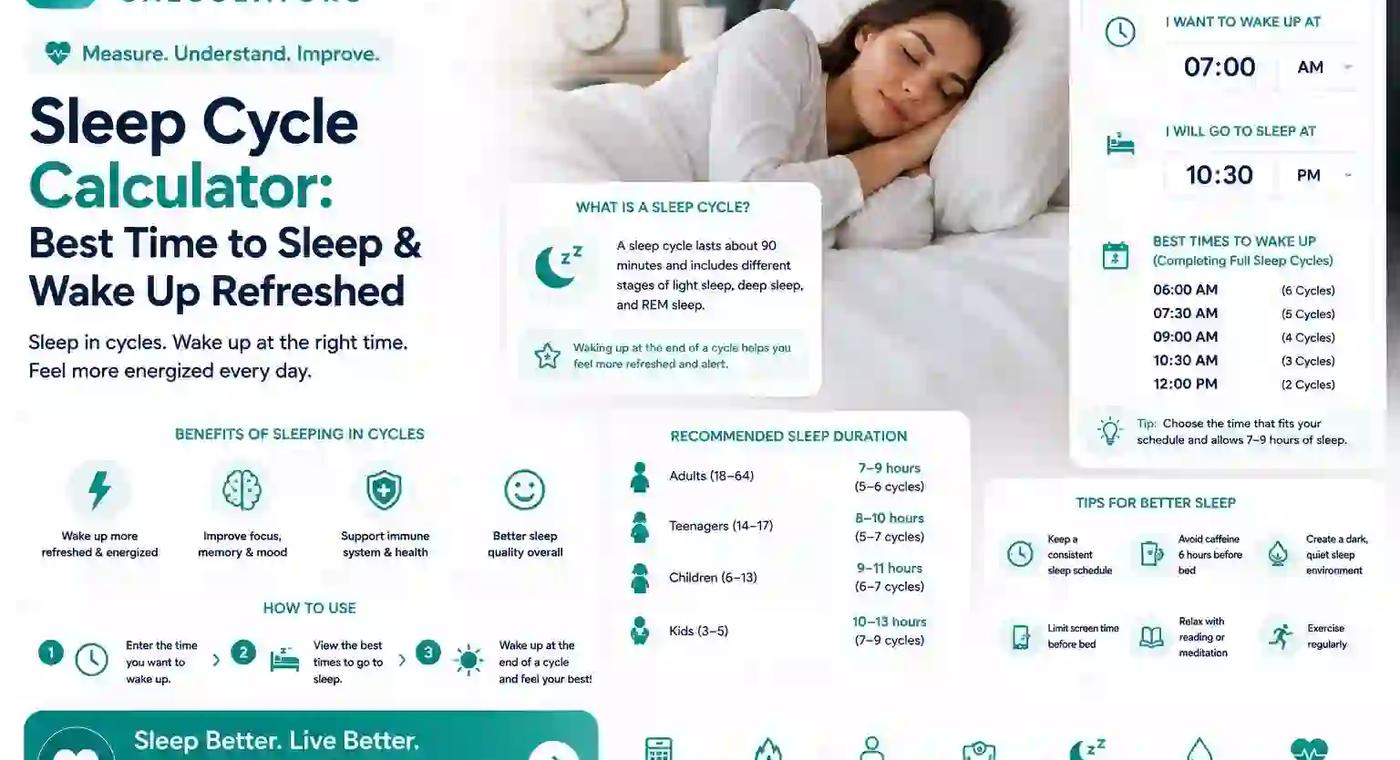
Sleep Cycle Calculator: Best Time to Sleep & Wake Up
Find your ideal bedtime with our sleep cycle calculator. Learn how 90-minute sleep cycles work and the best time to sleep and wake up refreshed.
Waking up feeling groggy isn't always about how many hours you slept — it's often about when in your sleep cycle your alarm went off. Sleep happens in roughly 90-minute cycles, and getting jolted awake in the middle of one (especially during deep sleep) is what causes that heavy, disoriented feeling, regardless of whether you slept 6 hours or 9.
A sleep cycle calculator works backward or forward from your bedtime or wake-up time, aligning your alarm with the end of a complete cycle rather than the middle of one. This guide explains exactly how that math works, why it matters more than total sleep hours alone, and gives you a practical reference table to plan your own schedule.
How a Sleep Cycle Calculator Actually Works
A sleep cycle calculator uses the average length of one complete sleep cycle — approximately 90 minutes — to work out bedtimes or wake times that align with the end of a cycle rather than somewhere in the middle. If you know when you need to wake up, the calculator counts backward in 90-minute blocks to suggest ideal bedtimes; if you know when you're going to bed, it counts forward the same way.
The core idea is simple: waking up between cycles, when your body is naturally in a lighter stage of sleep, feels far less jarring than waking up during deep sleep, even if the total sleep time is shorter. This is why 6 hours of well-timed sleep can sometimes feel more refreshing than 7.5 hours cut off mid-cycle.
Is the 90-Minute Rule Exact?
No, and it's worth being upfront about this. Actual sleep cycle length varies by individual, typically falling somewhere between 70 and 120 minutes, influenced by age, stress levels, and overall sleep health. The 90-minute figure is a useful average for planning purposes, not a precise, universal measurement.
This means a sleep cycle calculator gives you a strong starting estimate, not a guarantee. Most people find that using 90 minutes as a baseline and adjusting slightly based on how they actually feel over a week or two gets them very close to their personal optimal timing.
Bedtime and Wake-Up Time Reference Table
This is the most practical part of using a sleep cycle calculator — a quick lookup table showing recommended bedtimes based on your wake-up time, covering both 5 and 6 full sleep cycles (roughly 7.5 and 9 hours):
| Wake-Up Time | Bedtime for 5 Cycles (7.5 hrs) | Bedtime for 6 Cycles (9 hrs) |
|---|---|---|
| 5:00 AM | 9:15 PM | 7:45 PM |
| 5:30 AM | 9:45 PM | 8:15 PM |
| 6:00 AM | 10:15 PM | 8:45 PM |
| 6:30 AM | 10:45 PM | 9:15 PM |
| 7:00 AM | 11:15 PM | 9:45 PM |
| 7:30 AM | 11:45 PM | 10:15 PM |
| 8:00 AM | 12:15 AM | 10:45 PM |
These times factor in an average 15-minute sleep latency — the time it typically takes to actually fall asleep after getting into bed. If you tend to fall asleep faster or slower than that, shift your bedtime accordingly.
Why 8 Hours of Sleep Doesn't Always Feel Like Enough
This is one of the most common frustrations people search for, and it has a real physiological explanation rather than a vague one. If your alarm happens to go off during a deep sleep stage (N3), you experience what's called sleep inertia — a period of grogginess, slowed reaction time, and disorientation that can last anywhere from a few minutes to over half an hour.
Deep sleep is when your body does the most physical restoration, and your brain activity during this stage is significantly different from lighter sleep or REM. Getting pulled out of it abruptly essentially interrupts a process mid-way, which is why you can sleep a full 8 hours and still feel worse than a shorter, better-timed sleep.
Understanding Sleep Cycle Stages
Each 90-minute cycle moves through several distinct stages, and understanding them makes it much clearer why timing matters as much as duration.
N1 (Light Sleep Onset) The transition between wakefulness and sleep, lasting just a few minutes. Easy to wake from, with minimal grogginess if disturbed.
N2 (Light Sleep) Your heart rate and body temperature drop, and you spend the largest portion of the night in this stage. Still relatively easy to wake from.
N3 (Deep Sleep) The most physically restorative stage, where growth hormone release and tissue repair peak. This is the stage most responsible for sleep inertia if you're woken during it.
REM (Rapid Eye Movement) This is when most dreaming occurs and where a large share of memory consolidation and cognitive processing happens. REM periods get progressively longer as the night goes on, which is part of why cutting sleep short in the early morning hours disproportionately affects REM sleep. Our detailed comparison of REM sleep vs deep sleep breaks down exactly how these two stages differ in function and why both matter for feeling rested.
How Many Sleep Cycles Do Adults Actually Need?
Most adults need 5 to 6 complete sleep cycles per night, translating to roughly 7.5 to 9 hours of sleep. This aligns closely with the National Sleep Foundation's general recommendation of 7–9 hours nightly for adults aged 18–64, though individual needs vary based on age, activity level, and overall health.
Fewer than 5 cycles consistently is associated with the well-documented effects of sleep debt — impaired concentration, slower reaction times, and mood disruption. If you're noticing these effects regularly even after what feels like adequate sleep, it may be worth reviewing your overall signs of poor sleep quality rather than just adjusting bedtime alone.
What Happens If You Wake Up Mid-Cycle?
Waking up in the middle of a sleep cycle — particularly during deep sleep — triggers sleep inertia, the grogginess and mental fog described earlier. Your brain hasn't had the chance to naturally transition back toward lighter sleep before being interrupted, which is why the disorientation can feel disproportionate to how much sleep you actually got.
This is also why hitting snooze repeatedly often makes things worse rather than better. Each snooze cycle can pull you back into a new, incomplete sleep cycle, meaning you might be waking from deep sleep multiple times in a row instead of just once.
Chronotype: Why Sleep Timing Isn't One-Size-Fits-All
Beyond cycle length, your chronotype — whether you're naturally a morning person ("lark") or a night owl — affects when your body is genuinely ready for sleep and wake, independent of any calculator. Forcing an early bedtime onto a strong night owl chronotype, or vice versa, tends to create friction with your natural circadian rhythm even if the math on paper looks correct.
If you consistently struggle to fall asleep at your calculated bedtime despite feeling tired, chronotype mismatch is often part of the explanation, alongside factors like screen exposure or stress. Our guide on how stress affects sleep quality covers one of the most common reasons people can't fall asleep even when they're clearly overtired.
Sleep Cycle Calculators for Specific Situations
Shift Workers
Rotating or night shifts disrupt the natural circadian rhythm that normally supports consistent sleep cycles, making timing calculations more complex. The core 90-minute cycle logic still applies, but the "bedtime" simply shifts to whatever block of hours is actually available for sleep. Our guide on how to stay fit while working night shifts touches on broader strategies for managing health on non-standard schedules.
Students
Balancing study schedules with consistent sleep cycles is a common struggle, particularly around exam periods when the temptation to cut sleep short is highest. Prioritizing even 5 full cycles over an inconsistent 7-8 hours tends to produce better next-day cognitive performance.
New Parents
Sleep cycle calculators become less about precision and more about maximizing whatever sleep window is available, since infant feeding schedules rarely align with neat 90-minute blocks. Even partial cycles are better than none, but prioritizing at least one full 90-minute stretch when possible helps avoid compounding sleep debt.
Napping
For naps, the goal is usually the opposite of a full night's sleep — you generally want to avoid completing a full cycle to prevent grogginess. A 20–30 minute nap keeps you in light sleep stages, while a 90-minute nap allows a complete cycle and tends to avoid the inertia that a 45–60 minute nap (waking mid-deep-sleep) often causes.
Sleep Cycle Calculator vs. the Generic 8-Hour Rule
| Approach | Basis | Limitation |
|---|---|---|
| Generic 8-hour rule | Fixed total duration | Ignores where in a cycle you wake up |
| Sleep cycle calculator | 90-minute cycle multiples | Cycle length varies by individual (70–120 min) |
Neither approach is perfect, but the cycle-based method accounts for a mechanism the generic rule ignores entirely: when you wake up relative to your sleep architecture, not just how long you slept in total.
Practical Tips for Better-Timed Sleep
- Keep a consistent bedtime and wake time, even on weekends, since irregular schedules make it harder for your body to settle into predictable cycle timing
- Track how you feel, not just how long you slept, adjusting your personal cycle-length estimate slightly if 90 minutes consistently feels off
- Avoid screens for 30–60 minutes before bed, since blue light exposure delays natural melatonin release and can extend sleep latency beyond the typical 15-minute estimate
- Resist the snooze button, since repeated snoozing risks pulling you into a new incomplete cycle rather than letting you wake naturally
- Review your daily water and activity habits, since factors like hydration and daytime movement measurably affect sleep quality at night
Frequently Asked Questions
What time should I go to sleep to wake up refreshed? Count backward from your wake-up time in 90-minute blocks (5 or 6 cycles), then add roughly 15 minutes for sleep latency. For a 7:00 AM wake-up, that means a bedtime around 11:15 PM for 5 cycles or 9:45 PM for 6 cycles.
How long is a full sleep cycle? A full sleep cycle averages about 90 minutes, though it can range from 70 to 120 minutes depending on the individual.
How many sleep cycles do I need per night? Most adults need 5 to 6 complete cycles per night, equating to roughly 7.5 to 9 hours of sleep.
Why do I wake up tired even after 8 hours of sleep? This usually happens when your alarm interrupts a deep sleep stage rather than a lighter stage between cycles, triggering sleep inertia regardless of total sleep duration.
What is the best time to wake up based on sleep cycles? The best wake-up time falls at the end of a complete 90-minute cycle rather than in the middle of one — a sleep cycle calculator identifies this by counting cycles forward or backward from a known bedtime or wake time.
How does a sleep cycle calculator work? It uses the average 90-minute cycle length to calculate bedtimes or wake times in multiples of that duration, aiming to align waking with the end of a cycle rather than the middle.
What happens if I wake up in the middle of a sleep cycle? You're likely to experience sleep inertia — grogginess, disorientation, and slowed cognitive function — especially if woken during deep sleep (N3).
Is it better to sleep in multiples of 90 minutes? Generally yes, since this timing aligns waking with the natural end of a sleep cycle, though individual cycle length varies enough that some experimentation is worthwhile.
Final Takeaway
Total sleep hours matter, but timing matters just as much — waking up between cycles rather than in the middle of one is often the real difference between feeling rested and feeling wrecked. Use the 90-minute cycle math as a starting point, track how you actually feel over a week or two, and adjust your personal bedtime slightly based on real results rather than treating any calculator as an exact science.
If sleep quality issues persist beyond timing alone, it's worth digging deeper into what might be disrupting your rest — try our Sleep Quality Checker to get a clearer picture of your overall sleep health, and explore why choose Smart Health Calculators for a full suite of free, science-based tools covering everything from sleep to nutrition to fitness planning.
For official adult sleep duration guidelines, see the National Sleep Foundation's sleep recommendations.
Medical Disclaimer
This article is for general education only. It is not medical advice, diagnosis, treatment, prescription guidance, or a replacement for professional healthcare. Speak with a qualified healthcare professional for personal medical concerns, symptoms, pregnancy concerns, mental health crisis, medication questions, or before making major health changes.