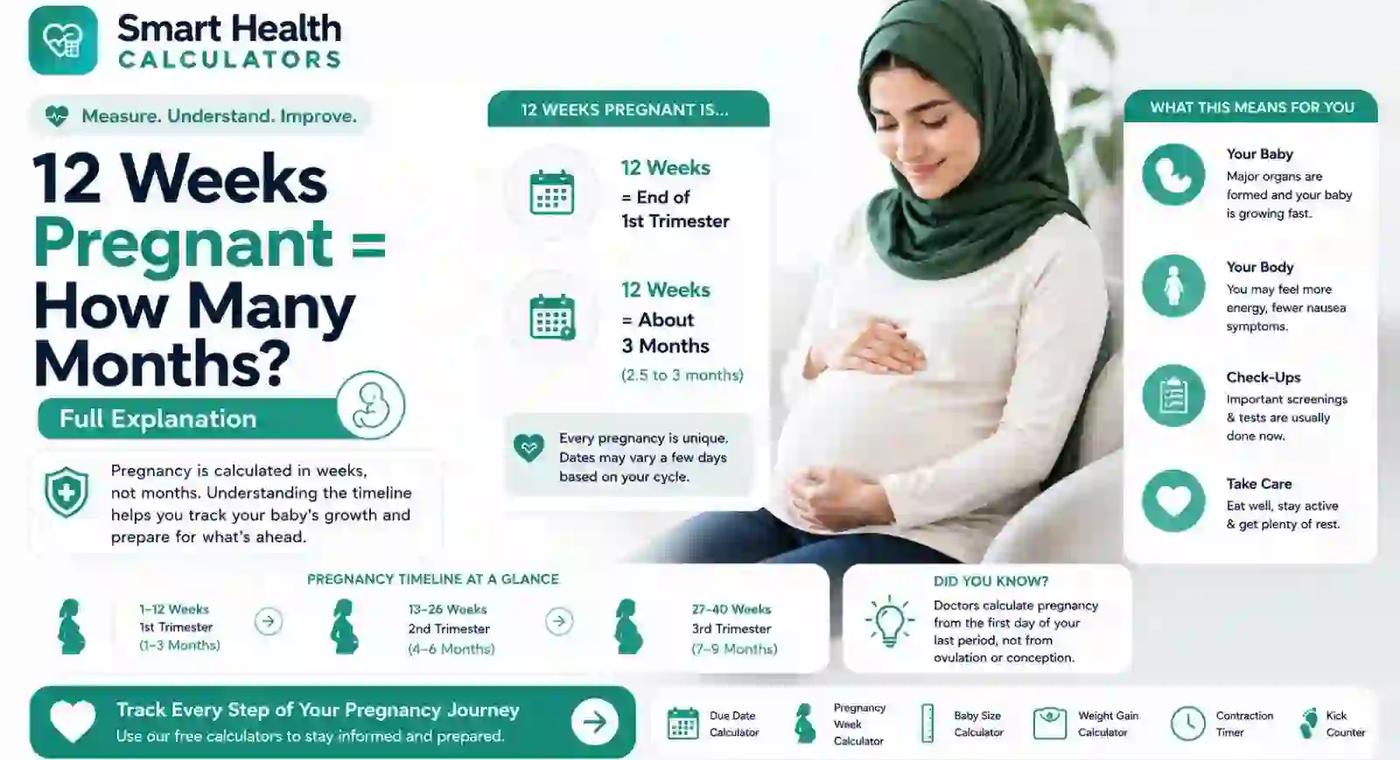
12 Weeks Pregnant = How Many Months? Full Explanation
12 weeks pregnant is about 2.8 months, often rounded to 3. See the exact conversion, trimester breakdown, and what to expect this week.
Twelve weeks pregnant equals approximately 2.8 months, which is why most people round it up and simply say "3 months pregnant." It also marks the final week of the first trimester for many providers, meaning you're right on the edge of moving into the second trimester and, for most people, into a noticeably easier stretch of pregnancy.
If you've just hit the 12-week mark and you're trying to figure out how that translates into "months" for your family group chat or your own tracking, you're dealing with one of the most searched pregnancy conversion questions out there. The short version: 12 weeks doesn't divide evenly into months, so the answer depends slightly on how precise you want to be. Here's the full breakdown, along with everything else worth knowing about week 12.
Is 12 Weeks Pregnant 3 Months? The Exact Math
Let's settle the number first, since this is what most people actually came here for.
A full-term pregnancy runs about 40 weeks, spread across roughly 9 calendar months. That works out to an average of 4.3 weeks per month — not a flat 4. So when you divide 12 weeks by 4.3, you get approximately 2.79 months, which is why "12 weeks pregnant" is commonly rounded to "3 months pregnant," even though it's technically a few days short of the full third month.
Here's the same math laid out simply:
| Measurement | Value |
|---|---|
| Weeks pregnant | 12 weeks 0 days |
| Months (precise) | ≈ 2.79 months |
| Months (commonly rounded) | 3 months |
| Trimester | End of First Trimester |
| Weeks remaining until 40 weeks | 28 weeks |
| Days pregnant | 84 days |
So if someone asks "is 12 weeks 3 months pregnant?" — the honest answer is: close enough that saying 3 months is fine in casual conversation, but if your doctor is tracking things clinically, they'll always refer to it as 12 weeks, not month 3, because that's the more exact unit.
Why the Math Doesn't Line Up Neatly
This confusion isn't unique to week 12 — it happens throughout pregnancy because weeks and months are fundamentally different units of measurement. A week is always exactly 7 days. A month, on the other hand, ranges from 28 to 31 days depending on the calendar month, which means "months pregnant" was never designed to be a precise clinical measurement in the first place.
Doctors and midwives track pregnancy in weeks because it allows for consistent, comparable timing across every single pregnancy, regardless of which calendar months it happens to span. A test scheduled for "week 12" means the same thing for every patient. A test scheduled for "month 3" could mean anywhere from week 9 to week 13, depending on rounding. That's simply too much variance for something as time-sensitive as first-trimester screening.
If you want the full picture of how every week maps to a month across all 40 weeks, our pregnancy weeks to months conversion chart breaks down the entire pregnancy timeline, not just this one milestone.
Is 12 Weeks the End of the First Trimester?
This is genuinely one of the most debated numbers in pregnancy tracking, and the honest answer is: it depends on which source you're reading.
Some medical organizations, including many UK-based NHS resources, define the first trimester as ending at the completion of week 12. Others, including several U.S.-based providers, place the cutoff at the end of week 13. In practice, this half-week discrepancy rarely matters clinically — what matters more is that by week 12 to 13, you're crossing into the safest, most stable phase of pregnancy.
That distinction matters because miscarriage risk drops meaningfully once you're past the first trimester. Research consistently shows the risk of pregnancy loss falls sharply after week 12, which is one of the biggest reasons many people wait until this point to announce their pregnancy publicly.
Practical takeaway: whether your provider says the first trimester ends at 12 weeks or 13 weeks, the underlying message is the same — you're at (or very near) one of the biggest milestones in early pregnancy.
What's Happening at 12 Weeks: Baby's Development
By week 12, the term "embryo" has already given way to "fetus" — that transition happened around week 10, once all the major organ structures had formed. From this point forward, development is mostly about growth and refinement rather than the formation of entirely new structures.
At 12 weeks, your baby:
- Measures roughly 2.1 inches (5.4 cm) from crown to rump — commonly compared to the size of a plum or a lime.
- Weighs approximately 0.49 ounces (14 grams).
- Has fully formed fingers and toes, though they're still fused by thin webbing that will separate over the coming weeks.
- Can make small, reflexive movements — though you almost certainly won't feel these yet.
- Has kidneys that have started producing urine, which contributes to the amniotic fluid.
- Has a nervous system developed enough to trigger basic reflexes, including sucking motions.
This is also frequently the window for the nuchal translucency scan, a first-trimester screening ultrasound (typically done between weeks 11 and 14) that measures fluid at the back of the baby's neck as part of screening for chromosomal conditions like Down syndrome. It's often combined with a blood test for a more complete risk assessment, a combination sometimes called the "combined first-trimester screen."
What to Expect at 12 Weeks: Symptoms and Body Changes
Week 12 is often described as the turning point where early pregnancy symptoms start to ease — though "often" is doing some heavy lifting there, because everybody's timeline is different.
Common experiences at this stage include:
- Morning sickness beginning to fade. For many people, nausea peaks around weeks 9–10 and starts improving by week 12–14, thanks to hCG hormone levels leveling off. It doesn't disappear for everyone this early, though, so don't worry if you're not there yet.
- Increased energy. As progesterone-driven fatigue starts to lift slightly, some people notice the fog beginning to clear.
- Bloating rather than a true baby bump. Most people don't have a visible bump at 12 weeks — what you're feeling is more likely bloating and uterine growth than the baby itself, which is still quite small.
- Mild cramping. Round ligament stretching can cause light, brief cramps as the uterus grows. Sharp, persistent, or one-sided pain, however, should always be checked by a provider.
- Headaches. Hormonal shifts and blood volume changes commonly trigger headaches in the first trimester.
- Light spotting. Occasional spotting can happen for benign reasons (like cervical sensitivity after intercourse or an internal exam), but any spotting should still be mentioned to your provider just to rule out other causes.
A quick note on "good signs" at 12 weeks: continued pregnancy symptoms (even mild ones), a detectable heartbeat on ultrasound, and steady growth measurements are generally the reassuring markers providers look for at this stage — not the presence or absence of a visible belly, which varies enormously from person to person.
Can I Have a Bump at 12 Weeks?
Yes, but it's genuinely uncommon to have a defined bump this early, and when it does show up, it's usually more noticeable in second or later pregnancies. First-time pregnancies tend to show later, often not until weeks 16–20, because abdominal muscles haven't previously been stretched by pregnancy.
If you're seeing something at 12 weeks, it's most likely one of these:
- Uterine growth (the uterus is roughly the size of a grapefruit by week 12, having grown up out of the pelvis)
- Bloating, which is extremely common in early pregnancy due to progesterone slowing digestion
- Simply how you're carrying weight generally, unrelated to the pregnancy itself
Should you feel the baby move at 12 weeks? No — this is too early. Fetal movement (quickening) is typically first felt between weeks 16 and 25, with first-time parents often noticing it later than those who've been pregnant before. Any movement your baby makes at 12 weeks is far too small and too early in development to be felt externally.
12 Weeks vs. 3 Months: A Side-by-Side Comparison
Since these terms get used almost interchangeably, here's a direct comparison to clarify where they actually match up and where they diverge.
| Category | 12 Weeks Pregnant | 3 Months Pregnant (rounded) |
|---|---|---|
| Precision | Exact clinical measurement | Casual, approximate label |
| Trimester | End of first trimester (per most guidelines) | Typically also described as end of first trimester |
| Days | Exactly 84 days | Varies (approx. 87–93 days depending on calendar months used) |
| Used by doctors | Yes — standard clinical unit | Rarely, except in casual conversation |
| Best for tracking milestones | Yes | No — too imprecise for test scheduling |
The practical difference matters most when you're scheduling appointments or reading pregnancy app milestones — always default to weeks if precision matters, and treat "months" as a rough, conversational shorthand.
How to Track Your Own Pregnancy Timeline Accurately
If you're only just now hitting week 12, you're at a great point to lock in an accurate tracking method for the rest of pregnancy. A few tips that make this easier:
- Anchor to your due date, not just your current week. Knowing you're "28 weeks from your due date" gives useful context that "month 3" simply can't.
- Use your dating ultrasound as your reference point. If your first-trimester ultrasound adjusted your due date, use that updated date going forward rather than your original LMP-based estimate — it's typically more accurate, especially with irregular cycles.
- Expect appointment frequency to shift. Most providers schedule prenatal visits roughly every 4 weeks through the second trimester, which is another reason weeks-based tracking is more useful than months for planning ahead.
- Don't stress over one-day discrepancies between apps. Different due date calculators occasionally land a day or two apart depending on rounding methods — this is normal and not something to worry about.
- Recalculate instantly instead of doing mental math. Rather than manually converting weeks to months every time you want an update, our Pregnancy Calculator converts your current week into months, trimester, and due date automatically based on your LMP or conception date.
Is 12 Weeks Too Early to Announce Pregnancy?
There's no universal rule here, and the "right" time to announce is a personal decision. That said, week 12–13 is one of the most common announcement windows, for a fairly specific reason: it lines up closely with the point where miscarriage risk drops substantially and the first major screening ultrasound has typically already happened.
Some people choose to wait until after the 20-week anatomy scan for additional reassurance, while others announce much earlier, particularly with subsequent pregnancies or in situations where hiding physical symptoms becomes impractical. Both are completely normal choices — the "12-week rule" is a common guideline, not a medical requirement.
What to Avoid in the First Trimester
Since week 12 falls right at the tail end of this window, it's worth reinforcing a few first-trimester guidelines that still apply through this stage:
- Alcohol — no amount is currently considered proven safe during pregnancy.
- Raw or undercooked meat, fish, and eggs — due to listeria and salmonella risk.
- High-mercury fish — such as swordfish, king mackerel, and shark.
- Unpasteurized dairy and soft cheeses — unless labeled pasteurized.
- Excessive caffeine — most guidelines recommend staying under 200mg per day (roughly one 12oz cup of coffee).
- Contact sports or activities with high fall risk — worth discussing with your provider if these are part of your normal routine.
For a broader breakdown of what changes trimester by trimester, our guide on pregnancy symptoms by trimester covers the full timeline in more depth. And if you're curious how your current symptoms compare to what's typical earlier on, first signs of pregnancy is a useful companion read.
Frequently Asked Questions
Is 12 weeks pregnant 3 months? Approximately, yes. Twelve weeks works out to about 2.8 months, which is commonly rounded up to "3 months" in everyday conversation, even though it's technically a few days short of the full third month.
Is 12 weeks the end of the first trimester? For many providers, yes — though some define the first trimester as running through week 13 instead. Either way, week 12 marks the very end of the highest-risk early pregnancy window.
Can I have a bump at 12 weeks? It's possible but uncommon, especially in first pregnancies. What looks like a bump this early is usually bloating or general uterine growth rather than a fully "showing" belly, which typically appears later.
Should I feel the baby move at 12 weeks? No. Fetal movement generally isn't felt until weeks 16–25. Any movement at 12 weeks is far too subtle to detect from the outside.
What are good signs at 12 weeks pregnant? A detectable heartbeat on ultrasound, appropriate growth measurements for gestational age, and continued (even if easing) pregnancy symptoms are generally reassuring signs at this stage.
Is 12 weeks too early to announce pregnancy? Not at all — many people announce around this point specifically because miscarriage risk drops significantly after the first trimester, though the right timing is ultimately a personal choice.
How many weeks are left after 12 weeks pregnant? About 28 weeks remain until the standard 40-week due date, putting you roughly 30% of the way through pregnancy.
Final Takeaway
Twelve weeks pregnant sits right at one of the most meaningful milestones in early pregnancy — close enough to "3 months" that the rounding is harmless in casual conversation, but precise enough clinically that your provider will always refer to it by week, not month. What actually matters more than the exact label is what week 12 represents: the tail end of the highest-risk period, the start of easing symptoms for many people, and the point where your baby has moved from "embryo" to fully-formed (if still tiny) fetus.
If you want to skip the manual math for the rest of your pregnancy, our Pregnancy Calculator instantly converts your current week into months and trimesters and keeps your due date updated as you go. And for the complete week-by-week and month-by-month picture beyond just week 12, the full pregnancy weeks to months conversion chart is worth bookmarking for the months ahead.
Medical Disclaimer
This article is for general education only. It is not medical advice, diagnosis, treatment, prescription guidance, or a replacement for professional healthcare. Speak with a qualified healthcare professional for personal medical concerns, symptoms, pregnancy concerns, mental health crisis, medication questions, or before making major health changes.