Pregnancy Weeks to Months: Chart, Calculator & Guide 2026
Convert pregnancy weeks to months with our 2026 chart. Learn trimester breakdowns, full-term weeks, due dates, and how doctors calculate pregnancy weeks.
Pregnancy is measured in 40 weeks, not a clean 9 months, because a calendar month doesn't divide evenly into 7-day weeks. On average, each pregnancy month equals about 4.3 weeks, which is why a "9-month" pregnancy actually stretches to roughly 40 weeks. Doctors track pregnancy by weeks because it gives far more accurate insight into fetal development and due date planning than months ever could.
If you've ever sat in a waiting room doing mental math — "wait, if I'm 27 weeks, how many months is that?" — you're not alone. It's one of the most common points of confusion in early and mid-pregnancy, mostly because our everyday calendars and medical calendars don't speak the same language. This guide breaks the whole thing down clearly, with a full conversion chart, trimester breakdown, and answers to the questions real expecting parents actually search for.
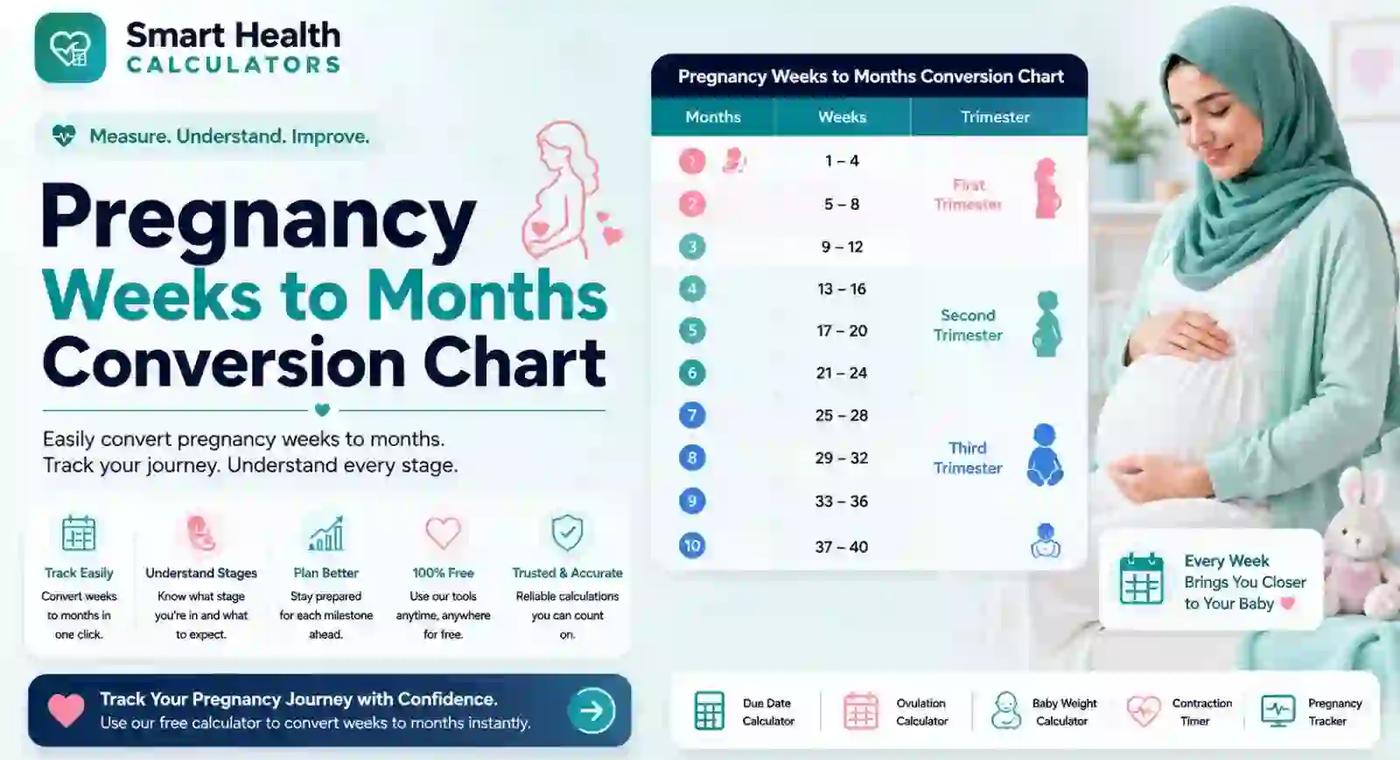
Pregnancy Weeks to Months Conversion Chart
Here's the full chart mapping pregnancy weeks to months and trimesters. Bookmark this — you'll probably refer back to it more than once over the next several months.
| Pregnancy Week | Approximate Month | Trimester |
|---|---|---|
| Weeks 1–4 | Month 1 | First Trimester |
| Weeks 5–8 | Month 2 | First Trimester |
| Weeks 9–13 | Month 3 | First Trimester |
| Weeks 14–17 | Month 4 | Second Trimester |
| Weeks 18–22 | Month 5 | Second Trimester |
| Weeks 23–27 | Month 6 | Second Trimester |
| Weeks 28–31 | Month 7 | Third Trimester |
| Weeks 32–35 | Month 8 | Third Trimester |
| Weeks 36–40 | Month 9 | Third Trimester |
A couple of notes on reading this table correctly. These month ranges are approximations, not rigid cutoffs, because months vary in length (28 to 31 days) while pregnancy weeks are always a consistent 7 days. So "month 6" for one person might technically start a few days earlier or later than for someone else, depending on how the weeks fall against the calendar. This is exactly why your doctor will always talk to you in weeks — it's the one unit that doesn't shift.
Why Doctors Count Pregnancy in Weeks, Not Months
This is probably the single most-asked question about pregnancy tracking, and the answer comes down to precision.
A calendar month isn't a fixed length. February has 28 days, July has 31 — so "I'm 3 months pregnant" could mean anywhere from 12 to 14 weeks depending on which months are involved. Weeks, on the other hand, are always exactly 7 days, which makes them a reliable, standardized unit for:
- Tracking fetal growth milestones — organ development, movement, and viability all happen on a weekly timeline that's been mapped through decades of clinical research.
- Scheduling prenatal tests and scans — things like the nuchal translucency scan (weeks 11–14) or the glucose tolerance test (weeks 24–28) are timed to specific weeks, not "month 3" or "month 6."
- Calculating due dates accurately — due dates are set at 40 weeks from the last menstrual period (LMP), not 9 months, because 9 months of 30 days each would only add up to 270 days — ten days short of the actual 280-day average pregnancy.
- Assessing preterm vs. full-term birth — labor at "36 weeks" carries very different clinical implications than labor at "38 weeks," a distinction that gets lost if you're only thinking in months.
In short: months are a convenience for casual conversation, but weeks are the language of clinical care. Most OB-GYNs, midwives, and organizations like the American College of Obstetricians and Gynecologists (ACOG) use weeks as the default standard specifically because of this precision.
How Many Weeks Are in a Pregnancy Month?
This is where a lot of the confusion actually starts. If pregnancy is "9 months," and there are roughly 4 weeks in a month, shouldn't that be 36 weeks? Not quite.
Here's the math: a full-term pregnancy lasts about 280 days, or 40 weeks. Divide 40 weeks by 9 months, and you get 4.3 weeks per month — not a clean 4. That extra third of a week per month adds up. Over 9 months, it accounts for the "missing" 4 weeks that make the difference between 36 weeks (what you'd get using a flat 4-weeks-per-month estimate) and the actual 40 weeks of a full-term pregnancy.
This is also why some sources describe pregnancy as "10 lunar months" — because a lunar month is exactly 4 weeks (28 days), and 40 weeks divided by 4 gives you 10 lunar months, not 9 calendar months. Both are technically correct; they're just using different definitions of "month."
Practical takeaway: if someone tells you they're "8 months pregnant," a safe estimate is that they're somewhere between 32 and 35 weeks, not exactly 32. This is exactly why apps and calculators built specifically for weeks-to-months conversion — like the Pregnancy Calculator — are far more reliable than doing the math in your head.
Trimester Breakdown: Weeks, Months, and What's Happening
Pregnancy is traditionally divided into three trimesters, each roughly 13 weeks long, though the exact boundaries vary slightly by source.
First Trimester (Weeks 1–13, Months 1–3)
This is the foundation-building phase. By week 4, implantation has occurred and hormone levels begin rising sharply enough to trigger a positive pregnancy test. By week 8, the embryo has a beating heart, and by week 12, most major organs have started to form. This trimester also carries the highest miscarriage risk, which is why many people wait until after the first prenatal ultrasound (typically weeks 8–12) to share the news publicly.
Common experiences during this window include morning sickness, fatigue, breast tenderness, and heightened smell sensitivity. If you're trying to pin down exactly when symptoms started, our guide on first signs of pregnancy breaks down what to expect week by week.
Second Trimester (Weeks 14–27, Months 4–6)
Often called the "golden trimester" because energy levels typically rebound and early nausea fades. This is when most people feel the first fetal movements (often called "quickening"), usually between weeks 16 and 22. The anatomy scan — a detailed ultrasound checking organ development — usually happens around week 20, which is also when many parents choose to find out the baby's sex.
Third Trimester (Weeks 28–40, Months 7–9)
The home stretch. The baby gains most of its birth weight during this period, and prenatal visits become more frequent — often weekly after week 36. Braxton Hicks contractions (practice contractions) tend to show up here, and by week 37, a baby is considered "early term." For a full breakdown of what to expect during each stage, see our detailed post on pregnancy symptoms by trimester.
Full-Term, Preterm, and Postterm: What the Labels Actually Mean
Because "9 months" gets thrown around so casually, a lot of people assume any birth before month 9 counts as premature. The clinical reality is more specific, and it matters for understanding risk:
- Preterm: Before 37 weeks
- Early term: 37 weeks 0 days – 38 weeks 6 days
- Full term: 39 weeks 0 days – 40 weeks 6 days
- Late term: 41 weeks 0 days – 41 weeks 6 days
- Postterm: 42 weeks and beyond
This classification system — used by both ACOG and the World Health Organization — replaced the older, vaguer "term" label around 2013, precisely because outcomes differ meaningfully between a baby born at 37 weeks versus 40 weeks, even though both used to just be called "full-term."
So if you're wondering "is 36 weeks exactly 9 months?" — mathematically it's close, but clinically it's still classified as preterm, not full-term. The month-based label and the medical risk category don't line up neatly, which is exactly why weeks matter more than months when it comes to safety.
How to Calculate Your Own Weeks-to-Months Conversion
There are three common starting points doctors use to calculate gestational age, and each gives a slightly different — but related — number.
1. Last Menstrual Period (LMP) method This is the standard starting point. Pregnancy is counted from the first day of your last period, even though conception typically happens about two weeks later. It sounds odd, but it's used because most people know their LMP date more reliably than their exact conception date.
2. Conception date method If you know your conception date (common with IVF or tracked ovulation), your actual fetal age is about 2 weeks behind your LMP-based gestational age. A doctor may adjust for this when discussing development milestones specifically.
3. Ultrasound dating Especially in early pregnancy, a dating ultrasound (usually done between weeks 8–13) measures the embryo/fetus size to estimate gestational age. This method is considered the most accurate, particularly for people with irregular cycles, and it's often used to adjust or confirm the due date calculated from LMP.
Once you know your gestational age in weeks, converting to months is simple using the chart above — or, for something quicker, plug your LMP or due date into the Pregnancy Calculator, which automatically calculates your current week, month, and trimester along with your estimated due date.
Regional Differences in Pregnancy Tracking
While the core week-based system is used worldwide, there are small variations in how different countries' health systems communicate it:
- United States (ACOG/CDC): Uses weeks as the primary clinical unit, with trimesters defined as weeks 1–13, 14–27, and 28–40.
- United Kingdom (NHS): Also primarily week-based, but antenatal appointment schedules and terminology (like "booking appointment" around week 8–10) differ slightly from the US model.
- WHO Global Guidelines: Uses the same 40-week, three-trimester framework as a global standard, which most national health systems — including those in Pakistan, India, and Australia — align with for consistency in maternal health reporting.
The math itself (40 weeks, roughly 4.3 weeks per month, three ~13-week trimesters) doesn't change country to country — it's really just appointment scheduling and terminology that varies.
Common Conversion Mix-Ups, Explained
A few specific week-to-month questions come up constantly, so here they are answered directly:
Is 20 weeks pregnant equal to 5 months? Yes, approximately. Week 20 falls right at the midpoint of pregnancy and lines up closely with the start of month 5 — it's actually one of the few points in pregnancy where the "weeks ÷ 4" shortcut is nearly accurate.
Is 24 weeks pregnant 6 months? Close, but technically it's the very end of month 5 heading into month 6. This is the point where the 4.3-weeks-per-month math starts to noticeably pull ahead of the simple "4 weeks = 1 month" assumption.
How many months is 28 weeks pregnant? About 6.5 months — right at the start of the third trimester.
How many months is 36 weeks pregnant? About 8.5 months, and clinically still classified as preterm rather than full-term, despite being so close to the "9 months" mark.
How many months is 40 weeks pregnant? Exactly 9 months, and the traditional due date marker — though only about 5% of babies are actually born on their exact due date.
Practical Tips for Tracking Your Pregnancy Timeline
A few things that make week-to-month tracking easier day to day:
- Use your due date as an anchor, not just your current week. Counting backward from your due date (40 weeks minus weeks remaining) is often more intuitive than counting forward from week 1.
- Don't panic over slight discrepancies between apps. A one-to-three-day difference in gestational age between two calculators is normal and usually comes down to whether they're using LMP or ultrasound dating.
- Track by trimester milestones, not just week numbers. Knowing you're "in week 3 of the second trimester" often communicates more practical information than "week 16" alone.
- Bring your own conversion chart to appointments. It sounds minor, but having a quick reference (like the table above) makes it easier to follow along when your provider discusses timing for tests or milestones.
- Recheck your due date after your first ultrasound. LMP-based due dates can be off by several days, especially with irregular cycles, and ultrasound dating in the first trimester is generally considered more accurate.
Frequently Asked Questions
How many weeks are in a pregnancy month? On average, about 4.3 weeks, not a flat 4. This is because 40 total pregnancy weeks divided across 9 months doesn't split evenly — each month works out to roughly 4 weeks and 2 days.
Is pregnancy 9 months or 10 months? Both are technically correct, depending on the type of month used. Using standard calendar months, pregnancy is about 9 months. Using lunar months (exactly 4 weeks each), it's 10 lunar months. Medically, it's simplest to just say 40 weeks.
Why is pregnancy 40 weeks but only 9 months? Because calendar months vary in length while pregnancy weeks are a fixed 7 days each. Forty weeks adds up to about 280 days, which lines up with roughly 9 calendar months, but not a perfectly even 4-weeks-per-month split.
What week does each trimester start and end? First trimester: weeks 1–13. Second trimester: weeks 14–27. Third trimester: weeks 28–40. Some providers use slightly different week cutoffs, but this three-way split is the standard used by ACOG and the WHO.
How do doctors calculate pregnancy weeks? Most commonly from the first day of your last menstrual period (LMP), then confirmed or adjusted using a first-trimester dating ultrasound if the dates don't quite match up.
Is 36 weeks considered full term? No. Thirty-six weeks is classified as preterm. Full term begins at 39 weeks 0 days, based on current ACOG and WHO guidelines.
Is my pregnancy 9 months or 10 months long? If you're counting standard calendar months, it's roughly 9. The "10 months" figure comes from counting in 4-week lunar months instead, which is a different — but equally valid — way of measuring the same 40-week span.
Final Takeaway
The confusion between pregnancy weeks and months isn't a knowledge gap on your part — it's a genuine mismatch between how calendars work and how pregnancy is actually measured. Weeks give a fixed, reliable unit that doctors use for everything from scheduling scans to assessing labor risk, while months are really just a rough, everyday shorthand.
The most useful habit you can build is this: whenever you hear a "months" figure, mentally convert it using the 4.3-weeks-per-month rule (or better yet, the chart above) rather than assuming a flat 4 weeks per month. It'll save you a fair amount of confusion during appointments and baby-tracking app updates alike.
If you want an exact, personalized breakdown instead of doing the math yourself, our free Pregnancy Calculator converts your current week into months and trimesters instantly, and estimates your due date based on your LMP or conception date. For more on what to expect as you move through each stage, check out our companion guides on pregnancy due dates and trimester milestones and early pregnancy symptoms.
Medical Disclaimer
This article is for general education only. It is not medical advice, diagnosis, treatment, prescription guidance, or a replacement for professional healthcare. Speak with a qualified healthcare professional for personal medical concerns, symptoms, pregnancy concerns, mental health crisis, medication questions, or before making major health changes.