5'6" 150 lbs Female BMI: Is It a Healthy Weight? (2026)
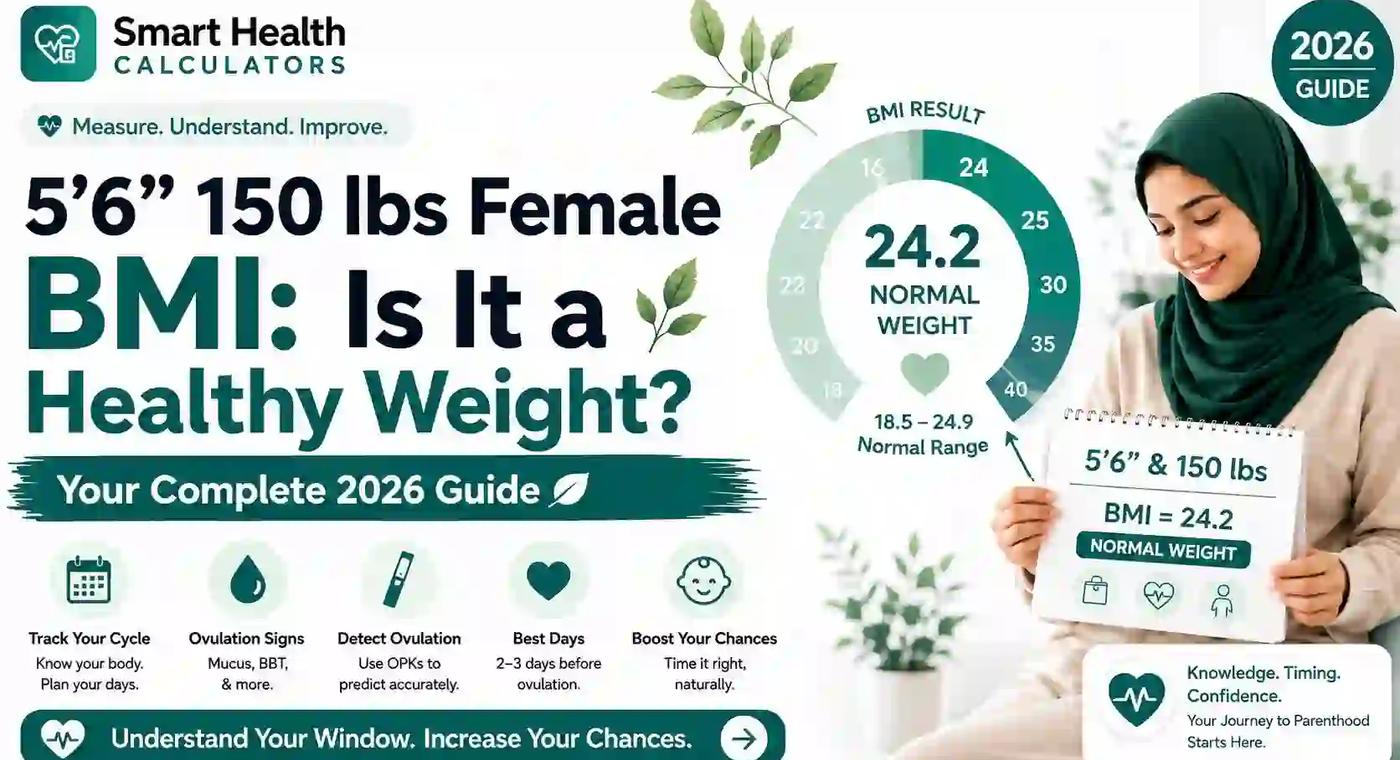
A 5'6", 150 lb woman has a BMI of 24.2. Learn what this means, the healthy weight range, BMI limits, and other health factors to consider.
A woman who is 5'6" and weighs 150 lbs has a BMI of approximately 24.2, which falls within the "normal weight" range of 18.5–24.9 as defined by the Centers for Disease Control and Prevention. That said, BMI is a starting point, not a verdict — it doesn't account for muscle mass, body composition, or where fat is distributed, all of which matter more for actual health than a single number on a chart.
The Direct Answer: What's the BMI for 5'6" and 150 lbs?
Using the standard BMI formula (weight in pounds × 703, divided by height in inches squared), a woman who is 5'6" (66 inches) and weighs 150 lbs calculates to a BMI of 24.2.
According to CDC and World Health Organization classification standards, adult BMI categories break down as follows:
| BMI Range | Category |
|---|---|
| Below 18.5 | Underweight |
| 18.5 – 24.9 | Normal/Healthy weight |
| 25.0 – 29.9 | Overweight |
| 30.0 and above | Obese |
At 24.2, this places a 5'6", 150 lb woman just inside the upper end of the "normal weight" category — close to, but not over, the threshold into "overweight" territory (which begins at 25.0, or roughly 155 lbs at this height). That's a genuinely useful data point, but it's also exactly the kind of borderline case where BMI's limitations become most relevant, which is why the rest of this article matters as much as the number itself.
If you want to run your own numbers or check a different height and weight combination, the BMI Calculator gives an instant result along with the category it falls into.
What BMI Actually Measures (and What It Doesn't)
BMI was developed in the 1830s by a Belgian mathematician, not a physician, as a population-level statistical tool — not an individual diagnostic measure. That origin matters, because it explains both why BMI is useful and why it has real, well-documented limitations.
What BMI does well: At a population level, BMI correlates reasonably well with health risk trends. Public health researchers, insurers, and clinicians use it as a fast, free, easily standardized screening tool because it only requires height and weight — no specialized equipment.
What BMI misses entirely:
- Muscle vs. fat mass. BMI can't distinguish between a pound of muscle and a pound of fat. A woman with significant lean muscle mass from strength training can register a higher BMI while carrying a lower body fat percentage than someone at the same BMI with less muscle.
- Fat distribution. Where fat is stored matters for health risk — visceral fat around the abdomen carries different metabolic implications than fat stored elsewhere, and BMI can't tell the difference.
- Frame size and bone density. A naturally larger or smaller bone structure shifts what a "normal" weight looks like for an individual, independent of body fat.
- Age-related composition changes. Body composition shifts with age even at a stable weight — muscle mass naturally declines while fat percentage can rise, meaning the same BMI can represent a different health picture at 25 versus 55.
For a deeper technical breakdown of exactly where BMI falls short and why researchers still use it despite these gaps, this piece on BMI's accuracy and limitations covers the topic in more depth than most surface-level explainers do.
Why Two Women at 5'6" and 150 lbs Can Have Very Different Health Profiles
This is the part BMI charts never capture, and it's genuinely important: identical height and weight numbers can represent meaningfully different bodies.
Athletic build. A woman who strength trains regularly and carries more lean muscle mass will often weigh more at a given height and appearance than someone with a similar look but less muscle. If you've built noticeable muscle through resistance training, your 150 lbs at 5'6" may reflect a genuinely lean, low-body-fat physique that BMI alone doesn't capture — this is one of the most common and well-documented BMI blind spots, particularly among athletic and active women.
Body fat percentage. Two women at the identical BMI of 24.2 can have meaningfully different body fat percentages — one might sit around 24% body fat (well within a healthy range for women), while another at the same BMI might be closer to 32%. This is precisely why health professionals increasingly pair BMI with a secondary measure. For a direct comparison of how these two metrics diverge and when each one matters more, BMI vs. body fat percentage walks through the practical differences.
Waist-to-hip ratio and fat distribution. Two women with the same BMI can carry fat differently — one more centrally around the abdomen, another more evenly distributed. Waist-to-hip ratio is often used alongside BMI precisely because it captures this distribution difference, which correlates with certain metabolic risk factors independent of overall weight.
Age. A 150 lb, 5'6" woman at 25 and a 150 lb, 5'6" woman at 55 are not physiologically equivalent, even at an identical BMI. Metabolic rate, natural muscle mass, and typical activity levels shift meaningfully across that age range, which is part of why "healthy weight" isn't a fixed target that applies uniformly across a lifespan.
Healthy Weight Range for a 5'6" Woman: The Fuller Picture
Rather than fixating on 150 lbs as a single number, it's more useful to look at the full range that falls within the "normal" BMI category at this height.
For a woman who is 5'6" (66 inches), the BMI-defined normal weight range spans roughly:
- BMI 18.5 (lower bound): approximately 114 lbs
- BMI 24.9 (upper bound): approximately 155 lbs
That means 150 lbs sits comfortably within this range, but it also illustrates something important: "healthy weight" at 5'6" spans over 40 pounds. A woman at 118 lbs and a woman at 152 lbs are both technically within the "normal" BMI category, yet those are very different bodies. This range-based framing matters more than a single ideal number, because it acknowledges that healthy bodies come in more than one shape at any given height.
For a broader look at how these ranges shift across different heights (useful if you're comparing against a partner, friend, or simply curious how the range changes), normal weight range by height breaks down the full spectrum.
How Age Affects What "Healthy" Looks Like at 5'6"
Weight guidance isn't static across a woman's life, and treating it as one fixed number ignores real physiological changes.
Teenage years and early twenties. Growth patterns, natural body development, and still-forming bone density mean weight guidance for younger women (and especially teenagers) should generally involve a pediatrician or healthcare provider rather than adult BMI charts alone, since standard adult BMI categories aren't designed for still-developing bodies.
20s to 30s. This period typically represents peak natural muscle mass and metabolic rate for most women, meaning the same weight often comes with a leaner body composition than the identical number would represent later in life.
40s and beyond. Hormonal shifts, particularly around perimenopause and menopause, commonly bring changes in fat distribution (often shifting toward the abdomen) and a natural decline in muscle mass, even without any change on the scale. This is a well-documented, normal physiological pattern — not a sign of doing anything wrong — but it does mean the same 150 lbs at 5'6" can represent a different body composition at 50 than it did at 25.
Pregnancy and postpartum. Weight guidance during and after pregnancy follows entirely different, individualized standards set by an obstetric care provider rather than standard adult BMI ranges, since healthy weight gain and postpartum recovery vary enormously by individual circumstances.
BMI vs. Body Fat Percentage: Which Matters More?
This comparison comes up constantly, and the honest answer is that they measure different things and work best together rather than as competitors.
BMI's advantage: It's instant, free, requires no special equipment beyond a scale and a tape measure, and correlates reasonably well with health risk across large populations — which is exactly why it remains the standard first-pass screening tool in most clinical settings.
Body fat percentage's advantage: It directly measures what BMI can only estimate indirectly — the actual proportion of your body that is fat versus lean mass (muscle, bone, water, organs). For an athletic woman, or anyone whose BMI sits in a borderline zone like the 24.2 example in this article, body fat percentage often paints a more accurate individual picture.
The practical approach most health professionals recommend: use BMI as a quick, free first checkpoint, and if the result sits in a borderline range or doesn't match how you feel physically, follow up with a body fat percentage estimate for a fuller picture. The Body Fat Estimator offers a quick way to get that second data point without needing specialized clinical equipment.
Beyond the Scale: Other Health Markers Worth Considering
Weight and BMI are just two data points in a much larger picture of overall health. A genuinely complete view considers several additional factors:
- Waist circumference and waist-to-hip ratio, which relate to how fat is distributed rather than just total amount
- Energy levels and sleep quality, since chronic fatigue or poor sleep often signals something worth addressing regardless of what the scale shows — this guide to what counts as poor sleep quality covers common warning signs
- Strength and physical function, since the ability to comfortably perform daily activities matters more day-to-day than a specific number
- Resting heart rate and blood pressure, both of which your doctor can check alongside weight during a routine visit
- Blood sugar and cholesterol markers, obtained through standard bloodwork rather than any weight-based calculation
- Consistent hydration, which affects both energy and overall metabolic function — the daily water intake guide offers practical, individualized targets
None of these replace a conversation with a healthcare provider, but together they paint a far more complete picture than weight or BMI alone ever could.
When to Talk to a Healthcare Provider About Weight
BMI and body composition tools are useful for general awareness, but certain situations genuinely call for professional guidance rather than a calculator:
- You've experienced unexplained weight change (gain or loss) without an intentional lifestyle shift
- You're planning a significant weight change and want a personalized, medically sound plan
- You have an existing health condition where weight management plays a role in treatment
- You're pregnant or postpartum and need guidance specific to that stage
- Your BMI falls in the underweight or obese categories, where individualized clinical guidance is particularly valuable
- You're experiencing symptoms (fatigue, irregular cycles, mood changes) that might relate to broader health factors beyond weight alone
A doctor or registered dietitian can combine your weight data with bloodwork, family history, and a physical exam to give guidance that a BMI number alone simply can't provide.
Frequently Asked Questions
Is 5'6 and 150 lbs a healthy weight for a woman? Yes, based on BMI alone — it calculates to approximately 24.2, which falls within the CDC's "normal weight" category of 18.5–24.9. However, individual factors like muscle mass, body composition, and overall health markers matter as much as this single number.
What is a healthy BMI for a 5'6" woman? A BMI between 18.5 and 24.9 is classified as "normal weight" for adults, corresponding to roughly 114–155 lbs at a height of 5'6". This range is broad, reflecting the fact that healthy bodies vary even at the same height.
Is 150 pounds overweight for someone 5'6"? No. At 5'6", 150 lbs calculates to a BMI of 24.2, which is within the normal weight range and just below the overweight threshold of 25.0 (approximately 155 lbs at this height).
Does BMI account for muscle mass? No. BMI is calculated purely from height and weight, so it cannot distinguish between muscle and fat. This means athletic or muscular women can register a higher BMI despite having a lower body fat percentage than the number alone suggests.
What is the ideal weight range for a 5'6" female? Rather than a single "ideal" number, the BMI-based normal weight range for 5'6" spans roughly 114–155 lbs. Individual factors like muscle mass, frame size, and age mean the right weight within that range varies from person to person.
Is BMI a reliable measure of health? BMI is a useful, free screening tool that correlates reasonably well with health trends at a population level, but it has documented individual limitations — it doesn't measure body fat percentage, fat distribution, or muscle mass directly. It's best used alongside other health markers rather than as a standalone verdict.
Final Takeaway
At 5'6" and 150 lbs, the BMI math places you within the recognized "normal weight" range — a genuinely reassuring data point, but not the complete story. Muscle mass, body fat percentage, waist-to-hip ratio, age, and overall health markers like energy, sleep, and bloodwork all contribute to a fuller, more accurate picture than a single BMI number ever could on its own.
If you want to explore your own numbers further, the BMI Calculator and Body Fat Estimator both offer quick, free starting points — and pairing that data with a conversation with your doctor gives you the most complete, personalized picture of what a healthy weight genuinely looks like for your body specifically. For more health calculators and evidence-based guides on weight, nutrition, and fitness, the full tools collection at Smart Health Calculators covers everything from calorie planning to sleep quality tracking in one place.
Medical Disclaimer
This article is for general education only. It is not medical advice, diagnosis, treatment, prescription guidance, or a replacement for professional healthcare. Speak with a qualified healthcare professional for personal medical concerns, symptoms, pregnancy concerns, mental health crisis, medication questions, or before making major health changes.