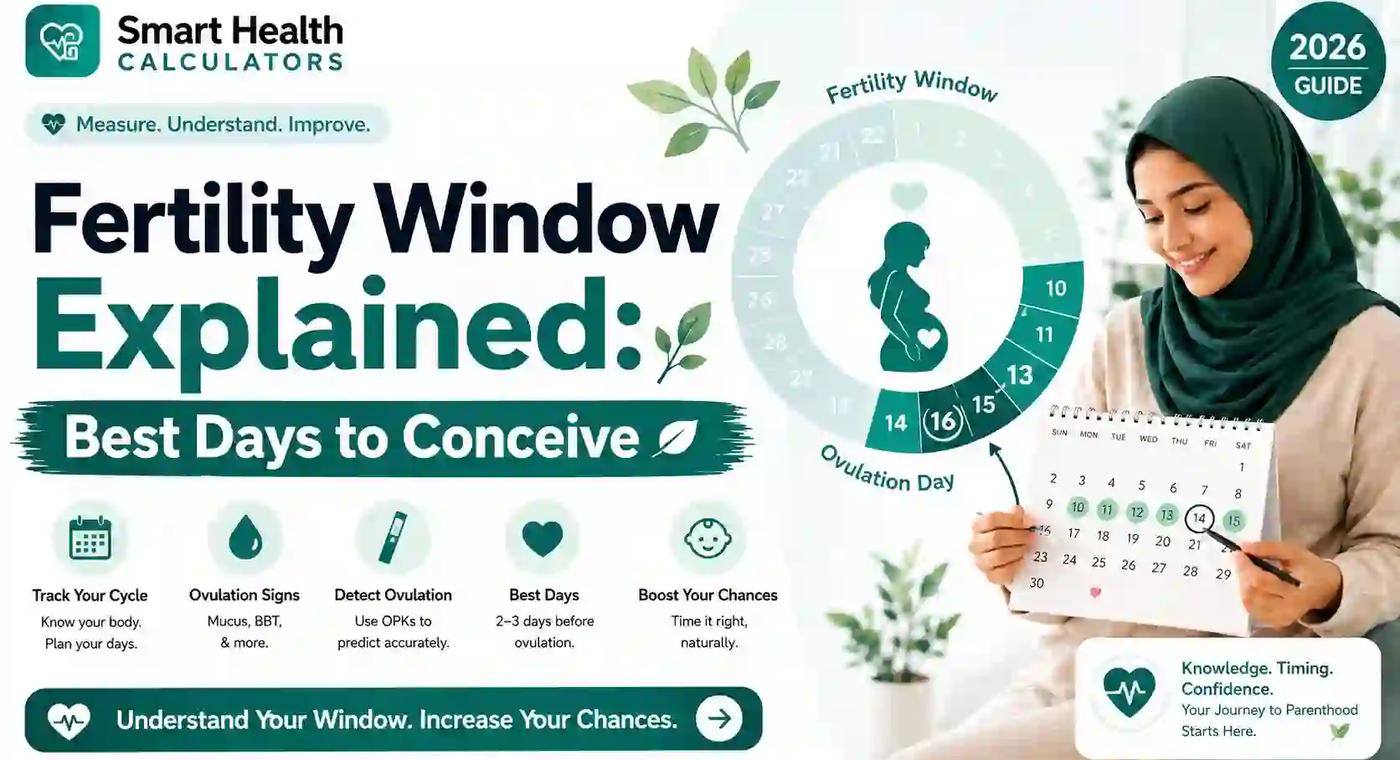
Fertility Window Explained: Best Days to Conceive
Learn how to calculate your fertility window and identify your most fertile days using cycle length, ovulation signs, cervical mucus, BBT, and OPKs.
If you're trying to get pregnant, timing matters more than almost anything else in the process. Understanding your fertility window — the specific days each cycle when conception is actually possible — can make the difference between months of guessing and a much clearer path forward.
This guide walks through exactly what the fertility window is, how to calculate it, what ovulation signs actually mean, and how to use that information without stressing over every single cycle detail.
What Is the Fertility Window?
The fertility window is the span of days in a menstrual cycle when pregnancy can occur. It typically spans about six days: the five days leading up to ovulation and the day of ovulation itself.
This window exists because of two biological facts working together. Sperm can survive inside the female reproductive tract for up to five days, while the egg released during ovulation is only viable for about 12 to 24 hours after release. So the "window" isn't really about the egg's short lifespan — it's about how long sperm can wait around for it.
Fertility peaks in the two to three days directly before ovulation, plus the day of ovulation itself. Outside that window, on any other day of the cycle, pregnancy is essentially not possible.
How the Menstrual Cycle Actually Works
To understand the fertility window, it helps to understand the cycle phases it sits inside. A menstrual cycle isn't one uniform block of time — it moves through distinct hormonal phases.
Follicular phase. This starts on day one of your period and lasts until ovulation. During this phase, follicle-stimulating hormone (FSH) prompts the ovaries to develop follicles, one of which will mature into the egg that gets released.
Ovulation. A surge in luteinizing hormone (LH) — the LH surge — triggers the release of a mature egg from the ovary, usually 24 to 36 hours after the surge begins. This is the single day the fertility window centers around.
Luteal phase. After ovulation, the ruptured follicle produces progesterone, which prepares the uterine lining for a potential pregnancy. This phase is fairly consistent in length — typically 12 to 14 days — regardless of how long the rest of the cycle runs.
The follicular phase is the variable part of the cycle. This is exactly why ovulation timing shifts from person to person, and even cycle to cycle for the same person, while the luteal phase stays relatively fixed.
When Does Ovulation Happen?
In a textbook 28-day cycle, ovulation typically occurs around day 14. But very few people actually have a perfectly consistent 28-day cycle, so that number is more of a reference point than a rule.
A simple way to estimate ovulation: count backward 14 days from the expected start of your next period. Because the luteal phase is fairly stable, this backward calculation tends to be more reliable than counting forward from your last period, especially for anyone with cycles shorter or longer than 28 days.
For someone with a 32-day cycle, for example, ovulation is more likely around day 18, not day 14. This is one of the most common miscalculations people make when trying to time conception — assuming every cycle mirrors the "standard" 28-day model.
How to Calculate Your Fertility Window
There isn't one single foolproof method, but combining a few approaches gives a much clearer picture than relying on just one.
- Track your cycle length for at least two to three months to identify your average cycle and any variation.
- Count back 14 days from your expected next period to estimate ovulation day.
- Mark the five days before that estimated ovulation day, plus ovulation day itself — that six-day span is your fertility window.
- Cross-check with physical signs like cervical mucus changes or a positive ovulation predictor kit result.
- Adjust monthly if your cycle length varies, rather than assuming the same dates apply every time.
For anyone who doesn't want to do this math manually every month, a pregnancy calculator can help map out cycle-related dates once you know your basic cycle information, though tools like this work best alongside physical tracking rather than as a replacement for it.
Signs of Ovulation Your Body Actually Gives You
Beyond calendar math, your body provides real physical signals that ovulation is approaching. Learning to recognize them adds a layer of accuracy that dates alone can't provide.
Cervical mucus changes. In the days before ovulation, cervical mucus typically becomes clearer, stretchier, and more slippery — often compared to raw egg white. This texture change helps sperm travel more easily and is one of the more reliable natural indicators of approaching ovulation.
Basal body temperature (BBT) shift. Basal body temperature — your temperature at rest, first thing in the morning — rises slightly (usually by 0.5 to 1 degree Fahrenheit) after ovulation occurs, due to increased progesterone. The catch is that this confirms ovulation has already happened rather than predicting it in advance, so it's more useful for pattern-tracking over several cycles than for real-time planning.
Mild pelvic or ovulation pain. Some people notice a dull ache or brief, sharp twinge on one side of the lower abdomen around ovulation, sometimes called mittelschmerz. It's not universal, and its absence doesn't mean ovulation isn't happening.
Positive ovulation predictor kit (OPK). These test strips detect the LH surge in urine, typically turning positive 24 to 36 hours before ovulation. They're one of the more precise at-home tools available, though results can occasionally be affected by conditions like PCOS, which naturally produce higher baseline LH levels.
Increased libido. Some research suggests a mild rise in sex drive around ovulation, likely tied to hormonal shifts, though this varies significantly from person to person and isn't a reliable standalone indicator.
Fertility Tracking Methods Compared
Different tracking methods vary in accuracy, effort required, and how far in advance they can predict ovulation. Here's how the main options stack up:
| Method | Predicts Ahead of Time? | Accuracy | Effort Required |
|---|---|---|---|
| Calendar/counting method | Yes, estimate only | Moderate (lower for irregular cycles) | Low |
| Basal body temperature (BBT) | No — confirms after the fact | High for confirming, not predicting | Moderate (daily tracking) |
| Cervical mucus observation | Yes, real-time signal | Moderate to high | Low to moderate |
| Ovulation predictor kits (OPK) | Yes, 24–36 hours ahead | High | Moderate (daily testing near ovulation) |
| Fertility tracking apps | Yes, based on input data | Varies by data quality | Low |
Most fertility specialists recommend combining at least two methods — commonly an OPK alongside cervical mucus observation — rather than relying on just the calendar method, particularly for anyone whose cycles aren't consistently the same length.
Common Questions About Ovulation and Cycle Timing
Can you get pregnant right after your period ends? It's possible but less likely for most people, unless you have a naturally short cycle where ovulation occurs earlier than average. Since sperm can survive up to five days, having intercourse just after your period could theoretically lead to conception if ovulation happens unusually early that cycle.
Can you get pregnant if you're not ovulating? No. Pregnancy requires an egg to be released and fertilized, so conception cannot occur without ovulation. This is also why conditions that disrupt ovulation, such as PCOS, are commonly linked to fertility challenges.
How long does an egg live after ovulation? An egg remains viable for roughly 12 to 24 hours after it's released. Once that window closes without fertilization, the egg breaks down and the body prepares to shed the uterine lining if pregnancy hasn't occurred.
Can you ovulate twice in one month? It's biologically rare but not impossible — occasionally, two eggs release within roughly 24 hours of each other during the same ovulation event, which is actually how fraternal twins occur. However, this isn't the same as ovulating twice at separate points across the month, which does not happen under normal circumstances.
Does stress affect ovulation timing? Yes, significant physical or emotional stress can delay or occasionally suppress ovulation by disrupting the hormonal signals that trigger the LH surge. This is one reason cycle length can shift during particularly demanding periods of life.
Do ovulation predictor kits really work? Generally yes — most OPKs are quite accurate at detecting the LH surge, with studies showing detection accuracy above 90% under proper use. Accuracy drops somewhat for people with conditions like PCOS that cause naturally elevated LH levels throughout the cycle.
Fertility Window vs. Ovulation Day: What's the Difference?
People often use these terms interchangeably, but they're not quite the same thing. Ovulation day is one specific 24-hour window when the egg is actually released. The fertility window is broader — it includes the days leading up to ovulation when sperm already present in the reproductive tract could still fertilize the egg once it's released.
This distinction matters practically. Waiting until the day of ovulation to try conceiving actually narrows your chances compared to having intercourse in the two to three days beforehand, since sperm need time to travel and position themselves before the egg arrives.
How Irregular Cycles Change the Picture
Not everyone has a predictable cycle, and irregular cycles make fertility window calculations noticeably harder. Conditions like PCOS, thyroid imbalances, high stress, extreme exercise, or perimenopause can all cause cycle length to vary significantly month to month.
For anyone in this situation, calendar-based counting becomes far less reliable. Physical tracking methods — particularly cervical mucus observation combined with ovulation predictor kits — become much more important, since they respond to what's actually happening hormonally rather than assuming a fixed pattern.
If cycles are consistently irregular (varying by more than seven to nine days repeatedly), it's worth discussing this with a healthcare provider, since irregular ovulation can sometimes point to an underlying hormonal condition worth addressing directly.
Does Age Affect the Fertility Window?
Age doesn't change how long the fertility window lasts within a single cycle, but it does affect overall fertility in ways worth understanding. Egg quantity and quality both decline with age, particularly after the mid-30s, which can reduce the likelihood of conception even when timing is accurate.
According to the American College of Obstetricians and Gynecologists (ACOG), fertility begins a gradual decline in the early 30s and drops more significantly after age 35. This doesn't mean pregnancy becomes impossible — it means the odds per cycle decrease, making precise fertility window tracking more valuable, not less, for anyone trying to conceive later in their reproductive years.
Best Days to Conceive: A Practical Breakdown
Based on established reproductive science, here's how conception probability generally breaks down across the fertility window:
- 5 days before ovulation: Low but present probability; sperm present could still be viable when ovulation occurs.
- 3–4 days before ovulation: Probability increases meaningfully.
- 1–2 days before ovulation: This is generally considered the peak fertility window — the highest probability days in the entire cycle.
- Day of ovulation: Still highly fertile, though slightly lower probability than the day immediately prior, since sperm need time to reach the egg.
- 1 day after ovulation: Probability drops sharply, since the egg's 12–24 hour viability window is closing.
- 2+ days after ovulation: Conception is very unlikely for the remainder of the cycle.
Practically, this means couples actively trying to conceive often get better results focusing intercourse frequency on the days leading into ovulation, rather than waiting for a positive OPK and only trying on ovulation day itself.
Practical Tips for Timing Conception
- Track for a few cycles before trying to conceive. One month of data isn't enough to spot your real pattern — three cycles gives a far more reliable baseline.
- Don't rely on a single method. Combining an OPK with cervical mucus observation catches more of the picture than either alone.
- Time intercourse before ovulation, not just on the day. Sperm need lead time; waiting until confirmed ovulation can mean missing the peak window.
- Avoid over-testing anxiety. Daily OPK testing near your estimated fertile window is enough — testing every single day of the cycle isn't necessary and can add unneeded stress.
- Account for irregular cycles honestly. If your cycle length swings by more than a week, calendar counting alone won't cut it — lean more heavily on physical signs.
- Give it real time. According to the Mayo Clinic, most healthy couples under 35 conceive within a year of regularly timed, unprotected intercourse — it's not usually an overnight process, and that's medically normal.
Real-World Example: How Tracking Changes the Outcome
Consider two people with a 30-day average cycle, both trying to conceive. One assumes a textbook 28-day cycle and times intercourse around day 14 — two days later than their actual ovulation, which typically falls closer to day 16. The other tracks basal body temperature and cervical mucus for three months, identifies day 16 as their consistent ovulation day, and times intercourse from day 13 through day 16.
The second approach directly targets the peak fertility window based on their actual cycle, not a generic assumption. This is the practical value of tracking — it replaces guesswork with a pattern specific to your own body.
Why Choose Smart Health Calculators
Understanding your fertility window is significantly easier when you're working with tools built specifically for cycle and health tracking, rather than piecing together information from scattered sources.
At Smart Health Calculators, the goal is straightforward: give people accurate, easy-to-use tools for understanding their own health data, without unnecessary complexity or paywalls. Whether you're mapping out a due date once pregnant or trying to understand your cycle beforehand, having reliable calculators in one place saves time and reduces guesswork.
If you're further along and want to understand what comes next, the guide on pregnancy calculator due dates and trimesters walks through what happens after conception, month by month.
Explore Advanced Tools at Smart Health Calculators
Fertility tracking is just one part of understanding your overall health picture. The tools library includes calculators for body metrics, sleep quality, and pregnancy planning that work well alongside cycle tracking for anyone building a fuller picture of their health.
For those specifically preparing for pregnancy, it's also worth reading about early signs of pregnancy so you know what to watch for once your fertility window has passed and the two-week wait begins.
Frequently Asked Questions
What is the fertility window? The fertility window is the roughly six-day span in a menstrual cycle when pregnancy is possible — the five days before ovulation plus the day of ovulation itself, based on how long sperm can survive while waiting for the egg.
How many days is the fertility window? It typically spans six days total, though the highest probability of conception falls within the one to two days directly before ovulation and the day of ovulation itself.
What are the best days to conceive? The two to three days leading up to ovulation, plus ovulation day itself, offer the highest chances of conception, since sperm need time in the reproductive tract before the egg is released.
How long does an egg live after ovulation? An egg survives approximately 12 to 24 hours after release. If it isn't fertilized within that window, conception cannot occur until the next cycle's ovulation.
How long can sperm survive inside the body? Sperm can survive inside the female reproductive tract for up to five days under favorable conditions, particularly when cervical mucus is fertile-quality around the time of ovulation.
Can irregular periods affect your fertile window? Yes, irregular cycles make ovulation timing less predictable, which is why physical tracking methods like cervical mucus observation and ovulation predictor kits become more important than calendar counting alone.
Final Takeaway
The fertility window comes down to a fairly simple biological principle: sperm can wait, but the egg can't wait long. Understanding your own cycle pattern — through a mix of calendar tracking, physical signs, and tools like OPKs — turns a vague "sometime mid-cycle" guess into a specific, actionable window.
If you've been tracking for a few months and still feel uncertain about your pattern, or if you've been trying for over a year without success (six months if you're over 35), it's worth speaking with a healthcare provider or fertility specialist. Timing helps, but it works best alongside professional guidance when something in the picture isn't adding up.
Medical Disclaimer
This article is for general education only. It is not medical advice, diagnosis, treatment, prescription guidance, or a replacement for professional healthcare. Speak with a qualified healthcare professional for personal medical concerns, symptoms, pregnancy concerns, mental health crisis, medication questions, or before making major health changes.