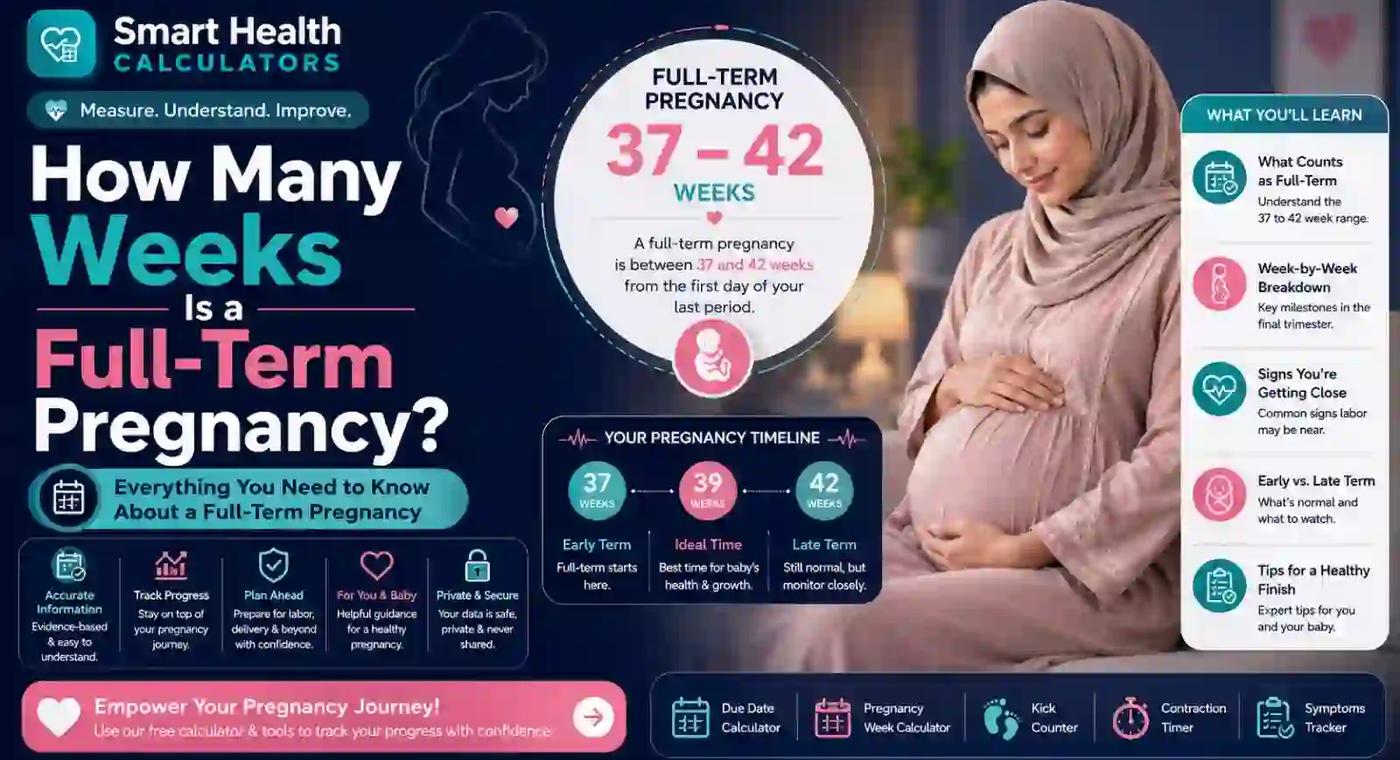
How Many Weeks Is a Full-Term Pregnancy?
Full term is 39–40 weeks 6 days, per ACOG. Learn the four official term categories, why timing matters, and what affects your due date.
Full term pregnancy is defined as 39 weeks 0 days through 40 weeks 6 days, according to the American College of Obstetricians and Gynecologists (ACOG). This sits within a broader four-category system ACOG established specifically because research showed that babies born even a week or two before 39 weeks face measurably higher risks of complications than those born right at term. Understanding which category your pregnancy falls into isn't just semantic — it reflects real differences in fetal development.
This guide breaks down all four ACOG term categories, explains why the distinction actually matters for your baby's development, and covers how due dates get calculated in the first place. If you're tracking your own pregnancy timeline, the Pregnancy Calculator can help you see exactly where you currently fall across these categories based on your due date.
The Four ACOG Term Categories
Before 2013, "term" was often used as a single loose label for anything from 37 to 42 weeks — a range so wide it obscured real differences in outcomes. ACOG, working alongside the Society for Maternal-Fetal Medicine, replaced that single category with four more precise definitions:
| Category | Week Range |
|---|---|
| Early Term | 37 weeks 0 days – 38 weeks 6 days |
| Full Term | 39 weeks 0 days – 40 weeks 6 days |
| Late Term | 41 weeks 0 days – 41 weeks 6 days |
| Post Term | 42 weeks 0 days and beyond |
Anything born before 37 weeks 0 days falls outside this system entirely and is classified as preterm (or premature), a distinct category with its own set of medical considerations.
Why Full Term Specifically Means 39–40 Weeks, Not 37
It's a common assumption that pregnancy is simply "done" at 37 weeks, but that's actually the earliest point of the early term category, not full term. The distinction exists because several critical organs continue developing meaningfully in those final two to three weeks:
- Lungs continue producing surfactant, the substance that keeps air sacs open, right up through 39 weeks in many pregnancies.
- Brain volume increases by a measurable percentage between 35 and 40 weeks, with ongoing development of the connections that support later cognitive and behavioral function.
- Liver function matures further, affecting the newborn's ability to process bilirubin and reducing the likelihood of significant jaundice.
Research reviewed by ACOG found that babies born in the early term window (37–38 weeks) have higher rates of respiratory problems, feeding difficulties, and NICU admission compared to babies born at 39 weeks or later — even though 37 weeks was, for decades, treated as essentially interchangeable with full term. This is part of why elective inductions and scheduled C-sections without a medical reason are now generally recommended to wait until at least 39 weeks whenever it's safe to do so.
Early Term vs. Full Term: What Actually Changes in Two Weeks
The difference between 37 weeks and 39 weeks might not sound significant, but the data suggests otherwise:
- Babies born early term have a higher likelihood of needing respiratory support immediately after birth.
- Feeding coordination — the ability to suck, swallow, and breathe in sequence — is often less developed at 37–38 weeks than at 39–40 weeks.
- Temperature regulation and blood sugar stability tend to be more robust in full term newborns.
None of this means an early term birth is inherently dangerous — the vast majority of babies born at 37–38 weeks do perfectly well. But when there's no medical reason to deliver early, the data supports letting a pregnancy progress to at least 39 weeks.
Late Term and Post Term: What Happens After the Due Date
On the other end of the range, late term (41 weeks 0 days–41 weeks 6 days) and post term (42 weeks and beyond) carry their own considerations, generally related to placental function beginning to decline and increased risk of complications the longer a pregnancy continues past 40 weeks.
Because of this, many care providers begin discussing induction options as a pregnancy approaches 41 weeks, and induction is more routinely recommended once a pregnancy reaches 42 weeks, given the rising risks associated with post term pregnancy. The exact approach varies by provider and individual circumstances, which is why this is very much a conversation to have directly with your OB-GYN or midwife rather than something to self-manage based on general guidelines.
How Your Due Date Gets Calculated in the First Place
Since "term" categories are measured against your due date, it helps to understand how that date is actually determined:
- Naegele's Rule is the traditional method: taking the first day of your last menstrual period (LMP) and adding 280 days (40 weeks), assuming a standard 28-day cycle.
- Dating ultrasound, typically performed in the first trimester, is now considered the most accurate method, especially for people with irregular cycles or uncertain LMP dates, since early ultrasound measurements correlate very closely with actual gestational age.
- IVF and other assisted conception dates allow for especially precise dating, since the exact date of fertilization or embryo transfer is known.
If your ultrasound dating and LMP-based date differ significantly, your provider will typically use the ultrasound date, particularly if it was performed early in the pregnancy. This is also why "estimated due date" is the accurate phrase — only a small percentage of babies are actually born on their exact calculated due date, and being born anywhere within the full term window is entirely normal.
Full Term for Twins and Multiples
It's worth noting that "full term" as defined above applies specifically to singleton pregnancies. Twin and multiple pregnancies are generally considered term earlier — often by 37–38 weeks for twins — since multiple pregnancies carry different risk profiles and placental demands than singleton pregnancies. If you're expecting multiples, your care provider will typically set a different target delivery window tailored to your specific situation rather than applying the singleton ACOG categories directly.
What This Means for Elective Induction Timing
If you're considering an elective induction (one without a specific medical indication), current guidance generally supports waiting until at least 39 weeks 0 days. This recommendation followed large studies showing that, contrary to earlier assumptions, elective induction at 39 weeks in low-risk pregnancies doesn't increase C-section rates and may even modestly reduce certain complications compared to expectant management — but induction before 39 weeks without medical necessity is generally avoided specifically because of the early term development considerations covered above.
This is a decision to make directly with your OB-GYN or midwife based on your specific pregnancy, not a generic rule to apply without medical guidance — individual circumstances (blood pressure, fetal growth, amniotic fluid levels, and more) can all shift the calculus in either direction.
Tracking Where You Are in Your Pregnancy
If you're trying to figure out exactly which term category applies to your current pregnancy, a few tools and resources can help:
- The Pregnancy Calculator lets you calculate your estimated due date and current gestational week based on your last menstrual period.
- For a broader understanding of what's happening trimester by trimester, this guide to pregnancy symptoms by trimester covers what to expect at each stage leading up to full term.
- If you're very early in pregnancy and still confirming symptoms, this article on first signs of pregnancy is a useful starting point before due date calculations become relevant.
- For a deeper dive specifically into due date math and how trimesters are divided, see pregnancy calculator, due dates, and trimesters explained.
Frequently Asked Questions
How many weeks is a full-term pregnancy? Full term is defined as 39 weeks 0 days through 40 weeks 6 days of pregnancy, according to ACOG's four-category classification system.
What is considered early term vs full term? Early term is 37 weeks 0 days through 38 weeks 6 days. Full term is 39 weeks 0 days through 40 weeks 6 days. The two-week difference reflects continued lung, brain, and liver development that occurs in the final weeks before 39 weeks.
Is 37 weeks full term? No. 37 weeks falls within the early term category, not full term. A baby born at 37 weeks is not premature, but is considered early term rather than full term.
What is a post-term pregnancy? A post-term pregnancy is one that continues to 42 weeks 0 days or beyond. Post term pregnancies carry increased monitoring and often a stronger recommendation for induction due to declining placental function the longer the pregnancy continues past 40 weeks.
Why does the exact week of birth matter? Fetal lung, brain, and liver development continues meaningfully through the last few weeks before 39 weeks. Babies born early term (37–38 weeks) show statistically higher rates of respiratory issues, feeding difficulties, and NICU admission compared to babies born full term.
Can a pregnancy go past 42 weeks? It's uncommon but possible without medical intervention. Most care providers recommend induction by or before 42 weeks specifically because of the rising risks associated with post term pregnancy, though the exact timing is a decision made with your provider based on your individual case.
The Bottom Line
"Full term" isn't just a casual phrase — it's a specific, research-backed window of 39 to 40 weeks 6 days, distinct from early term, late term, and post term. Those two extra weeks beyond 37 give the lungs, brain, and liver meaningful additional time to mature, which is exactly why unnecessary early delivery is generally avoided when a pregnancy is otherwise healthy and progressing normally.
If you're tracking your own timeline, use the Pregnancy Calculator to see exactly where your due date places you across these categories, and bring any specific questions about your delivery timing directly to your OB-GYN or midwife — they're the ones who can weigh your individual circumstances against this general framework.
Source: American College of Obstetricians and Gynecologists (ACOG) — acog.org
Medical Disclaimer
This article is for general education only. It is not medical advice, diagnosis, treatment, prescription guidance, or a replacement for professional healthcare. Speak with a qualified healthcare professional for personal medical concerns, symptoms, pregnancy concerns, mental health crisis, medication questions, or before making major health changes.