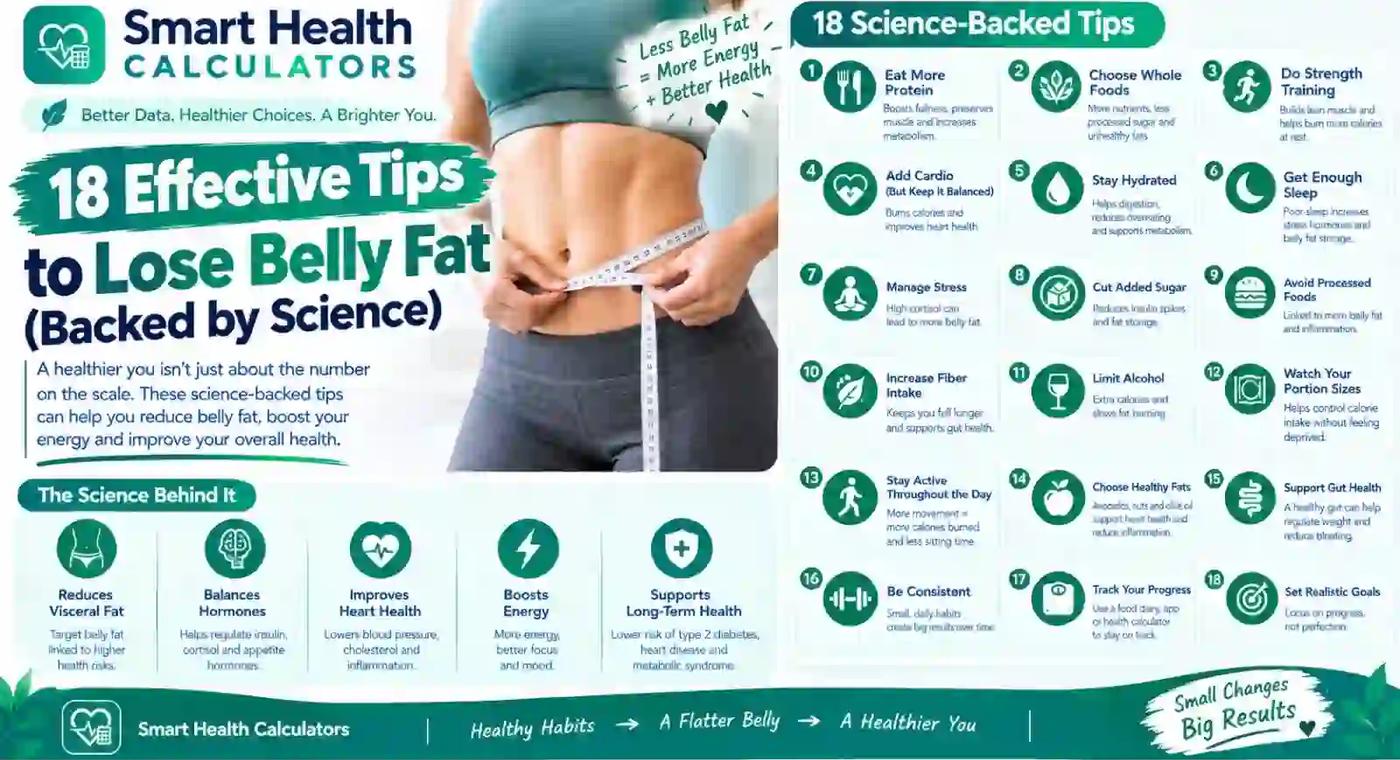
18 Effective Tips to Lose Belly Fat (Science-Backed)
Discover 18 science-backed ways to lose belly fat through nutrition, exercise, sleep, stress management, and sustainable habits for healthy fat loss.
Belly fat has a reputation for being stubborn, and there's real biology behind that reputation. Abdominal fat — particularly visceral fat, the kind that sits around your internal organs — responds to hormones, sleep, stress, and overall calorie balance in ways that make it genuinely harder to shift than fat in some other areas. But "harder" doesn't mean "impossible," and the actual science behind abdominal fat loss is far more specific and actionable than most generic listicles suggest.
This guide walks through 18 evidence-based strategies for reducing belly fat, grounded in guidance from the CDC, NIDDK, and NHLBI rather than fitness-influencer folklore. We'll also address the spot-reduction question honestly, since the research here is more nuanced than a simple yes or no.
Understanding Belly Fat: Visceral vs Subcutaneous
Before diving into tactics, it's worth understanding what you're actually trying to reduce, since not all abdominal fat behaves the same way.
Visceral fat sits deep in the abdominal cavity, surrounding organs like the liver and intestines. This is the fat most strongly linked to metabolic risk — insulin resistance, type 2 diabetes, and cardiovascular concerns.
Subcutaneous fat sits just beneath the skin and is what you can typically pinch. It's less metabolically dangerous than visceral fat, though it still contributes to overall waist size.
The distinction matters because visceral fat, despite sitting deeper, actually tends to respond somewhat more readily to overall lifestyle changes — exercise and calorie deficit — than stubborn subcutaneous fat in some individuals. For a deeper technical breakdown, our guide on visceral fat vs subcutaneous fat covers the distinction in more detail.
Why Waist Size Matters Beyond Appearance
According to NIDDK guidance, a waist circumference greater than 35 inches for women or 40 inches for men is associated with increased health risk in general U.S. population guidance. This isn't a universal cutoff for every body type or ethnicity, but it's a useful general marker worth tracking alongside weight itself. You can check your own ratio using our waist-to-height ratio calculator, which gives a more individualized read than a fixed inch measurement alone.
The 18 Science-Backed Strategies
1. Create a Modest, Sustainable Calorie Deficit
Weight loss, including abdominal fat loss, fundamentally requires burning more calories than you consume. The CDC notes that people who lose weight at a gradual, steady pace — about 1 to 2 pounds per week — are more likely to keep it off than those who lose weight faster. This typically comes from a daily deficit of roughly 500 calories, achieved through a combination of diet and activity rather than extreme restriction.
2. Set a Realistic Initial Goal
Rather than aiming for a dramatic transformation, NIDDK-aligned guidance suggests an initial weight-loss goal of 5-10% of your starting body weight over about six months for many people in structured weight-management programs. This modest target has been shown to produce meaningful improvements in blood pressure, cholesterol, and diabetes risk even before reaching a "final" goal weight.
3. Prioritize Protein at Every Meal
Higher protein intake supports satiety, helps preserve lean muscle during a calorie deficit, and has a modestly higher thermic effect than carbohydrates or fat (meaning your body burns slightly more energy digesting it). Practical sources include eggs, lean poultry, fish, legumes, and dairy — spread across meals rather than concentrated in one sitting.
4. Increase Soluble Fiber Intake
Soluble fiber — found in oats, beans, lentils, and certain fruits — forms a gel-like substance in the digestive tract that slows digestion and helps regulate appetite. Some research has associated higher soluble fiber intake with reduced visceral fat accumulation over time, making it one of the more evidence-supported dietary levers for abdominal fat specifically.
5. Meet the Recommended Physical Activity Targets
Current U.S. Physical Activity Guidelines, reflected in CDC guidance, recommend adults get at least 150 minutes of moderate-intensity aerobic activity per week (or 75 minutes of vigorous activity), plus muscle-strengthening activity on at least two days per week. This isn't an arbitrary number — it's the threshold most consistently associated with meaningful health benefits in population research.
6. Add Resistance Training, Not Just Cardio
Resistance training builds and preserves muscle mass, which supports a higher resting metabolic rate over time. It also appears to have a meaningful effect on reducing visceral fat specifically, independent of weight loss alone, making it a genuinely complementary strategy to cardio rather than a substitute or an afterthought.
7. Understand That Walking Genuinely Counts
Walking is aerobic activity, and it counts fully toward the 150-minutes-per-week target. Brisk walking, in particular, is one of the most sustainable, joint-friendly ways to build consistent activity into daily life without requiring a gym membership or specialized equipment.
8. Incorporate HIIT Strategically, Not Exclusively
High-intensity interval training (HIIT) can be time-efficient and has shown some evidence of favorable effects on visceral fat in research settings. However, it's not inherently superior to steady-state cardio for everyone — it's more demanding on recovery and joints, and consistency (whichever method you'll actually sustain) tends to matter more than the specific modality.
9. Address the Spot-Reduction Question Honestly
This is worth stating clearly rather than glossing over: a well-known 2011 randomized trial found that abdominal exercises alone did not significantly reduce abdominal fat, even though it improved muscular endurance in the area. More recent, smaller studies have reported some localized effects under specific exercise protocols, so the evidence isn't perfectly uniform. The honest, science-backed summary is this: doing crunches alone is very unlikely to meaningfully reduce belly fat without an overall calorie deficit and broader activity — ab exercises build muscle underneath the fat, but they don't preferentially burn the fat sitting on top of it.
10. Prioritize Sleep Duration and Quality
Sleep deprivation disrupts the hormones that regulate hunger (ghrelin and leptin) and has been associated with increased abdominal fat accumulation in multiple studies. The CDC identifies adequate sleep as one of the core components of healthy weight management, alongside nutrition and activity. Our guide on how stress affects sleep quality covers the bidirectional relationship between these two factors in more depth.
11. Manage Chronic Stress and Cortisol
Chronic stress elevates cortisol, a hormone that has been linked in research to increased abdominal fat storage specifically, more so than fat storage elsewhere in the body. This connection is genuinely supported by evidence, though it's one piece of a larger picture rather than the sole driver of belly fat for most people. Practical stress-reduction habits — including breathing exercises to lower stress — are a legitimate part of an abdominal fat strategy, not a separate wellness tangent.
12. Limit Added Sugar and Sugar-Sweetened Beverages
The World Health Organization recommends limiting free sugars as part of general obesity prevention, and sugar-sweetened beverages specifically have been associated with increased visceral fat in observational research, likely due to their combination of high calorie density and minimal satiety. Swapping sugary drinks for water is one of the simpler, higher-impact dietary changes available.
13. Moderate Alcohol Consumption
Alcohol is calorie-dense, provides no satiety benefit, and can also lower inhibition around other food choices. Regular, higher alcohol intake has been associated with increased abdominal fat accumulation in research, making moderation a genuinely relevant lever for anyone specifically targeting waist reduction.
14. Track Progress With Waist Circumference, Not Just Weight
Since visceral fat responds to lifestyle changes somewhat independently of overall scale weight, tracking waist circumference alongside weight gives a more complete picture of actual abdominal fat change — particularly relevant if you're building muscle simultaneously, which can keep the scale steady while your waist measurement still improves.
15. Build Consistency Before Intensity
A moderate, sustainable routine followed consistently for months outperforms an aggressive plan abandoned after three weeks. This is less an exciting scientific finding and more the accumulated result of behavioral research on habit formation — but it's arguably the single most important item on this list in practice.
16. Adjust Expectations by Life Stage
Hormonal shifts during menopause are associated with a tendency toward increased abdominal fat storage even without changes in overall diet or activity, which is a genuine physiological shift rather than a personal failing. Similarly, natural declines in muscle mass and testosterone with age can make abdominal fat accumulation more likely in men over 40. Strategies remain the same — calorie balance, resistance training, sleep, stress management — but expectations around pace should adjust accordingly.
17. Be Skeptical of Fat-Burning Supplements and Quick Fixes
Claims that a specific supplement, tea, or "detox" drink burns abdominal fat specifically are not well-supported by rigorous evidence. Products marketed this way frequently rely on modest stimulant effects or diuretic water-weight loss rather than genuine fat reduction. The same skepticism applies to waist trainers, which may create temporary visual compression but have no evidence of producing permanent fat loss.
18. Use Your Numbers to Build a Realistic Plan
Rather than following a generic diet plan, calculating your actual calorie needs, protein targets, and activity baseline gives you a plan built around your real numbers rather than someone else's. This is exactly the kind of planning our calorie intake planner and BMR calculator are built for — starting from your actual metabolic baseline rather than a one-size-fits-all number.
How Long Does It Actually Take?
Given the CDC's 1-2 lb/week guidance, a realistic timeline for meaningful, visible abdominal fat reduction is measured in months, not weeks. Someone aiming for the NIDDK-aligned 5-10% initial goal might reasonably expect that timeline to span roughly 3-6 months, depending on starting point and consistency — a timeframe that feels unglamorous compared to social media transformation claims, but one that's genuinely grounded in sustainable, research-backed pacing.
A Practical Example: Combining the Strategies
Consider someone with a desk job, moderate stress, and inconsistent sleep who wants to reduce visceral fat specifically. Rather than starting with an aggressive diet, a more evidence-aligned approach looks like: establishing a modest 500-calorie daily deficit, adding three weekly resistance sessions alongside daily walking to hit the 150-minute activity target, prioritizing 7-8 hours of sleep consistently, and reducing sugar-sweetened beverage intake. Tracking waist circumference monthly alongside weight gives a fuller picture of progress than the scale alone — and after 8-12 weeks of this combined approach, meaningful, measurable change in both waist size and metabolic markers is a realistic expectation, based on the pacing this evidence base supports.
Frequently Asked Questions
Can you actually target belly fat with exercise?
Not reliably through ab exercises alone — a well-known 2011 trial found abdominal exercises didn't significantly reduce abdominal fat despite improving muscle endurance. Overall calorie deficit combined with broader exercise remains the primary driver of abdominal fat loss.
How long does it take to lose belly fat?
Following CDC guidance of 1-2 pounds of total weight loss per week, meaningful abdominal fat reduction typically takes several months of consistent effort rather than weeks, with NIDDK-aligned programs often targeting 5-10% of starting weight over roughly six months.
Can walking help reduce belly fat?
Yes. Walking counts fully toward the CDC's recommended 150 minutes of weekly moderate aerobic activity, and consistent aerobic activity is one of the more evidence-supported approaches for reducing visceral fat specifically.
Does stress cause belly fat?
Chronic stress elevates cortisol, which has been linked in research to increased abdominal fat storage specifically. It's a genuine contributing factor, though it works alongside diet, activity, and sleep rather than acting alone.
What waist size is considered a health risk?
NIDDK guidance identifies waist circumference above 35 inches for women and 40 inches for men as associated with increased health risk in general U.S. population guidance, though this threshold can vary by individual context and population.
Can you lose belly fat after age 40?
Yes, though natural declines in muscle mass and hormonal shifts can make it slower. The same core strategies — calorie balance, resistance training, sleep, and stress management — remain effective; timeline expectations may simply need adjusting.
Final Takeaway: Consistency Over Shortcuts
The science behind abdominal fat loss doesn't support dramatic, fast transformations — it supports a modest calorie deficit, resistance and aerobic activity meeting current CDC guidelines, adequate sleep, stress management, and patience measured in months rather than days. Spot-reduction through ab exercises alone isn't well-supported by the evidence, but a genuinely evidence-based combined approach consistently is.
Start by understanding your actual numbers rather than guessing. Explore Smart Health Calculators' full toolkit to calculate your calorie needs, BMR, and body fat estimate, and pair that data with the habits outlined above for a plan built on your real starting point rather than a generic template.
Medical Disclaimer
This article is for general education only. It is not medical advice, diagnosis, treatment, prescription guidance, or a replacement for professional healthcare. Speak with a qualified healthcare professional for personal medical concerns, symptoms, pregnancy concerns, mental health crisis, medication questions, or before making major health changes.