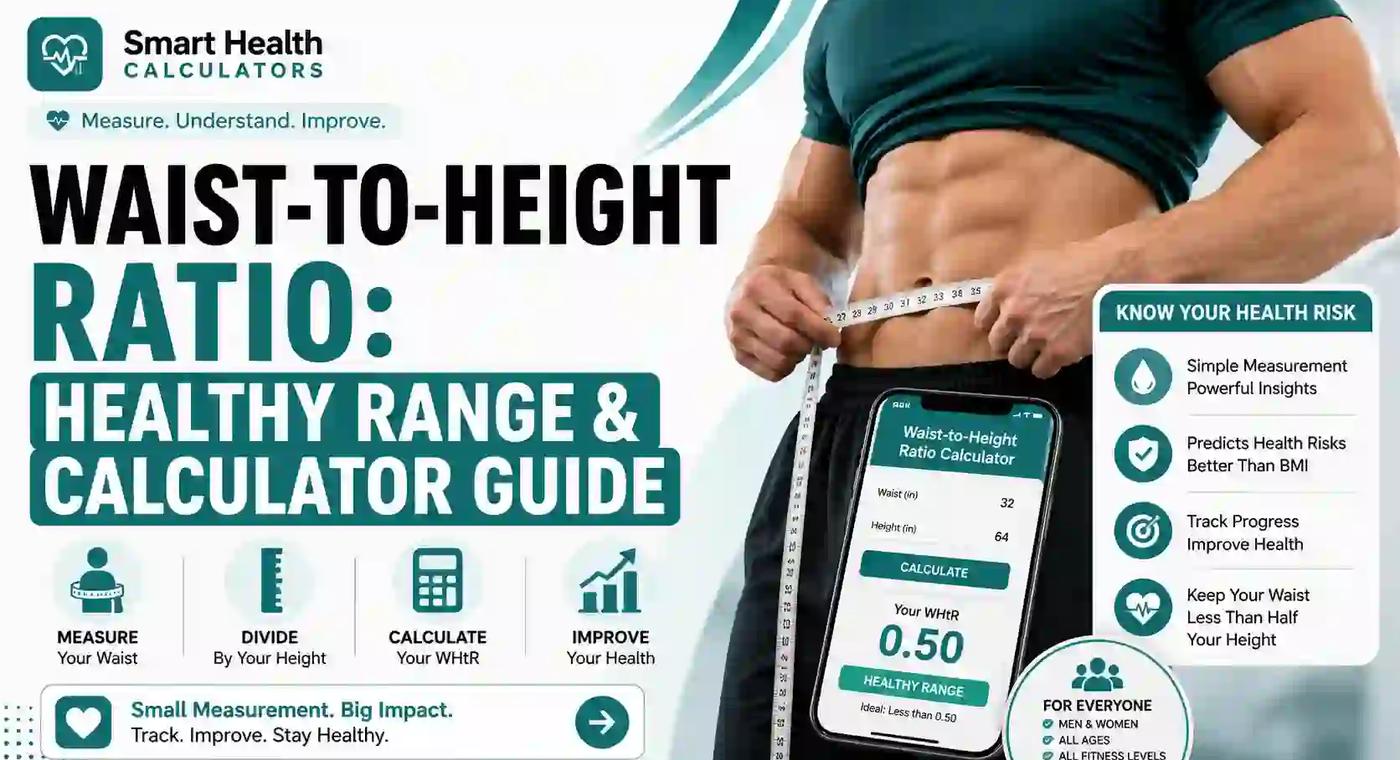
Waist-to-Height Ratio: Healthy Range & Calculator Guide
Learn how to calculate your waist-to-height ratio, understand the healthy 0.5 cutoff, compare WHtR with BMI, and track your health risk.
If you've ever stepped on a scale and felt like the number didn't tell you the full story, you're not alone. Weight alone can't show where your body is storing fat, and that matters more than most people realize. This is exactly why researchers and doctors increasingly rely on a simple, low-cost measurement called the waist-to-height ratio (WHtR) — a number that often predicts health risk more accurately than BMI alone.
In this guide, you'll learn what a healthy waist-to-height ratio actually looks like, how to calculate yours in under a minute, why doctors trust it, and what to do if your number falls outside the healthy range. We'll also compare it against BMI and waist-to-hip ratio so you know exactly which tool fits your goals.
What Is Waist-to-Height Ratio?
Waist-to-height ratio is a simple calculation that divides your waist circumference by your height, using the same unit of measurement for both. The result is a decimal number, usually somewhere between 0.35 and 0.75, that reflects how much abdominal fat you're carrying relative to your body frame.
The formula looks like this:
WHtR = Waist Circumference ÷ Height
For example, if your waist measures 32 inches and you're 64 inches tall, your WHtR would be 32 ÷ 64 = 0.5. That single number carries a surprising amount of information, because abdominal fat — the fat stored around your organs and midsection — behaves differently in the body than fat stored in your hips, thighs, or arms.
Unlike BMI, which only accounts for total weight and height, WHtR zeroes in on fat distribution. Two people can have an identical BMI yet carry very different amounts of visceral fat, and that difference shows up clearly in their waist-to-height ratio.
Why Waist-to-Height Ratio Matters More Than You Think
Abdominal fat isn't just a cosmetic concern. It's metabolically active tissue that surrounds internal organs like the liver, pancreas, and intestines, and it's been linked repeatedly to serious health conditions. A large-scale analysis of U.S. adults published in a peer-reviewed public health journal found that a cohort of over 100,000 postmenopausal women showed a notably higher risk of cardiovascular events when their WHtR reached 0.5 or above, with the strength of that association comparable to waist circumference and possibly stronger than BMI-based obesity classification.
What makes WHtR especially useful is that it captures risk in people who look "normal weight" on a BMI chart. Research tracking national health survey data found that roughly a quarter of the population had a normal waist circumference but an elevated waist-to-height ratio, and this group still carried an increased likelihood of cardiometabolic disease, particularly diabetes. In plain terms: you can pass a BMI check and still be carrying dangerous levels of abdominal fat that only WHtR picks up.
A separate population study comparing WHtR against the combined BMI-and-waist-circumference method for detecting health risk found that the waist-to-height ratio identified considerably more people at early health risk than the traditional BMI-plus-waist-circumference matrix, while showing comparable accuracy for predicting hypertension across both genders and age groups. This is a big reason clinicians and researchers now treat WHtR as a frontline screening tool rather than a niche measurement.
Health Risks Linked to a High Waist-to-Height Ratio
- Cardiovascular disease — elevated visceral fat increases strain on the heart and blood vessels
- Type 2 diabetes — abdominal fat interferes with insulin sensitivity
- High blood pressure (hypertension) — consistently linked with elevated WHtR in multiple studies
- Metabolic syndrome — a cluster of conditions including high blood sugar, high blood pressure, and abnormal cholesterol
- Certain cancers — some prospective cohort studies have linked elevated WHtR with higher liver cancer risk
How to Calculate Your Waist-to-Height Ratio (Step-by-Step)
You don't need special equipment — just a flexible tape measure and two minutes.
- Stand up straight and breathe out normally (don't suck in your stomach).
- Find your waist — this is typically the narrowest point between your ribs and your hip bones, roughly at belly-button level for most people.
- Wrap the tape measure around your waist, keeping it parallel to the floor and snug but not compressing your skin.
- Record your waist measurement in inches or centimeters.
- Measure your height in the same unit.
- Divide your waist measurement by your height. The result is your WHtR.
If math isn't your thing, you can skip the manual calculation entirely using a waist-to-height ratio calculator that does the division instantly and tells you which risk category you fall into.
Healthy Waist-to-Height Ratio Chart
While no single number applies perfectly to every body type, most researchers use 0.5 as the primary cutoff point. This "keep your waist to less than half your height" rule has been studied extensively because researchers using data from national health surveys applied a value of 0.5 or higher as the threshold indicating increased health risk across both sexes, since no universally agreed-upon alternative cutoff has been formally established.
| WHtR Range | Category | What It Generally Means |
|---|---|---|
| Below 0.40 | Underweight range | May indicate insufficient body fat; worth discussing with a doctor |
| 0.40 – 0.49 | Healthy range | Low risk of abdominal-fat-related health issues |
| 0.50 – 0.59 | Increased risk | Consider lifestyle adjustments; monitor other health markers |
| 0.60 and above | High risk | Strongly associated with cardiometabolic disease; medical consultation recommended |
This chart is a general screening guide, not a diagnostic tool. Genetics, muscle mass, age, and ethnicity all influence how these numbers apply to an individual, which is why WHtR should be viewed alongside other health indicators rather than in isolation.
Waist-to-Height Ratio for Men vs. Women
Interestingly, the 0.5 threshold applies fairly consistently across both sexes, which is one of WHtR's biggest advantages over waist circumference alone (which uses different cutoffs for men and women — typically above 40 inches for men and above 35 inches for women being flagged as elevated).
For men: A WHtR consistently under 0.5 is associated with lower cardiometabolic risk. Men naturally tend to store more visceral fat than women even at similar body weights, which is why abdominal measurements matter more for male health screening than many people assume.
For women: The same 0.5 threshold applies, though hormonal factors — especially after menopause — can shift fat storage patterns toward the abdomen. This explains why postmenopausal women are frequently the focus of WHtR research, including the cardiovascular study cited earlier in this article.
Waist-to-Height Ratio vs. BMI: Which Is More Accurate?
This comparison comes up constantly, and for good reason — most people have used a BMI calculator at some point, but far fewer have measured their WHtR.
| Factor | BMI | Waist-to-Height Ratio |
|---|---|---|
| What it measures | Overall weight relative to height | Fat distribution around the midsection |
| Accounts for muscle mass | No | Partially |
| Detects "normal weight obesity" | No | Yes |
| Ease of measurement | Requires scale and height | Requires tape measure and height |
| Predictive of cardiometabolic risk | Moderate | Strong, per multiple studies |
| Consistent cutoff across sexes | No (different charts for men/women) | Yes (0.5 for both) |
A comprehensive review of screening tools found that WHtR performs better than BMI in assessing central obesity, and comparative studies using receiver operating characteristic analysis showed it also outperforms both BMI and waist circumference alone in classifying cardiovascular risk factors among both adults and children.
That doesn't mean BMI is useless — it's still a quick, population-level screening tool, and pairing it with WHtR gives a far more complete picture than relying on either measurement alone. If you want to see how the two compare for your own numbers, our guide on whether BMI is accurate and where it falls short breaks this down in more depth, and our dedicated piece on BMI vs. body fat percentage covers a third angle on the same question.
Waist-to-Height Ratio vs. Waist-to-Hip Ratio
These two are often confused, so here's the distinction in plain language:
- Waist-to-height ratio (WHtR) compares your waist to your total height, making it useful across people of very different builds.
- Waist-to-hip ratio (WHR) compares your waist to your hip circumference, which highlights "apple" versus "pear" body shapes but doesn't account for how tall or short you are.
Both are legitimate screening tools, but WHtR has gained more traction in recent research because height-adjustment makes it comparable across a wider, more diverse population — from a 5'2" adult to a 6'4" adult — without needing separate charts.
What Waist-to-Height Ratio Doesn't Tell You
No single number captures your entire health picture, and it's worth being upfront about WHtR's limitations:
- It doesn't distinguish between muscle and fat in the midsection, so very muscular individuals may score higher without added health risk.
- It doesn't account for bone structure or where else your body naturally stores fat.
- It's a screening indicator, not a diagnosis — it flags risk, but bloodwork, blood pressure, and a physician's assessment tell the fuller story.
- Pregnant women, growing children, and certain medical conditions require different interpretation frameworks entirely.
If you want a broader view of your body composition, pairing your WHtR with a body fat percentage calculator or checking your results against a body fat percentage chart rounds out the picture considerably.
How to Improve a High Waist-to-Height Ratio
If your ratio comes back above 0.5, the good news is that abdominal fat tends to respond well to consistent lifestyle changes — often faster than fat stored elsewhere in the body.
1. Prioritize a modest calorie deficit. You don't need an extreme diet. A sustainable, moderate reduction in daily intake, tracked through a calorie intake planner, tends to outperform crash diets over the long run.
2. Add resistance training, not just cardio. Strength training helps preserve lean muscle while you lose fat, which keeps your metabolism working in your favor. Two to three sessions a week targeting major muscle groups is a reasonable starting point.
3. Walk more than you think you need to. Low-intensity movement — 7,000 to 10,000 steps daily — has consistently shown benefits for reducing visceral fat, partly because it's sustainable in a way high-intensity workouts sometimes aren't.
4. Manage stress and sleep. Chronically elevated cortisol from poor sleep or unmanaged stress is directly linked to abdominal fat storage. If your sleep has been inconsistent, our article on how stress affects sleep quality explains the connection in more detail.
5. Cut back on refined sugar and alcohol. Both are strongly associated with visceral fat accumulation, more so than fat stored in other areas of the body.
6. Re-measure monthly, not daily. Waist measurements fluctuate with water retention, digestion, and even the time of day. Monthly tracking gives you a much clearer trend line than obsessive daily checks.
For a more complete, week-by-week approach, our natural body fat reduction guide and our piece on lowering BMI naturally both offer practical frameworks that pair well with WHtR tracking.
Real-World Example: How WHtR Catches What BMI Misses
Consider two hypothetical adults, both 5'8" tall and 165 pounds, giving them an identical BMI of 25.1 — technically in the "overweight" category by standard BMI charts.
- Person A carries most of their weight as muscle from regular strength training, with a 34-inch waist. Their WHtR is 34 ÷ 68 = 0.5.
- Person B carries most of their weight around the midsection with minimal muscle mass, with a 40-inch waist. Their WHtR is 40 ÷ 68 = 0.59.
Both share the exact same BMI, yet Person B falls into a considerably higher-risk category once WHtR is factored in. This is the exact blind spot that makes waist-to-height ratio such a valuable companion metric rather than a replacement for BMI — it adds the context that weight-based formulas simply can't capture.
Waist-to-Height Ratio and Age
Your ideal WHtR doesn't change dramatically with age the way some other health markers do, but body composition naturally shifts as you get older. Muscle mass tends to decline while fat — particularly visceral fat — tends to increase, even if your weight on the scale stays the same. This is one reason WHtR is increasingly recommended for older adults as a more meaningful check than weight alone.
If you're curious how your ideal weight range shifts with age and height, our guide on normal weight range by height is a useful companion resource, and our broader collection of free health calculators can help you track multiple markers together over time.
Frequently Asked Questions
What is a healthy waist-to-height ratio?
A WHtR below 0.5 is generally considered healthy for most adults, regardless of sex. This means your waist circumference should be less than half your height. Ratios of 0.5 or higher are associated with increased risk of cardiovascular disease, diabetes, and metabolic syndrome.
How do I calculate my waist-to-height ratio?
Measure your waist circumference at its narrowest point, measure your height using the same unit, then divide the waist measurement by your height. For example, a 30-inch waist divided by 66 inches of height equals a WHtR of 0.45, which falls in the healthy range.
Is waist-to-height ratio more accurate than BMI?
For assessing abdominal fat and related health risks, research suggests WHtR often outperforms BMI, since it accounts for fat distribution rather than just overall weight. However, the two measurements serve different purposes and work best when used together rather than as substitutes for one another.
What does a 0.5 waist-to-height ratio mean?
A WHtR of exactly 0.5 sits right at the widely used risk threshold. It's not an emergency number, but it's generally treated as a signal to pay closer attention to lifestyle factors like diet, activity level, and sleep before the ratio climbs higher.
Can waist-to-height ratio predict heart disease risk?
Yes, to a meaningful degree. Large cohort studies have found that individuals with a WHtR of 0.5 or above face a notably higher risk of cardiovascular events compared to those below that threshold, with the association holding even after adjusting for other risk factors.
Does waist-to-height ratio work well for athletes and muscular individuals?
Not always. Because WHtR can't distinguish between muscle and fat, very muscular individuals may score higher than their actual health risk would suggest. In these cases, pairing WHtR with a body fat percentage measurement gives a more accurate picture.
How often should I check my waist-to-height ratio?
Once a month is generally sufficient for tracking meaningful trends. Daily measurements tend to reflect short-term fluctuations like water retention rather than real changes in body composition.
Final Takeaway
Your waist-to-height ratio is one of the simplest, most researched, and most actionable health numbers you can track — no expensive equipment, no lab visit, just a tape measure and basic math. Aiming to keep your waist circumference under half your height gives you a practical, evidence-backed target that's easier to act on than most health goals.
If you haven't measured yours yet, take two minutes to do it today, then use our waist-to-height ratio calculator to instantly see where you stand. And if the number surprises you, pair it with our ideal weight calculator and body fat estimator to build a complete, realistic picture of your health — then check out our guide to setting realistic health goals to turn that number into an actual plan.
Medical Disclaimer
This article is for general education only. It is not medical advice, diagnosis, treatment, prescription guidance, or a replacement for professional healthcare. Speak with a qualified healthcare professional for personal medical concerns, symptoms, pregnancy concerns, mental health crisis, medication questions, or before making major health changes.