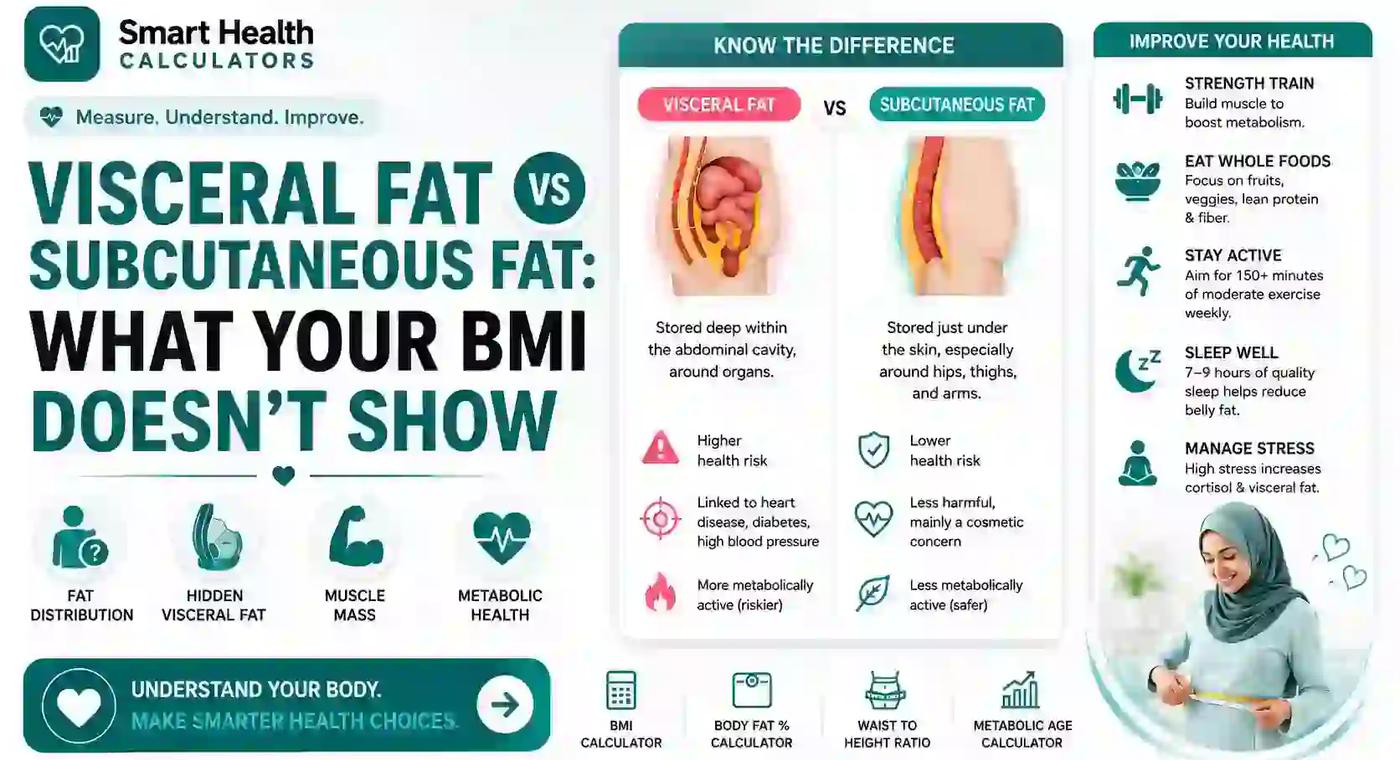
Visceral Fat vs Subcutaneous Fat: Differences & How to Reduce It.
Learn the difference between visceral and subcutaneous fat, why visceral fat is more dangerous, how to measure it, and evidence-based ways to reduce it.
Visceral fat sits deep inside your abdomen, wrapped around organs like the liver, pancreas, and intestines, while subcutaneous fat sits just under your skin — the kind you can pinch on your arms, thighs, or belly. They look similar on a scale and even feel similar under a bit of skin, but metabolically they behave very differently, and that difference matters more than your BMI will ever tell you.
This is the gap most people miss: you can have a completely "normal" BMI and still be carrying a dangerous amount of visceral fat, a pattern researchers sometimes call TOFI — thin outside, fat inside. BMI measures total weight relative to height; it has no way of knowing whether that weight is muscle, subcutaneous fat, or visceral fat wrapped around your liver. Here's what actually distinguishes these two fat types, why one carries meaningfully more health risk, and how to get a realistic read on your own risk without needing an expensive scan.
Visceral Fat vs. Subcutaneous Fat: The Core Difference
Subcutaneous fat is the fat stored directly beneath your skin, distributed across your entire body — arms, thighs, hips, and the outer layer of your abdomen. It's the fat you can physically grab between your fingers, and it serves genuinely useful purposes: insulation, energy storage, and cushioning.
Visceral fat, also called visceral adipose tissue (VAT), is stored deeper in the abdominal cavity, surrounding internal organs rather than sitting under the skin. You can't pinch it, and you often can't see it directly, even in someone who appears relatively lean, because it sits behind the abdominal wall muscles rather than on the surface.
| Factor | Visceral Fat | Subcutaneous Fat |
|---|---|---|
| Location | Deep abdomen, around internal organs | Just beneath the skin, all over the body |
| Visibility | Not directly visible or pinchable | Visible and pinchable |
| Health risk | Strongly linked to metabolic and cardiovascular disease | Lower risk in moderate amounts |
| Metabolic activity | Highly active, releases inflammatory compounds | Less metabolically active |
| Measurement | Waist circumference, CT/MRI, DEXA scan | Skinfold calipers, visual assessment |
The key distinction isn't just where the fat sits — it's what the fat tissue actually does once it's there. Subcutaneous fat is comparatively inert. Visceral fat is metabolically active tissue that produces inflammatory compounds and hormones directly linked to elevated disease risk, which is exactly why doctors and researchers treat it as a genuinely different health concern rather than just "more of the same fat in a different spot."
Why Visceral Fat Is More Dangerous
Visceral fat's proximity to major organs, especially the liver, isn't incidental to why it's risky — it's central to it. Fat stored viscerally releases fatty acids and inflammatory signaling molecules directly into the portal vein, which carries blood straight to the liver. This constant exposure contributes to insulin resistance, elevated blood lipids, and low-grade systemic inflammation in a way that subcutaneous fat, stored elsewhere in the body, generally doesn't replicate to the same degree.
This mechanism connects visceral fat to a genuinely serious list of health conditions:
- Type 2 diabetes, through its role in worsening insulin resistance
- Cardiovascular disease, including elevated risk of heart attack and stroke
- Non-alcoholic fatty liver disease, given the direct anatomical proximity to the liver
- Metabolic syndrome — the cluster of elevated blood pressure, blood sugar, and cholesterol that significantly raises cardiovascular risk
- Certain cancers, where research has found associations with visceral adiposity specifically, independent of overall body weight
A notable finding from Mayo Clinic researchers found that people with a normal body weight but high visceral fat — the TOFI pattern — had a 2.75 times higher risk of heart disease and a 2.08 times higher risk of death from any cause compared to normal-weight people without visceral obesity. That's a striking number precisely because it applies to people whose BMI would suggest they're in a low-risk category.
The "Normal BMI, High Visceral Fat" Problem (TOFI)
This is the scenario that gives this article its title, and it deserves a direct explanation rather than a passing mention.
BMI is a simple ratio of weight to height. It cannot distinguish between a kilogram of muscle, a kilogram of subcutaneous fat, or a kilogram of visceral fat — to the formula, weight is just weight. Someone can land squarely in the "normal" BMI range while carrying a meaningfully elevated amount of visceral fat, particularly if they have low muscle mass, a naturally slim frame, or a genetic tendency to store fat viscerally rather than subcutaneously.
This pattern is sometimes called TOFI (Thin Outside, Fat Inside), and it's a genuinely useful term because it captures exactly what BMI misses. A person can look lean in clothing, weigh what's considered a "healthy" amount for their height, and still be carrying significant metabolic risk hidden inside the abdominal cavity.
Certain factors make TOFI more likely:
- Low muscle mass, common in people who are sedentary or haven't done resistance training, since muscle contributes to a healthier weight-to-composition ratio
- Genetics, which influence where the body preferentially stores excess fat
- Aging, particularly the shift in fat distribution that occurs with declining hormone levels
- Chronic stress, since elevated cortisol specifically promotes visceral fat storage over subcutaneous storage
- Poor sleep, which research has linked to a redirection of fat storage toward the abdomen even over just a few nights of restriction
If you've ever wondered why BMI sometimes doesn't match how someone actually looks or feels health-wise, this is a large part of the explanation. Our guide on why BMI has real limitations goes deeper into the specific ways this single number can mislead, beyond just the visceral fat question.
How to Estimate Visceral Fat Without a Scan
Precise visceral fat measurement genuinely requires imaging — a CT scan, MRI, or specialized DEXA scan can directly quantify how much fat sits in the abdominal cavity. Most people don't have easy or affordable access to that kind of imaging, which is exactly why waist circumference has become the standard practical stand-in, endorsed by the National Heart, Lung, and Blood Institute (NHLBI, part of the NIH) as a supplementary indicator alongside BMI.
Waist circumference thresholds for increased risk, based on NHLBI guidance:
- Men: 102 cm (40 inches) or more indicates substantially increased risk
- Women: 88 cm (35 inches) or more indicates substantially increased risk
These specific numbers were developed primarily from data on populations of European descent, and it's worth knowing that ethnicity-specific thresholds exist because body composition and fat distribution patterns genuinely differ across populations. The International Diabetes Federation, for instance, sets lower thresholds for South Asian and East Asian populations — around 90 cm for men and 80 cm for women — reflecting research showing that people of Asian descent tend to carry more visceral fat at the same waist measurement compared to European populations.
How to measure your waist circumference correctly:
- Stand up straight and locate the top of your hip bone and the bottom of your rib cage
- Wrap a flexible tape measure around your waist at the midpoint between these two landmarks, roughly at your belly button level for most people
- Keep the tape snug but not compressing the skin
- Measure after exhaling normally, not while holding your breath in or sucking your stomach in
- Take the measurement twice to confirm consistency
Waist-to-hip ratio is another useful supplementary metric, calculated by dividing your waist measurement by your hip measurement at the widest point. Elevated ratios — generally cited in the range of 0.90 to 1.00 for men and 0.80 to 0.90 for women — correlate with increased health risk independent of total body weight.
Neither of these measurements diagnoses anything on its own — crossing a threshold is a signal worth paying attention to, not a medical verdict. If you want an easy way to track this alongside your broader body composition over time, our Body Fat Estimator is a useful companion tool for monitoring trends between any formal check-ups with a healthcare provider.
What Causes Visceral Fat to Increase
Understanding what actually drives visceral fat accumulation helps explain why it's not purely a matter of "eating too much" — several distinct factors contribute, often simultaneously:
- Chronic stress and elevated cortisol. Cortisol specifically promotes fat storage in the visceral compartment rather than subcutaneously, which is one reason prolonged high-stress periods often coincide with abdominal weight gain even without major changes in diet.
- Poor sleep quality and duration. Sleep deprivation has been linked to shifts in fat storage patterns favoring the abdomen, independent of total calorie intake.
- Sedentary behavior. Research has found that physical inactivity specifically promotes preferential visceral fat deposition, separate from its general effect on total body weight.
- Excess alcohol intake. Alcohol consumption has a well-documented relationship with abdominal fat accumulation, independent of the calories alcohol itself contributes.
- Hormonal changes, particularly around menopause. Declining estrogen shifts fat storage patterns from the hips toward the abdomen, which is part of why cardiovascular risk tends to rise noticeably in postmenopausal women.
- Genetics. Some people are simply predisposed to store a larger share of excess energy as visceral fat rather than subcutaneous fat, even at similar overall body weights.
This list matters because it shows visceral fat reduction isn't purely a diet-and-exercise equation — sleep and stress management genuinely belong in the conversation too, not as an afterthought.
How to Reduce Visceral Fat
The encouraging news in all of this: visceral fat tends to respond relatively well to lifestyle interventions, in some research responding more readily than subcutaneous fat does to the same changes. Here's what the evidence-based approach generally looks like:
Aerobic exercise has consistently shown a meaningful effect on visceral fat specifically, even without significant total weight loss in some studies. Regular moderate-to-vigorous cardio — brisk walking, cycling, swimming — appears to preferentially target visceral fat stores.
Resistance training supports visceral fat reduction both directly and indirectly, by building metabolically active muscle tissue and improving overall insulin sensitivity. Combining both training types generally outperforms either alone.
Reducing added sugar and refined carbohydrates appears to have an outsized effect on visceral fat specifically, likely tied to how these foods influence insulin response and fat storage patterns.
Prioritizing sleep genuinely belongs in a visceral fat reduction plan, not just a general wellness one, given the documented link between sleep restriction and abdominal fat storage.
Managing chronic stress through whatever sustainable method works for you — since elevated cortisol specifically favors visceral over subcutaneous storage, stress management isn't a soft add-on here, it's addressing one of the actual mechanisms.
Moderating alcohol intake can meaningfully affect abdominal fat storage independent of its calorie contribution alone.
If you're building out a broader plan, our guide to natural body fat reduction covers the practical nutrition and training fundamentals in more depth, and pairing that with our Calorie Intake Planner can help you find a sustainable starting point rather than an extreme approach that's hard to maintain.
Is Subcutaneous Fat Dangerous Too?
Not to nearly the same degree, though "harmless" isn't quite accurate either. Subcutaneous fat in moderate amounts is a normal, even protective, part of human physiology — it provides insulation, cushions organs and joints, and serves as an accessible energy reserve. Research consistently shows it carries substantially lower metabolic risk than visceral fat at equivalent amounts.
That said, excessive subcutaneous fat isn't risk-free — it still contributes to overall body weight, can affect joint stress and mobility, and in very large amounts has its own associated health considerations. The key distinction is one of degree and mechanism: subcutaneous fat's risks are largely mechanical and volume-related, while visceral fat's risks are driven by its direct metabolic and inflammatory activity near vital organs, which is why researchers and clinicians treat it as the more urgent concern of the two.
Fat Distribution Patterns: Android vs. Gynoid
You may come across the terms "android" and "gynoid" fat distribution in more clinical discussions of this topic, and they're worth understanding briefly:
- Android distribution (sometimes called "apple-shaped") describes fat concentrated around the abdomen and upper body, more common in men and associated with higher visceral fat proportions.
- Gynoid distribution ("pear-shaped") describes fat concentrated around the hips and thighs, more common in women, and associated with a higher proportion of subcutaneous fat relative to visceral.
These patterns aren't absolute or purely determined by sex — genetics, hormones, age, and menopausal status all influence where an individual's body preferentially stores fat, and patterns can shift over a lifetime, particularly around major hormonal transitions.
Frequently Asked Questions
What is the difference between visceral fat and subcutaneous fat? Visceral fat is stored deep in the abdominal cavity around internal organs and is metabolically active in ways linked to disease risk, while subcutaneous fat sits just beneath the skin throughout the body and carries comparatively lower health risk.
Why doesn't BMI show visceral fat? BMI only calculates weight relative to height and cannot distinguish between muscle, subcutaneous fat, or visceral fat, meaning two people with identical BMIs can have very different amounts of visceral fat and very different health risk profiles.
Can you have a normal BMI and still have dangerous visceral fat? Yes — this pattern, sometimes called TOFI (Thin Outside, Fat Inside), shows up in research as carrying meaningfully elevated cardiovascular and mortality risk even in people whose BMI falls within the normal range.
How can I tell if I have visceral fat? Without imaging like a CT or DEXA scan, waist circumference is the most practical indicator — measurements at or above 102 cm (40 inches) in men or 88 cm (35 inches) in women are flagged by NIH guidance as indicating substantially increased risk.
What are the health risks of visceral fat? Visceral fat is linked to type 2 diabetes, cardiovascular disease, non-alcoholic fatty liver disease, metabolic syndrome, and certain cancers, largely due to the inflammatory compounds it releases near the liver and other organs.
How do I measure visceral fat without a scan? Waist circumference and waist-to-hip ratio are the most accessible practical estimates, though neither is as precise as imaging-based methods like CT, MRI, or DEXA scanning.
What causes visceral fat to build up? Contributing factors include chronic stress, poor sleep, sedentary behavior, excess alcohol intake, hormonal shifts (particularly around menopause), and genetic predisposition toward visceral rather than subcutaneous fat storage.
How can I reduce visceral fat? A combination of regular aerobic exercise, resistance training, reduced added sugar intake, adequate sleep, stress management, and moderate alcohol consumption has shown the most consistent evidence for reducing visceral fat specifically.
The Bottom Line
BMI was never designed to tell you where your fat is stored, and that gap matters more than most people realize — a normal number on that scale doesn't rule out the kind of visceral fat that meaningfully raises your risk of diabetes, heart disease, and fatty liver disease. Waist circumference, while imperfect, gives you a genuinely practical way to check for that risk without needing a scan, and the lifestyle factors that reduce visceral fat — movement, sleep, stress management, and eating patterns — are the same ones worth prioritizing regardless of what your BMI says.
If you want a fuller picture of your body composition beyond a single number, pair a waist circumference check with our BMI Calculator and Body Fat Estimator to see how these different measurements align — or diverge — for your own body, and talk to a healthcare provider if your waist measurement crosses into the higher-risk range regardless of what your BMI shows.
Medical Disclaimer
This article is for general education only. It is not medical advice, diagnosis, treatment, prescription guidance, or a replacement for professional healthcare. Speak with a qualified healthcare professional for personal medical concerns, symptoms, pregnancy concerns, mental health crisis, medication questions, or before making major health changes.