How to Lose Fat and Gain Muscle at the Same Time (2026)
Learn how to lose fat and gain muscle with body recomposition. Discover calories, protein, strength training, timelines, and practical tips for 2026.
Yes, you can lose fat and build muscle at the same time — but it works far better for some people than others. Beginners to strength training, people returning to the gym after a long break, and anyone carrying extra body fat with relatively little muscle (often called "skinny fat") tend to see this happen almost automatically. Lean, experienced lifters chasing serious muscle gains, on the other hand, usually need a more deliberate bulk-and-cut approach instead.
This is body recomposition — reshaping the ratio of muscle to fat in your body without necessarily changing much on the bathroom scale. It's one of the most misunderstood concepts in fitness, partly because so much generic advice treats it as either impossible or as a universal solution. Neither is accurate. Let's break down what's actually happening physiologically, who it works best for, and how to structure your training and eating to make it happen.
What Is Body Recomposition, Exactly?
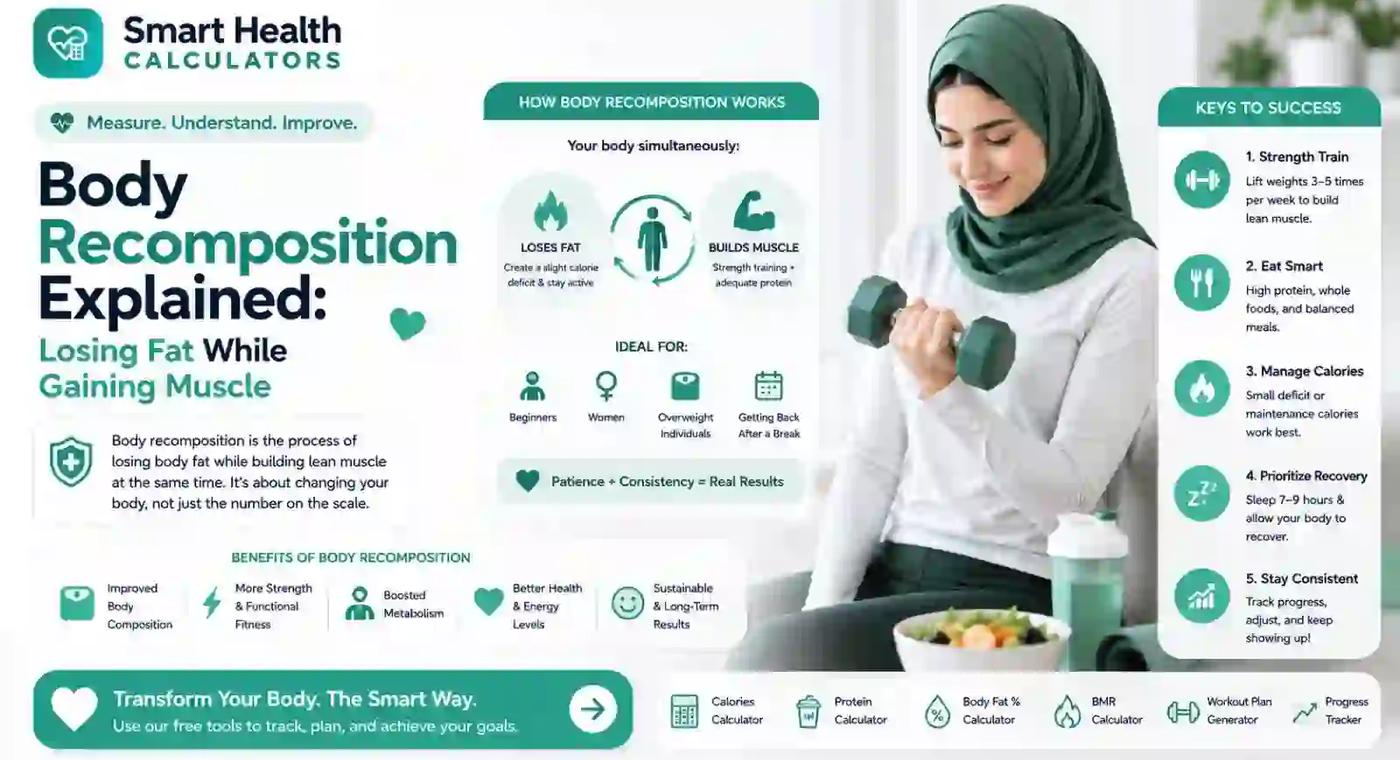
Body recomposition refers to simultaneously losing body fat and gaining lean muscle mass, resulting in a body composition shift even when total body weight stays relatively stable. It's a different goal from traditional weight loss, which focuses purely on the number on the scale regardless of what's actually being lost — fat, muscle, or water.
The distinction matters more than it might seem. Someone who loses 15 pounds through aggressive dieting without resistance training often loses a meaningful chunk of that as muscle, not fat — leaving them lighter, but not necessarily leaner or stronger. Body recomposition avoids that trade-off by pairing resistance training with a more measured approach to eating, so the body has both the stimulus and the resources to preserve or build muscle while fat comes down.
How Does Body Recomposition Actually Work?
To understand why recomposition is possible at all, it helps to know that muscle building and fat loss operate through genuinely different physiological processes, even though people often talk about them as if they're opposites on the same dial.
Muscle growth (hypertrophy) happens primarily through resistance training that creates mechanical tension and metabolic stress in muscle fibers, triggering a repair-and-growth process called muscle protein synthesis. This process depends on adequate protein intake and doesn't strictly require a calorie surplus — it requires the right training stimulus and enough raw material (protein) to rebuild with.
Fat loss happens when the body burns more energy than it takes in, forcing it to draw on stored fat for fuel. This is driven by an overall calorie deficit, independent of what's happening with muscle tissue.
Because these two processes run on somewhat different mechanisms, it's biologically possible for muscle protein synthesis to outpace muscle breakdown even while the body is in a mild energy deficit — provided training stimulus and protein intake are both adequate. This is the physiological basis of recomposition, and it's genuinely well-supported science, not gym folklore, even though how much recomposition happens varies significantly from person to person.
Who Body Recomposition Actually Works Best For
This is the section most articles skip, and it's arguably the most important one. Recomposition isn't equally effective for everyone, and being upfront about that saves people from frustration down the line.
Recomposition works well for:
- True beginners to resistance training. New lifters experience what's often called "newbie gains" — a window where the body responds unusually efficiently to training stimulus, building muscle relatively easily even while in a calorie deficit.
- People returning after a long training break. Muscle has a kind of physiological memory; previously trained muscle tends to rebuild faster than it built the first time, making recomposition realistic even in a deficit.
- "Skinny fat" individuals. People with a higher body fat percentage relative to a smaller amount of muscle mass tend to see the clearest recomposition results, since there's meaningful room for both fat loss and muscle gain simultaneously.
- People with a higher starting body fat percentage generally. More stored fat means more available energy reserves the body can draw on to fuel muscle repair and growth, even during a deficit.
Recomposition is slower or less reliable for:
- Lean, experienced lifters. Someone who's been training seriously for years and is already close to their genetic muscle-building potential has a much narrower window for simultaneous fat loss and muscle gain — traditional bulk/cut cycling usually works better here.
- Very lean individuals attempting further fat loss. At low body fat percentages, the body has fewer stored energy reserves to draw on, making simultaneous muscle building considerably harder.
This doesn't mean experienced lifters can't ever recomp — it just tends to happen much more slowly and requires closer attention to training and nutrition precision than it does for a beginner.
Body Recomposition vs. Bulking and Cutting
The traditional alternative to recomposition is the bulk-and-cut cycle: eating in a calorie surplus for months to maximize muscle growth (accepting some fat gain along the way), then following with a dedicated cutting phase to lose the added fat while trying to preserve the muscle built during the bulk.
| Factor | Body Recomposition | Bulk and Cut |
|---|---|---|
| Calorie approach | Maintenance or slight deficit | Surplus, then separate deficit phase |
| Best suited for | Beginners, returning lifters, skinny fat individuals | Lean, experienced lifters wanting maximum muscle gain |
| Timeline | Slower, more gradual | Faster muscle gain during bulk phase |
| Scale weight | Stays relatively stable | Fluctuates significantly across phases |
Neither approach is universally "better" — they suit different starting points and goals. Someone who's already lean and wants to add significant muscle mass will generally progress faster with a structured bulk phase, accepting that some fat gain comes with it, followed by a cut. Someone who's carrying more body fat and is newer to training will likely see better overall results — and avoid the psychological rollercoaster of intentional fat gain — by recomposing instead.
Calories and Macros for Body Recomposition
This is the part everyone actually wants a straight answer on, so here it is: for most people attempting recomposition, the target is maintenance calories or a very slight deficit — nowhere near the aggressive deficit typically used for pure fat loss, and nowhere near the surplus used for a dedicated bulk.
A practical starting framework:
- Calories: Maintenance level, or roughly a 10–15% deficit at most. A steep deficit undermines the muscle-building side of the equation by limiting the energy and protein available for repair and growth.
- Protein: This is the single most important macro for recomposition. Research from sports nutrition sources generally supports a range of 1.6 to 2.2 grams of protein per kilogram of body weight for people actively resistance training, on the higher end of that range if you're in a calorie deficit, since protein helps protect existing muscle mass during energy restriction.
- Carbohydrates: Important for fueling training performance — carbs support the intensity needed to actually stimulate muscle growth, so cutting them too aggressively can undermine your workouts.
- Fats: Needed for hormone production and overall health; typically making up the remaining calorie allocation after protein and carbs are set.
If you want a personalized calorie starting point based on your specific stats, our Calorie Intake Planner calculates your maintenance level, which is the right starting reference point for most recomposition approaches — you'll then adjust slightly based on how your body responds over several weeks.
The Training Side: What Actually Drives the "Gain Muscle" Half
Diet alone doesn't build muscle — the training stimulus is what actually triggers the growth response, and this is where a lot of people attempting recomposition fall short without realizing it.
Resistance training is non-negotiable. Cardio burns calories and supports fat loss, but it doesn't provide the mechanical tension muscles need to grow. A recomposition approach without structured resistance training is really just a fat-loss plan with extra steps.
Progressive overload matters more than exercise variety. The core principle driving muscle growth is gradually increasing the demand placed on your muscles over time — more weight, more reps, or more total training volume, tracked and increased incrementally. Without this progression, muscles have little reason to adapt and grow, regardless of how "hard" a workout feels.
Frequency and consistency beat intensity spikes. Training each major muscle group roughly 2–3 times per week tends to produce better results for recomposition than sporadic, occasional high-intensity sessions, since consistent stimulus supports steadier muscle protein synthesis over time.
A reasonable weekly structure for recomposition might include:
- 3–4 resistance training sessions per week, covering all major muscle groups
- Compound movements as the foundation — squats, deadlifts, presses, rows — since these recruit the most muscle mass per session
- Light to moderate cardio, used to support the calorie deficit without eating into recovery capacity needed for strength training
If you're building this out for the first time, our Workout Planner can help structure a weekly routine that balances resistance training frequency with adequate recovery.
How Long Does Body Recomposition Take?
This is genuinely one of the hardest questions to answer with a single number, because the timeline depends heavily on training status, starting body composition, consistency, and individual response. That said, general patterns hold reasonably well across most people:
- True beginners often see visible changes within 8 to 12 weeks, since both the muscle-building and fat-loss processes are working in their favor simultaneously during the newbie gains window.
- Returning lifters (people rebuilding previously trained muscle) typically see noticeable recomposition within a similar 8 to 16 week window, sometimes faster due to muscle memory.
- Experienced, lean lifters attempting recomposition should generally expect a much slower timeline — meaningful visible change can take 6 months or longer, since the physiological window for simultaneous gain and loss is considerably narrower at that stage.
Patience matters more in recomposition than in either pure bulking or pure cutting, precisely because progress happens more gradually and isn't always reflected clearly on a scale.
Why the Scale Isn't Moving (And Why That's Normal)
This is probably the single most common source of frustration and premature quitting during body recomposition, so it deserves a direct answer: your weight can stay essentially flat for weeks while your body composition genuinely improves.
Here's why: if you're losing a pound of fat while simultaneously gaining roughly a pound of muscle over the same stretch of time, the scale won't move at all — but your body is measurably different. You're carrying less fat and more muscle, your clothes likely fit differently, and your strength in the gym is probably increasing even though your bodyweight reading hasn't budged.
This is exactly why relying on the scale alone during a recomposition phase is misleading. Better indicators include:
- Body measurements (waist, hips, chest) taken consistently every 2–4 weeks
- Progress photos under consistent lighting and poses
- Strength progression in the gym — are your working weights or reps increasing over time?
- How clothes fit, which often shifts noticeably before the scale reflects any change
- Body fat percentage tracking, using something like a Body Fat Estimator periodically, rather than relying purely on scale weight
Bodyweight is one data point among several, not the definitive measure of whether recomposition is actually working. If you want to understand why scale weight alone can be a genuinely misleading indicator of progress, our guide on BMI versus body fat percentage explains this distinction in more depth.
Signs Body Recomposition Is Actually Working
Since scale weight is unreliable here, here's what to actually watch for over the weeks and months of a recomposition approach:
- Strength increases in your main lifts, even modestly, week over week
- Waist measurement decreasing while other measurements (shoulders, arms, legs) hold steady or increase slightly
- Visible muscle definition improving, particularly in areas that were previously less defined
- Clothes fitting differently — often looser around the waist, sometimes tighter around the shoulders or arms
- Energy and workout performance improving rather than declining, which suggests you're fueling adequately rather than under-eating
If none of these are moving after a reasonable stretch of consistent effort — generally 8-plus weeks — it's worth reassessing either your training volume, your protein intake, or your overall calorie level, since one of those three is almost always the sticking point.
Body Recomposition for Specific Situations
For women, the core principles don't fundamentally differ, though hormonal factors across the menstrual cycle can influence strength performance, water retention, and how progress feels week to week — tracking trends over several weeks rather than reacting to single data points matters even more here.
For people over 40, resistance training becomes increasingly important for preserving muscle mass that naturally declines with age, and recomposition is a genuinely well-suited goal at this life stage, though recovery between sessions may need to be slightly more generous than for younger trainees.
For vegetarians, hitting adequate protein intake requires more deliberate planning, since plant-based protein sources are generally less calorically dense per gram of protein — tracking intake more closely and considering a protein supplement can help close any gaps.
For beginners specifically without gym access, bodyweight resistance training (push-ups, squats, lunges, resistance bands) can still provide adequate stimulus for the newbie gains window, though a gym environment does make progressive overload easier to track and execute over time. Our guide to beginner home workouts requiring no equipment is a solid starting point if that's your situation.
Common Mistakes That Stall Body Recomposition
- Cutting calories too aggressively. This is the most frequent error — treating recomposition like a standard weight-loss diet and creating too large a deficit, which undermines the muscle-building half of the equation entirely.
- Skipping progressive overload. Doing the same weights and reps week after week gives muscles no reason to adapt, regardless of how much protein you're eating.
- Under-eating protein. Falling short of the 1.6–2.2g/kg range makes it genuinely difficult for the body to support muscle repair, especially while in any degree of calorie deficit.
- Judging progress by scale weight alone. As covered above, this is the single most common reason people abandon a recomposition approach that was actually working.
- Excessive cardio at the expense of recovery. Too much cardio volume can interfere with strength training recovery, blunting the muscle-building side of recomposition.
- Expecting bulk-and-cut speed. Recomposition is a slower, steadier process by design — comparing its pace to a dedicated bulk phase sets unrealistic expectations from the start.
Frequently Asked Questions
Is it possible to lose fat and gain muscle at the same time? Yes, particularly for beginners, people returning to training after a break, and those with a higher starting body fat percentage — the physiological processes behind muscle growth and fat loss operate independently enough to occur simultaneously under the right conditions.
How long does body recomposition take to show results? Beginners often see visible changes within 8 to 12 weeks, while experienced, leaner lifters should expect a considerably slower timeline, sometimes six months or more, due to a narrower physiological window for simultaneous gain and loss.
How many calories should I eat for body recomposition? Most people do best around maintenance calories or a modest 10–15% deficit at most, since a steeper deficit tends to limit the energy and protein available to support muscle growth alongside fat loss.
How much protein do I need during body recomposition? General sports nutrition guidance supports roughly 1.6 to 2.2 grams of protein per kilogram of body weight for people resistance training, leaning toward the higher end of that range if you're in any calorie deficit.
Is body recomposition better than bulking and cutting? Neither is universally better — recomposition tends to suit beginners, returning lifters, and those with higher body fat well, while lean, experienced lifters chasing maximum muscle growth generally progress faster with a structured bulk-and-cut approach.
Can beginners build muscle while losing fat? Yes, beginners are typically the group best positioned for successful recomposition, since new lifters experience an efficient early training response often called "newbie gains" that supports muscle growth even in a calorie deficit.
Why isn't my weight changing during body recomposition? Stable scale weight during recomposition often reflects simultaneous fat loss and muscle gain roughly offsetting each other — body measurements, strength progression, and progress photos are more reliable indicators of real change than the scale alone.
What is the best diet for body recomposition? A diet built around maintenance-level or slightly reduced calories, high protein intake (roughly 1.6–2.2g/kg bodyweight), adequate carbohydrates to fuel training, and consistent resistance training generally produces the best recomposition results.
The Bottom Line
Body recomposition is genuinely achievable, but it rewards patience and consistency far more than it rewards aggressive dieting or sporadic intense workouts. The formula is straightforward even if the execution takes discipline: train with progressive resistance several times a week, eat enough protein to support muscle repair, keep calories at maintenance or only slightly below it, and judge your progress by measurements and strength rather than the number on your scale.
If you're just starting out, get a clear read on your maintenance calories with our Calorie Intake Planner, then build a consistent training structure with our Workout Planner — those two numbers, combined with a genuinely consistent effort over 8 to 12 weeks, are what actually move the needle on body recomposition, far more than any single dietary trick or workout hack.
Medical Disclaimer
This article is for general education only. It is not medical advice, diagnosis, treatment, prescription guidance, or a replacement for professional healthcare. Speak with a qualified healthcare professional for personal medical concerns, symptoms, pregnancy concerns, mental health crisis, medication questions, or before making major health changes.