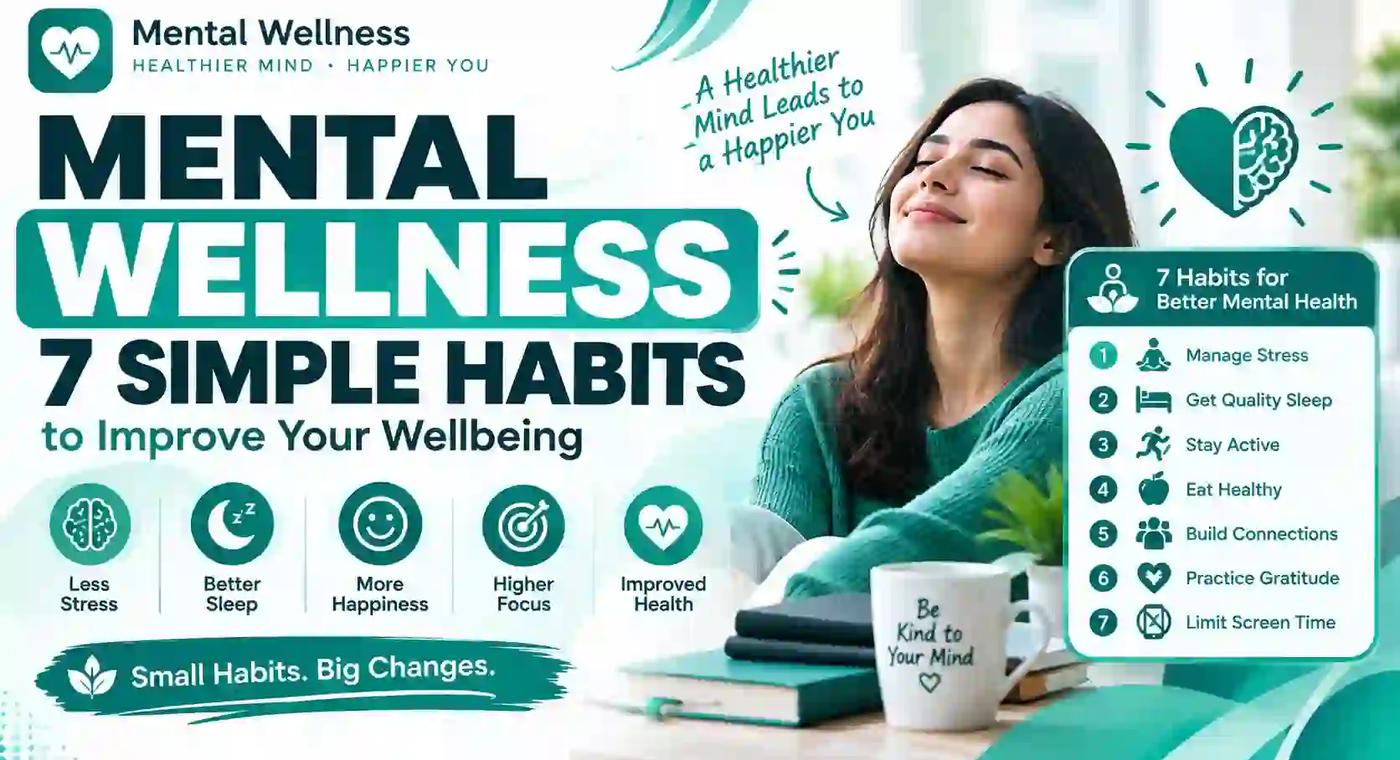
Mental Wellness: 7 Simple Habits to Improve Your Wellbeing
Improve your mental wellness with 7 simple daily habits, including better sleep, regular movement, mindfulness, social connection, gratitude, and healthy routines.
Most advice about mental wellness sounds like it requires a complete life overhaul — wake up at 5am, meditate for an hour, journal three pages, cut out sugar, run five miles. For anyone already feeling overwhelmed, that kind of list makes things worse, not better. The habits that actually stick tend to be smaller, more specific, and genuinely doable on an ordinary Tuesday.
This guide covers seven such habits, each grounded in guidance from organizations like the World Health Organization, the National Institute of Mental Health, and the CDC. These aren't a clinically defined "magic number" of interventions — they're a practical starting point drawn from consistent public health guidance around sleep, movement, connection, and stress management. And one important note before we start: these habits are meant to support everyday mental wellbeing, not replace professional care when it's genuinely needed. We'll cover exactly when that line matters toward the end.
What "Mental Wellness" Actually Means
Before diving into specific habits, it helps to have a clear working definition. The World Health Organization currently defines mental health as a state of mental wellbeing that enables people to cope with life's stresses, realize their abilities, learn and work well, and contribute to their communities.
That framing matters because it positions mental wellness as an active, ongoing state — not simply the absence of a diagnosable condition. You can be free of any mental illness and still have room to build stronger coping skills, better stress resilience, or more consistent daily habits that support how you feel day to day. That's exactly the space these seven habits are designed for.
It's also worth stating clearly upfront: self-care habits like the ones below are meant to complement professional mental health care, not substitute for it. The WHO explicitly frames self-care as working alongside formal healthcare systems and professionals, not replacing them — a distinction we'll return to later in this guide.
Habit 1: Prioritize Consistent, Sufficient Sleep
Sleep is often the first thing people sacrifice when life gets busy, and it's also one of the habits most consistently linked to mental wellbeing across major health organizations. The CDC's stress management guidance specifically identifies getting enough sleep — generally 7 or more hours nightly for adults — as a foundational stress-management practice.
The relationship between sleep and mental wellness runs in both directions: poor sleep makes stress harder to manage, and unmanaged stress makes good sleep harder to achieve. Breaking that cycle usually starts with a few consistent habits rather than a single dramatic change:
- Going to bed and waking at roughly the same time daily, even on weekends
- Limiting screen exposure in the hour before bed
- Keeping your sleep environment cool, dark, and quiet
- Avoiding caffeine in the afternoon and evening
If sleep has been a genuine struggle rather than just an occasional off night, our signs of poor sleep quality guide can help you identify specific patterns worth addressing, and the Sleep Quality Checker gives you a quick way to assess where you currently stand. The connection between stress and sleep specifically is also worth understanding in more depth — our guide on how stress affects sleep quality breaks down that relationship directly.
Habit 2: Move Your Body Regularly
Physical activity is one of the most consistently recommended habits across every major mental health authority — WHO, NIMH, and CDC guidance all identify regular movement as a meaningful support for mood and stress management. This doesn't require intense training; the mental health benefits associated with physical activity show up with genuinely moderate movement, not just structured workouts.
The specific type of exercise matters less than consistency. A daily 20-minute walk, some light stretching, or a few short movement breaks throughout a desk-bound day can all contribute meaningfully. NIMH's self-care guidance specifically lists exercise alongside sleep and relaxation as core self-care practices worth building into a regular routine.
If you're looking to structure this into an actual plan rather than vague intentions, our beginner weekly workout plan and 30-minute workout plan for busy people both offer realistic starting points, and the Workout Planner can help you build something sustainable around your actual schedule.
Habit 3: Practice Short, Regular Mindfulness
Mindfulness doesn't have to mean a 30-minute seated meditation practice, and treating it that way is exactly why a lot of people give up on it quickly. Even brief mindfulness moments — a minute of focused breathing between tasks, or a short body scan before a stressful meeting — genuinely count as practice.
The CDC's stress management guidance specifically recommends techniques like deep breathing, stretching, and brief meditation as accessible ways to manage everyday stress in the moment, rather than framing mindfulness as an all-or-nothing daily commitment. This "micro-mindfulness" approach — a minute here, ninety seconds there, worked into natural transitions in your day — tends to be far more sustainable than trying to carve out a large uninterrupted block of time that competing priorities will inevitably crowd out.
A simple way to start: pick one recurring daily transition (making coffee, sitting down at your desk, getting into your car) and attach 60 seconds of focused breathing to it. Over time, that single anchor point becomes a genuine, low-effort habit rather than one more thing competing for your limited willpower.
Habit 4: Stay Connected to Other People
Social connection is one of the most robustly supported factors in mental wellbeing across public health research, and it's also one of the habits most likely to quietly slip away during busy or stressful periods — precisely when it matters most. The CDC's guidance on social connection notes its relevance to both mental and physical health, describing links to stress, anxiety, depression, and sleep quality.
This doesn't require an active, expansive social calendar. Genuine connection can be as simple as:
- A short phone call or voice message to a friend or family member
- A brief, real conversation with a coworker rather than just task-focused exchanges
- Making time for one recurring social commitment each week, even a small one
- Reaching out first, rather than waiting to be contacted, when you notice you've been isolating
The NHS's Five Steps to Mental Wellbeing framework specifically identifies "connect with others" as one of its five core evidence-informed recommendations, alongside physical activity, continued learning, giving to others, and mindfulness — a useful public health model that mirrors much of what's covered in this guide.
Habit 5: Build a Gratitude Practice
Gratitude practices show up consistently in self-care guidance from NIMH and CDC alike, and the appeal is largely in how low the barrier to entry actually is. This isn't about forcing positivity or ignoring genuine difficulties — it's a specific, low-effort habit of directing attention toward things that are going reasonably well, even during a hard stretch.
A practical version of this habit: at the end of each day, note down (mentally or on paper) three specific things from that day, however small, that you're grateful for. Specificity matters more than scale here — "my coworker covered a meeting for me" tends to be a more useful gratitude entry than a vague "I'm grateful for my job," since specific observations are easier to genuinely feel rather than just intellectually acknowledge.
If you want a more structured approach to this and related reflective practices, our guide on journaling for mental health and self-awareness covers gratitude journaling alongside other reflective writing techniques in more depth.
Habit 6: Set Realistic Priorities and Boundaries
This habit gets less attention than sleep or exercise, but NIMH's self-care guidance specifically lists setting priorities as a core self-care practice — and for good reason. Chronic overcommitment is a significant, often underestimated driver of everyday stress, and no amount of breathing exercises or gratitude journaling fully compensates for a schedule that's structurally overloaded.
Practical ways to build this habit:
- Reviewing your commitments weekly and identifying at least one thing you can realistically decline or delegate
- Being explicit (even just with yourself) about which tasks genuinely require your immediate attention versus which ones feel urgent but aren't
- Setting a specific boundary around work communication outside your actual working hours, if that's a recurring source of stress
- Protecting time for the other habits on this list, rather than treating them as the first thing to sacrifice when the schedule gets tight
This is also where screen time and digital habits often intersect with mental wellness in ways people underestimate. If notifications and constant connectivity are part of what's driving your sense of being perpetually "on," our guide on screen time and mental health covers that specific connection in detail.
Habit 7: Build a Consistent Daily Routine
The final habit ties several of the others together: having a reasonably consistent daily structure, particularly around wake time, meals, and wind-down. Routine reduces the mental overhead of constant decision-making and gives your body predictable cues that support better sleep, steadier mood, and lower baseline stress.
This doesn't mean rigid scheduling down to the minute — it means having a general shape to your day that you can return to, especially during stressful periods when structure tends to matter most. A simple, sustainable morning and evening anchor routine often does more for consistent mental wellness than an elaborate but fragile system that collapses the first time your schedule shifts.
Our guide to building a healthy morning routine offers a practical starting framework if you don't currently have one, and it pairs naturally with the sleep habit covered earlier in this list, since morning and evening routines reinforce each other.
Putting the Seven Habits Together
You don't need to adopt all seven habits simultaneously — in fact, trying to do so is a common reason these kinds of lists fail to stick. A more realistic approach:
- Pick one habit that addresses whatever feels most immediately relevant to how you're currently struggling.
- Attach it to an existing routine rather than treating it as a separate task competing for attention (the coffee-and-breathing example from Habit 3 is a good template).
- Give it two to three weeks before adding a second habit, since consistency matters more than variety in the early stages.
- Reassess periodically — what you need during a high-stress work period may differ from what you need during a calmer stretch.
If you want a broader framework for evaluating your current stress and wellbeing before choosing where to start, our mental health self-check-in guide and the Mental Health Checker both offer a starting point for identifying which of these seven habits might matter most for your specific situation right now.
What These Habits Can't Replace
This deserves direct, honest treatment rather than a vague disclaimer buried at the end. These seven habits are genuinely useful for everyday mental wellness, but they are not a substitute for professional mental health care when it's actually needed.
NIMH's guidance specifically recommends seeking professional support when severe or distressing symptoms persist for two weeks or more — including significant sleep disruption, difficulty functioning in daily responsibilities, loss of interest in things you normally enjoy, or persistent difficulty concentrating. If you're experiencing this kind of sustained pattern, self-care habits are a complement to professional support, not an alternative to it.
Some signs that it's worth reaching out to a healthcare provider or mental health professional rather than relying solely on self-care habits:
- Symptoms that persist for two weeks or longer despite consistent self-care efforts
- Difficulty functioning at work, in relationships, or in daily responsibilities
- Thoughts of self-harm or a sense of hopelessness that doesn't lift
- Physical symptoms (significant appetite or sleep changes, unexplained fatigue) alongside emotional distress
- A feeling that things are getting worse rather than better despite genuine effort
Reaching out for professional support in these situations isn't a failure of self-care — it's the appropriate next step when a situation genuinely calls for it, in exactly the same way you'd see a doctor for a physical symptom that home care wasn't resolving.
Frequently Asked Questions
What is mental wellness?
Mental wellness refers to a state of wellbeing that allows a person to cope with life's normal stresses, work productively, maintain relationships, and contribute to their community — distinct from simply the absence of a diagnosed mental illness.
How can I improve my mental wellness?
Consistent, small daily habits — adequate sleep, regular movement, brief mindfulness practices, social connection, gratitude, realistic priorities, and a steady daily routine — are all supported by major public health guidance as practical ways to support everyday mental wellbeing.
Can daily habits improve mental wellbeing?
Yes, according to guidance from organizations like NIMH, WHO, and the CDC, though these habits function as supportive self-care practices rather than treatment for diagnosed mental health conditions, which require professional care.
How does sleep affect mental health?
Insufficient or inconsistent sleep is closely linked with increased stress and reduced emotional resilience, and the relationship works in both directions — poor sleep worsens stress, and unmanaged stress often disrupts sleep further.
How much time should I spend on self-care?
There's no universal number, since it depends on your specific circumstances and which habits you're building. Starting with a few minutes daily attached to an existing routine tends to be more sustainable than committing to a large block of time upfront.
When should I seek professional mental health support?
If distressing symptoms persist for two weeks or longer, interfere with your ability to function in daily life, or include thoughts of self-harm, reaching out to a healthcare provider or mental health professional is the appropriate next step rather than relying solely on self-care habits.
Can lifestyle changes support mental wellbeing?
Yes — sleep, physical activity, social connection, and stress management are all consistently identified by major health authorities as lifestyle factors that support mental wellbeing, working alongside rather than replacing professional care when it's needed.
The Bottom Line
None of these seven habits require a dramatic life overhaul, and that's intentional — sustainable mental wellness tends to come from small, consistent practices rather than ambitious short-lived ones. Start with a single habit that addresses what feels most relevant right now, attach it to something you already do daily, and build from there rather than trying to implement all seven at once.
Last medically reviewed/verified: September 2026. This information is educational and reflects general public health guidance; it is not a substitute for personalized medical or mental health advice.
If you want a clearer picture of your current stress and wellbeing before deciding where to start, the Mental Health Checker offers a quick, free starting point, and our guides on natural ways to reduce stress and the connection between sleep, stress, and mental health go deeper into two of the habits covered here if either feels especially relevant to your situation.
Medical Disclaimer
This article is for general education only. It is not medical advice, diagnosis, treatment, prescription guidance, or a replacement for professional healthcare. Speak with a qualified healthcare professional for personal medical concerns, symptoms, pregnancy concerns, mental health crisis, medication questions, or before making major health changes.