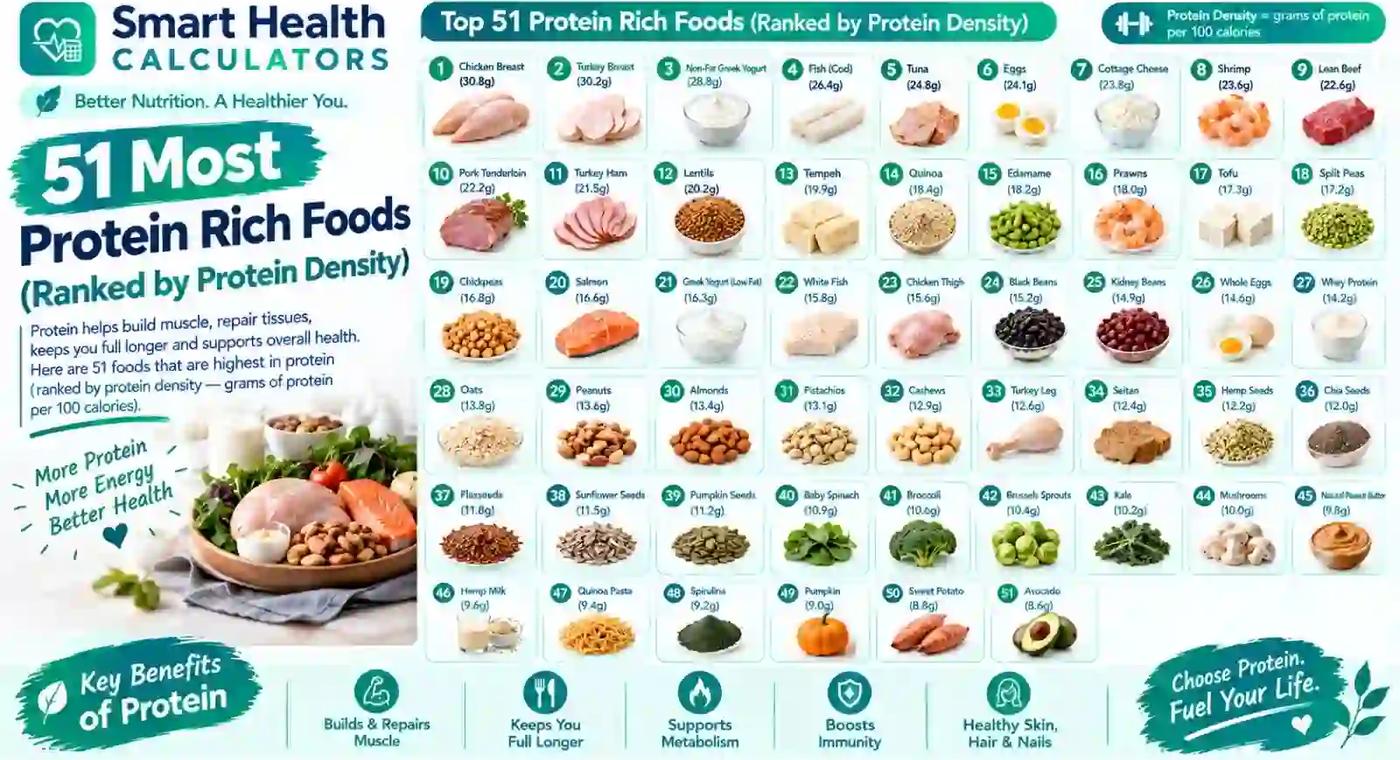
51 Most Protein Rich Foods (Ranked by Protein Density)
The most protein rich foods, ranked by grams of protein per 100g — from lean meats and fish to plant-based sources. See the full list with preparation states noted.
By protein density — grams of protein per 100 grams of food — the most protein-dense foods are largely dried, dehydrated, or highly processed items like seitan, spirulina, and parmesan cheese, followed closely by lean meats, poultry, and seafood. Whole plant foods rarely match animal sources gram-for-gram, though legumes and soy products come surprisingly close. The ranking below uses this same consistent measure throughout — protein grams per 100g — with each food's preparation state (raw, cooked, or dried) clearly noted, since that single detail can shift a food's apparent ranking dramatically.
Most "high protein foods" lists online quietly mix raw and cooked values, or blend "protein per 100g" with "protein per serving," which produces rankings that don't actually compare apples to apples. This guide fixes that by using one formula throughout — Protein Density = grams of protein ÷ grams of food × 100 — sourced against USDA nutrient data, so you're comparing foods on the same basis from top to bottom.
Why Preparation State Changes Everything
Before diving into the ranking, here's the single most important thing to understand about protein-density lists: the same food can show wildly different numbers depending on whether it's raw, cooked, or dried.
Dehydration removes water weight without removing protein, which is why beef jerky (dried) shows a higher protein-per-100g figure than a fresh steak (raw or cooked) — the jerky simply has less water diluting the same protein content. This is exactly why a fair ranking needs to state preparation state explicitly rather than letting readers assume "chicken breast" always means the same thing.
Throughout this list, we note whether each entry is raw, cooked, or dried/dehydrated. If you're building a meal plan around these numbers, always check the specific state you're actually eating against USDA FoodData Central directly, since values shift meaningfully between preparation methods.
The Ranking: 51 Foods by Protein Density (Per 100g)
Tier 1: Extremely Protein-Dense (35g+ per 100g)
| Rank | Food | Protein/100g | State |
|---|---|---|---|
| 1 | Seitan (wheat gluten) | ~75g | Prepared |
| 2 | Textured vegetable protein | ~51g | Dry |
| 3 | Peanut flour | ~52g | Dry/defatted |
| 4 | Spirulina | ~57g | Dried |
| 5 | Parmesan cheese | ~36-38g | Aged/dry |
| 6 | Beef jerky | ~33-34g | Dried |
| 7 | Nutritional yeast | ~45-50g | Dry flakes |
| 8 | Dried cod (bacalhau) | ~62g | Dried, salted |
| 9 | Whey protein isolate | ~90g | Powder |
| 10 | Soy protein isolate | 88g | Powder |
Important caveat for this tier: several of these — protein powders, isolates, textured vegetable protein — are processed protein concentrates, not whole foods in the traditional sense. They rank at the top of a pure density measure, but the "protein package" framework matters here: these foods often carry very little else nutritionally (fiber, micronutrients) compared to whole foods lower on this list.
Tier 2: Very High Protein Density (25-35g per 100g)
| Rank | Food | Protein/100g | State |
|---|---|---|---|
| 11 | Chicken breast, skinless | ~31g | Cooked, roasted |
| 12 | Turkey breast | ~29-30g | Cooked, roasted |
| 13 | Tuna steak | ~28-30g | Cooked |
| 14 | Pork tenderloin | ~28g | Cooked |
| 15 | Lean beef (top round) | ~28g | Cooked |
| 16 | Halibut | ~27g | Cooked |
| 17 | Cheddar cheese | ~25-27g | Aged |
| 18 | Swordfish | ~26g | Cooked |
| 19 | Venison | ~30g | Cooked |
| 20 | Duck breast, skinless | ~27g | Cooked |
| 21 | Anchovies | ~29g | Canned in oil, drained |
| 22 | Salmon | ~25g | Cooked |
| 23 | Shrimp | ~24-26g | Cooked |
| 24 | Tempeh | ~26g | Cooked |
| 25 | Lamb loin | ~25g | Cooked |
This is the tier most people actually build meals around — lean meats, poultry, and firm fish that deliver strong protein density while still functioning as a genuinely balanced whole food.
Tier 3: High Protein Density (18-25g per 100g)
| Rank | Food | Protein/100g | State |
|---|---|---|---|
| 26 | Edam cheese | ~25g | Aged |
| 27 | Crab | ~19-20g | Cooked |
| 28 | Cod | ~20-23g | Cooked |
| 29 | Tilapia | ~26g | Cooked |
| 30 | Feta cheese | ~14-15g | Aged (lower than expected due to fat/moisture) |
| 31 | Eggs, whole | ~13g raw, ~14g cooked (individual eggs ~6g each) | Cooked |
| 32 | Egg whites | ~11g | Raw |
| 33 | Lentils, cooked | ~9g | Cooked |
| 34 | Black beans, cooked | ~8-9g | Cooked |
| 35 | Chickpeas, cooked | ~9g | Cooked |
| 36 | Edamame, cooked | ~11g | Cooked |
| 37 | Greek yogurt (nonfat) | ~10g | Prepared |
| 38 | Cottage cheese | ~9-12g | Prepared |
| 39 | Almonds | 21g | Raw |
| 40 | Peanuts | ~25-26g | Raw |
| 41 | Pumpkin seeds | 19g | Raw |
| 42 | Hemp seeds | ~31g | Raw, hulled |
| 43 | Chia seeds | ~17g | Raw |
| 44 | Sesame seeds | ~17-18g | Raw |
| 45 | Quinoa, cooked | ~4.4g | Cooked |
| 46 | Soybeans, cooked | ~17-18g | Cooked |
| 47 | Mussels | ~17g | Cooked |
| 48 | Prawns | ~15-22g | Cooked |
| 49 | Whole milk | ~3.3g | Fluid |
| 50 | Firm tofu | ~13-17g | Prepared |
| 51 | Ricotta cheese | ~11g | Prepared |
A note on the wide ranges you'll see: figures like "prawns 15-22g" reflect genuine variation across species, preparation, and specific USDA database entries — this is normal in nutrient databases and exactly why checking the specific entry for your exact food matters more than treating any single number as universal.
The Biggest Surprise in This Ranking: Dried and Processed Foods Dominate the Top
If you expected chicken breast or salmon to top a "most protein-dense foods" list, the actual data tells a different story — and this is worth explaining rather than glossing over. Dehydrated, aged, and processed foods (jerky, parmesan, protein powders, textured vegetable protein) consistently rank higher in pure grams-per-100g terms than fresh whole foods, purely because removing water concentrates everything else, protein included.
This is precisely why Harvard's Nutrition Source emphasizes looking at the complete "protein package" a food delivers — its fat content, sodium, fiber, and overall nutrient profile — rather than treating raw protein density as a standalone health ranking. A food topping this list on protein-per-100g grounds isn't automatically the "best" choice for your diet; it's simply the most protein-concentrated by weight.
Animal Protein vs. Plant Protein: What the Density Numbers Actually Show
Looking at this ranking as a whole, animal-based whole foods (lean meats, poultry, fish) generally out-rank whole plant foods on pure protein-per-100g density. Cooked chicken breast at roughly 31g per 100g significantly outpaces cooked lentils at roughly 9g per 100g, for instance.
But this comparison needs an important qualifier: cooking method matters enormously for legumes specifically, since beans and lentils absorb substantial water during cooking, which dilutes their protein density compared to their dry, uncooked state. A dry lentil actually shows a much higher protein-per-100g figure than the cooked version most people actually eat — which is exactly the kind of raw-vs-cooked confusion this guide is built to avoid.
Plant-based standouts that genuinely compete with animal sources include seitan, tempeh, edamame, hemp seeds, and soy protein isolate — all of which land in the upper half of this ranking. If you're building a vegetarian or vegan high-protein diet, these are the foods worth prioritizing rather than assuming plant sources can't compete on density.
How Much Protein Do You Actually Need?
Protein density is only useful once you know your actual target. The commonly cited baseline adult Recommended Dietary Allowance is 0.8 grams of protein per kilogram of body weight per day, according to National Academies dietary reference intake guidance — though this figure varies by life stage, activity level, and physiological condition, and shouldn't be treated as a one-size-fits-all number for every reader.
Athletes, older adults working to preserve muscle mass, and people in a calorie deficit trying to protect lean tissue often benefit from protein intake meaningfully above this baseline figure. Rather than guessing at your own target, our detailed breakdown of how much protein you need per day walks through the calculation based on your specific body weight, activity level, and goal.
Using This List for Weight Loss: Protein Density vs. Protein Per Calorie
If your goal is weight management specifically, protein-per-100g isn't necessarily the most useful metric — protein per calorie often matters more, since it captures how much protein you're getting relative to the energy cost of eating that food.
Lean chicken breast and white fish tend to perform exceptionally well on this alternative metric, since they combine high protein with relatively low fat and therefore lower calorie density. By contrast, parmesan cheese and peanuts rank high on pure protein-per-100g but carry substantially more calories per gram due to their fat content — meaning they're protein-dense but not necessarily calorie-efficient for a weight-loss context specifically.
If weight loss is your primary goal, pairing this protein-density list with a proper calorie framework matters more than protein density alone. Our Calorie Intake Planner and guide to calorie intake vs. calories burned help you build that fuller picture rather than optimizing for protein density in isolation.
Using This List for Muscle Building
For muscle gain specifically, both total daily protein intake and how it's distributed across meals matter, alongside resistance training itself. The animal-based foods in Tier 2 of this ranking — chicken breast, lean beef, turkey, tuna, salmon — are frequently favored in muscle-building diets precisely because they combine high protein density with a complete amino acid profile and relatively manageable calorie cost.
For plant-based muscle building, combining complementary protein sources (like rice and beans, or hummus and whole grain bread) helps ensure a fuller essential amino acid profile across a day's meals, since few individual plant foods contain every essential amino acid in ideal proportions on their own. Our muscle gain diet plan guide covers how to structure a full day of eating around this kind of protein targeting.
Complete Proteins vs. Incomplete Proteins: What This Actually Means
A "complete protein" contains all nine essential amino acids your body can't produce on its own, in reasonably sufficient amounts. Most animal proteins (meat, poultry, fish, eggs, dairy) are complete proteins by this definition, as are a handful of plant sources — quinoa, soy, and buckwheat among them.
It's worth being precise here, since this concept gets oversimplified constantly: an individual plant food not being "complete" doesn't mean it doesn't meaningfully contribute to your protein intake. Combining different plant proteins across meals or even across a day — not necessarily in the same meal — generally provides a full amino acid profile for most people eating a varied diet. Treating incomplete plant proteins as nutritionally worthless is a common and unnecessary oversimplification.
Common Mistakes People Make Reading Protein-Density Lists
Comparing raw and cooked values without noticing. A "high protein" claim for a raw food will look different once cooked, since cooking changes water content substantially for many foods, especially legumes and grains.
Assuming the highest-ranked food is automatically the healthiest. As covered above, dried and processed foods often top pure density rankings while offering a much narrower nutritional profile than whole foods further down the list.
Ignoring sodium content in processed high-protein foods. Beef jerky, parmesan, and many protein-dense processed snacks carry considerably more sodium than fresh whole-food protein sources — worth checking if you're managing blood pressure or sodium intake specifically.
Treating protein density and protein-per-calorie as interchangeable. As explained above, these are genuinely different metrics that can produce different "best" answers depending on your specific goal.
Frequently Asked Questions
What food has the most protein per 100g?
Among concentrated and processed sources, protein isolates (whey or soy) and seitan rank among the highest, often exceeding 75-90g per 100g. Among more typical whole foods, dried options like beef jerky and aged hard cheeses like parmesan rank near the top, generally in the 33-38g range.
Which meat has the most protein per 100g?
Lean, cooked chicken breast and turkey breast typically rank among the highest common meats, at roughly 29-31g of protein per 100g, though venison and duck breast can rank comparably high depending on the specific cut.
Which plant food has the most protein?
Seitan (wheat gluten) ranks exceptionally high among plant-based options, often reaching around 75g per 100g when prepared, with tempeh, edamame, and hemp seeds also ranking well above most whole plant foods.
Is protein density the same as protein quality?
No. Protein density measures how much protein a food contains by weight, while protein quality refers to its amino acid completeness and digestibility — a food can rank high on density without being a complete protein, and vice versa.
Should I compare foods raw or cooked?
Always compare foods in the same preparation state for a fair ranking. Cooking changes water content substantially for many foods, meaning raw and cooked values for the same food can differ significantly and shouldn't be mixed in one comparison.
Are plant proteins less effective than animal proteins?
Not inherently — the difference lies mainly in amino acid completeness and digestibility for some individual plant sources, not in plant protein being universally inferior. A varied plant-based diet combining different protein sources can meet essential amino acid needs effectively for most people.
What foods should I eat for high protein but low calories?
Lean cooked chicken breast, white fish like cod and tilapia, egg whites, and non-fat Greek yogurt tend to offer the best protein-per-calorie ratio, since they combine solid protein content with relatively low fat.
The Bottom Line
Protein density — grams of protein per 100g — gives you a consistent, comparable way to rank foods, but it's genuinely just one piece of the picture. The foods at the very top of a pure density ranking are often dried, processed, or concentrated products, while the whole foods most people actually build sustainable diets around — lean meats, fish, eggs, legumes, and dairy — sit solidly in the upper-middle tiers with a far more complete nutritional profile alongside their protein content.
Whatever your specific goal — muscle building, weight loss, or simply hitting a daily protein target — start by figuring out your actual number using our protein needs calculator guide, then use this ranking to choose foods that fit both your protein target and your broader dietary goals, rather than chasing the single highest number on the list. For a fuller daily eating plan built around your specific protein and calorie targets together, the Diet Plan Generator and Calorie Intake Planner can help you put this list into practice.
Medical Disclaimer
This article is for general education only. It is not medical advice, diagnosis, treatment, prescription guidance, or a replacement for professional healthcare. Speak with a qualified healthcare professional for personal medical concerns, symptoms, pregnancy concerns, mental health crisis, medication questions, or before making major health changes.