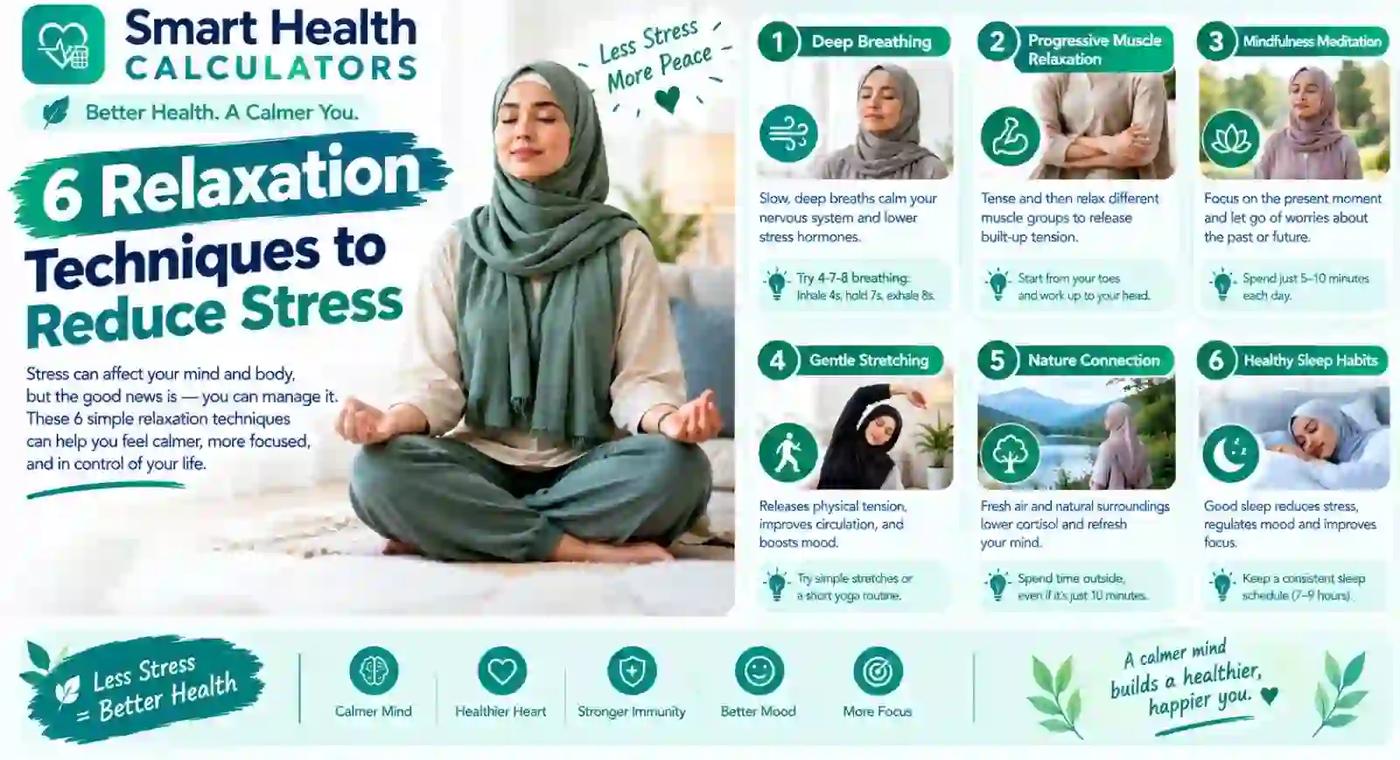
six relaxation techniques to reduce stress
Six relaxation techniques to reduce stress — deep breathing, progressive muscle relaxation, guided imagery, biofeedback, autogenic training, and self-hypnosis .
Stress isn't something you can simply decide to stop feeling — but you can train your body to switch out of its stress response faster, and that's exactly what relaxation techniques are designed to do. Rather than one-size-fits-all advice like "just relax," researchers and clinicians have studied specific, teachable methods that engage your nervous system directly.
The National Center for Complementary and Integrative Health (NCCIH) identifies deep breathing, progressive muscle relaxation, guided imagery, biofeedback, autogenic training, and self-hypnosis among the relaxation techniques most commonly studied for stress. This guide walks through all six — what each one actually involves, how to practice it, and what the current evidence does and doesn't support — so you can pick the approach that fits your situation rather than guessing.
What Relaxation Techniques Actually Do
Relaxation techniques work by engaging what's often called the relaxation response — a state involving slower breathing, reduced heart rate, and lower blood pressure that essentially counters your body's stress response. Your stress response (sometimes called fight-or-flight) is driven by your sympathetic nervous system; relaxation techniques generally aim to activate the parasympathetic nervous system instead, which governs rest and recovery.
Interest in these techniques isn't niche. NCCIH's national survey data shows that use of guided imagery and progressive muscle relaxation among U.S. adults rose from 3.8% in 2002 to 6.4% in 2022 — a meaningful increase, though still a historical U.S. figure rather than a current global prevalence number.
It's worth being upfront about something important before going further: NCCIH notes that while research supports relaxation techniques for various stress-related outcomes, evidence quality varies by technique, population, and specific health condition. These aren't cure-alls, and they aren't a replacement for professional care when stress becomes severe, persistent, or tied to a diagnosable condition. With that context set, here's how each of the six techniques works.
1. Deep Breathing (Diaphragmatic Breathing)
Deep breathing, sometimes called diaphragmatic or belly breathing, is often the first technique people try because it requires no equipment, no training, and can be done anywhere in under a minute.
How it works: Instead of shallow chest breathing, diaphragmatic breathing engages the diaphragm to draw air deeper into the lungs, which is associated with slower breathing rate and activation of the relaxation response.
How to practice it:
- Sit or lie down comfortably, with one hand on your chest and one on your abdomen.
- Breathe in slowly through your nose, letting your abdomen rise while your chest stays relatively still.
- Exhale slowly through pursed lips, feeling your abdomen fall.
- Continue for several minutes, focusing attention on the breath itself.
What the evidence says: NCCIH's evidence summary describes a review of three studies involving 880 participants examining diaphragmatic breathing, characterizing the evidence for stress reduction as preliminary rather than conclusive — a genuinely useful, low-risk technique, but not one with a large, definitive body of research behind it yet.
If you want a structured, guided way to build this into a daily habit rather than practicing it ad hoc, our 5-minute breathing exercises to lower your stress score walks through a specific short routine you can use as a starting point.
2. Progressive Muscle Relaxation (PMR)
Progressive muscle relaxation involves systematically tensing and then releasing different muscle groups throughout the body, building awareness of the contrast between tension and relaxation.
How it works: By deliberately tensing a muscle group for a few seconds and then fully releasing it, PMR is thought to help people recognize and release physical tension they might otherwise carry unconsciously — tight shoulders, a clenched jaw, tension in the hands.
How to practice it:
- Starting with your feet, tense the muscles tightly for about 5 seconds.
- Release the tension completely, noticing the difference in sensation.
- Move progressively upward — calves, thighs, abdomen, hands, arms, shoulders, face — repeating the tense-and-release pattern.
- A full session typically takes 10–20 minutes, though shorter versions targeting just a few areas are common too.
What the evidence says: A 2021 controlled study directly compared progressive muscle relaxation, deep breathing, and guided imagery among 60 healthy undergraduate participants, using 20-minute sessions, and found increased relaxation states across all three intervention groups compared to a control group — though the researchers noted further work is needed to establish how the techniques compare to each other specifically.
3. Guided Imagery
Guided imagery involves visualizing a calming scene or scenario in detail, engaging multiple senses to shift attention away from stress and toward a constructed, peaceful mental environment.
How it works: Rather than passively daydreaming, guided imagery typically involves deliberately imagining specific sensory details — the sound of waves, the warmth of sunlight, the texture of sand — which is thought to help redirect focus away from stress-related thoughts.
How to practice it:
- Find a quiet space and close your eyes.
- Picture a specific, calming scene in as much sensory detail as possible — what you see, hear, smell, and feel.
- Stay with that scene for several minutes, gently returning your focus to it if your mind wanders.
- Guided audio recordings or scripts can help structure this for beginners who find open-ended visualization difficult.
What the evidence says: Guided imagery was one of the three techniques included in the 2021 undergraduate study referenced above, showing measurable increases in relaxation state during the 20-minute session. As with the other techniques, NCCIH's broader guidance notes evidence varies depending on the specific application and population studied.
4. Biofeedback
Biofeedback is a more technology-assisted approach, using sensors to give you real-time information about physiological signals — heart rate, muscle tension, skin temperature — so you can learn to consciously influence them.
How it works: A biofeedback device measures a specific physiological signal and displays it back to you, often as a visual or auditory cue. Over repeated sessions, people can learn to recognize what mental or physical adjustments shift that signal in a calmer direction, essentially training voluntary control over processes that are normally automatic.
A specific and well-studied form is heart rate variability (HRV) biofeedback, which focuses on training a person to influence the variation in time between heartbeats — a physiological marker linked to nervous system balance. NCCIH cites a review covering 24 studies and 484 participants examining HRV biofeedback in relation to self-reported stress and anxiety outcomes.
How to access it: Unlike the other techniques on this list, biofeedback typically requires either a trained practitioner, a clinical setting, or a consumer wearable device with biofeedback-specific software — it's less of a "do it anywhere, right now" technique and more of a trained skill built over sessions.
5. Autogenic Training
Autogenic training uses a structured series of verbal cues — repeated phrases focused on sensations like warmth and heaviness in different body parts — to guide the body into a state of deep relaxation.
How it works: The technique involves silently repeating specific phrases (such as "my right arm is heavy" or "my hands are warm") while focusing attention on the corresponding body part, which is thought to trigger physiological relaxation responses through this form of guided autosuggestion.
How to practice it:
- Sit or lie in a comfortable position with eyes closed.
- Mentally repeat a phrase focused on heaviness in one limb (e.g., "my right arm is heavy") several times, holding attention on that sensation.
- Progress through each limb and area of the body using similar phrases.
- A full sequence often also includes phrases related to warmth, heart rate, breathing, and a sense of calm.
Autogenic training generally takes more practice to master than deep breathing or basic guided imagery, since it relies on building a learned association between the verbal cues and the physical sensation over repeated sessions — it's not typically something that produces strong effects the very first time you try it.
6. Self-Hypnosis
Self-hypnosis involves guiding yourself into a focused, relaxed state of concentration, often using pre-recorded scripts or a learned self-induction process, with suggestions aimed at reducing stress or promoting calm.
How it works: Despite popular misconceptions, self-hypnosis for stress isn't about losing control or awareness — it's more accurately described as a state of highly focused attention combined with reduced peripheral awareness, during which a person may be more receptive to calming or reframing suggestions they give themselves.
How to practice it:
- Many people start by learning a self-hypnosis technique from a trained practitioner or a structured program before practicing independently.
- A typical session involves a relaxation induction (often incorporating elements of deep breathing or progressive relaxation), followed by focused, positive self-suggestions related to calm and reduced stress.
- Sessions are usually practiced in a quiet setting, free from interruption.
Because self-hypnosis benefits from proper initial instruction, it's often introduced with the guidance of a trained provider rather than attempted purely from written instructions, at least for the first several sessions.
Which Technique Should You Actually Choose?
There's no single "best" relaxation technique — evidence-based guidance consistently frames this as a matter of fit rather than ranking. A few practical considerations:
- If you need something immediate and require no preparation: deep breathing is the most accessible starting point, usable in a meeting, before a presentation, or during a stressful commute.
- If you're carrying noticeable physical tension: progressive muscle relaxation directly targets that muscular tightness in a way breathing alone doesn't.
- If your stress is more mental or anxious in character: guided imagery can help redirect racing thoughts toward a calmer mental focal point.
- If you want objective, measurable feedback on your progress: biofeedback offers data-driven training that the other techniques don't.
- If you're looking for a deeper, more structured relaxation practice over time: autogenic training and self-hypnosis both involve more of a learning curve but can become powerful tools once established.
It's also entirely reasonable to combine techniques — deep breathing as an immediate in-the-moment tool, paired with a longer PMR or guided imagery session as part of an evening wind-down routine, for instance.
Building a Daily Relaxation Routine
Consistency tends to matter more than intensity when it comes to relaxation practice. A short daily session is generally more useful for building the skill than an occasional long one, particularly for techniques like autogenic training and self-hypnosis that improve with repeated practice.
A simple structure that works well for many people:
- Morning: A brief 3–5 minute deep breathing session to start the day with a lower baseline stress level.
- Midday: A short guided imagery or breathing break during a work pause, particularly useful before a stressful meeting or task.
- Evening: A longer progressive muscle relaxation or autogenic training session as part of a wind-down routine before sleep.
If stress is specifically affecting your sleep — a very common pattern — our guide on how stress affects sleep quality and the deeper look at the connection between sleep, stress, and mental health cover that specific relationship in more depth, since evening relaxation practice often does double duty for both stress relief and sleep quality.
Common Questions About Practicing These Techniques
How long should a session last? This varies by technique and by individual. Deep breathing can be genuinely useful in as little as one to two minutes, while progressive muscle relaxation and autogenic training are often practiced in 10–20 minute sessions. There's no universal "correct" duration — what matters more is regular practice over time.
How often should you practice? Daily practice, even briefly, tends to build the skill more effectively than infrequent longer sessions, particularly for techniques that rely on learned association (autogenic training, self-hypnosis) rather than immediate physiological effect (deep breathing).
Do these techniques work for everyone? Not universally, and that's an honest, important caveat. Response to relaxation techniques varies by individual, by technique, and by the specific type of stress or condition involved — what works well for one person's work-related tension might feel unhelpful for someone else's anxiety.
Can these replace treatment for anxiety or chronic stress? No. NCCIH is specific on this point: relaxation techniques are generally considered safe for most people, but they aren't a substitute for conventional medical or psychological care, and some individuals may experience adverse reactions in specific circumstances. If stress is persistent, severe, or interfering significantly with daily functioning, discussing it with a healthcare provider or mental health professional is the appropriate next step, not a relaxation app alone.
When to Seek Additional Support
Relaxation techniques are genuinely useful tools for everyday stress, but they have limits worth being honest about. Consider reaching out to a healthcare provider or mental health professional if:
- Stress feels persistent, overwhelming, or disproportionate to your circumstances
- You're experiencing physical symptoms alongside stress — chest tightness, significant sleep disruption, appetite changes — that concern you
- Relaxation techniques themselves feel uncomfortable or distressing rather than calming (this can happen, and it's worth mentioning to a provider rather than pushing through it)
- Stress is connected to a broader pattern that might reflect an anxiety disorder or other diagnosable condition
Our mental health self-check-in guide offers a starting point for reflecting on whether your stress levels warrant additional support, and the Mental Health Checker can help you get a clearer initial picture before deciding whether to seek professional input.
Relaxation Techniques vs. Other Common Stress Approaches
It's worth briefly distinguishing these six techniques from other stress-related practices people often lump together with them:
Relaxation techniques vs. mindfulness meditation: The six techniques above generally involve more structured, specific physiological or cognitive processes (tensing muscles, visualizing scenes, controlling breath), while mindfulness meditation centers more on non-judgmental present-moment awareness without necessarily aiming for a specific relaxed physical state. Both can reduce stress, but through somewhat different mechanisms.
Relaxation techniques vs. physical exercise: Exercise reduces stress partly through different physiological pathways (including its own effects on mood-regulating neurochemicals) and generally requires more time and physical exertion than a five-minute breathing exercise. Both are valuable, and many people benefit from combining both approaches rather than treating them as interchangeable.
Relaxation techniques vs. journaling: Journaling addresses stress more through cognitive processing and emotional expression, while relaxation techniques target the physiological stress response more directly. If you're interested in the reflective, cognitive side of stress management alongside these physical techniques, our guide on journaling for mental health and self-awareness covers that complementary approach.
A Practical Example: Combining Techniques for a Stressful Day
Consider someone facing a high-pressure presentation at work. A practical, evidence-informed approach might look like this:
The night before: A 15-minute progressive muscle relaxation session before bed, helping release the physical tension that often builds up around anticipated stress, paired with attention to overall sleep quality since poor sleep tends to amplify next-day stress reactivity.
The morning of: A brief 3-minute deep breathing session upon waking, rather than reaching immediately for a phone or moving straight into a rushed routine.
Right before the presentation: A minute of diaphragmatic breathing in a quiet space — the deep breathing technique's biggest practical advantage is exactly this kind of immediate, no-equipment-needed application.
That evening, win or not: A short guided imagery session to help transition out of the day's stress response, rather than carrying residual tension into the rest of the evening.
This kind of layered approach — different techniques suited to different moments — tends to be more practical and sustainable than committing to just one method and expecting it to cover every situation.
Frequently Asked Questions
What are six relaxation techniques for reducing stress?
Six commonly studied relaxation techniques are deep breathing, progressive muscle relaxation, guided imagery, biofeedback, autogenic training, and self-hypnosis. The right technique can vary by person and situation, and evidence quality differs across methods and conditions.
How do relaxation techniques reduce stress?
Most relaxation techniques work by engaging the relaxation response — activating the parasympathetic nervous system to counter the physiological stress response, which is typically associated with slower breathing, reduced heart rate, and lower blood pressure.
What is the fastest way to relax when stressed?
Deep breathing is generally the most immediately accessible technique, since it requires no equipment or prior training and can meaningfully shift your physiological state in as little as one to two minutes.
Does deep breathing really reduce stress?
Research on diaphragmatic breathing for stress reduction exists but is still described by NCCIH as preliminary — it's a low-risk, widely accessible technique with some supporting evidence, though not yet an extensively established one.
How does biofeedback help you relax?
Biofeedback uses sensors to give real-time information about physiological signals like heart rate or muscle tension, helping you learn, through repeated practice, which mental or physical adjustments shift those signals toward a calmer state.
Are relaxation techniques safe for everyone?
They're generally considered safe for most people, but NCCIH notes some individuals may experience adverse reactions in specific circumstances, and these techniques should not replace conventional medical care, particularly for diagnosed conditions or severe symptoms.
How long should I practice relaxation exercises?
This depends on the technique — deep breathing can help in just a minute or two, while progressive muscle relaxation and autogenic training are often practiced over 10–20 minute sessions. Regular, brief daily practice tends to be more effective than occasional longer sessions.
The Bottom Line
These six relaxation techniques — deep breathing, progressive muscle relaxation, guided imagery, biofeedback, autogenic training, and self-hypnosis — each engage your body's stress response through a slightly different mechanism, which is exactly why trying more than one and noticing what actually works for you tends to be more useful than committing blindly to a single method. Start with the most accessible option (deep breathing) if you're new to this, build in consistency over intensity, and treat these as genuinely useful tools for everyday stress rather than a substitute for professional support when stress becomes persistent or severe.
For a broader look at lifestyle-level stress management beyond these specific techniques, our guide on natural ways to reduce stress covers complementary daily habits, and if screen time is a contributing factor in your stress levels, our piece on screen time and mental health is worth a look too. If you'd like a fuller picture of where you're starting from, the Mental Health Checker offers a quick, free way to reflect on your current stress and wellbeing before building a personalized routine around these techniques.
Medical Disclaimer
This article is for general education only. It is not medical advice, diagnosis, treatment, prescription guidance, or a replacement for professional healthcare. Speak with a qualified healthcare professional for personal medical concerns, symptoms, pregnancy concerns, mental health crisis, medication questions, or before making major health changes.