15% Body Fat for Men: What It Looks Like & How to Get There
See what 15% body fat looks like for men, how to measure it, and practical tips for reaching and maintaining a lean, athletic physique.
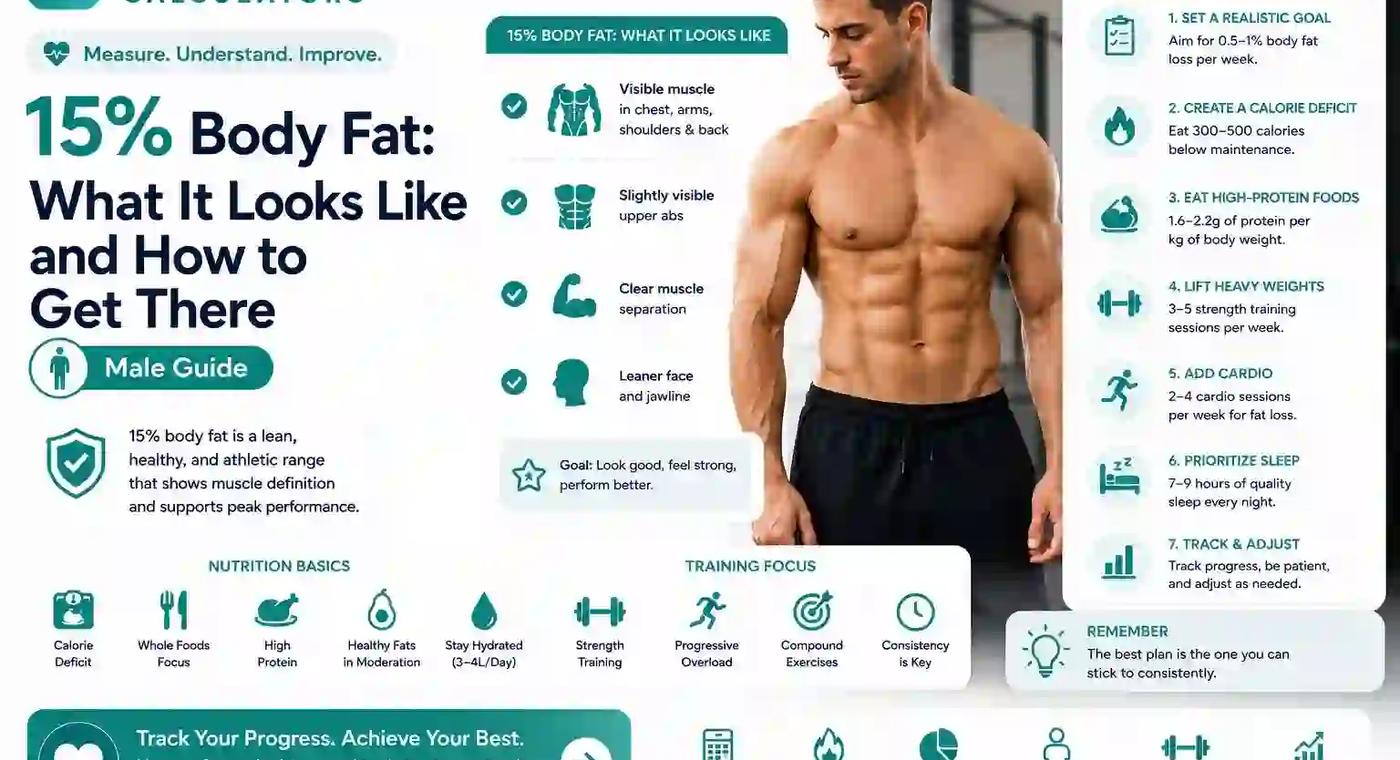
At 15% body fat, most men show the top two abdominal muscles starting to peek through, a visibly flatter stomach than average, and clear muscle separation in the arms and shoulders — without the deep vascularity or fully "shredded" look associated with single-digit body fat. This sits comfortably in the "fit" to "athletic" range on most body fat charts, genuinely achievable and sustainable for most men without extreme dieting.
This guide covers exactly what 15% looks like in practice, how to measure where you're starting from, and a realistic, sourced plan for getting there without losing the muscle you've already built.
What Does 15% Body Fat Actually Look Like?
Visual appearance at any given body fat percentage varies meaningfully based on genetics, fat distribution patterns, and how much muscle mass someone is carrying — two men at exactly 15% can look noticeably different depending on these factors. That said, some patterns show up consistently enough to describe with confidence.
Typical visual markers at 15% body fat for men:
- Upper abs beginning to show, particularly under good lighting or when the abdominal muscles are flexed, while the lower abs remain less defined
- A visibly flatter stomach than the average adult male, without the stomach protruding at rest
- Clear muscle separation in the arms, shoulders, and back — you can generally make out where one muscle group ends and another begins
- A defined jawline and facial leanness, since facial fat is often among the more visible places body fat percentage shows up
- Visible vein definition in the forearms and biceps for many men, though not the extensive vascularity associated with lower body fat percentages
- A generally "fit" rather than "shredded" aesthetic — clothes fit noticeably better, but this isn't the extreme leanness seen in bodybuilding competition prep
Body Fat Percentage Chart for Men: Where 15% Fits
Context matters here — 15% isn't meaningful in isolation, it's meaningful relative to the broader range men's body fat typically falls into.
| Body Fat % Range | Category | Typical Visual Description |
|---|---|---|
| 3-6% | Essential fat / competition shredded | Extreme muscle striations, minimal subcutaneous fat, not sustainable long-term |
| 6-10% | Very lean / athletic | Full six-pack visible, significant vascularity, common in fitness competitors |
| 10-14% | Lean / fit | Visible abs, clear muscle definition throughout |
| 14-17% | Fit / athletic-moderate | Upper abs visible, good overall muscle definition (15% sits here) |
| 18-24% | Average / fit-adjacent | Some muscle definition, less ab visibility, softer overall appearance |
| 25%+ | Above average | Limited visible muscle definition, higher stored fat |
These ranges are approximate and vary somewhat depending on which classification system you're referencing — the American Council on Exercise, military standards, and academic sources each draw slightly different boundaries. Treat this table as a general reference rather than a precise diagnostic tool.
Is 15% Body Fat Good for a Man?
Yes, genuinely — 15% sits in a range widely considered both healthy and aesthetically lean without requiring the extreme dietary restriction needed to maintain single-digit body fat year-round. It's a realistic, sustainable target for most men who train consistently and eat reasonably well, rather than a narrow window only achievable through short-term extreme dieting.
For comparison, many health authorities place the general "acceptable" body fat range for adult men somewhere between roughly 8% and 24%, with 15% landing comfortably within the leaner half of that range without tipping into the territory that's genuinely difficult to maintain long-term.
How to Measure Your Current Body Fat Percentage
Before working toward 15%, you need a reasonably accurate sense of where you're actually starting — guessing based on the mirror alone is unreliable in both directions.
Practical measurement methods, ranked by accessibility:
- Visual estimation against reference photos. Genuinely useful as a rough starting point, though it's the least precise method and prone to both over- and under-estimation depending on lighting and personal bias.
- The U.S. Navy method, which uses waist, neck, and height measurements (plus hip measurement for women) in a formula to estimate body fat percentage. It's not lab-precise, but it's free, repeatable, and reasonably consistent for tracking change over time.
- Skinfold calipers, which measure the thickness of skin folds at several body sites. Reasonably accurate when performed consistently by the same person at the same sites, though technique matters significantly.
- Bioelectrical impedance scales, the kind built into many bathroom scales. Convenient but genuinely sensitive to hydration status, so results can swing noticeably based on when you last ate or drank.
- DEXA scan, the most accurate widely-available method, using low-dose X-ray to directly measure fat, muscle, and bone. Requires a specialized facility and typically costs money per scan, but gives the most reliable number if you want precision.
For most people, the practical approach is picking one consistent method — the Navy formula or a bioelectrical scale used under similar conditions each time — and tracking the trend over weeks and months rather than obsessing over the precision of any single reading. Our Body Fat Estimator uses the Navy method to give you a reasonable starting estimate without needing any special equipment, and pairing that with our Waist-to-Height Ratio calculator gives you a useful secondary data point that tracks fat distribution specifically around the midsection.
How Long Does It Take to Reach 15% Body Fat?
This genuinely depends on your starting point, but sustainable fat loss follows a reasonably predictable pattern that lets you estimate a realistic timeline.
A commonly cited sustainable fat loss rate is roughly 0.5-1% of total body weight per week, achieved through a moderate calorie deficit combined with resistance training to preserve muscle mass. Faster rates are possible but become progressively harder to sustain and carry higher risk of muscle loss alongside fat loss.
Rough timeline estimates based on starting point:
| Starting Body Fat % | Approximate Time to Reach 15% |
|---|---|
| 20% | 8-16 weeks |
| 25% | 16-24 weeks |
| 30%+ | 24+ weeks, likely in phases |
These are genuinely rough estimates, not guarantees — individual metabolism, adherence consistency, training experience, and how aggressively you diet all shift the actual timeline meaningfully. Someone newer to structured training and nutrition may also see faster initial progress due to what's sometimes called "beginner gains" working in their favor alongside fat loss.
The Calorie Deficit: What Actually Drives Fat Loss
Fat loss fundamentally requires consuming fewer calories than you burn, sustained over time — no amount of specific food choices, supplements, or training style changes that basic energy balance principle.
A practical, sustainable deficit approach:
- Aim for a moderate deficit of roughly 15-25% below maintenance calories, rather than an extreme cut. Very aggressive deficits accelerate muscle loss risk and are considerably harder to sustain psychologically over the weeks needed to reach 15%.
- Prioritize protein intake at roughly 1.6-2.2 grams per kilogram of body weight, since adequate protein is one of the most well-supported factors in preserving muscle mass during a calorie deficit.
- Don't cut carbs or fats to zero. Both play genuine roles in training performance and hormone function — a moderate, balanced approach to macronutrients tends to be more sustainable than extreme restriction of any single macro.
- Recalculate your calorie target periodically as your weight drops, since your maintenance calories genuinely decrease as body weight decreases — a deficit calculated for your starting weight becomes progressively less aggressive as you lose weight unless adjusted.
Our Calorie Intake Planner can help establish a realistic starting deficit based on your specific stats, and our guide on how much protein you actually need per day breaks down protein targets in more depth if you want to fine-tune that specific number.
Training: Preserving Muscle While Losing Fat
Diet alone drives fat loss, but training determines whether that fat loss reveals visible muscle definition or just leaves you smaller and softer. This distinction matters enormously for actually achieving the "15% body fat look" rather than just hitting a number on a scale.
Core training principles for this goal:
- Resistance training 3-5 days per week, prioritizing compound movements (squats, deadlifts, presses, rows) that recruit the most muscle mass and provide the strongest signal for muscle preservation during a deficit.
- Maintain training intensity even while in a deficit. The goal during fat loss isn't necessarily to build significant new muscle — it's to give your body a strong enough signal that it prioritizes keeping the muscle you already have rather than breaking it down for energy.
- Progressive overload still matters, even modestly, during a cut — continuing to challenge your muscles, even if you're not adding significant weight to the bar, helps preserve strength and muscle mass better than simply going through the motions.
- Add moderate cardio to support the deficit, without over-relying on it. Cardio burns calories, but excessive cardio volume without adequate recovery can work against muscle preservation goals if it's not balanced against resistance training and recovery.
If you're building this out as a structured plan rather than improvising, our guide on structuring a workout plan from beginner to advanced and our piece on combining cardio and strength training effectively both cover this balance in more depth.
Cutting vs. Body Recomposition: Which Approach Fits You?
Not everyone needs the same strategy to reach 15% body fat, and the right approach depends heavily on your current starting point and training experience.
A traditional cut (calorie deficit focused purely on fat loss) tends to suit people who already have a reasonable amount of muscle mass and primarily need to reduce body fat to reveal that muscle. This is generally the faster, more direct route to a specific body fat percentage.
Body recomposition (losing fat and building muscle simultaneously, generally at maintenance or a very slight deficit) tends to suit beginners, people returning to training after a break, or those carrying a higher starting body fat percentage with relatively less muscle mass — sometimes called "skinny fat." Our detailed guide on body recomposition — losing fat while gaining muscle walks through exactly who this approach suits and how to structure it.
Nutrition Beyond Calories: What Actually Helps
While total calorie balance is the primary driver, a few nutritional details genuinely make the process more sustainable and effective:
- Adequate hydration supports training performance and can help manage hunger during a deficit — our water intake guide covers practical daily targets.
- Fiber-rich foods (vegetables, whole grains, legumes) support satiety at relatively low calorie cost, making a deficit genuinely easier to stick to day after day.
- Consistent meal timing that fits your actual life, rather than a rigid schedule you'll abandon within two weeks — sustainability matters more than optimizing meal timing to a theoretical ideal.
- Sleep quality, which directly affects hunger hormone regulation and recovery capacity — poor sleep genuinely undermines fat loss efforts independent of diet and training quality.
Common Mistakes That Slow Progress Toward 15%
- Cutting calories too aggressively, which accelerates initial weight loss but increases muscle loss risk and makes the process harder to sustain, often leading to rebound weight regain.
- Neglecting resistance training during the deficit, relying purely on cardio and calorie restriction — this typically produces a smaller, softer body rather than the lean, defined look associated with 15% body fat.
- Chasing the scale number rather than body composition. Two people at the same body weight can look dramatically different depending on how much of that weight is muscle versus fat — the scale alone doesn't tell the full story.
- Expecting a linear, unbroken progression. Weight and visible body composition changes rarely move in a perfectly straight line — plateaus and fluctuations are normal parts of the process, not signs of failure.
- Underestimating how genetics affect fat distribution. Some men show ab definition earlier in the process due to where their body naturally stores fat, while others need to get notably leaner before the same muscles become visible — this is normal variation, not something training or diet choices control.
Maintaining 15% Body Fat Long-Term
Reaching 15% is one thing; staying there requires a different mindset than the deficit phase that got you there.
- Transition to maintenance calories gradually once you reach your target, rather than immediately returning to pre-diet eating habits, which commonly leads to rapid regain.
- Continue resistance training consistently, since the muscle mass you built or preserved during the cutting phase is what maintains the visible definition associated with 15% body fat — stopping training tends to soften that appearance even if body weight stays stable.
- Allow for natural, small fluctuations. Body fat percentage isn't a fixed number day to day — normal variation of a percent or two around your target is expected and not a sign anything's going wrong.
- Reassess periodically using the same measurement method you used to track progress initially, so you're comparing consistent data over time rather than switching methods and getting confused by different baseline numbers.
Frequently Asked Questions
What does 15% body fat look like on a man? Most men at 15% body fat show visible upper ab definition, a flatter stomach than average, and clear muscle separation in the arms and shoulders, without the extensive vascularity or fully "shredded" appearance seen at single-digit body fat percentages.
Is 15% body fat good for a man? Yes — it's widely considered a healthy, athletic range that's genuinely sustainable long-term, unlike much lower body fat percentages that typically require restrictive dieting to maintain.
How long does it take to reach 15% body fat? This depends heavily on your starting point, but at a sustainable fat loss rate of roughly 0.5-1% of body weight per week, someone starting around 20% body fat might realistically reach 15% in about 8-16 weeks.
Do you have visible abs at 15% body fat? Partially — the upper abdominal muscles typically become visible around this range, while the lower abs generally need a lower body fat percentage to show clearly, though individual fat distribution affects exactly where this shows up.
What is a healthy body fat percentage for men? Most health authorities place the generally healthy range for adult men somewhere between roughly 8% and 24%, with 15% sitting comfortably within the leaner half of that range.
How do I measure my body fat percentage accurately? Options range from free at-home methods like the Navy body fat formula to more precise but less accessible options like DEXA scans — for most people, picking one consistent method and tracking the trend over time matters more than achieving lab-level precision on any single measurement.
What should I eat to lower my body fat to 15%? Focus on a moderate calorie deficit (roughly 15-25% below maintenance), adequate protein intake (1.6-2.2g per kg of body weight), and a balanced approach to carbs and fats rather than eliminating any macronutrient entirely.
Is 15% body fat considered athletic? Yes, 15% generally falls within or near the athletic-to-fit range on most body fat classification charts, representing a genuinely lean, defined physique without the extreme leanness associated with competitive bodybuilding.
The Bottom Line
Reaching 15% body fat is a realistic, sustainable goal for most men willing to commit to a moderate calorie deficit paired with consistent resistance training — it doesn't require extreme dieting or unsustainable restriction, which is exactly what makes it a genuinely maintainable long-term target rather than a temporary before-and-after transformation. The combination that actually works is straightforward: eat in a measured deficit, prioritize protein, keep training hard enough to preserve muscle, and track progress consistently rather than chasing perfect precision on any single measurement.
Start by getting a realistic baseline with our Body Fat Estimator, set your calorie target with our Calorie Intake Planner, and build your training structure around preserving the muscle that will actually make 15% body fat look the way you're picturing it.
Medical Disclaimer
This article is for general education only. It is not medical advice, diagnosis, treatment, prescription guidance, or a replacement for professional healthcare. Speak with a qualified healthcare professional for personal medical concerns, symptoms, pregnancy concerns, mental health crisis, medication questions, or before making major health changes.