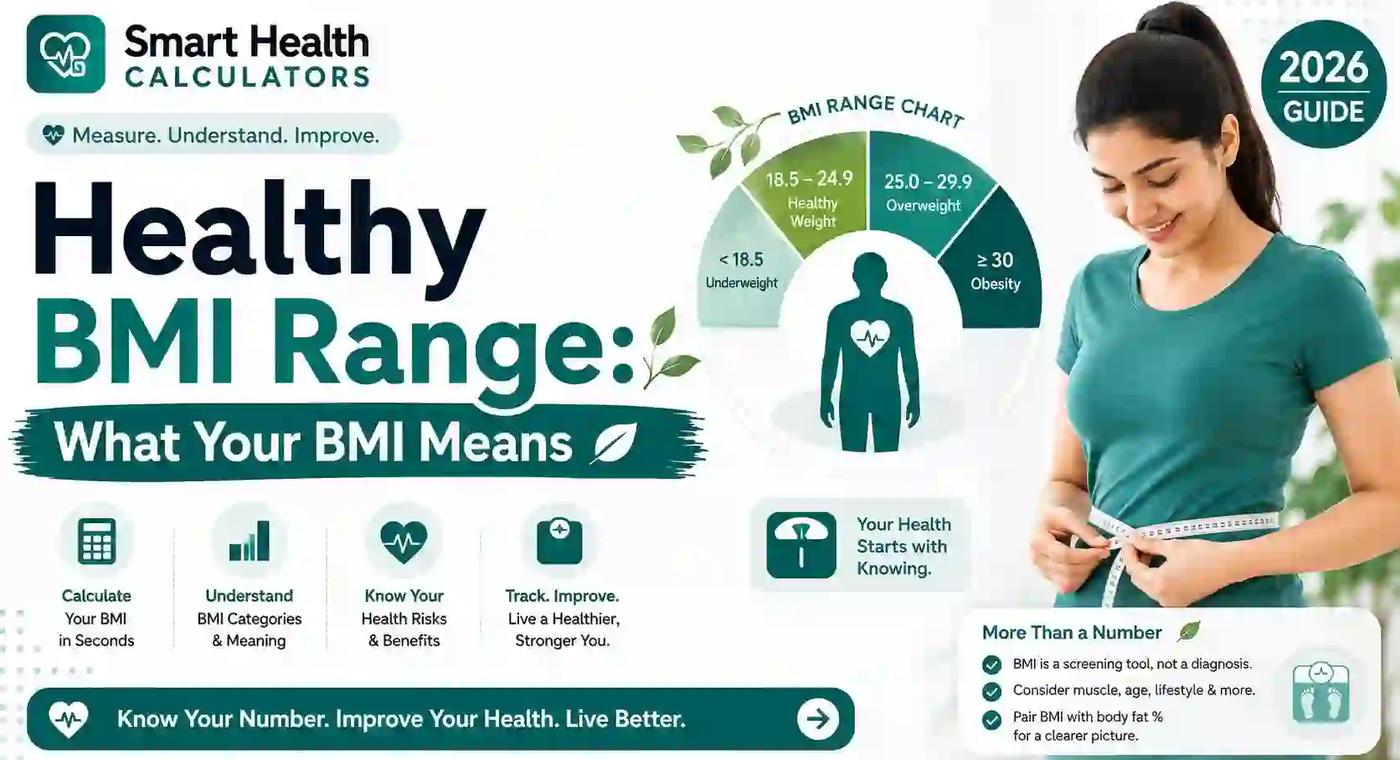
Healthy BMI Range: What Your BMI Means (2026 Guide)
Learn the healthy BMI range for adults, how to calculate BMI, what each category means, and why BMI isn't a complete measure of health.
You just typed your height and weight into a calculator, and now you're staring at a number — 23.4, 27.1, 31.8 — wondering what it actually means for your health. That number is your Body Mass Index, and while it's one of the most widely used health screening tools in the world, it's also one of the most misunderstood.
This guide walks through exactly what a healthy BMI range looks like, how to calculate it yourself, what each category actually means, and — just as important — where BMI falls short as a health measure. By the end, you'll be able to read your own result with confidence instead of guessing.
What Is a Healthy BMI, Exactly?
For most adults, a BMI between 18.5 and 24.9 falls into the "healthy weight" category, according to standards used by both the CDC and the World Health Organization. Below that range is classified as underweight, and above it moves into overweight and then obesity classifications.
Here's the full breakdown adults typically see on a standard BMI chart:
| BMI Range | Category |
|---|---|
| Below 18.5 | Underweight |
| 18.5 – 24.9 | Healthy weight |
| 25.0 – 29.9 | Overweight |
| 30.0 – 34.9 | Obesity (Class 1) |
| 40.0 and above | Obesity (Class 3, sometimes called severe obesity) |
)
These ranges apply to adults 20 and older. Kids and teens use a different system entirely — BMI-for-age percentiles — because growth patterns vary so much by age and sex during childhood.
One thing worth saying clearly up front: BMI is a screening tool, not a diagnosis. It gives your doctor a quick, low-cost starting point for a conversation about your health — it doesn't tell the whole story on its own, and we'll get into exactly why later in this guide.
How to Calculate BMI (By Hand or With a Calculator)
The BMI formula itself is simple — it's just weight divided by height squared. Here's how it breaks down in both metric and imperial units.
Metric formula: BMI = weight (kg) ÷ height (m)²
Imperial formula: BMI = [weight (lb) ÷ height (in)²] × 703
A Quick Example
Let's say someone weighs 70 kg and is 1.7 meters tall.
- Square the height: 1.7 × 1.7 = 2.89
- Divide weight by that number: 70 ÷ 2.89 = 24.2
That result, 24.2, sits comfortably in the healthy weight range.
For an imperial example: a person who weighs 150 lbs and is 5'5" (65 inches) would calculate it as (150 ÷ 65²) × 703 = 24.96 — right at the edge of the healthy range.
Doing this by hand is a good exercise once, just so you understand where the number comes from. After that, using a BMI calculator is faster and removes any risk of a rounding error throwing off your result.
How to Read Your BMI Result: What Each Category Actually Means
Underweight (Below 18.5)
A BMI under 18.5 can sometimes point to inadequate nutrition, an underlying health condition, or a naturally lean body type. It's associated with risks like weakened immune function, bone density loss, and fertility issues in some cases. If your BMI consistently falls here, it's worth a conversation with a healthcare provider rather than assuming it's automatically fine just because it's "low."
Healthy Weight (18.5–24.9)
This range is associated with the lowest average risk of weight-related health complications like type 2 diabetes, heart disease, and high blood pressure. That said, falling in this range doesn't automatically mean someone is metabolically healthy — a sedentary lifestyle, poor diet, or high stress can still affect health even at a "normal" BMI.
Overweight (25.0–29.9)
This category signals an increased — but not necessarily severe — risk of weight-related conditions. For many people in this range, especially those newer to strength training, a higher BMI can reflect muscle mass rather than excess fat, which is exactly why BMI alone doesn't tell the full story (more on that below).
Obesity (30.0 and above)
Obesity is broken into three classes, with risk generally increasing as the number climbs. This is where BMI tends to correlate most strongly with real health outcomes, since at higher BMI levels, excess body fat (rather than muscle) is almost always the driving factor.
Why BMI Isn't a Perfect Measure — And When to Look Beyond It
This is the part most quick-answer BMI articles skip, and it's genuinely important. BMI was developed in the 1830s by Belgian mathematician Adolphe Quetelet as a population-level statistical tool, not as an individual diagnostic measure. It has real, well-documented limitations:
- It can't tell muscle from fat. A muscular athlete and a sedentary person of the same height and weight can have identical BMIs and completely different body compositions. This is the single biggest reason a bodybuilder might technically show as "overweight" on a BMI chart.
- It doesn't account for fat distribution. Two people with the same BMI can carry very different amounts of visceral fat (the fat around internal organs, which carries more health risk) versus subcutaneous fat.
- It varies in accuracy across ethnic groups. Research has shown that some populations, including many people of Asian descent, face elevated health risks at BMI levels that would be considered "normal" by standard Western cutoffs.
- It changes meaning with age. Older adults often benefit from carrying slightly more weight than younger adults, since a bit of extra reserve is linked to better outcomes during illness or recovery.
- It doesn't apply during pregnancy. Standard BMI categories aren't designed for pregnant individuals, since healthy weight gain during pregnancy follows an entirely different pattern.
For a deeper look at exactly how much you should — and shouldn't — trust your BMI number, our guide on whether BMI is actually accurate walks through the research in more detail.
BMI vs. Body Fat Percentage: What's the Real Difference?
If BMI has these gaps, why is it still used everywhere? Mostly because it's free, fast, and requires nothing more than a scale and a tape measure — compare that to body fat percentage, which typically requires tools like skinfold calipers, bioelectrical impedance scales, or a DEXA scan for real precision.
| Factor | BMI | Body Fat Percentage |
|---|---|---|
| What it measures | Weight relative to height | Actual proportion of body fat |
| Tools needed | Scale, tape measure | Calipers, smart scale, or DEXA scan |
| Accounts for muscle mass | No | Yes |
| Cost | Free | Free to moderate (DEXA scans cost more) |
| Best used for | Quick population-level screening | Individual body composition tracking |
If you want a more complete picture of your health than BMI alone provides, pairing it with a body fat estimate gives you a much clearer sense of what your weight is actually made of. We've also broken down this comparison in full in our article on BMI vs. body fat percentage, including which measurement matters more depending on your goals.
Does BMI Differ by Age and Gender?
The standard adult BMI formula and category cutoffs are the same for men and women — there's no separate "male BMI chart" or "female BMI chart" in terms of the ranges themselves. What does differ between men and women, on average, is body composition at a given BMI: women naturally tend to carry a higher percentage of body fat than men at the same BMI, due to physiological differences.
Age matters more than gender here. As people get older, muscle mass naturally declines (a process called sarcopenia) even if weight stays the same, which means an older adult and a younger adult with an identical BMI may have meaningfully different body compositions. This is part of why some clinicians treat BMI more cautiously as a standalone measure in older patients.
What Should You Do If Your BMI Falls Outside the Healthy Range?
A single BMI reading isn't a verdict — it's a starting point for a bigger conversation. Here's a practical way to think about next steps depending on where your number lands:
If you're underweight:
- Track your weight over a few weeks rather than reacting to one measurement.
- Talk to a healthcare provider to rule out underlying causes.
- Focus on nutrient-dense meals rather than just "eating more."
If you're in the overweight or obesity range:
- Look at trends, not single readings — has your weight been climbing steadily, or is it stable?
- Pair your BMI with a waist circumference measurement, since abdominal fat is a stronger predictor of cardiovascular risk than BMI alone.
- Build small, sustainable habits — consistent movement and balanced meals tend to outperform drastic short-term changes.
- Bring your results to a doctor, especially if you have a family history of diabetes, heart disease, or high blood pressure.
If you're an athlete or very muscular:
- Don't rely on BMI alone. A body fat percentage check will give you a far more accurate read on your actual health status.
If you're working on shifting your BMI into a healthier range gradually and sustainably, our guide on lowering BMI naturally covers realistic, non-extreme approaches that hold up over time.
BMI for Different Life Stages and Situations
BMI isn't one-size-fits-all across every population:
- Children and teens (2–19 years): Use BMI-for-age percentiles instead of fixed adult cutoffs, since healthy weight changes constantly during growth.
- Pregnant individuals: Standard BMI categories don't apply; healthy weight gain is tracked differently by trimester.
- Adults over 65: Slightly higher BMI ranges are sometimes considered acceptable, since being mildly underweight in older age carries its own risks.
- Athletes and bodybuilders: Muscle mass can push BMI into "overweight" territory despite low body fat — a body fat percentage or waist measurement gives a more accurate picture here.
A Quick, Honest Example
Here's a scenario that shows exactly why context matters: two people, both 5'10" and 190 lbs, will show the identical BMI of 27.3 — technically "overweight." One of them is a competitive powerlifter with 14% body fat. The other has a largely sedentary lifestyle with 32% body fat. Same number on the chart, very different health pictures.
This is exactly why doctors use BMI as a first-pass filter, not a final answer — and why it's worth checking your result against other data points like waist circumference or body fat percentage before drawing conclusions about your own health.
Frequently Asked Questions
What is a healthy BMI range? For most adults, a BMI between 18.5 and 24.9 is classified as healthy weight. This range is associated with the lowest average risk of weight-related health conditions.
How do I calculate my BMI? Divide your weight in kilograms by your height in meters squared (kg/m²). If using pounds and inches, divide weight by height squared, then multiply by 703.
Is BMI accurate for everyone? No. BMI doesn't distinguish between muscle and fat, and it can be less accurate for athletes, older adults, and certain ethnic populations who may face different health risks at the same BMI level.
What BMI is considered overweight? A BMI between 25.0 and 29.9 falls into the overweight category for adults.
Does BMI account for muscle mass? No. BMI is based purely on weight and height, so it can't tell the difference between muscle, fat, or bone mass — which is why a muscular person can register as "overweight" despite having low body fat.
Can I be healthy with a high BMI? Yes, it's possible, particularly for muscular individuals with low body fat. However, at higher BMI levels, excess weight is more often driven by fat rather than muscle, so it's worth checking additional measures like waist circumference or body fat percentage rather than relying on BMI alone.
The Bottom Line
Your BMI number is a useful first checkpoint, not a complete health report. It's fast, free, and backed by decades of population data — but it works best when paired with other information: your waist measurement, your body fat percentage, your family health history, and how you actually feel day to day.
If you haven't calculated your number yet, our free BMI calculator gives you an instant, accurate result in both metric and imperial units. And if your reading raises questions rather than answering them, that's completely normal — that's exactly what a conversation with your healthcare provider is for.
Medical Disclaimer
This article is for general education only. It is not medical advice, diagnosis, treatment, prescription guidance, or a replacement for professional healthcare. Speak with a qualified healthcare professional for personal medical concerns, symptoms, pregnancy concerns, mental health crisis, medication questions, or before making major health changes.