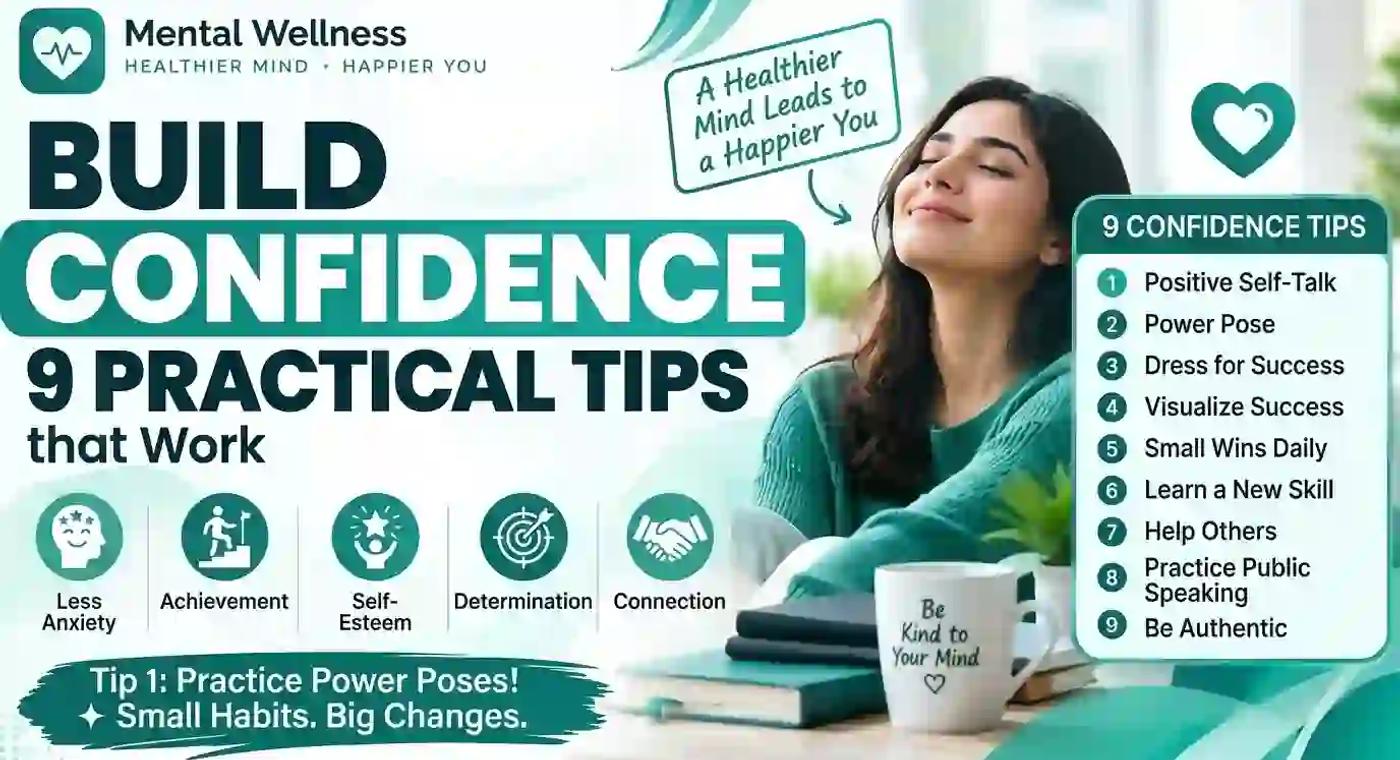
How to Build Confidence: 9 Practical Tips That Work
How to build confidence with 9 practical strategies, including positive self-talk, small challenges, self-compassion, skill-building, exercise, and healthy boundaries.
Confidence isn't something you're born with in a fixed amount — it's closer to a skill you build through repetition, small wins, and honest self-talk. Yet most advice on the topic stays vague: "just believe in yourself," "fake it till you make it," "think positive." None of that tells you what to actually do on a Monday morning when you're dreading a meeting or hesitating to speak up in a group.
This guide breaks confidence down into nine concrete, evidence-informed strategies — the kind grounded in how psychologists and health bodies like the NHS and Mind actually describe building self-belief. You'll also find a few small daily habits that compound over time, along with tools to track how your mental wellbeing shifts as you put these into practice.
What Confidence Actually Means (And What It Doesn't)
Before diving into tips, it helps to define the term precisely, because "confidence" gets conflated with several related but distinct ideas.
Confidence is trust in your own judgment, abilities, or decisions in a specific situation. Self-esteem is broader — it's how you value yourself overall, independent of any particular task. Self-efficacy, a term from psychology, refers specifically to your belief that you can successfully complete a given task or challenge.
Mind, the UK mental health charity, is careful to point out that confidence isn't the same as being loud, fearless, or believing you're superior to other people. You can be a quiet, introverted person and still be deeply confident in your abilities. Confidence is internal — it's about trusting yourself, not about performing certainty for an audience.
This distinction matters because a lot of "confidence advice" online actually teaches performance rather than genuine self-trust — and performance without substance tends to crack under real pressure.
Why Building Confidence Actually Matters
Low confidence doesn't just feel uncomfortable in the moment. Left unaddressed, it tends to narrow your life in quiet ways: you stop raising your hand for opportunities, you avoid conversations that might lead somewhere good, and you talk yourself out of chances before anyone else gets the opportunity to say no.
NHS guidance on self-esteem describes how people with persistently low self-esteem may withdraw from social situations, avoid new challenges, and reinforce their own doubts by consistently choosing avoidance over exposure. Over time, this avoidance pattern can affect mental health more broadly, sometimes contributing to anxiety or low mood.
The good news is that confidence responds well to deliberate practice. It isn't a fixed trait locked in during childhood — it's shaped continuously by the experiences you choose to have and the way you talk to yourself about them.
Tip 1: Challenge Negative Self-Talk Before It Runs the Show
The voice in your head narrating your capabilities is often harsher and less accurate than any external critic you'll ever face. Left unchecked, that internal monologue becomes the loudest input shaping your confidence.
NHS Every Mind Matters recommends a self-help technique borrowed from cognitive behavioral therapy (CBT): noticing an unhelpful thought, then actively questioning whether it's actually true or just a habitual pattern. If you catch yourself thinking "I always mess up presentations," pause and ask what evidence actually supports that. Usually, the honest answer is a lot thinner than the thought felt in the moment.
A practical way to practice this:
- Write down the automatic negative thought exactly as it appeared in your head.
- Ask yourself: "Would I say this to a friend in the same situation?"
- Replace it with a more balanced, realistic statement — not an over-the-top positive one, just an accurate one.
This isn't about forcing false positivity. It's about correcting a thinking pattern that's skewed unfairly against you. Keeping a written record of this process — even briefly — tends to make the pattern easier to notice over time, which is one reason journaling for mental health and self-awareness is such a commonly recommended companion habit alongside cognitive restructuring.
Tip 2: Set Small, Achievable Challenges Instead of Overwhelming Goals
One of the fastest ways to erode confidence is setting a goal so large that failure feels inevitable before you even start. NHS guidance specifically recommends setting manageable challenges as a core strategy for raising low self-esteem — not because small wins are impressive on their own, but because they build a track record your brain can actually trust.
If public speaking terrifies you, the goal isn't "give a flawless TED talk." It's "speak up once in tomorrow's team meeting." If you're nervous about socializing, it's not "become the most outgoing person at the party." It's "start one conversation and see it through."
Why smaller works better than bigger here:
- Small challenges are actually completable, which means you get real evidence of success instead of another data point confirming self-doubt.
- Each completed challenge slightly raises your baseline tolerance for the next, slightly bigger one.
- Failure at a small challenge is low-stakes and easy to learn from, unlike failure at something you've built up as make-or-break.
This is the mechanism behind what's often called the competence-confidence loop: doing something builds a small amount of competence, competence builds a small amount of confidence, and that confidence makes the next attempt easier. It's slow, but it's durable in a way that motivational bursts rarely are.
Tip 3: Practice Self-Compassion Instead of Self-Criticism
It's easy to assume that being hard on yourself is what keeps standards high. In practice, harsh self-criticism tends to do the opposite — it makes people more risk-averse, more likely to avoid situations where they might fail, and more likely to interpret ordinary mistakes as proof of inadequacy.
Mind's guidance on improving self-esteem specifically highlights self-kindness as a practical strategy, alongside recognizing your own strengths rather than fixating exclusively on weaknesses. This doesn't mean lowering your standards. It means treating a mistake as information rather than a verdict on your worth.
A useful mental shift: when something goes wrong, ask "what can I learn here?" instead of "what's wrong with me?" The first question keeps you engaged and moving forward. The second one tends to spiral into rumination that makes trying again feel riskier than it actually is.
Tip 4: Use Your Body Language to Influence How You Feel
The relationship between body language and internal state runs both directions — how you feel affects your posture, but your posture also feeds back and affects how you feel and how others perceive you.
Simple, low-effort adjustments make a measurable difference in how you come across, and often in how you feel internally:
- Stand and sit with an open posture. Uncrossed arms and a straight (not rigid) spine tend to read as more approachable and self-assured, and can shift your own physiological state toward feeling steadier.
- Slow down your speech slightly. Nervous speech tends to speed up and get quieter. Deliberately slowing your pace and speaking at a normal volume signals — to yourself and others — that you're not rushing to escape the moment.
- Make consistent, natural eye contact. You don't need to stare anyone down. Holding eye contact for a few seconds at a time during conversation, rather than glancing away immediately, is one of the most reliable nonverbal signals of ease.
- Slow your breathing before a high-stakes moment. A few slow, deliberate breaths before walking into a meeting or conversation can reduce the physical symptoms of anxiety — racing heart, shallow breathing — that otherwise undercut how confident you feel.
If breathing techniques are new to you, a short guided practice like 5-minute breathing exercises to lower stress is a good low-commitment entry point before a nerve-wracking event.
Tip 5: Build Genuine Competence Through Skill Development
Confidence that isn't backed by any actual skill tends to be fragile — it collapses the moment reality pushes back. NHS guidance identifies learning new skills as one of the practical activities that supports both self-esteem and self-confidence, and the logic is straightforward: competence gives your confidence something real to stand on.
This doesn't mean you need to master something before you're allowed to feel capable. It means confidence grows fastest when it's paired with deliberate skill-building in the specific area where you feel shaky.
Examples of how this plays out:
- Nervous about job interviews? Practice answering common questions out loud, ideally with another person, rather than only rehearsing mentally.
- Anxious about public speaking? Join a low-stakes speaking group or practice presenting to a small, familiar audience before a high-pressure one.
- Uncomfortable with difficult conversations at work? Read up on assertive communication techniques and practice phrasing before you need them in the moment.
Skill-building doesn't have to be dramatic. Consistent, small increments of practice — the kind that feels almost too easy to matter — is what actually produces durable competence over weeks and months.
Tip 6: Learn to Say No and Set Personal Boundaries
Confidence and assertiveness are closely linked but not identical. Assertiveness is the ability to express your needs, opinions, and limits clearly and respectfully — without either suppressing yourself to keep the peace or steamrolling others to get your way.
NHS guidance specifically calls out learning to say no as part of raising low self-esteem, because chronically overcommitting yourself to avoid disappointing others quietly reinforces the belief that your own preferences don't matter as much as everyone else's. Over time, this erodes confidence in a way that's easy to miss because it doesn't look like an obvious failure — it looks like being agreeable.
A simple framework for practicing this:
- State your position clearly, without over-explaining or apologizing excessively.
- Acknowledge the other person's request or feelings without necessarily agreeing to it.
- Hold your boundary calmly if they push back, rather than immediately backing down.
It's worth distinguishing assertiveness from aggressiveness here. Assertive communication respects both your needs and the other person's; aggressive communication disregards the other person's needs entirely. The goal is the former — clear, respectful, and firm.
Tip 7: Stay Physically Active
The connection between physical activity and mood is one of the more consistently discussed relationships in mental health guidance. NHS Every Mind Matters resources connect regular movement with improvements in mood, reduced anxiety symptoms, and better self-esteem over time — not as a cure-all, but as one meaningful lever among several.
You don't need an intense training regimen for this to matter. A daily walk, a short home workout, or even ten minutes of stretching can shift your energy and mood enough to notice a difference in how capable you feel tackling the rest of your day.
If you're building a movement habit from scratch, starting with something structured but low-barrier — like a beginner home workout plan requiring no equipment — removes a lot of the friction that stops people before they start. Tracking basic markers like resting heart rate or activity consistency with a workout planner can also make progress feel more concrete, which reinforces the same competence-confidence loop discussed earlier.
Tip 8: Seek Out Genuine Connection and Supportive Relationships
Isolation tends to amplify self-doubt, because there's no outside perspective to correct distorted thinking. Mind's guidance on confidence and self-esteem highlights relationships and social connection as a meaningful factor in how people experience their own worth and capability.
This doesn't mean surrounding yourself with people who only validate you. It means having relationships where you feel safe enough to be honest, where feedback is constructive rather than harsh, and where you're not constantly performing a version of yourself designed to avoid judgment.
Practical ways to nurture this:
- Reach out first, rather than waiting for others to initiate — this alone builds a small but real form of social confidence.
- Choose a few relationships to actually invest time in, rather than spreading attention thin across many surface-level connections.
- Be honest about struggles with at least one trusted person, since keeping everything internal tends to make self-doubt louder rather than quieter.
Reduced screen time and more intentional in-person interaction can also play a role here — research and health guidance increasingly point to a connection between heavy passive screen use and lower mood, which is worth considering if screen time is affecting your mental health more than you've noticed.
Tip 9: Try New Things and Step Outside Your Comfort Zone Deliberately
Confidence doesn't grow in comfort. It grows in the small, manageable discomfort of trying something you're not already good at and discovering you can handle the outcome — whatever it turns out to be.
Mind's guidance connects confidence-building with trying new experiences, not because novelty itself is magic, but because it repeatedly proves to you that uncertainty is survivable. Every time you do something new and come out the other side — even if it didn't go perfectly — you're collecting evidence that contradicts the belief that unfamiliar situations are dangerous or beyond you.
Examples of low-stakes ways to practice this:
- Take a class in something you've never tried, purely for the experience rather than mastery.
- Strike up a conversation with someone you wouldn't normally approach.
- Volunteer for a task at work slightly outside your usual role.
- Travel somewhere unfamiliar, even locally, without over-planning every detail.
The goal isn't constant discomfort for its own sake. It's occasional, deliberate exposure to situations that stretch your sense of what you can handle — because that sense expands every time you test it.
How Long Does It Actually Take to Feel More Confident?
There's no universal timeline, and Mind explicitly notes that different approaches work differently for different people — what accelerates confidence for one person might feel irrelevant to another. That said, most people notice small shifts within a few weeks of consistent practice, particularly with the self-talk and small-challenge strategies, since those provide the fastest feedback loop.
Lasting change — the kind that holds up under real pressure, not just in low-stakes moments — tends to build over months rather than days. This is less about how fast you can push it and more about staying consistent long enough for new patterns to actually replace old ones.
If low confidence is significantly affecting your daily life, relationships, or ability to function at work, it's worth talking to a healthcare provider or therapist rather than relying solely on self-guided strategies. Persistent low self-esteem can sometimes overlap with anxiety or depression, and NHS guidance recommends considering talking therapies such as CBT when self-help approaches aren't providing enough relief on their own. A mental health self-check-in guide can help you get a clearer read on whether what you're experiencing warrants professional support.
A Simple Weekly Structure to Put These Tips Into Practice
Rather than trying to implement all nine tips simultaneously, it's more sustainable to build them into a loose weekly rhythm:
| Day | Focus |
|---|---|
| Monday | Set one small, achievable challenge for the week |
| Tuesday | Practice catching and reframing one negative thought |
| Wednesday | Movement — a walk, workout, or stretch session |
| Thursday | Reach out to one person you haven't spoken to recently |
| Friday | Practice one instance of assertive communication or boundary-setting |
| Weekend | Try one small new experience or reflect in a journal on the week's wins |
This structure isn't rigid — the point is spreading these practices out so they become habits rather than one-off efforts you abandon after a week. Building a healthy morning routine around even one or two of these elements tends to make the whole practice stick better than trying to squeeze it in reactively.
Frequently Asked Questions
What is the best way to become more confident?
There isn't a single "best" method — confidence builds through a combination of small achievable challenges, reframing negative self-talk, and gaining real competence through practice. Combining several approaches tends to work better than relying on just one.
Can confidence be learned, or is it something you're born with?
Confidence is widely understood as a skill that develops through experience and practice, not a fixed trait. People can and do meaningfully build confidence at any stage of life through consistent effort.
Does exercise actually help with confidence?
Physical activity is associated with improved mood and reduced anxiety, both of which support confidence indirectly. It isn't a direct cause-and-effect fix, but it's a consistently recommended piece of the broader picture.
What's the difference between confidence and self-esteem?
Confidence usually refers to trust in your ability to handle a specific task or situation. Self-esteem is broader — it's your overall sense of self-worth, independent of any one skill or challenge.
How can I stop worrying about what other people think?
This often improves gradually as you accumulate evidence that taking social risks doesn't lead to catastrophe. Practicing small exposures — speaking up, trying something new, setting a boundary — tends to reduce this fear more effectively than simply trying to think your way out of it.
Should I see a therapist for low confidence?
If low confidence is persistent, significantly affects your daily functioning, or overlaps with symptoms of anxiety or depression, speaking with a healthcare provider or therapist is a reasonable and often helpful step. Self-help strategies work well for many people, but they aren't a substitute for professional support when it's needed.
Bringing It Together
Confidence isn't built in a single decisive moment — it's built in the accumulation of small challenges completed, negative thoughts questioned, and new situations survived. None of the nine strategies above require dramatic life changes. They require consistency, and a willingness to keep showing up to slightly uncomfortable situations even when the outcome isn't guaranteed.
Start with just one or two of these tips this week rather than all nine at once. Track how you feel as you go, and if you notice your mood, sleep, or stress levels shifting alongside your confidence, a broader mental health self-check-in can help you see the fuller picture of how your wellbeing is trending over time.
Medical Disclaimer
This article is for general education only. It is not medical advice, diagnosis, treatment, prescription guidance, or a replacement for professional healthcare. Speak with a qualified healthcare professional for personal medical concerns, symptoms, pregnancy concerns, mental health crisis, medication questions, or before making major health changes.