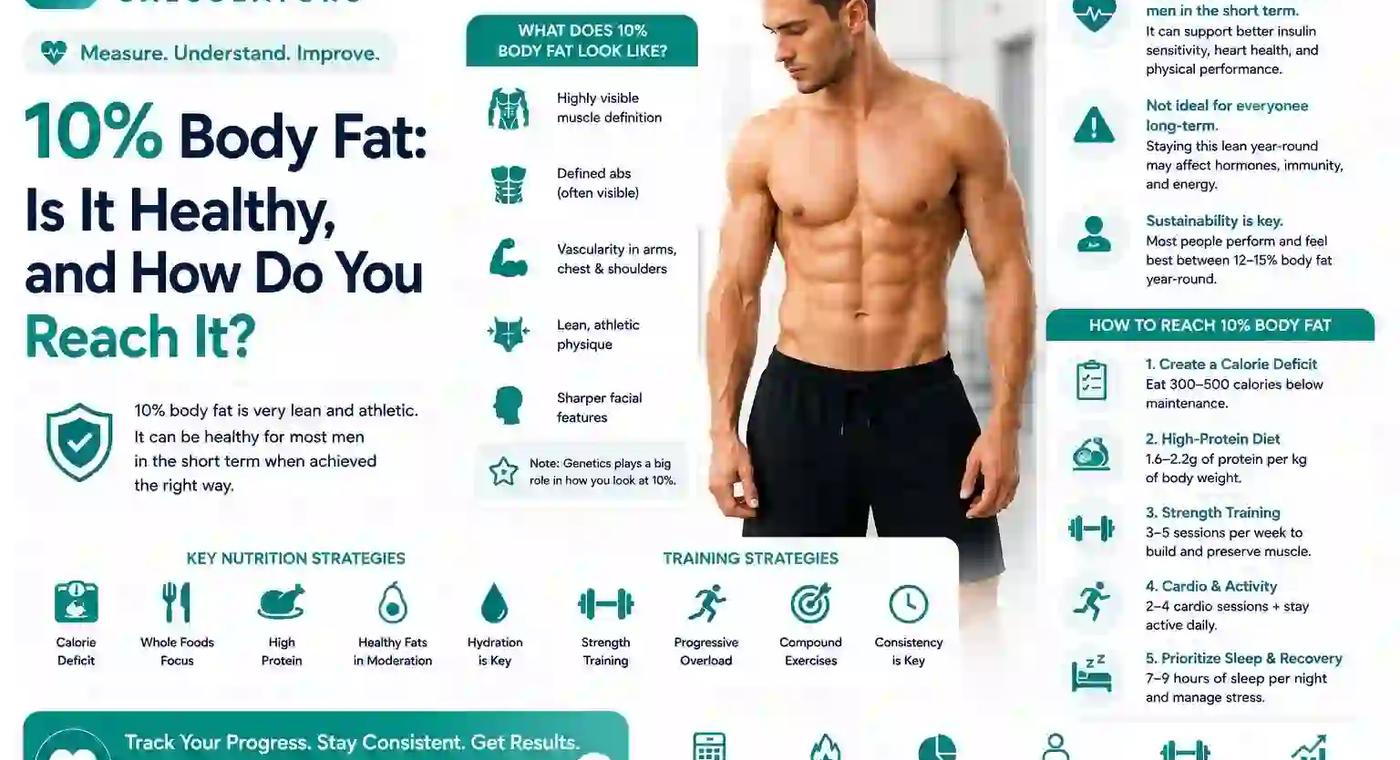
10% Body Fat: Is It Healthy & How to Reach It?
Is 10% body fat healthy? Learn what 10% body fat looks like, how to reach it safely, health risks, and how to maintain a lean physique.
10% Body Fat: Is It Healthy, and How Do You Reach It?
Scroll through any fitness feed and you'll find someone bragging about hitting single-digit or low-teens body fat. But before you chase that number, it's worth asking a more useful question: is 10% body fat actually good for you, or is it just good for Instagram?
The honest answer depends heavily on your sex, your genetics, your goals, and how long you plan to stay there. This guide breaks down what 10% body fat really means, who it's realistic for, the health trade-offs involved, and a practical, non-extreme roadmap for getting there if it's the right target for you.
What Body Fat Percentage Actually Measures (and Why It Beats the Scale)
Body fat percentage tells you what portion of your total body weight is fat mass versus everything else — muscle, bone, organs, and water. Two people can weigh exactly the same and look completely different because one carries more muscle and the other carries more fat.
This is why body fat percentage is a far more useful health and fitness metric than body weight alone. It's also more informative than BMI, which only compares height to weight and can't distinguish a muscular athlete from someone carrying excess fat. If you've ever wondered why a 200-pound bodybuilder and a 200-pound sedentary man can have wildly different BMI classifications and health profiles, body composition is the missing piece. Our breakdown of BMI vs body fat percentage covers this gap in more detail if you want the full comparison.
Body fat isn't inherently bad, either. A certain amount is essential for hormone production, temperature regulation, cushioning organs, and reproductive health. The goal isn't zero fat — it's finding the range that supports performance and long-term health without unnecessary risk.
What Does 10% Body Fat Look Like?
At 10% body fat, most men show clearly visible abdominal muscles, prominent vascularity in the arms and legs, and very little softness around the waist, chest, or lower back. Muscle striations often become visible during flexed poses, and the face typically looks leaner with more defined jawline and cheekbones.
For women, 10% body fat is a different story entirely — and a much more extreme one, which we'll get into shortly.
Here's a general reference chart based on classifications commonly used by fitness professionals and organizations like the American Council on Exercise:
| Category | Men | Women |
|---|---|---|
| Essential Fat | 2–5% | 10–13% |
| Athletes | 6–13% | 14–20% |
| Fitness | 14–17% | 21–24% |
| Acceptable | 18–24% | 25–31% |
| Obese | 25%+ | 32%+ |
Notice something important: 10% body fat falls within the "athlete" range for men but sits right at the edge of "essential fat" for women. That single distinction changes everything about whether this target is healthy. If you want the fully detailed chart with descriptions for every range, we've laid it out visually in our body fat percentage chart guide.
Is 10% Body Fat Healthy?
For Men
For most men, 10% body fat is achievable and generally safe when reached through sensible training and nutrition — not crash dieting. It sits comfortably above the essential fat threshold (2–5%), so there's still a reasonable buffer for hormone production and immune function.
Many recreational lifters, runners, and athletes maintain 8–12% body fat for extended periods without health complications. That said, staying below 6–7% for long stretches can start to interfere with testosterone production, sleep quality, and recovery — this is more relevant to competitive bodybuilders during contest prep than to the average gym-goer.
For Women
This is where the picture changes substantially. Because women require more essential fat for hormonal regulation and reproductive function, 10% body fat is at or below the essential fat line for most women. Reaching and holding this number typically requires extremely aggressive dieting and training, and it's rarely sustainable outside of competitive bodybuilding or physique competition prep.
Women who drop to 10% body fat often experience amenorrhea (loss of menstrual cycle), decreased bone density, hair thinning, chronic fatigue, and mood disturbances. Medical literature on the female athlete triad — a combination of low energy availability, menstrual dysfunction, and reduced bone density — consistently points to very low body fat as a contributing factor. For most women, a healthier and still lean target sits in the 16–20% range rather than 10%.
Health Risks of Getting Too Lean
Even for men, pushing body fat too low or holding it there for too long isn't automatically "healthier." Some risks that show up at the lower end of the spectrum include:
- Hormonal disruption — reduced testosterone in men, disrupted estrogen and progesterone balance in women
- Weakened immune function — leptin, produced by fat cells, plays a role in immune signaling
- Poor temperature regulation — less insulation makes you more sensitive to cold
- Reduced recovery capacity — less energy reserve for muscle repair after training
- Mood and cognitive effects — chronic caloric restriction is linked to irritability, poor concentration, and disrupted sleep
- Bone density loss — particularly significant in women at very low body fat
None of this means lean physiques are unhealthy by default. It means there's a real difference between "lean and athletic" and "as low as physically possible," and the second one carries diminishing returns fast.
How Long Does It Take to Reach 10% Body Fat?
This depends almost entirely on your starting point, consistency, and how aggressive your calorie deficit is.
As a rough guideline:
- Starting around 20% body fat (men): 4–6 months of consistent training and dieting
- Starting around 25%+ body fat (men): 6–12 months, sometimes longer if muscle preservation is a priority
- Already at 12–14% (men): 6–10 weeks with a focused cut
A safe, sustainable rate of fat loss is roughly 0.5–1% of body weight per week. Faster than that, and you start risking muscle loss, metabolic slowdown, and the kind of rebound weight regain that makes the whole process pointless. If you're mapping out a timeline, running your numbers through a calorie intake planner first will give you a far more realistic target date than guessing.
How to Reach 10% Body Fat: The Diet Side
You cannot out-train a bad diet, and this is especially true the leaner you try to get. Nutrition does roughly 70–80% of the work here.
1. Establish a moderate caloric deficit. Aim for a deficit of 300–500 calories below maintenance. Larger deficits accelerate muscle loss and make training performance suffer, which defeats the purpose if you want a lean, muscular look rather than just a smaller frame. Your BMR calculator is the right starting point for figuring out your baseline maintenance calories before applying a deficit.
2. Prioritize protein intake. Protein preserves lean muscle during a deficit and keeps you fuller for longer. Most people cutting fat should aim for roughly 0.8–1 gram of protein per pound of body weight. Our guide on how much protein you actually need per day breaks this down by activity level and goal.
3. Don't fear carbohydrates entirely. Carbs fuel intense training sessions and support recovery. Cutting them too aggressively often tanks workout performance, which slows fat loss indirectly by reducing training intensity.
4. Track intake honestly, at least initially. You don't need to count calories forever, but a few weeks of accurate tracking reveals patterns — like underestimating portion sizes or forgetting liquid calories — that are nearly impossible to catch by guessing.
5. Plan for diet breaks. A week at maintenance calories every 6–8 weeks of dieting helps preserve metabolic rate and mental energy, especially on longer cuts toward very lean body fat percentages.
The Training Side: What Actually Works
Diet gets you lean; training determines what you look like once you're there. Without resistance training, a calorie deficit shrinks both fat and muscle, leaving you "skinny-fat" rather than defined.
- Resistance train 3–5 times per week. Full-body or upper/lower splits both work well; consistency matters more than the specific program.
- Keep lifting heavy in a deficit. Strength training signals your body to hold onto muscle even while losing fat.
- Add cardio strategically, not excessively. Two to four sessions per week is usually enough. Overdoing cardio while under-eating accelerates muscle loss and burnout.
- Prioritize recovery. Sleep and stress management directly affect cortisol, which influences fat storage patterns, especially around the midsection.
For a deeper look at balancing these two training styles without one undermining the other, see our comparison on cardio and strength training. If you need a structured starting point rather than building a program from scratch, a workout planner can map out a weekly split based on your schedule and experience level.
How to Measure Your Body Fat Percentage
Getting an accurate reading matters — guessing based on the mirror is unreliable, especially in the 10–20% range where visual differences get subtle. Common methods, ranked roughly by accessibility:
- Skinfold calipers — Inexpensive and reasonably accurate when done consistently by the same person, though technique-dependent.
- Bioelectrical impedance scales (BIA) — Convenient and available in most smart scales, but sensitive to hydration levels, which can swing readings by several percentage points day to day.
- U.S. Navy method — Uses waist, neck, and (for women) hip measurements in a formula. Free, decently accurate for tracking trends over time.
- DEXA scan — The gold standard for accuracy, measuring bone density, fat mass, and lean mass separately. More expensive and less accessible, but worth it if you want precise numbers.
- Bod Pod (air displacement) — Similar accuracy to DEXA, using air displacement instead of X-ray technology.
For most people, consistency of method matters more than which one you pick. If you switch between calipers one month and a DEXA scan the next, don't be surprised if the numbers don't match perfectly — track trends within a single method instead. Our body fat estimator tool uses the Navy method formula and is a solid free option for tracking progress at home.
10% vs 15% vs 20% Body Fat: What's the Real Difference?
| Body Fat % (Men) | Visual Appearance | Sustainability |
|---|---|---|
| 10% | Visible abs, vascular, lean face | Moderate — requires ongoing discipline |
| 15% | Abs visible with some definition, less vascularity | High — easy to maintain long-term |
| 20% | Soft midsection, minimal visible muscle definition | Very high — comfortable maintenance range |
The jump from 15% to 10% requires disproportionately more effort than the jump from 20% to 15%. Fat loss becomes progressively harder as you get leaner because your body actively resists it through hormonal adaptations designed to protect essential fat stores. This is why the "last five pounds" cliché exists — it's not just mental, it's physiological.
How to Maintain 10% Body Fat Without Burning Out
Reaching a number is one thing; living there is another. A few practical strategies:
- Shift from a deficit to a slight surplus or maintenance once you hit your target, rather than continuing to cut indefinitely.
- Reverse diet gradually — increase calories slowly over several weeks to avoid rapid fat regain.
- Keep resistance training a permanent habit, not just a "getting lean" phase activity.
- Monitor body fat monthly, not daily. Daily fluctuations from water retention and food volume are normal and don't reflect real fat changes.
- Accept some flexibility. Many people cycle between 10% and 13–14% seasonally rather than staying pinned at one number year-round — this is far more sustainable than rigid maintenance.
If long-term maintenance interests you more than a short-term cut, our guide on body recomposition — losing fat while gaining muscle is a better long-game strategy than repeated aggressive cutting cycles.
Common Mistakes People Make Chasing 10% Body Fat
- Cutting calories too aggressively, leading to muscle loss and metabolic slowdown
- Doing excessive cardio instead of prioritizing resistance training
- Ignoring protein intake, which accelerates muscle loss during a deficit
- Chasing the scale instead of body composition, leading to disappointment even when fat loss is happening
- Comparing themselves to fitness models or influencers who may be dieted down temporarily for a photoshoot, not living at that body fat level year-round
- Neglecting sleep and stress, both of which significantly affect fat loss and hormone balance
Frequently Asked Questions
What is a healthy body fat percentage? For men, a healthy range is generally 10–20%. For women, it's typically 18–28%, since women require more essential fat for hormonal and reproductive health.
Is 10% body fat healthy? For most men, yes — it falls within the athletic range and is achievable through consistent training and nutrition. For most women, 10% is at or below essential fat levels and is generally not considered healthy or sustainable long-term.
Is 10% body fat too low for women? Yes, for the vast majority of women. It typically requires extreme dieting and can disrupt menstrual cycles, bone density, and hormone balance.
How long does it take to reach 10% body fat? Anywhere from a couple of months to a year, depending on your starting body fat percentage, training consistency, and how aggressive your calorie deficit is.
How do you calculate body fat percentage at home? The U.S. Navy method (using waist, neck, and height measurements) and bioelectrical impedance scales are the two most accessible home methods, though a DEXA scan offers the most accuracy if available.
Does very low body fat affect hormones? Yes. In men, extremely low body fat can reduce testosterone production. In women, it commonly disrupts estrogen and progesterone balance, sometimes leading to loss of menstrual cycle.
Can you build muscle while getting to 10% body fat? Building significant muscle while cutting to very low body fat is difficult but not impossible, especially for beginners or those returning to training after time off. Most experienced lifters find it easier to build muscle and lose fat in separate phases.
Is 10% body fat sustainable long-term? For men, it can be maintained for extended periods with consistent habits, though many find cycling between 10% and 13–14% more realistic than staying rigidly at 10% year-round. For women, sustained 10% body fat is uncommon and generally not recommended.
Final Takeaway
Ten percent body fat isn't a universal health target — it's a number that means something very different depending on whether you're a man or a woman, and how you plan to get there and stay there. For most men, it's an achievable, healthy goal when approached with a moderate deficit, consistent resistance training, and adequate protein. For most women, it's an extreme outlier that typically comes with real hormonal trade-offs rather than genuine health benefits.
Before chasing a specific percentage, get an accurate baseline reading, set a realistic timeline, and build a plan around sustainable habits rather than crash dieting. If you want to calculate where you currently stand and map out a realistic path forward, start with our free body fat estimator and calorie intake planner — two tools designed to take the guesswork out of body composition goals at Smart Health Calculators.
Sources for further reading: the American Council on Exercise's body composition guidelines and Harvard Health Publishing's overview of body fat and health risk offer additional context on healthy body fat ranges and the science behind them.
Medical Disclaimer
This article is for general education only. It is not medical advice, diagnosis, treatment, prescription guidance, or a replacement for professional healthcare. Speak with a qualified healthcare professional for personal medical concerns, symptoms, pregnancy concerns, mental health crisis, medication questions, or before making major health changes.