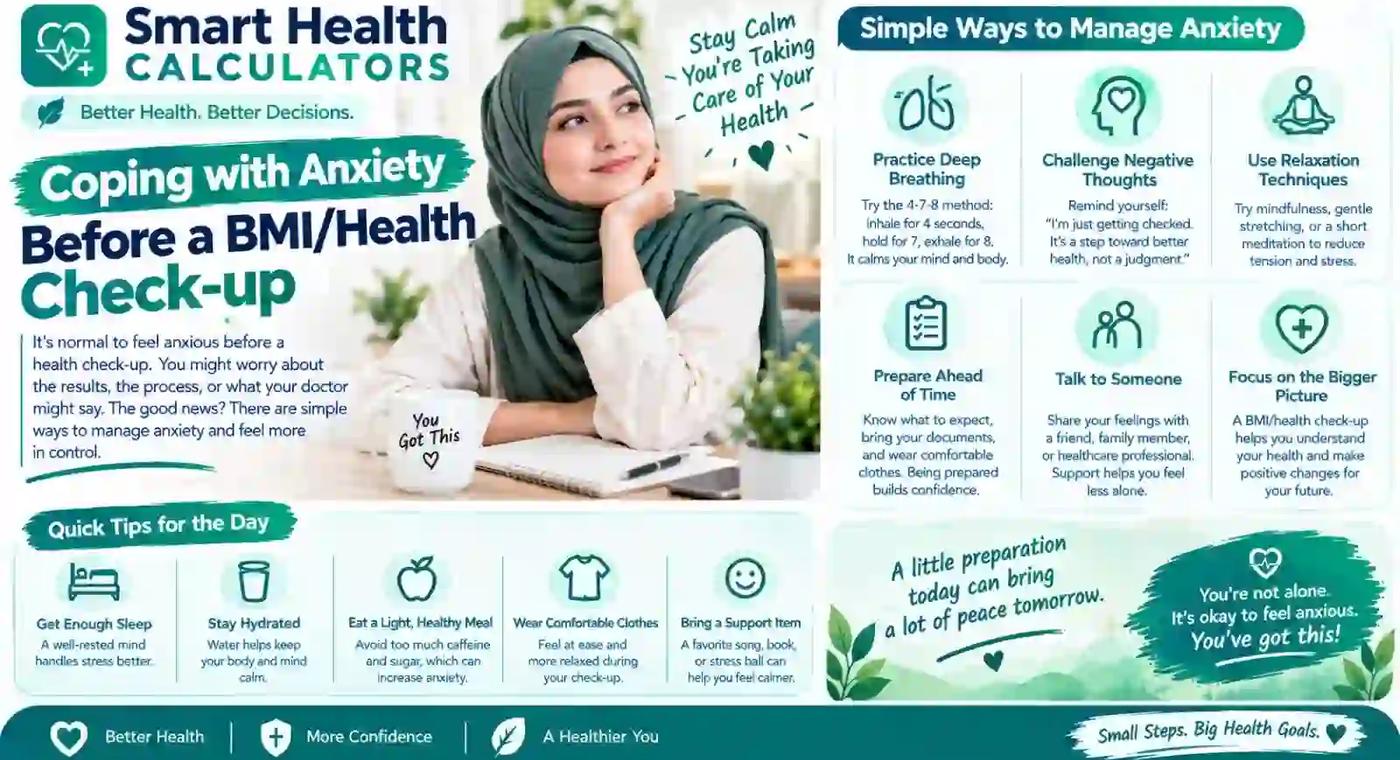
Coping With Anxiety Before a Health Check-Up (2026)
Feeling anxious before a health check-up or BMI test? Learn why it happens, what BMI really measures, and evidence-based ways to calm your nerves.
You've got a health check-up in a few days and you already know how this goes: the intrusive thoughts start creeping in, your stomach tightens every time you think about the scale, and you catch yourself replaying old appointments in your head. If this sounds familiar, you're dealing with something genuinely common — and there are concrete, evidence-based ways to make it more manageable.
Anxiety before a health check-up, BMI measurement, or routine physical is one of the most under-discussed forms of everyday stress. It doesn't always mean something is medically wrong with you, and it doesn't automatically mean you have an anxiety disorder either. This guide walks through why check-ups trigger this response, what BMI actually does and doesn't tell you, practical coping strategies you can use starting today, and how to know when it's time to talk to someone about it.
Why Do Health Check-Ups Trigger Anxiety in the First Place?
Anticipatory anxiety — the nervous, on-edge feeling that builds before an event — is a completely normal human response, not a sign that something is wrong with you psychologically. According to the National Institute of Mental Health, occasional anxiety before an important or uncertain event is a typical part of life; it becomes a different matter when anxiety is persistent, disproportionate, or interferes with daily functioning.
Health check-ups specifically tend to trigger this response for a few overlapping reasons:
- Loss of control. You don't know what the numbers will say until they say it, and that uncertainty itself is uncomfortable for most people.
- Past experiences. If a previous appointment involved an uncomfortable comment about your weight, an unexpected diagnosis, or a dismissive provider, your nervous system can reasonably associate check-ups with threat.
- Weight stigma. Being weighed or measured can feel like a moral judgment rather than a clinical data point, especially if you've encountered weight-focused commentary from providers in the past.
- The white coat effect. Clinical environments themselves — the smell, the paperwork, the waiting room — can trigger a physiological stress response independent of what's actually being tested.
None of this means you're overreacting. It means your nervous system is doing what nervous systems do when faced with uncertainty and a history of discomfort. Recognizing that distinction — that this is a normal stress response, not a character flaw — is often the first real step toward managing it.
Is This Normal Nervousness, or Something More?
This is worth pausing on, because the two aren't the same thing, and conflating them tends to make people either dismiss a real problem or over-pathologize a normal one.
Ordinary pre-appointment nervousness typically shows up as short-term jitters, a bit of stomach tension, maybe some difficulty sleeping the night before — and it resolves once the appointment is over, regardless of the outcome.
Health anxiety, as described by the NHS, is a different pattern. It involves persistent, excessive worry about being ill, often accompanied by behaviors like repeatedly checking your body for symptoms, seeking constant reassurance from others or the internet, and continuing to worry even after being told test results are normal. Health anxiety doesn't resolve when the appointment ends — it often shifts to worrying about the next one, or about symptoms that haven't even been evaluated yet.
If what you're experiencing is limited to the days surrounding an appointment and eases once it's done, that's typical anticipatory stress. If the worry is constant, involves frequent body-checking or reassurance-seeking, or significantly disrupts your daily life regardless of whether an appointment is coming up, that pattern is worth discussing with a healthcare provider or mental health professional. If you want a low-pressure way to reflect on which pattern better describes your experience, our mental health self check-in guide walks through some useful questions to ask yourself, and our mental health checker can help you track how you're feeling over time rather than relying on a single snapshot.
What BMI Actually Measures (and What It Doesn't)
A huge share of pre-check-up anxiety centers specifically on the number that's about to appear on a chart. It helps enormously to understand what that number is actually doing.
Body Mass Index is calculated from your height and weight, and the National Heart, Lung, and Blood Institute is explicit that BMI functions as a screening measure — it is not, by itself, a diagnosis of your body fat percentage or your overall health status. The current adult BMI categories used by NHLBI are:
- Below 18.5 — underweight
- 18.5–24.9 — healthy weight range
- 25.0–29.9 — overweight
- 30.0 and above — obesity
Here's the part that gets left out of a lot of conversations: BMI doesn't distinguish between muscle mass and fat mass, doesn't account for where fat is distributed on the body, and doesn't capture things like bone density or overall fitness level. NHLBI itself notes that additional measurements, such as waist circumference, are often considered alongside BMI when a healthcare provider is actually evaluating someone's health, rather than BMI being used as a standalone verdict.
This matters for the anxiety conversation specifically: a single BMI number is one data point among many that a provider might look at, not a final judgment on your worth, discipline, or overall health. If you want to understand this in more depth before your appointment, our guide on what BMI is and why it matters breaks down the calculation itself, and our piece on BMI's accuracy and its limitations goes further into exactly where the measurement falls short — which can be genuinely reassuring context if you're dreading a specific number.
If you'd rather see where you currently land before you're sitting in an exam room, you can run the numbers yourself with our BMI calculator ahead of time. Some people find that removing the surprise factor — knowing roughly what to expect rather than being told a new number cold — meaningfully reduces the anticipatory anxiety around the appointment itself.
BMI Isn't the Only Number That Matters
If BMI specifically feels like a sore spot, it can help to know it's genuinely not the only — or even the most informative — measure available. Waist-to-height ratio and body fat percentage are two additional measures that some providers use precisely because they capture things BMI misses, like fat distribution and body composition.
Our waist-to-height ratio guide and our comparison of BMI versus body fat percentage both explain how these measures differ from BMI and what each one is actually designed to tell you. If you want a more complete picture of your own composition ahead of an appointment, our body fat estimator tool can give you a broader sense of where you stand beyond a single BMI figure.
Practical Ways to Calm Anxiety Before Your Appointment
None of the following are guaranteed treatments, and they aren't a substitute for professional care if your anxiety is significant. But they're genuinely useful, evidence-informed tools that NIMH and the NHS both point to as reasonable coping strategies for everyday anxiety.
In the Days Leading Up to the Appointment
Limit reassurance-seeking spirals. It's tempting to Google symptoms or scroll health forums the night before an appointment, but this tends to increase anxiety rather than reduce it, since it's easy to land on worst-case scenarios that have little relevance to your actual situation. If you notice yourself doing this repeatedly, it's worth naming it as a pattern rather than a one-off.
Write it down. Journaling — even just a few minutes of getting your specific worries onto paper — is a technique NIMH lists among practical coping approaches for everyday stress. It externalizes the anxious thoughts instead of letting them loop internally. Our guide on journaling for mental health and self-awareness has a few simple prompts if you're not sure where to start.
Protect your sleep the night before. Poor sleep amplifies next-day anxiety and makes it harder to regulate your emotional response in the moment. If pre-appointment nerves are already disrupting your sleep, our piece on the connection between sleep, stress, and mental health covers why this happens and what actually helps break the cycle.
Set realistic expectations. Remind yourself, specifically, what a check-up actually is: a routine data-gathering appointment, not a verdict. Reframing the appointment as "gathering information I can use" rather than "a test I might fail" is a small shift that genuinely changes how the anticipation feels.
The Morning Of: Grounding Techniques That Actually Work
Try the 4-7-8 breathing technique. Inhale through your nose for 4 seconds, hold for 7 seconds, exhale slowly through your mouth for 8 seconds. This activates your parasympathetic nervous system — the part responsible for calming your body down — and can be done discreetly in a waiting room. Our 5-minute breathing exercises guide covers several variations if 4-7-8 doesn't feel like the right fit for you.
Ground yourself with your senses. A simple technique: name five things you can see, four you can hear, three you can touch, two you can smell, one you can taste. This interrupts spiraling thoughts by redirecting attention to the present moment rather than an imagined future outcome.
Arrive a few minutes early, not a lot early. Sitting in a waiting room for 30 minutes gives anxious thoughts more time to build. Arriving just enough ahead of your appointment to check in comfortably, without a long buffer, can genuinely reduce anticipatory dwelling.
Move your body beforehand if you can. A short walk before the appointment helps metabolize some of the stress hormones your body produces in anticipation, and NIMH lists physical activity among its recommended coping approaches for everyday stress and anxiety.
During the Appointment Itself
You're allowed to ask questions about the process. If being weighed specifically is a major source of anxiety, you can ask your provider what the number will be used for, or whether you can decline to see it on the scale (many providers will accommodate a "blind weigh-in" on request — it's a reasonable thing to ask for).
Tell your provider you're anxious. This sounds simple, but it changes the interaction. A provider who knows you're nervous is more likely to explain things clearly, slow down, and check in with you, rather than moving through the appointment on autopilot.
Use a physical anchor. Something as simple as pressing your feet firmly into the floor or holding a small object in your hand can help keep you grounded if you start to feel your anxiety spike mid-appointment.
Reframing BMI and Health Numbers as Data, Not Judgment
A lot of pre-check-up dread isn't really about the appointment itself — it's about what a specific number might mean about you as a person. This is worth addressing directly, because it's often the actual source of the anxiety, more than the appointment logistics themselves.
A BMI reading, a blood pressure number, or a cholesterol panel result is a single measurement taken at a single point in time. It reflects a data point your provider can use, alongside other information, to have an informed conversation with you — it isn't a moral scorecard, and it doesn't define your worth, your effort, or your character. Providers who frame health metrics that way are not practicing good medicine; NHLBI's own guidance on BMI emphasizes that it's one screening tool among several that should be considered together, not a standalone verdict.
If you're working toward specific health goals and the anxiety is partly about "not measuring up" to a target you've set for yourself, it can help to set expectations that are realistic and sustainable rather than rigid. Our guide on setting realistic health goals with calculators talks through how to use tools like BMI or calorie tracking as helpful reference points without letting them become sources of constant self-judgment.
When Anxiety About Check-Ups Needs Professional Support
Most pre-appointment nervousness is manageable with the strategies above, and it typically fades once the appointment is behind you. But there are signals worth taking seriously.
It's worth speaking with a doctor or a mental health professional if:
- Your anxiety about health appointments is severe enough that you've delayed or avoided scheduling necessary care
- You experience physical symptoms — racing heart, chest tightness, nausea, panic — that feel disproportionate to the situation
- The worry doesn't resolve after the appointment and instead shifts to the next one, or to symptoms unrelated to what was actually tested
- You find yourself repeatedly checking your body, weight, or symptoms outside of medical settings, or seeking frequent reassurance from others about your health
- Anxiety around health topics is affecting your work, relationships, or general daily functioning
According to NIMH's most recent national data, an estimated 19.1% of U.S. adults experienced an anxiety disorder in the past year — a reminder that if you're struggling with this, you're genuinely not alone, and it's a well-recognized, treatable pattern rather than a personal failing. Cognitive behavioral therapy is one of the most well-supported approaches for both generalized anxiety and health-specific anxiety, according to both the American Psychological Association and the NHS, and it can specifically help with the kind of catastrophic thinking ("this result means something is seriously wrong") that often drives pre-check-up dread.
Telling your primary care provider that you experience significant anxiety around appointments is also a reasonable and useful step — they may be able to adjust how they run the appointment, offer additional support, or refer you to someone who specializes in health-related anxiety specifically.
Frequently Asked Questions
Why do I feel anxious before a health check-up?
Anticipatory anxiety before a check-up is a normal stress response tied to uncertainty, past experiences, and sometimes anxiety about being weighed or measured. It becomes worth addressing further if it's persistent, disproportionate, or interferes with your daily life rather than easing once the appointment is over.
Is BMI a diagnosis or a screening measure?
BMI is a screening measure based on height and weight, not a standalone diagnosis. Healthcare providers typically consider it alongside other information, such as waist circumference or overall health history, rather than using it in isolation to determine someone's health status.
Can I refuse to be weighed at the doctor?
In most cases, yes — you can decline a weigh-in or ask for a "blind" weigh-in where you don't see the number, though the specific policy can vary by provider and by the reason for your visit. It's reasonable to ask your provider about this option in advance if it would reduce your anxiety.
What breathing exercises help before a check-up?
The 4-7-8 technique (inhale for 4 seconds, hold for 7, exhale for 8) is a simple, discreet option that can be done in a waiting room. It works by activating your parasympathetic nervous system, which helps counter the physical symptoms of anticipatory anxiety.
Should I tell my doctor that I feel anxious?
Yes. Letting your provider know you're anxious about the appointment often changes how they communicate with you — they may explain things more clearly, move at a slower pace, or offer accommodations like a blind weigh-in. This is a normal and reasonable thing to share.
When does check-up anxiety become something more serious?
If the anxiety persists well beyond the appointment itself, involves frequent body-checking or reassurance-seeking, or significantly disrupts your daily functioning, it may reflect health anxiety or a broader anxiety disorder rather than typical pre-appointment nerves — and it's worth discussing with a healthcare or mental health professional.
Moving Forward: A Few Things Worth Remembering
Anxiety before a health check-up is common, understandable, and manageable — and feeling nervous doesn't mean something is wrong with you, either physically or psychologically. A BMI number, a blood pressure reading, or any other single measurement is one piece of information your provider can use, not a final judgment on your health or your worth.
If you want to walk into your next appointment with fewer unknowns, running your own numbers ahead of time with our BMI calculator or checking in on your general wellbeing with our mental health checker can take some of the uncertainty out of the process. And if the anxiety feels bigger than "a bit of nervousness before an appointment," that's worth naming to a healthcare provider directly — it's a normal, common thing to raise, and it often changes how the whole experience goes.
Medical Disclaimer
This article is for general education only. It is not medical advice, diagnosis, treatment, prescription guidance, or a replacement for professional healthcare. Speak with a qualified healthcare professional for personal medical concerns, symptoms, pregnancy concerns, mental health crisis, medication questions, or before making major health changes.