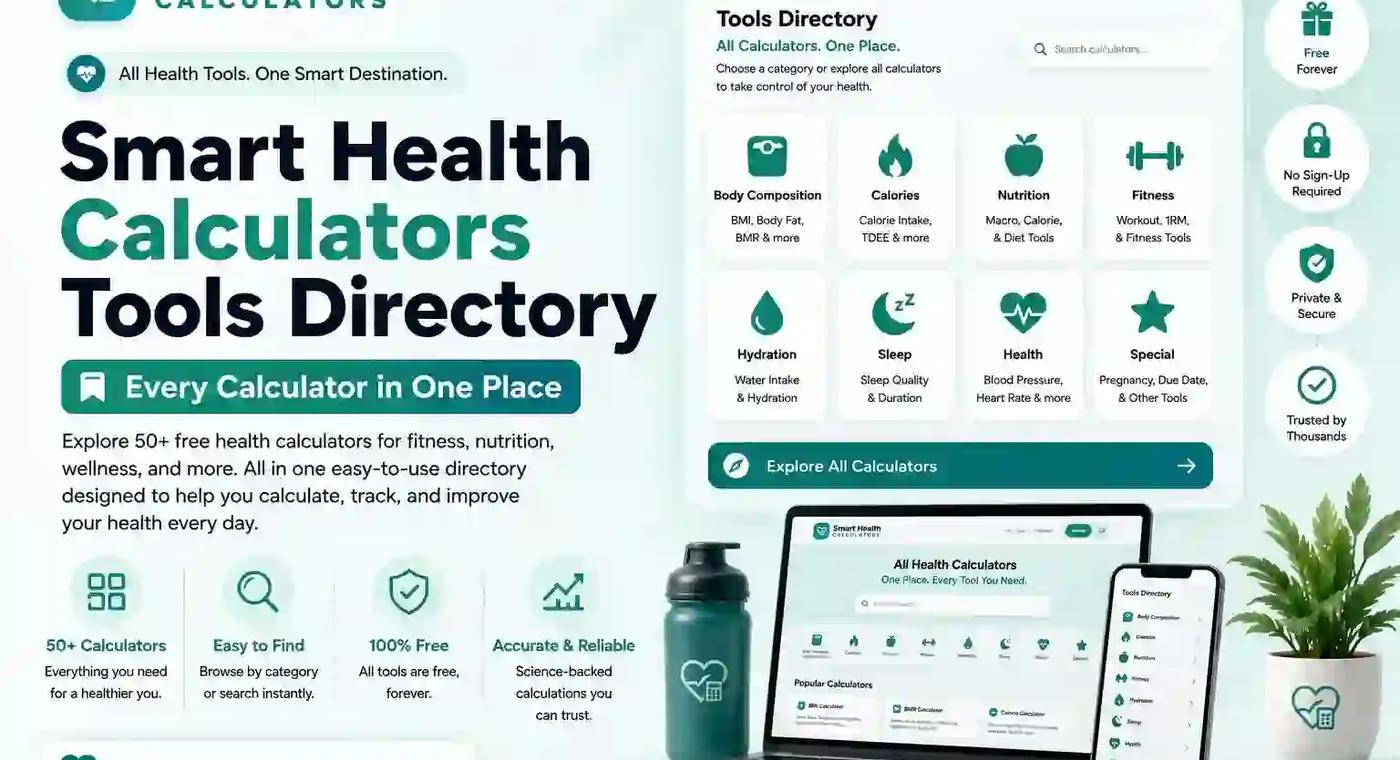
Health Calculator: BMI, BMR, Calories, Body Fat & More
Use our free health calculator directory for BMI, BMR, calorie needs, body fat, water intake, sleep, and health age. Get useful health insights in one place.
Most people don't need one calculator. They need five or six, scattered across different apps, each asking for the same height and weight over and over. The Smart Health Calculators directory solves that by putting every major health and fitness tool — BMI, BMR, calorie needs, body fat, water intake, sleep quality, and more — under one roof, so you can check your numbers once and actually use them together instead of juggling tabs.
This guide walks through what each calculator measures, how they connect to each other, and which ones actually matter depending on what you're trying to achieve — whether that's losing weight, training smarter, or just understanding your own body better.
What Is a Health Calculator Directory, and Why Does It Matter?
A health calculator directory is exactly what it sounds like: a curated hub of tools that turn your basic stats — height, weight, age, activity level — into usable numbers. Instead of searching "BMI calculator," then "calorie calculator," then "how much water should I drink" separately, you get all of it in one place, built on the same input data.
The reason this matters more than it sounds is consistency. If you calculate your BMI on one site, your calorie needs on another, and your water intake on a third, you're often working with three slightly different formulas, three different assumptions about your activity level, and three sets of results that don't actually talk to each other. A single directory built around one consistent methodology gives you numbers that fit together — your calorie target actually accounts for the BMR you just calculated, not a generic average.
The Core Calculators Everyone Should Know
Before getting into the full list, it helps to understand the handful of calculators that form the foundation almost everything else builds on.
BMI Calculator
Body Mass Index remains the most commonly used starting point for assessing weight status, mainly because it only needs height and weight. It's not a perfect measure — it can't distinguish muscle mass from fat, which is why a muscular athlete can register as "overweight" — but it's still a useful first checkpoint. The World Health Organization's BMI classification is the global reference most calculators, including ours, are built around. You can run your numbers on the BMI calculator and see exactly where you fall on the WHO scale.
If you want the full picture on where BMI falls short, our breakdown on whether BMI is actually accurate covers the specific situations where it misleads — athletes, older adults, and certain body types in particular.
BMR Calculator (Basal Metabolic Rate)
Your BMR is the number of calories your body burns just existing — breathing, circulating blood, maintaining organ function — before you've moved a single muscle on purpose. Most modern calculators, including ours, use the Mifflin-St Jeor equation, which has largely replaced the older Harris-Benedict formula because it's more accurate across a wider range of body types. Once you know your BMR, everything else — calorie targets, deficits, surpluses — becomes a matter of adjusting from that baseline. Try the BMR calculator to get your number.
Calorie Intake Planner (TDEE)
This is where BMR becomes practical. Your Total Daily Energy Expenditure takes your BMR and multiplies it by an activity factor — sedentary, lightly active, moderately active, very active — to estimate how many calories you actually burn in a day. From there, the calorie intake planner can suggest a deficit for weight loss, a surplus for muscle gain, or maintenance calories if your goal is simply staying where you are. For age and gender-specific baselines, our guide on recommended calorie intake per day breaks down typical ranges by demographic.
Ideal Weight & Body Fat Estimator
Weight alone tells you less than most people assume. The ideal weight calculator gives you a healthy range based on height and frame, while the body fat estimator goes a step further using circumference measurements to estimate what percentage of your weight is actually fat versus lean mass. This pairing matters because two people can weigh exactly the same and have completely different body compositions — our comparison on BMI vs. body fat percentage explains why relying on just one number can be misleading.
Full Calculator Directory: What Each Tool Measures
Here's the complete lineup, organized by what each tool actually tells you and who benefits most from using it.
| Calculator | What It Measures | Best For |
|---|---|---|
| BMI Calculator | Weight status relative to height | Quick health screening |
| Calorie Intake Planner | Daily calorie needs (TDEE) | Weight loss, gain, or maintenance planning |
| Diet Plan Generator | Personalized meal structure by goal | Anyone starting a structured eating plan |
| Body Fat Estimator | Estimated body fat percentage | Tracking composition, not just weight |
| Ideal Weight Calculator | Healthy weight range by height/frame | Setting realistic weight goals |
| Water Intake Calculator | Daily hydration needs | Athletes, hot climates, general health |
| Workout Planner | Structured exercise routine by level | Beginners to advanced trainees |
| Step Counter Goal Planner | Daily step targets by activity goal | General fitness, low-impact movement |
| Sleep Quality Checker | Sleep duration and quality patterns | Anyone with fatigue or inconsistent sleep |
| Health Age Calculator | Biological age vs. actual age | Long-term lifestyle tracking |
| Mental Health Checker | Self-reported stress and mood indicators | Early self-awareness, not diagnosis |
| Pregnancy Calculator | Due date and trimester tracking | Expecting parents |
How These Calculators Work Together
The real value of a directory isn't any single tool — it's how they connect. Here's a practical example of how someone trying to lose weight sustainably might actually use this stack:
- Start with BMI and body fat to get a baseline picture, not just a single weight number.
- Calculate BMR, then run it through the calorie intake planner to find a realistic deficit — most sustainable weight loss plans use a 500-calorie daily deficit, not the crash-diet extremes.
- Check water intake needs, since even mild dehydration is often mistaken for hunger and can undermine calorie tracking.
- Build a workout plan matched to current fitness level rather than copying a generic routine that assumes months of prior training.
- Track sleep quality, because poor sleep directly disrupts the hormones (ghrelin and leptin) that regulate appetite — something most calorie-focused plans ignore entirely.
- Recheck health age periodically as a broader signal of whether the plan is actually improving long-term health markers, not just the number on the scale.
This is the difference between guessing and planning. A single BMI reading tells you where you stand today; using it alongside calorie needs, hydration, activity, and sleep tells you what to actually do about it.
Why Body Composition Matters More Than the Scale Alone
One of the most common mistakes people make is treating "weight" and "health" as the same thing. They're not. Someone who loses 10 pounds of muscle through under-eating looks like a success story on the scale but is often in worse metabolic shape than before. This is exactly why pairing the body fat estimator with the standard BMI check gives a more honest picture — our detailed body fat percentage chart breaks down healthy ranges by age and gender so you're not comparing yourself to an arbitrary number.
It's also worth noting that body fat distribution matters as much as the total percentage. Fat stored around the abdomen (visceral fat) carries higher health risks than fat stored elsewhere, even at the same overall percentage — a nuance that a single BMI number simply can't capture.
Sleep, Stress, and the Calculators Most People Skip
Diet and exercise tools get most of the attention, but sleep and mental health calculators are just as important — arguably more so, since poor sleep undermines almost every other health goal. The sleep quality checker looks at duration and consistency rather than just hours logged, since irregular sleep timing disrupts your circadian rhythm even if you're technically getting eight hours. If you're regularly struggling to fall asleep, our guide on sleep latency and falling asleep faster covers practical fixes beyond the usual "avoid screens" advice.
The mental health checker works similarly — it's a self-awareness tool, not a diagnostic instrument. It's designed to flag patterns in stress and mood over time so you notice trends early, the same way a fitness tracker flags a resting heart rate trending upward. For structured ways to build this into a routine, our mental health self check-in guide offers a simple weekly framework.
Who Should Use Each Type of Calculator
Not every tool applies to every person at every stage. Here's a practical breakdown:
- New to fitness tracking? Start with BMI, ideal weight, and the calorie intake planner — these three give you a baseline without overwhelming you with data.
- Training for performance or muscle gain? BMR, body fat estimator, and the workout planner matter more than BMI, since BMI won't reflect muscle gain accurately.
- Managing a chronic condition or working with a doctor? Health age and body fat tracking give more clinically relevant trend data than weight alone — but these tools should supplement, not replace, medical guidance.
- Expecting a baby? The pregnancy calculator estimates due dates and trimester milestones — our companion piece on pregnancy symptoms by trimester pairs well with it for what to expect at each stage.
- Older adults focused on longevity? The health age calculator is more relevant than weight-focused tools — see our guide on lowering biological age through lifestyle habits for the specific factors that move this number.
Regional and Population Considerations
Standard BMI cutoffs were developed largely from data on European populations, and health authorities have acknowledged that risk thresholds differ for other groups. Research organizations have noted that South Asian populations tend to show higher health risks at lower BMI values compared to Western populations, largely due to differences in body fat distribution. This is why calculators built for a global audience should ideally let users account for regional or ethnic-specific reference ranges rather than applying one flat scale to everyone — something worth checking for if you're comparing tools.
Are These Calculators Accurate?
This is the fair question, and the honest answer is: accurate enough to guide decisions, not accurate enough to replace lab testing or a doctor's exam. BMI is a screening tool, not a diagnosis. Body fat estimators using circumference measurements typically carry a margin of error of a few percentage points compared to methods like DEXA scans. BMR formulas like Mifflin-St Jeor are validated against large populations but still represent an estimate for any single individual.
The practical takeaway: use these numbers as trend indicators. If your calculated body fat percentage drops consistently over three months, that's meaningful information — even if the exact number carries some margin of error.
Frequently Asked Questions
What is a health calculator used for? A health calculator converts basic personal data — height, weight, age, activity level — into actionable numbers like BMI, calorie needs, or body fat percentage, helping you set realistic fitness or wellness goals without guesswork.
Are online health calculators accurate? They're accurate enough for tracking trends and setting general goals, but they use population-based formulas and estimates rather than clinical testing, so results should be treated as guidance rather than a medical diagnosis.
Which health calculator should I use first? Start with BMI and the calorie intake planner — together they give you a baseline weight status and a realistic daily calorie target, which most other goals (weight loss, muscle gain, hydration) build on.
Is BMI a reliable measure of health? BMI is a useful screening tool for population-level trends, but it doesn't distinguish muscle from fat, so it can misclassify athletes or older adults with lower muscle mass. Pairing it with a body fat estimate gives a fuller picture.
Are these health calculators free to use? Yes, every calculator in this directory — BMI, BMR, calorie planning, body fat, water intake, sleep, and more — is free to use with no login required.
Do health calculators replace a doctor's advice? No. These tools are designed for self-awareness and planning, not diagnosis. Anyone with an existing health condition, unexplained symptoms, or concerns about their results should consult a medical professional.
Final Takeaway
The point of a calculator directory isn't to hand you more numbers — it's to make the numbers you already have useful. BMI without context is just a ratio. Paired with body fat, calorie needs, sleep quality, and activity data, it becomes an actual picture of where you stand and what to adjust next.
Start with the BMI calculator or the calorie intake planner if you're new here, then work through the rest of the full tools directory as your goals get more specific. And if you want the reasoning behind any single number, the blog has a deeper breakdown for almost every calculator in this list.
Medical Disclaimer
This article is for general education only. It is not medical advice, diagnosis, treatment, prescription guidance, or a replacement for professional healthcare. Speak with a qualified healthcare professional for personal medical concerns, symptoms, pregnancy concerns, mental health crisis, medication questions, or before making major health changes.