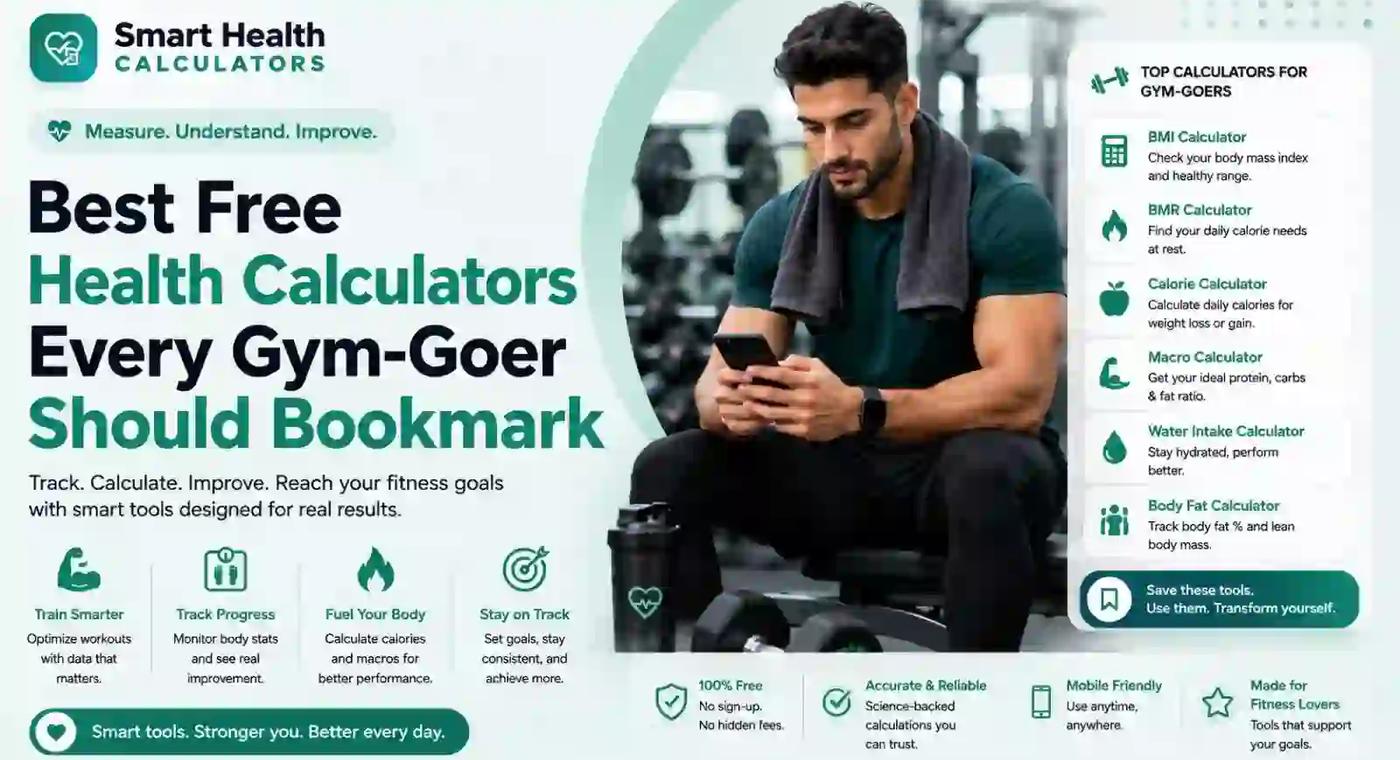
Best Free Health Calculators Every Gym-Goer Should Bookmark
Discover the best free health calculators for tracking BMI, calories, body fat, and hydration — everything gym-goers need to train and eat smarter.
Walk into any gym and you'll notice two kinds of people: those who train based on gut feeling, and those who train based on numbers they actually track. The second group tends to make faster, more consistent progress, not because they're more disciplined, but because they're not guessing.
Free health calculators are online tools that estimate metrics like BMI, calorie needs, body fat percentage, and hydration requirements, giving gym-goers a data-based starting point for training and nutrition decisions without paying for a subscription app. Used correctly, they turn vague goals like "get fitter" into specific, measurable targets you can actually track week over week.
This guide breaks down the calculators every gym-goer genuinely benefits from bookmarking, organized by category, what each one actually measures, who it's most useful for, and how to avoid the common mistake of treating any single number as more precise than it really is.
Why Bother With Calculators at All?
It's a fair question. Plenty of people train for years without ever touching a calculator and still make progress. But calculators solve a specific problem: they replace guesswork with a defensible starting estimate, which you can then adjust based on real-world results.
Someone guessing their daily calorie needs might be off by 500 calories or more in either direction, enough to stall a cut or blunt a bulk for months without them realizing why. A calculator gets you into a reasonable starting range immediately, so any adjustments you make afterward are refinements rather than blind trial and error.
That said, these tools are estimates, not diagnoses. Genuine value comes from treating them as a starting point you track and adjust, not a fixed number you follow rigidly regardless of how your body actually responds.
Body Composition & Weight Tools
These tools answer the most basic gym question: where do I actually stand right now?
BMI Calculator
Body Mass Index remains one of the most widely used screening tools for weight status, calculated from height and weight alone. According to the CDC, BMI is a quick, inexpensive, and reliable screening measure used to assess a person's weight relative to their height, and it's been used for decades to track trends across populations.
For gym-goers specifically, BMI has a well-known limitation: it doesn't distinguish muscle mass from fat mass, meaning a muscular, low-body-fat lifter can register as "overweight" on the scale despite being in excellent shape. It's genuinely useful as a quick population-level screening tool, but it shouldn't be your only metric if you're carrying significant muscle mass.
Try it here: BMI Calculator. For a deeper look at where this metric falls short for lifters specifically, our breakdown on whether BMI is accurate and its limitations is worth a read.
Body Fat Estimator
Body fat percentage gives a more meaningful picture of body composition than BMI alone, since it separates lean mass from fat mass rather than lumping everything into a single weight-to-height ratio. Most online estimators use circumference measurements (waist, neck, and sometimes hip) combined with height to approximate body fat percentage.
It's not as precise as a DEXA scan or hydrostatic weighing, but for tracking trends over time, a consistent estimation method is genuinely useful. Try it here: Body Fat Estimator. Our comparison of BMI vs. body fat percentage and full body fat percentage chart are both useful companion reads if you're trying to interpret your result.
Ideal Weight Calculator
This tool estimates a target weight range based on height, sex, and frame size using established formulas. It's a reasonable ballpark reference, particularly useful for setting a general direction, but it shouldn't be treated as a rigid target, since healthy weight varies significantly based on muscle mass, bone density, and individual body composition.
Try it here: Ideal Weight Calculator. For more context on interpreting the result relative to your height, our guide on the normal weight range by height breaks this down further.
Calorie & Metabolism Tools
If body composition tools answer "where am I now," calorie tools answer "what do I need to eat to get where I'm going."
BMR Calculator
Basal Metabolic Rate (BMR) estimates how many calories your body burns at complete rest, just to maintain basic functions like breathing, circulation, and cell repair. It's the foundation every other calorie calculation builds on top of.
Try it here: BMR Calculator.
Calorie Intake Planner (TDEE)
Total Daily Energy Expenditure (TDEE) takes your BMR and adds your activity level on top, giving you a realistic estimate of your actual daily calorie needs, whether you're trying to maintain, lose, or gain weight. This is genuinely the single most useful calculator for anyone with a physique or performance goal, since nearly every nutrition decision downstream depends on getting this baseline roughly right.
Try it here: Calorie Intake Planner. For the difference between what you eat and what you burn (and why both numbers matter independently), our explainer on calorie intake vs. calories burned clears up a common point of confusion. If you want general daily intake benchmarks broken down by age and sex before running your own numbers, recommended calorie intake per day is a useful reference.
Diet Plan Generator
Once you know your target calorie intake, the next question is how to actually structure meals around it. A diet plan generator takes your calorie and macro targets and translates them into a practical daily eating structure, saving the manual math of building a plan from scratch.
Try it here: Diet Plan Generator.
Hydration Tools
Hydration is one of the most underrated variables in gym performance, and it's also one of the easiest to track once you have a target number.
Water Intake Calculator
This tool estimates daily fluid needs based on body weight, activity level, and climate, giving you a personalized target instead of relying on the generic (and not particularly accurate) "eight glasses a day" rule.
Try it here: Water Intake Calculator. If you train intensely or for long durations, our guide on water intake for athletes covers how sweat rate and session length should adjust your baseline number, and how much water to drink before a workout is worth checking before your next heavy training session.
Training & Performance Tools
These tools help structure the actual work you do in the gym, not just the numbers behind it.
Workout Planner
Rather than winging your training week, a workout planner helps structure sessions around your specific goals, whether that's strength, hypertrophy, endurance, or general fitness, and your available training days.
Try it here: Workout Planner. If you're building your very first structured week, our beginner weekly workout plan and guide to structuring a workout plan from beginner to advanced are solid starting points. Short on time? The 30-minute workout plan for busy people shows how to get meaningful results without a two-hour gym commitment.
Step Counter Goal Planner
Not every gym-goer wants structured lifting sessions tracked, but nearly everyone benefits from a daily movement target. This tool sets a personalized step goal based on your activity level and fitness objectives, useful as a low-barrier way to build consistency outside of formal workouts.
Try it here: Step Counter Goal Planner.
Recovery & Wellbeing Tools
Training progress isn't only built in the gym. Recovery, sleep, and mental wellbeing directly affect how well your body adapts to the work you're putting in.
Sleep Quality Checker
Poor sleep undermines nearly every other fitness metric on this list, from recovery to hormone regulation to workout performance the next day. This tool assesses your sleep patterns and flags areas that might be holding your training back.
Try it here: Sleep Quality Checker. If you're waking up tired despite logging enough hours, our explainer on signs of poor sleep quality and breakdown of REM sleep vs. deep sleep are useful next reads.
Mental Health Checker
Gym progress and mental wellbeing are more connected than most people acknowledge. Overtraining, poor recovery, and chronic stress often show up as plateaued performance before they show up as anything else. This tool offers a quick, private self-check-in, not a diagnostic tool, but a useful prompt to pay attention if something feels consistently off.
Try it here: Mental Health Checker.
Health Age Calculator
This tool estimates your biological age based on lifestyle factors like activity level, sleep, and diet quality, giving a broader sense of how your habits are affecting your body beyond the number on your birth certificate.
Try it here: Health Age Calculator. Our guide on lowering your biological age through lifestyle habits pairs well with this tool if your result comes back higher than expected.
Quick Comparison: Which Calculator Should You Use First?
| Calculator | What It Measures | Best For |
|---|---|---|
| BMI Calculator | Weight relative to height | Quick general screening |
| Body Fat Estimator | Lean mass vs. fat mass | Tracking body composition changes |
| BMR Calculator | Calories burned at rest | Baseline for any calorie plan |
| Calorie Intake Planner (TDEE) | Total daily calorie needs | Weight loss, maintenance, or bulking |
| Water Intake Calculator | Daily hydration target | Performance and recovery |
How to Actually Use These Tools Together
Individually, each calculator answers a narrow question. Used together, they form a genuinely useful feedback loop:
- Start with body composition (BMI and body fat estimator) to establish your current baseline.
- Calculate your energy needs (BMR, then TDEE through the calorie intake planner) to set a realistic nutrition target.
- Set a hydration target based on your activity level, particularly important if your training volume is high.
- Structure your training around your goal using the workout planner, rather than training without a plan.
- Track recovery inputs (sleep quality, general wellbeing) since these directly affect whether your training and nutrition plan actually produces results.
- Recheck your numbers periodically, roughly every four to six weeks, since your calorie needs and body composition shift as your training progresses.
Trying to optimize everything at once is a common beginner mistake. Our guide on setting realistic health goals with calculators covers how to prioritize which numbers actually matter most for your specific stage of training.
Are Free Online Health Calculators Accurate?
This deserves an honest answer rather than a marketing one. Free calculators are estimates built from population-level formulas and averages, not personalized lab measurements. A BMR or TDEE calculator can be off by 10 to 15 percent for any given individual, since factors like genetics, muscle mass, and hormonal variation aren't captured in a simple height-weight-age input.
That said, "estimate" doesn't mean "useless." These tools are accurate enough to give you a sensible starting point, and more importantly, they're consistent, meaning if you use the same tool over time, the trend in your results matters more than the precision of any single number. If you want a genuinely individualized number rather than a formula-based estimate, options like indirect calorimetry testing or a DEXA scan exist, but they involve real cost and aren't necessary for most recreational gym-goers.
Common Mistakes People Make With Health Calculators
- Treating a single result as gospel. A calculator output is a starting estimate, not a diagnosis. Adjust based on how your body actually responds over several weeks.
- Ignoring activity level accuracy. Overestimating how active you are is one of the most common reasons TDEE calculations come back too high, leading to stalled fat loss despite "following the numbers."
- Recalculating too often. Adjusting your targets daily based on minor fluctuations creates noise rather than useful signal. Reassess every few weeks instead.
- Skipping the recovery-side tools. Focusing exclusively on calorie and training calculators while ignoring sleep and stress tracking misses a genuinely significant piece of the progress equation.
- Comparing your numbers to someone else's. These calculators are individualized to your inputs; a friend's TDEE or body fat percentage isn't a meaningful benchmark for your own plan.
Frequently Asked Questions
What health calculators should every gym-goer use? At minimum, a BMI or body fat estimator for body composition, a BMR/TDEE calculator for nutrition planning, and a workout planner for structuring training sessions cover the core fundamentals most gym-goers need.
Are online health calculators accurate? They're reasonably accurate estimates based on population-level formulas, generally within 10 to 15 percent of an individual's true values. They're best used as a consistent starting point you track over time rather than a precise, one-time measurement.
What is the difference between BMI and body fat calculators? BMI estimates weight status using only height and weight, without distinguishing muscle from fat. A body fat calculator estimates the actual percentage of your body composed of fat versus lean mass, making it more informative for gym-goers carrying significant muscle.
How often should I recalculate my calorie needs? Roughly every four to six weeks, or whenever your weight, activity level, or training goal changes meaningfully. Recalculating too frequently based on minor day-to-day fluctuations creates unnecessary noise.
What is a TDEE calculator used for? TDEE (Total Daily Energy Expenditure) estimates your full daily calorie burn, including activity, giving you a realistic baseline for setting calorie targets for weight loss, maintenance, or muscle gain.
Do free fitness calculators work as well as paid apps? For most recreational gym-goers, free calculators provide comparable baseline accuracy to paid apps, since both rely on similar underlying formulas. Paid apps typically add value through tracking convenience, integrations, and ongoing logging features rather than fundamentally more accurate calculations.
What's the best calculator for tracking weight loss progress? A combination of the body fat estimator and calorie intake planner works best, since body fat percentage changes reflect genuine fat loss progress more accurately than scale weight alone, which fluctuates with water and other factors.
How do I know which health calculator I actually need? Start with your primary goal: body composition change points you toward BMI and body fat tools, nutrition planning points to BMR/TDEE, and training structure points to the workout planner. Add hydration and recovery tools once your core numbers are established.
Final Thoughts
None of these calculators replace listening to your body or working with a qualified coach or healthcare provider when needed. What they do is remove the guesswork from the starting point, giving you real numbers to build a plan around instead of vague intentions.
The gym-goers who make the most consistent progress usually aren't the ones training the hardest every single session. They're the ones tracking the right handful of numbers, adjusting based on what the data actually shows, and staying patient enough to let trends play out over weeks rather than days.
Ready to build your baseline? Start with the BMI Calculator and Calorie Intake Planner, then explore the full toolkit at Smart Health Calculators to build out your complete training and nutrition picture.
For more on how BMI is used as a health screening measure, see the CDC's official overview of About Body Mass Index (BMI).
Medical Disclaimer
This article is for general education only. It is not medical advice, diagnosis, treatment, prescription guidance, or a replacement for professional healthcare. Speak with a qualified healthcare professional for personal medical concerns, symptoms, pregnancy concerns, mental health crisis, medication questions, or before making major health changes.