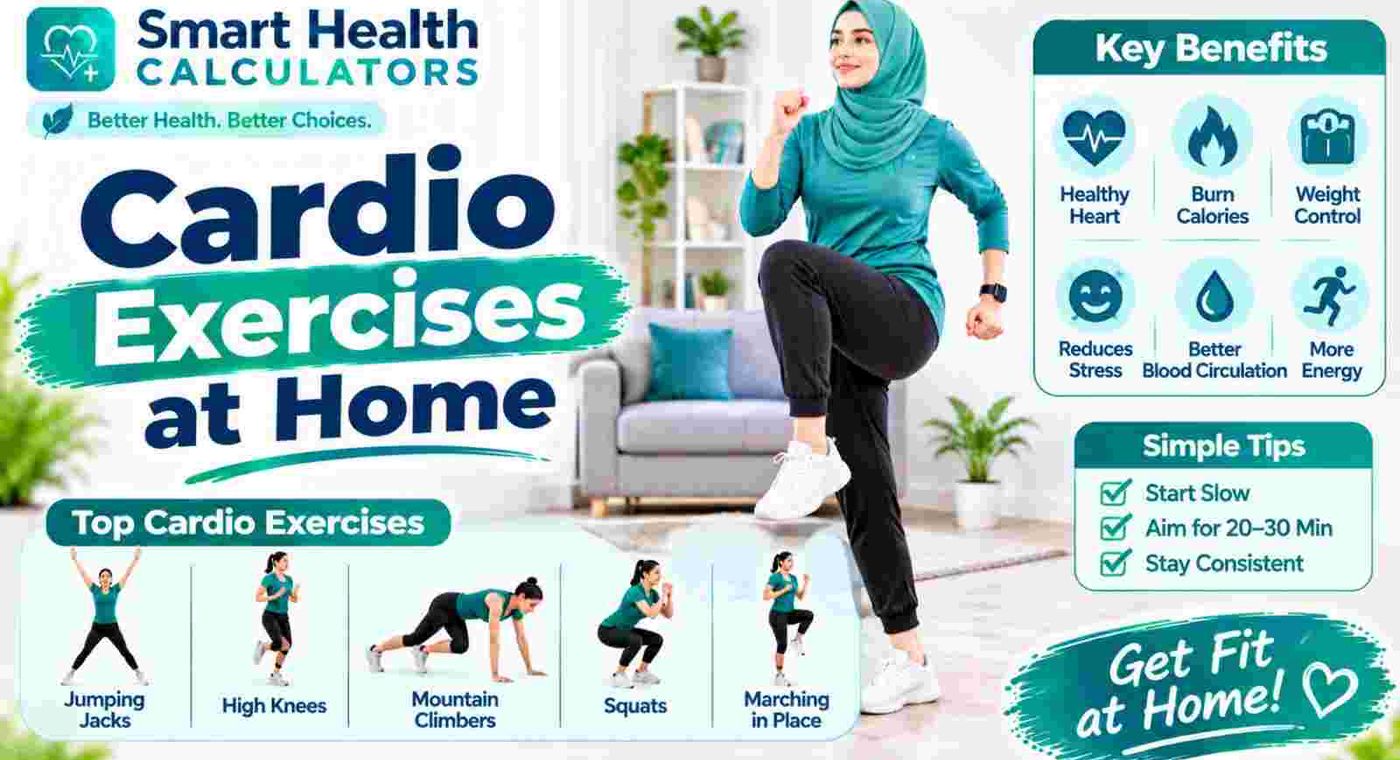
25 Best Cardio Exercises at Home
25 effective cardio exercises at home without equipment. Learn beginner-friendly routines, low-impact workouts, benefits, and weekly fitness tips.
Cardio exercises at home are bodyweight or low-equipment movements, such as marching in place, jumping jacks, high knees and shadow boxing, that raise your heart rate for a sustained period. Adults are advised to build toward 150–300 minutes of moderate activity a week, and you can reach that in short sessions without a gym.
You don't need a treadmill, a gym membership or even a spare room to train your heart. A patch of floor about the size of a yoga mat is enough for most of the 25 exercises below.
This guide covers what counts as cardio, how much you need, how to judge intensity, and how to build a routine you can keep. You'll get low-impact options for sore knees, quiet options for apartments, and short 15- and 20-minute plans for busy days.
What Are Cardio Exercises at Home?
Cardio, short for cardiovascular exercise, is any rhythmic activity that makes your heart beat faster and your breathing deeper for a sustained period. You'll also see it called aerobic exercise, because your muscles rely on oxygen delivered by your heart and lungs to keep going.
Doing it at home simply means you use your own body weight, your stairs and your living room instead of machines. Marching, dancing, shadow boxing and fast-paced bodyweight circuits all count, as long as you reach the right effort level.
Cardio, Aerobic and Anaerobic: What's the Difference?
In everyday use, "cardio" and "aerobic" mean the same thing. Anaerobic exercise, such as a heavy lift or an all-out sprint, uses energy faster than oxygen can supply it, so you can only keep it up briefly.
Most home sessions mix both. A steady march is mostly aerobic. The hardest 30 seconds of a burpee round leans anaerobic. Your body handles the blend without any help from you.
Why Intensity Matters More Than the Exercise Name
Two people can do the same exercise at very different effort levels. A fit person jogging in place might be barely breathing hard. For a beginner, the same movement can feel vigorous.
That's why guidelines describe activity by intensity (moderate or vigorous) rather than by exercise name. We'll cover how to measure it shortly.
Benefits of Indoor Cardio Workouts
Regular aerobic activity supports cardiorespiratory fitness, which is how well your heart, lungs and muscles work together. Health agencies link regular physical activity with better cardiovascular and metabolic health, and the WHO fact sheet describes the health benefits of meeting its recommendations as "substantial."
Here is what home cardio can realistically do for you:
- Build stamina: everyday tasks like climbing stairs or carrying shopping feel easier over time.
- Support heart health: your heart handles effort more efficiently with regular training.
- Support weight management: cardio adds to your weekly energy use, though it's only one part of the picture.
- Fit your schedule: there's no commute, no waiting for equipment and no travel time.
- Cost nothing: most movements need no gear.
- Help you wind down: many people find a short session improves mood and helps them sleep. Our guide on sleep hygiene explains how to protect that benefit.
What Cardio Won't Do
It won't "spot reduce" fat from one area, and it can't undo a diet that doesn't suit your goals. It also doesn't replace strength training. We'll return to both points later.
How Much Cardio Do Adults Need Each Week?
The WHO advises adults aged 18–64 to do 150–300 minutes of moderate-intensity aerobic activity, or 75–150 minutes of vigorous-intensity activity, or an equivalent mix, each week. It also recommends muscle-strengthening activities for all major muscle groups on two or more days a week.
The CDC gives the same weekly targets and notes that one vigorous minute counts as about two moderate minutes. It also stresses that you don't have to do everything at once, since you can split activity into smaller chunks across the week.
| Goal | Weekly target | Example |
|---|---|---|
| Minimum for health benefits | 150 minutes moderate | 30 minutes, 5 days |
| Extra benefit | 300+ minutes moderate | 45 minutes most days |
| Vigorous option | 75–150 minutes vigorous | 25 minutes, 3 days |
| Strength | 2+ days | Bodyweight circuits |
The WHO adds that going beyond 300 minutes of moderate activity (or 150 of vigorous) gives additional benefit for adults who can do so safely.
Is 20 Minutes of Cardio a Day Enough?
Twenty minutes a day adds up to 140 minutes a week. That's just under the 150-minute moderate target, and it clearly beats doing nothing. The CDC says directly that some physical activity is better than none.
Add a couple of longer weekend sessions, or push some of your minutes into the vigorous zone, and you'll comfortably reach the guideline. For a deeper plan, see our 30-minute workout plan for busy people.
Can You Do Cardio Every Day?
For most healthy adults, light to moderate cardio most days is fine. The NHS suggests spreading activity across four to five days a week, or every day.
Hard sessions are different. If you do vigorous work, add easier days in between and listen to soreness. Easy movement on those days is called active recovery, and a gentle walk or stretch counts.
How to Measure Your Workout Intensity
You don't need a smartwatch. Three simple methods work well at home.
Method 1: The Talk Test
The talk test is the quickest check. According to the NHS:
- Moderate intensity: you can still talk, but you can't sing.
- Vigorous intensity: you can only say a few words before pausing for breath.
The CDC describes it the same way. If you can sing easily, speed up. If you can't speak at all, slow down.
Method 2: Target Heart Rate
The American Heart Association gives these zones:
- Moderate activity: about 50–70% of your maximum heart rate.
- Vigorous activity: about 70–85% of your maximum heart rate.
- Maximum heart rate: about 220 minus your age.
The AHA calls this an estimate, and the table figures are averages, so treat them as a general guide. Some medications can lower your maximum heart rate and target zone. If you have a heart condition or take medication, ask your health professional what your heart rate should be.
| Age | Estimated max | Target zone (50–85%) |
|---|---|---|
| 20 | 200 bpm | 100–170 bpm |
| 40 | 180 bpm | 90–153 bpm |
| 60 | 160 bpm | 80–136 bpm |
These figures come from the AHA's age table. For other ages, our heart rate zone calculator guide and normal heart rate by age article explain the maths.
Method 3: Perceived Exertion
The Borg Rating of Perceived Exertion scale lets you score effort by feel. Many people use a simple 1–10 version, where 5–6 feels like moderate effort and 7–8 feels hard. It's a personal scale, so it works best when you use it consistently.
Before You Start: Warm-Up and Safety Basics
A good warm-up costs three to five minutes and makes the first real minutes of your workout feel easier.
A Simple Dynamic Warm-Up
Do each for 30 seconds, then repeat once:
- Gentle march in place with arm swings.
- Shoulder rolls, forward and back.
- Hip circles.
- Bodyweight squats to a comfortable depth.
- Heel digs with a small arm reach.
Who Should Check With a Doctor First
The CDC advises talking to your doctor before starting vigorous activity if you've been inactive, have a disability, or have overweight. The same applies if you have a chronic condition such as heart disease, arthritis or diabetes.
Stop and Get Help If You Notice These Signs
Stop exercising if you feel chest pain, faintness or unusual, severe breathlessness. Seek urgent medical help for chest pain or fainting. Don't try to push through these symptoms.
Practical Safety Habits
- Wear supportive shoes. Barefoot or socks on a slippery floor raises your risk of falling.
- Exercise on a stable, non-slip surface with enough clearance around you.
- Start with manageable sessions and increase time or intensity gradually.
- Drink water when thirsty. Our guide on how much water to drink before a workout covers timing.
25 Best Cardio Exercises at Home Without Equipment
Each move below includes a quick how-to and a note on impact. Start with the low-impact group, then add harder ones as your fitness improves.
Low-Impact Cardio Exercises (Quiet and Joint-Friendly)
1. March in Place
Lift your knees to a comfortable height and swing your arms. Keep your chest tall and your steps light. It's the simplest way to start and fully counts as walking-style activity.
2. Step Touch
Step to the right, bring your left foot to meet it, then step back left. Add a gentle arm swing or a clap. It's a good option for beginner indoor cardio, and it's quiet.
3. Standing Knee Raises
Lift one knee toward your waist, lower it, and switch sides. Pull your elbow down to meet the knee for extra effort. Hold a wall or chair if balance is a concern.
4. Seated Marching
Sit tall on a sturdy chair and lift your knees alternately while pumping your arms. This is a seated cardio option for people with limited mobility, or for anyone who needs a safer starting point.
5. Shadow Boxing
Stand in a relaxed stance and throw jabs, crosses and hooks at the air. Keep your knees soft and shift your weight with each punch. Speed it up for a harder session. It's quiet, fun and works your whole upper body.
6. Modified Jumping Jacks (Step Jacks)
Step one foot out to the side while raising both arms overhead, then step it back. Alternate sides. You get the rhythm of a jumping jack without the landing impact, which suits beginner aerobic workouts without jumping.
7. Standing Mountain Climbers
Raise your hands in front of you and drive one knee up toward your chest, then switch quickly. It mimics the floor version without loading your wrists.
8. Stair Climbing
Walk up and down your stairs at a steady pace. If you have stairs at home, this is one of the most effective no-gear options. Hold the rail and take your time. Stair climbing sits in the vigorous category in the NHS examples, so treat a brisk pace as hard work.
9. Lateral Shuffles
Stay low with soft knees and shuffle sideways for four steps, then back. Don't cross your feet. It raises your heart rate without much jumping.
Moderate-Impact Cardio Exercises (Build Your Pace)
10. Jogging in Place
Jog on the spot, landing softly on the balls of your feet. It's one of the most common home cardio moves, and it works well for intervals of 30–60 seconds.
11. Butt Kicks
Jog in place while flicking your heels up toward your glutes. Keep your torso upright. It adds a hamstring challenge to the usual jog.
12. High Knees
Run on the spot, driving your knees up to hip height. Pump your arms in opposition. It's a fast way to raise your heart rate, so keep your core tight and land lightly.
13. Jumping Jacks
Jump your feet out wide as your arms sweep overhead, then return. A classic for a reason. If your knees complain, switch to step jacks (exercise 6).
14. Low Skaters
Step wide to the side, sweep the opposite foot behind you, and swing your arms across. Don't hop yet. This builds balance and works your outer thighs.
15. Speed Skaters
Hop laterally from one leg to the other, landing softly and bringing your arm across your body. Move up to this from low skaters once you feel steady. It's a high-impact variation.
High-Intensity Cardio Exercises (Short Bursts)
16. Mountain Climbers
From a high plank, drive your knees toward your chest in a running motion. Keep your hips level and your hands under your shoulders. It's a cardio and core exercise in one.
17. Plank Jacks
From a plank, hop both feet out wide and back in. Slow it down if your shoulders tire. If you're a beginner, step the feet out instead of hopping.
18. Squat Jumps
Sit back into a squat, then spring up and land softly into the next squat. Keep your knees tracking over your toes. This one is demanding, so limit your reps at first.
19. Burpees
Squat, place your hands down, kick your feet back to a plank, return, and jump up. Burpees are a full-body move, but they're tough. Use the step-back version (exercise 24) if you're new.
20. Jump Rope (or Pretend Rope)
Skipping is listed among the vigorous examples in the NHS guidance. If you don't own a rope, mimic the wrist turns and bounce lightly on both feet. Check that the ceiling is high enough.
21. Fast Feet
Stay low, feet shoulder-width apart, and tap your feet rapidly on the spot for 20 seconds. Keep your weight on the balls of your feet. It's a short, sharp effort for interval work.
Fun and Flexible Options
22. Dance Cardio
Put on a playlist and keep moving for a full song. Dance workouts are a great fit if traditional exercise feels dull. The NHS lists dancing among its moderate-intensity examples.
23. Bear Crawls
On hands and feet with knees just off the floor, crawl forward and back. It's tough on your shoulders and legs, so try 20–30 seconds.
24. Step-Back Burpees (No Jump)
Squat, step both feet back to plank one at a time, step forward, and stand up. Add a reach overhead. It's a lower-impact version of exercise 19.
25. Stationary Cycling (If You Own a Bike)
If you already have a stationary bike, it's a joint-friendly way to build endurance. Don't buy one just for this. Every other exercise on this list works without equipment.
Beginner-Friendly Indoor Cardio Routine
Here's a four-week approach that follows the "start low, go slow" principle. These are suggested starting points rather than medical prescriptions, so adjust them to how you feel.
| Week | Sessions | Time | Effort | Focus |
|---|---|---|---|---|
| 1 | 3 | 10–15 min | Easy (can sing) | March, step touch, knee raises |
| 2 | 3–4 | 15–20 min | Moderate (can talk) | Add shadow boxing, step jacks |
| 3 | 4 | 20 min | Moderate | Add jogging in place, shuffles |
| 4 | 4–5 | 20–25 min | Moderate with short hard bursts | Add high knees, skaters |
Our beginner weekly workout plan and beginner home workout plan with no equipment show how to place strength days around these sessions.
15-Minute Home Cardio Workout
- Warm-up march: 2 minutes.
- Step jacks: 40 seconds, rest 20.
- Standing knee raises: 40 seconds, rest 20.
- Shadow boxing: 40 seconds, rest 20.
- Lateral shuffles: 40 seconds, rest 20.
- Repeat items 2–5 twice more.
- Cool-down walk and stretch: 2 minutes.
20-Minute Home Cardio Workout
- Dynamic warm-up: 4 minutes.
- Jogging in place: 1 minute.
- High knees: 30 seconds.
- Jumping jacks: 45 seconds.
- Low skaters: 45 seconds.
- Rest: 30 seconds.
- Repeat items 2–6 three times.
- Cool-down: 3 minutes of slow walking and stretches.
If jumping bothers your knees, swap in step jacks, march in place and standing mountain climbers.
Low-Impact Cardio Without Jumping
Some people need quiet, joint-friendly routines. That could be because of sore knees, a downstairs neighbour, or simply preference.
A No-Jump Circuit
Do each move for 40 seconds with 20 seconds of rest, and repeat 3–4 rounds:
- March in place with big arm swings
- Step touch with a reach
- Standing mountain climbers
- Shadow boxing
- Step-back burpees
- Seated marching, if you need a breather
Does Cardio Without Jumping Still Work?
Yes. Intensity depends on effort and pace, not on whether both feet leave the floor. The NHS talk test applies equally to a fast, no-jump circuit. If you can only say a few words, you're in vigorous territory.
Noise and Neighbours
Soft-landing moves like shadow boxing, step touches and seated marching are the quietest. A thick mat or a folded towel under your feet also reduces noise.
Cardio for Weight Management: What to Expect
Cardio uses energy, so it can support weight management as part of a broader plan. It isn't a guaranteed fat-loss method on its own, and results vary from person to person.
Why Calorie Estimates Vary
You'll see calorie-burn figures for every exercise online. Treat them as rough guides. The amount you burn depends on your body weight, how long you exercise and how hard you work. Two people doing the same 20 minutes can burn quite different amounts.
To compare your intake and output realistically, see calorie intake vs calories burned, or estimate your daily needs with our TDEE calculator guide.
What Does the Evidence Say About HIIT?
High-intensity interval training (HIIT) alternates hard bursts with rest. Research results vary depending on the group studied, so it's best to check the population and design of any study you read before applying its numbers to yourself. For beginners, the NHS describes HIIT as very vigorous activity in short bursts with rest, and says several short sessions can count toward your weekly target.
A Realistic Mindset
Three habits matter most:
- Pick activities you'll repeat.
- Pair cardio with sensible eating, sleep and recovery.
- Track trends over weeks, not days.
Our guides on weight loss strategies and losing belly fat go deeper on this.
HIIT vs Steady-State Cardio at Home
| Feature | Steady-state | Interval (HIIT) |
|---|---|---|
| Pattern | Constant moderate pace | Hard bursts with rests |
| Example | 30 minutes marching or brisk dance | 40 seconds hard, 20 seconds rest |
| Feel | Comfortable, conversational | Breathless during bursts |
| Best for | Beginners, recovery days | Short on time, people with a base level |
| Joint load | Usually lower | Depends on moves chosen |
Neither is "best" for everyone. A sensible plan mixes both. Do steady sessions on most days and add one or two interval sessions once you feel comfortable.
Cardio vs Strength Training
Guidelines recommend both. The CDC lists two days a week of muscle-strengthening alongside the aerobic target. The NHS counts bodyweight exercises such as push-ups and sit-ups among strength activities.
Should You Do Cardio Before or After Strength Training?
There's no single right answer. If strength is your priority, do it first while you're fresh. If endurance is your priority, start with cardio. Short, easy cardio makes a good warm-up either way.
For a longer comparison, read our guide on cardio and strength training and our full body toning exercises.
Common Cardio Workout Mistakes
- Going too hard too soon. Beginners often start vigorous and quit within a week. Begin at a pace where you can still talk.
- Skipping warm-up and cool-down. Both help your body adjust.
- Ignoring landing technique. Land softly, with knees slightly bent.
- Relying on one move. Variety protects against boredom and overuse.
- Chasing calories on a watch. Estimates are rough. Use effort and consistency instead.
- No plan. A written weekly schedule beats "I'll do something today."
How to Build a Weekly Schedule You'll Actually Follow
Here is a sample week for a healthy beginner:
| Day | Activity |
|---|---|
| Monday | 20-minute moderate cardio |
| Tuesday | Strength circuit (bodyweight) |
| Wednesday | 15-minute low-impact cardio |
| Thursday | Rest or gentle walk |
| Friday | 20-minute cardio with short intervals |
| Saturday | Strength plus 10 minutes easy cardio |
| Sunday | Active recovery: walk or stretch |
Our workout planner tool can help you build and adjust a schedule. For daily movement, the step counter goal planner helps you set realistic targets.
Morning vs Evening Cardio
The best time is the one you'll stick to. Morning sessions can help you finish before the day gets busy. Evening sessions can help you decompress. If a hard workout late at night keeps you awake, move it earlier or choose something gentler.
Staying Motivated Alone
- Schedule workouts like appointments.
- Keep a simple activity log.
- Use a playlist or a timer for each interval.
- Start with a "two-minute rule": commit to two minutes, and keep going if you feel like it.
Cardio for Specific Situations
Small Apartments
All of the low-impact options work in a small space. Choose standing and in-place moves, and clear a spot of about two metres by two. This applies in cities like Karachi, Lahore, Islamabad, London or Dubai just as much as anywhere else.
Hot Weather
If you live somewhere hot, indoor sessions help you avoid heat stress outdoors. Keep the room ventilated, wear light clothing and drink when thirsty. Our guide on drinking water in extreme heat and how climate affects water needs explain how to adjust.
Ramadan
Many people who fast prefer to keep exercise light, or to move their session to after iftar. This is a practical habit rather than a formal guideline, so adjust it to how you feel. If you feel dizzy or unwell at any point, stop and rest.
Older Adults and People With Health Conditions
Choose seated or standing low-impact options and keep a chair or wall within reach. The figures in this article are adult guidelines for ages 18–64. If you're older, have a heart condition, are pregnant or have another medical condition, get individual guidance from your clinician. Our article on pregnancy workouts at home is a starting point, not a replacement for your doctor's advice.
What Should You Eat Before an Indoor Workout?
Most people do well with something light that they tolerate easily, such as a banana or a small snack, one to two hours beforehand. Avoid heavy, greasy meals right before intense work. This is general practical advice rather than a medical prescription, so adjust it to your own digestion and any dietary needs.
Why Choose Smart Health Calculators for Your Fitness Journey
Guides are useful, but numbers make them personal. Why choose Smart Health Calculators? Because the site pairs plain-English explanations with free tools that help you estimate your needs and track progress.
You can estimate your daily energy needs with the BMR calculator, check your goals with the BMI calculator, and plan your activity with the workout planner. When you're ready for more, Explore Advanced Tools at Smart Health Calculators.
Frequently Asked Questions
What are the best cardio exercises to do at home?
Good starting options include marching in place, step touches, shadow boxing, step jacks and stair climbing. Move on to jogging in place, high knees and jumping jacks as your fitness improves. The best exercise is one you can do safely and repeat.
Can I get fit by doing cardio at home?
Yes. Guidelines count any activity that reaches moderate or vigorous intensity, wherever you do it. Pair it with two days of muscle-strengthening to follow the WHO and CDC advice.
How long should a beginner do cardio each day?
Start with 10–15 minutes at an easy pace and build up gradually. The weekly goal is 150 minutes of moderate activity, but you can reach it over time.
Is 20 minutes of cardio at home enough?
Twenty minutes a day totals 140 minutes a week, close to the 150-minute target. Add a longer session or some vigorous minutes to meet it fully.
Can I lose weight with indoor cardio exercises?
Cardio can support weight management as part of a plan that includes nutrition, sleep and strength work. Results vary and aren't guaranteed.
Which home exercises raise heart rate fastest?
High knees, burpees, mountain climbers and squat jumps tend to raise heart rate quickly. They're vigorous, so build up to them.
Is cardio without jumping effective?
Yes. Intensity depends on effort, not just impact. Fast shadow boxing, step jacks and standing mountain climbers can all get you to a moderate or vigorous level.
Can walking in place count as cardiovascular exercise?
Yes, if you do it at a pace that raises your heart rate to a moderate level. Use the talk test: you should be able to talk but not sing.
Should I do cardio before or after strength training?
It depends on your priority. Do the exercise you care most about first, or use light cardio as a warm-up.
What should I do if I feel dizzy during exercise?
Stop, sit down and rest. If dizziness comes with chest pain, faintness or severe breathlessness, seek urgent medical help. If it keeps happening, speak to your doctor before exercising again.
Conclusion:
Home cardio works because it removes excuses. You can start today with a ten-minute march and a few step jacks.
Here is your plan for this week:
- Pick three exercises from the low-impact group.
- Do 10–15 minutes on three days, at a pace where you can talk but not sing.
- Add one short strength session.
- Log how you felt after each workout.
- Next week, add five minutes or one harder exercise.
Ready to turn that into a plan? use Free Tools offered by Smart Health Calculators and start with a routine built around your goals.
Medical Disclaimer
This article is for general education only. It is not medical advice, diagnosis, treatment, prescription guidance, or a replacement for professional healthcare. Speak with a qualified healthcare professional for personal medical concerns, symptoms, pregnancy concerns, mental health crisis, medication questions, or before making major health changes.