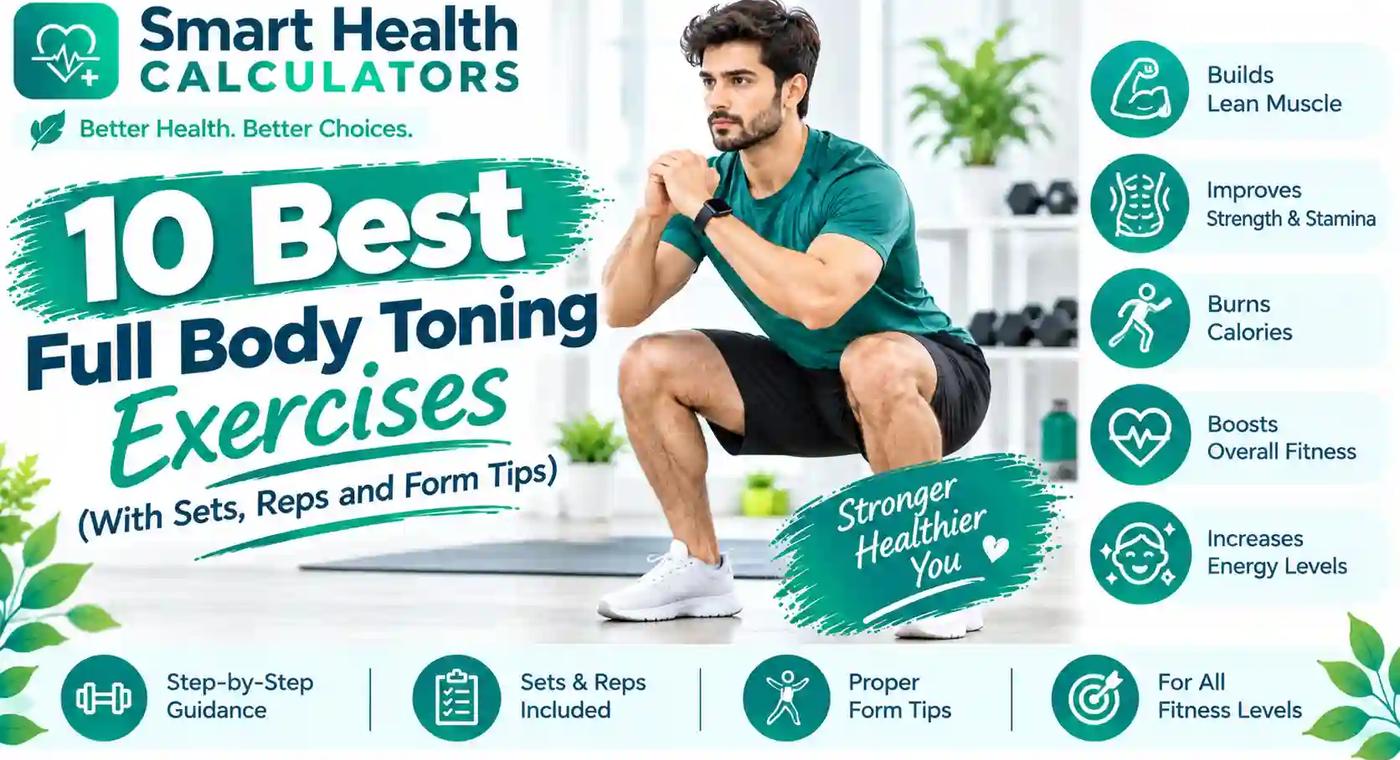
10 Best Full Body Toning Exercises: Sets, Reps & Form Tips
10 best full body toning exercises with sets, reps, form tips and beginner options. Includes a 45-minute sample workout and weekly plan.
Most "toning" advice falls into two camps: endless crunches, or a 40-exercise routine nobody can finish. Neither works well for real life.
The good news is that you do not need a long list. Ten well-chosen moves can train your legs, hips, back, chest, shoulders, arms and core in one session. Each exercise below comes with the muscles it works, step-by-step form, sets and reps, common mistakes, and an easier option if you are just starting.
You can do this routine at home with a pair of dumbbells, or with nothing but your bodyweight. Let's get into it.
What Are the Best Full Body Toning Exercises?
The best full body toning exercises are compound movements that work several large muscle groups at once. Ten reliable choices are:
- Goblet squat
- Reverse lunge
- Romanian deadlift
- Glute bridge
- Push-up
- Bent-over row
- Overhead press
- Plank
- Bird dog
- Farmer's carry
A good starting point is 2 to 3 sets of 8 to 12 repetitions for most moves, with 60 to 90 seconds of rest, performed on 2 to 3 non-consecutive days a week.
What Does "Toning" Actually Mean?
"Toning" is a popular word, but it is not a scientific one. In practice, when people say they want to tone up, they usually mean two things:
- More muscle definition, meaning firmer-looking muscles
- Less body fat covering that muscle, so the shape shows
Both come from the same basic process: resistance training to build or maintain muscle, plus overall habits (nutrition, sleep, activity) that influence body fat.
Here is what that means for you:
- You cannot spot-reduce fat. Doing endless crunches will not burn belly fat specifically. Fat loss happens across the whole body, and where it comes off first is largely genetic.
- You will not "bulk up" by accident. Building significant muscle takes years of focused training and eating for it. Most beginners simply get stronger and firmer.
- Strength matters more than the label. Getting better at squats and push-ups is a more reliable goal than chasing a look.
If you want a deeper explanation of how muscle and fat change together, read our guide on losing fat and gaining muscle through body recomposition.
Why Full Body Training Works So Well
Full body workouts train every major muscle group in each session. That makes them ideal for beginners and busy adults.
The benefits:
- Efficiency. Compound moves like squats and rows work many muscles at once, so you get more from less time.
- Frequency. Training each muscle two or three times a week fits recommended activity levels.
- Flexibility. Miss a day and you have not skipped an entire body part for the week.
- Simplicity. One routine covers everything.
Public-health guidance backs the basics. The CDC's adult activity guidelines recommend muscle-strengthening activities that involve all major muscle groups on two or more days a week. They also describe 8 to 12 repetitions as one example for building strength, not a rigid rule.
The World Health Organization gives similar advice, and the Physical Activity Guidelines for Americans are the underlying U.S. reference.
Full Body vs Split Training
| Feature | Full Body | Split Training |
|---|---|---|
| Sessions per week | 2 to 3 | 4 to 6 |
| Muscle frequency | High | Lower |
| Best for | Beginners, busy schedules | Experienced lifters, specific goals |
| Flexibility if you miss a day | High | Lower |
For most people starting out, full body wins on simplicity and consistency.
Before You Start: Warm-Up, Equipment and Safety
A 5-Minute Warm-Up
Do not skip this. A warm-up raises your heart rate and prepares your joints.
- March in place or walk briskly for 1 to 2 minutes
- Arm circles, 10 forward and 10 backward
- Bodyweight squats, 8 to 10 slow reps
- Hip circles, 5 each direction
- Cat-cow or gentle spinal rolls, 6 to 8 reps
Simple Equipment List
You can start with almost nothing. Helpful extras:
- A pair of dumbbells (light and medium weights)
- A resistance band
- An exercise mat
- A sturdy chair or bench
- A backpack you can load with books for extra weight
For a no-equipment option, see our beginner home workout plan with no equipment.
Safety Notes
- Use a weight that lets you finish every rep with good form.
- Stop if you feel sharp pain (not to be confused with normal muscle effort).
- If you have an injury, joint condition, heart condition, are pregnant, or have not exercised in a long time, speak with a healthcare professional first.
- Breathe steadily. Do not hold your breath.
Quick Reference: The 10 Exercises at a Glance
| Exercise | Main Muscles | Sets × Reps | Beginner Option |
|---|---|---|---|
| Goblet squat | Quads, glutes, core | 3 × 10 to 12 | Chair squat |
| Reverse lunge | Glutes, quads, hamstrings | 2 × 8 to 10 per leg | Supported split squat |
| Romanian deadlift | Hamstrings, glutes, back | 3 × 8 to 12 | Hip hinge, no weight |
| Glute bridge | Glutes, hamstrings | 3 × 12 to 15 | Bodyweight bridge |
| Push-up | Chest, shoulders, triceps, core | 3 × 6 to 12 | Incline push-up |
| Bent-over row | Back, biceps, rear shoulders | 3 × 8 to 12 | Band row or supported row |
| Overhead press | Shoulders, triceps, core | 3 × 20 to 40 sec | Knee or incline plank |
| Plank | Core, shoulders, glutes | 3 × 20 to 40 sec | Knee or incline plank |
| Bird dog | Core, glutes, lower back | 2 × 8 per side | Leg-only lift |
| Farmer’s carry | Grip, core, traps, legs | 3 × 20 to 40 steps | Lighter weight, shorter distance |
The 10 Best Full Body Toning Exercises
1. Goblet Squat (Lower Body and Core)
Muscles worked: quadriceps, glutes, hamstrings, core
Why it is on the list: The squat is a foundational movement that trains your biggest muscles. Holding a weight at your chest also encourages an upright posture.
How to do it:
- Stand with feet slightly wider than shoulder-width, toes turned out a little.
- Hold one dumbbell vertically against your chest with both hands.
- Brace your core and keep your chest tall.
- Sit your hips back and down, as if lowering into a chair.
- Lower until your thighs are about parallel to the floor, or as low as you comfortably can with good form.
- Press through your whole foot to stand.
Sets and reps: 3 sets of 10 to 12 reps.
Common mistakes:
- Knees collapsing inward (push them out in line with your toes)
- Heels lifting off the floor
- Rounding the lower back at the bottom
- Dropping quickly instead of controlling the descent
Beginner option: Squat down to a chair and stand back up, lightly tapping the seat.
Progression: Use a heavier dumbbell, slow the lowering phase to 3 seconds, or add a pause at the bottom.
2. Reverse Lunge (Legs and Glutes)
Muscles worked: glutes, quadriceps, hamstrings, stabilising muscles
Why it is on the list: Lunges train each leg separately. This is called unilateral training, and it helps balance strength between sides. Stepping backward is often easier on the knees than stepping forward.
How to do it:
- Stand tall with feet hip-width apart, a dumbbell in each hand if desired.
- Step one foot straight back, landing on the ball of the foot.
- Lower until both knees bend to roughly 90 degrees.
- Keep your front knee above your ankle and your torso upright.
- Push through the front heel to return to standing.
- Alternate legs.
Sets and reps: 2 sets of 8 to 10 reps per leg.
Common mistakes:
- Taking too short a step, which loads the front knee
- Leaning far forward
- Letting the back knee slam the floor
- Wobbling because feet are in a "tightrope" line (keep them hip-width)
Beginner option: Hold a chair or wall for balance and use a smaller range of motion.
Progression: Add dumbbells or pause for one second at the bottom.
3. Romanian Deadlift (Hamstrings, Glutes and Back)
Muscles worked: hamstrings, glutes, lower back, upper back, grip
Why it is on the list: The hip hinge is one of the most useful movement patterns in daily life, from lifting a box to picking up a child. It also trains the back of the body, which many routines neglect.
How to do it:
- Stand with feet hip-width apart, a dumbbell in each hand in front of your thighs.
- Soften your knees slightly.
- Push your hips straight back as if closing a car door with your backside.
- Slide the dumbbells down your thighs, keeping them close.
- Lower until you feel a stretch in the hamstrings, usually around mid-shin.
- Drive your hips forward to stand tall, squeezing your glutes.
Sets and reps: 3 sets of 8 to 12 reps.
Common mistakes:
- Rounding the spine (keep a neutral spine, long from head to tailbone)
- Bending the knees too much so it becomes a squat
- Letting the weights drift away from the legs
- Overextending the lower back at the top
Beginner option: Practice the hip hinge without weight, with a broomstick along your back to feel the alignment.
Progression: Use heavier dumbbells, or try a single-leg version once balance improves.
4. Glute Bridge (Glutes and Hamstrings)
Muscles worked: glutes, hamstrings, core
Why it is on the list: It is gentle on the joints, easy to learn, and a solid way to strengthen the hips. It also balances all the sitting most of us do.
How to do it:
- Lie on your back with knees bent and feet flat, hip-width apart.
- Place your arms by your sides.
- Press through your heels and lift your hips until your body forms a straight line from shoulders to knees.
- Squeeze your glutes at the top for one second.
- Lower slowly.
Sets and reps: 3 sets of 12 to 15 reps.
Common mistakes:
- Arching the lower back instead of using the glutes
- Pushing through toes instead of heels
- Lifting too high and flaring the ribs
Beginner option: Keep a small range of motion and focus on squeezing.
Progression: Hold a dumbbell across your hips, try single-leg bridges, or pause for three seconds at the top.
5. Push-Up (Chest, Shoulders, Arms and Core)
Muscles worked: chest, front shoulders, triceps, core
Why it is on the list: A push-up trains your upper body and your trunk at the same time. It needs no equipment and scales easily.
How to do it:
- Start in a high plank with hands slightly wider than shoulder-width.
- Keep your body in a straight line from head to heels.
- Lower your chest toward the floor, elbows at roughly 45 degrees from your body.
- Press the floor away to return to the top.
Sets and reps: 3 sets of 6 to 12 reps, or as many good reps as you can.
Common mistakes:
- Sagging hips or sticking the backside up
- Flaring elbows straight out to the sides
- Dropping the head forward
- Partial reps that barely lower the chest
Beginner option: Incline push-ups with hands on a sturdy counter, bench or sofa. The higher the surface, the easier the move.
Progression: Lower the incline over time, then try standard push-ups, then slow tempo or feet-elevated versions.
6. Bent-Over Row (Back, Biceps and Rear Shoulders)
Muscles worked: lats, upper back, rear shoulders, biceps
Why it is on the list: Most people do plenty of pushing and not enough pulling. Rows balance your upper body and support better posture through scapular control, which means moving your shoulder blades well.
How to do it:
- Hold a dumbbell in each hand and hinge forward at the hips until your torso is roughly 45 degrees, back flat.
- Let the weights hang below your shoulders, arms long.
- Pull the dumbbells toward your ribs, driving elbows back.
- Squeeze your shoulder blades together briefly.
- Lower under control.
Sets and reps: 3 sets of 8 to 12 reps.
Common mistakes:
- Using momentum or jerking the weights
- Rounding the upper back
- Shrugging shoulders toward the ears
- Standing too upright, which turns it into a partial curl
Beginner option: Single-arm row with one hand and one knee supported on a bench, or a resistance band row anchored to a door.
Progression: Increase the weight, slow the lowering phase, or pause at the top.
7. Overhead Press (Shoulders and Triceps)
Muscles worked: shoulders, triceps, upper chest, core
Why it is on the list: Pressing weight overhead builds shoulder strength and teaches you to keep your trunk stable under load.
How to do it:
- Stand (or sit) with a dumbbell in each hand at shoulder height, palms facing forward or slightly inward.
- Squeeze your glutes and brace your core.
- Press the weights straight up until your arms are extended but not locked hard.
- Lower slowly to shoulder height.
Sets and reps: 2 to 3 sets of 8 to 10 reps.
Common mistakes:
- Arching the lower back and flaring the ribs
- Pressing forward instead of straight up
- Using weights that are too heavy
- Shrugging at the top
Beginner option: Sit on a chair with back support and use light dumbbells.
Progression: Move to standing, increase weight gradually, or try a single-arm press to challenge your core.
8. Plank (Core and Shoulders)
Muscles worked: deep core muscles, shoulders, glutes
Why it is on the list: The plank teaches your body to hold a rigid, stable position, which carries over to nearly every other exercise. It trains the core to resist movement rather than flex, which is a smarter use of time than endless sit-ups.
How to do it:
- Place forearms on the floor with elbows under shoulders.
- Extend your legs behind you, toes on the floor.
- Squeeze glutes and abs, keeping a straight line from head to heels.
- Look at a spot slightly ahead of your hands.
- Hold, breathing steadily.
Sets and reps: 3 sets of 20 to 40 seconds. Stop when your form breaks.
Common mistakes:
- Sagging hips or lifting them too high
- Holding your breath
- Letting shoulders collapse toward the ears
- Chasing long holds with poor form
Beginner option: Plank from your knees, or with hands on an elevated surface.
Progression: Longer holds, shoulder taps, or reaching one arm forward while keeping hips still.
9. Bird Dog (Core, Glutes and Lower Back)
Muscles worked: core, glutes, lower back, shoulders
Why it is on the list: The bird dog improves coordination and spinal control with very little joint stress. It is a favourite in rehab and beginner programs.
How to do it:
- Start on hands and knees, hands under shoulders, knees under hips.
- Keep your back flat like a tabletop.
- Reach your right arm forward and extend your left leg back at the same time.
- Hold for 2 seconds without twisting your hips.
- Return and switch sides.
Sets and reps: 2 sets of 8 reps per side.
Common mistakes:
- Rotating the pelvis
- Lifting the leg too high and arching the back
- Rushing through the reps
Beginner option: Lift just your leg, or just your arm, until balance improves.
Progression: Add a pause, bring the elbow to the knee under your body before extending again, or use ankle weights.
10. Farmer's Carry (Grip, Core and Legs)
Muscles worked: forearms and grip, upper back, core, hips, legs
Why it is on the list: Carrying heavy things is one of the most natural and functional movements there is. It trains posture and the entire kinetic chain, which is how force travels from your feet through your body.
How to do it:
- Hold a dumbbell (or a loaded bag) in each hand at your sides.
- Stand tall, shoulders back and down.
- Walk with controlled, steady steps.
- Keep your ribs stacked over your hips and avoid leaning.
- Set the weights down with a flat back.
Sets and reps: 3 sets of 20 to 40 steps (about 15 to 30 metres).
Common mistakes:
- Leaning to one side
- Shrugging shoulders to the ears
- Rushing with short, choppy steps
- Choosing weights too heavy to carry with good posture
Beginner option: Use lighter weights or carry shopping bags for a short distance.
Progression: Add weight, increase distance, or try a one-handed "suitcase carry" for extra core challenge.
A Sample Full Body Toning Workout (45 Minutes)
Here is a ready-to-use session. It works for beginners and intermediate trainees by changing the weight and the number of sets.
| Order | Exercise | Sets | Reps / Time | Rest |
|---|---|---|---|---|
| Warm-up | Walking, mobility, bodyweight squats | 1 | 5 minutes | None |
| 1 | Goblet squat | 3 | 10 to 12 | 60 to 90 sec |
| 2 | Push-up (or incline) | 3 | 6 to 12 | 60 sec |
| 3 | Romanian deadlift | 3 | 8 to 12 | 60 to 90 sec |
| 4 | Bent-over row | 3 | 8 to 12 | 60 sec |
| 5 | Reverse lunge | 2 | 8 to 10 per leg | 60 sec |
| 6 | Overhead press | 2 | 8 to 10 | 60 sec |
| 7 | Glute bridge | 3 | 12 to 15 | 45 sec |
| 8 | Plank | 3 | 20 to 40 sec | 45 sec |
| 9 | Bird dog | 2 | 8 per side | 30 sec |
| 10 | Farmer’s carry | 3 | 20 to 40 steps | 60 sec |
| Cool-down | Gentle stretching | 1 | 3 to 5 minutes | None |
Why This Order Works
- Big lifts first (squat, push-up, deadlift) when you have the most energy.
- Pulling and pushing alternated so muscles recover while others work.
- Core and carries last, so your trunk is fresh for the heavier lifts.
Short on Time? Try the 20-Minute Version
Pick six moves: goblet squat, push-up, Romanian deadlift, row, plank, and glute bridge. Do two sets each with 45 seconds of rest. For more time-smart plans, see our 30-minute workout plan for busy people.
How Often Should You Do a Full Body Workout?
Most adults do well with 2 to 3 full body sessions per week on non-consecutive days. A typical schedule looks like this:
| Day | Activity |
|---|---|
| Monday | Full body workout |
| Tuesday | Walk or light activity |
| Wednesday | Full body workout |
| Thursday | Rest or gentle stretching |
| Friday | Full body workout |
| Weekend | Active fun: hiking, swimming, sport |
Muscles need recovery time to adapt, so training the same muscles hard every day is not recommended. If you feel unusually sore or fatigued, take another rest day. For a weekly structure that grows with you, read our beginner weekly workout plan and the guide on structuring a workout plan from beginner to advanced.
What About Cardio?
Strength work is one half of the picture. The CDC and WHO also recommend regular aerobic activity, roughly 150 minutes a week at moderate intensity for most adults. You can split it any way that suits you, such as brisk walks on rest days. Our article on cardio and strength training explains how to combine them, and the heart rate zone calculator guide helps you set the right effort level.
How to Choose Sets, Reps and Weight
There is no single perfect formula. These practical guidelines work well for most beginners.
Repetition Ranges
| Goal | Typical Range |
|---|---|
| Building strength and size (beginner) | 6 to 12 reps |
| Muscular endurance | 12 to 20 reps |
| Core holds | 20 to 40 seconds |
The 8 to 12 range is a good middle ground for beginners. Other ranges also work if you train close to your limit.
How Heavy Is Heavy Enough?
Use the repetitions-in-reserve (RIR) method:
- Finish a set and ask, "How many more good reps could I have done?"
- Aim for about 2 reps left in the tank on most sets.
- If you could have done 6 more, add weight.
- If form broke before the target, lower the weight.
Rest Between Sets
- 60 to 90 seconds for most exercises
- 45 seconds or less for lighter core and mobility work
- Up to 2 minutes for your heaviest sets
Progressive Overload: The Secret to Continued Results
Your body adapts to whatever you repeatedly do. To keep improving, gradually ask a little more of it. This is called progressive overload.
A simple method is double progression:
- Pick a rep range, such as 8 to 12.
- Start with a weight where you reach 8 reps with good form.
- Add a rep each week until you can do 12 reps on every set.
- Then increase the weight slightly and start again at 8.
Other ways to progress: add a set, slow the tempo, reduce rest, or move to a harder variation, such as an incline push-up to a standard push-up.
Not sure where to begin? Our workout planner helps you build a routine, and the monthly workout planner guide shows how to track your progress.
Beginner Modifications and Equipment Alternatives
You do not need to do every exercise perfectly on day one. Start where you are.
If an Exercise Feels Too Hard
- Reduce the range of motion
- Use a lighter weight, or none
- Choose the beginner option listed above
- Do fewer reps and add one each week
- Slow down and prioritise control
Low-Impact and Joint-Friendly Tips
- Choose controlled tempo over speed
- Avoid jumping moves if your joints complain
- Use supports like a chair or wall
- Stay within a pain-free range
Common Mistakes That Slow Your Results
- Skipping the warm-up. Cold muscles and stiff joints are more prone to strain.
- Lifting too light for too long. If every set feels easy, increase the challenge.
- Lifting too heavy too soon. Sloppy form wastes effort and raises injury risk.
- Doing the same workout forever. Progress needs gradual change.
- Ignoring recovery. Sleep, rest days and stress management matter.
- Chasing spot reduction. Hundreds of crunches will not shrink your waist alone.
- Inconsistent training. Two decent sessions weekly beat one heroic session monthly.
Our guide on workout planning mistakes that slow results goes deeper into these.
What Else Affects Muscle Definition?
Exercise is only one piece. These factors shape how your body looks and performs.
Nutrition
You need enough protein and overall energy to support muscle. Eating far too little can slow progress and recovery. To estimate your needs, use our guide on how much protein you need per day, the muscle gain diet plan, and the calorie intake planner. If fat loss is your goal, read about natural body fat reduction.
Hydration
Even mild dehydration can make training feel harder. Learn how much water to drink before a workout and use the water intake calculator.
Sleep and Recovery
Muscles adapt while you rest. Poor sleep can hurt energy and recovery. Check your habits with the sleep quality checker and read about the signs of poor sleep quality.
Daily Movement
Steps and everyday activity add up. Set a target with the step counter goal planner.
How to Measure Progress Beyond the Scale
The scale cannot tell fat from muscle. Better indicators include:
- Strength gains (heavier weights, more reps)
- How your clothes fit
- Progress photos taken monthly in the same lighting
- Waist measurements (see waist-to-height ratio)
- Body composition estimates (try the body fat estimator and see the body fat percentage chart)
Remember that BMI has limits, especially for people who strength train. We explain why in is BMI accurate?.
How Long Until You See Changes?
Honestly, it depends. Many beginners notice better strength and energy within a few weeks. Visible changes usually take longer and vary with starting point, consistency, nutrition, sleep and genetics. Set goals around habits you control, not a fixed date. Our article on realistic health goals can help.
Real-World Examples
The busy parent. Maya has three 30-minute windows a week. She does goblet squats, incline push-ups, rows, glute bridges and planks with a pair of 8 kg dumbbells. After two months, she reports easier stairs and better posture. Her routine did not change much. Her consistency did.
The desk worker. Daniel sits for most of the day and has a stiff lower back. He starts with hip hinges, glute bridges, bird dogs and rows. Within a few weeks, those moves feel easier and his back feels less cranky. (He also checks in with his doctor about persistent pain.)
The complete beginner. Aisha has never trained. She begins with chair squats, wall push-ups and short planks, then moves to lower inclines over six weeks. She never lifted a dumbbell the first month, and that was fine.
Why Choose Smart Health Calculators for Your Fitness Journey?
A good routine works better when it fits your numbers. Smart Health Calculators gives you simple, free tools and clear guides in one place:
- Planning tools such as the workout planner, BMR calculator and BMI calculator
- Practical articles that explain the "why" behind the numbers
- Connected topics like hydration, sleep, nutrition and stress
- No signup needed for basic tools
Ready for more? Explore Advanced Tools at Smart Health Calculators, or browse our list of the best free health calculators.
Frequently Asked Questions
What does full body toning actually mean?
Full body toning means building or maintaining muscle across the whole body while managing body fat, so muscles look firmer and more defined. It is not a separate process from strength training.
Can I tone my whole body with ten exercises?
Yes. The ten moves in this guide cover legs, hips, back, chest, shoulders, arms and core. Done two to three times a week with gradual progression, they can build a solid foundation.
How many sets and reps should beginners do?
Beginners can start with 2 to 3 sets of 8 to 12 repetitions for most exercises, using a weight that leaves about two good reps in reserve. Plank holds usually last 20 to 40 seconds.
How long should I rest between sets?
Rest about 60 to 90 seconds between most sets. Light core work may need only 30 to 45 seconds, and your heaviest sets may need up to 2 minutes.
Should I do full body exercises every day?
Not usually. Two to three sessions a week on non-consecutive days gives muscles time to recover. On other days, choose walking, stretching or light activity.
Do I need dumbbells to tone my entire body?
No. Bodyweight exercises such as squats, lunges, push-ups, glute bridges and planks can build strength, especially at first. Dumbbells or bands make it easier to progress.
Can I do a full body workout in 20 minutes?
Yes. Choose six exercises, do two sets each, and keep rest short. It will not be as thorough as a 45-minute session, but it is far better than skipping a workout.
What is the difference between toning and building muscle?
They are essentially the same process. "Toning" is a casual term for building or keeping muscle while body fat is low enough for it to show.
Should I warm up before resistance exercises?
Yes. A 5-minute warm-up with light movement and mobility prepares your muscles and joints and can make your first sets feel better.
When should I increase my weights or repetitions?
When you can complete all sets at the top of your rep range with good form and feel you could do more, increase the weight slightly or add a rep or set.
Trusted Sources and Further Reading
For primary guidance on activity levels, technique and safety:
- CDC: Adult physical activity guidelines
- WHO: Physical activity fact sheet
- Physical Activity Guidelines for Americans (Health.gov)
- Mayo Clinic: Weight training do's and don'ts of proper technique
- NHS: Exercise
More from Smart Health Calculators:
- Beginner home workout plan with no equipment
- Beginner weekly workout plan
- Cardio and strength training
- Personalized workout plan for clients
- Stay fit while working night shifts
- Why your diet is not working
Conclusion:
You do not need a complicated plan to build a stronger, firmer body. You need a handful of good exercises, sensible sets and reps, and enough consistency to let progress add up.
Here is your action plan:
- Pick your starting level. Choose beginner options if any move feels too hard.
- Schedule two or three sessions this week and put them in your calendar.
- Warm up, then follow the sample workout in the order shown.
- Leave about two reps in reserve and focus on form first.
- Track your numbers. Add a rep, a set or a little weight when it feels easy.
- Support the work with protein, water, sleep and daily movement.
- Add aerobic activity across the week, about 150 minutes if you can.
Start with the workout planner to build your week.
Medical Disclaimer
This article is for general education only. It is not medical advice, diagnosis, treatment, prescription guidance, or a replacement for professional healthcare. Speak with a qualified healthcare professional for personal medical concerns, symptoms, pregnancy concerns, mental health crisis, medication questions, or before making major health changes.