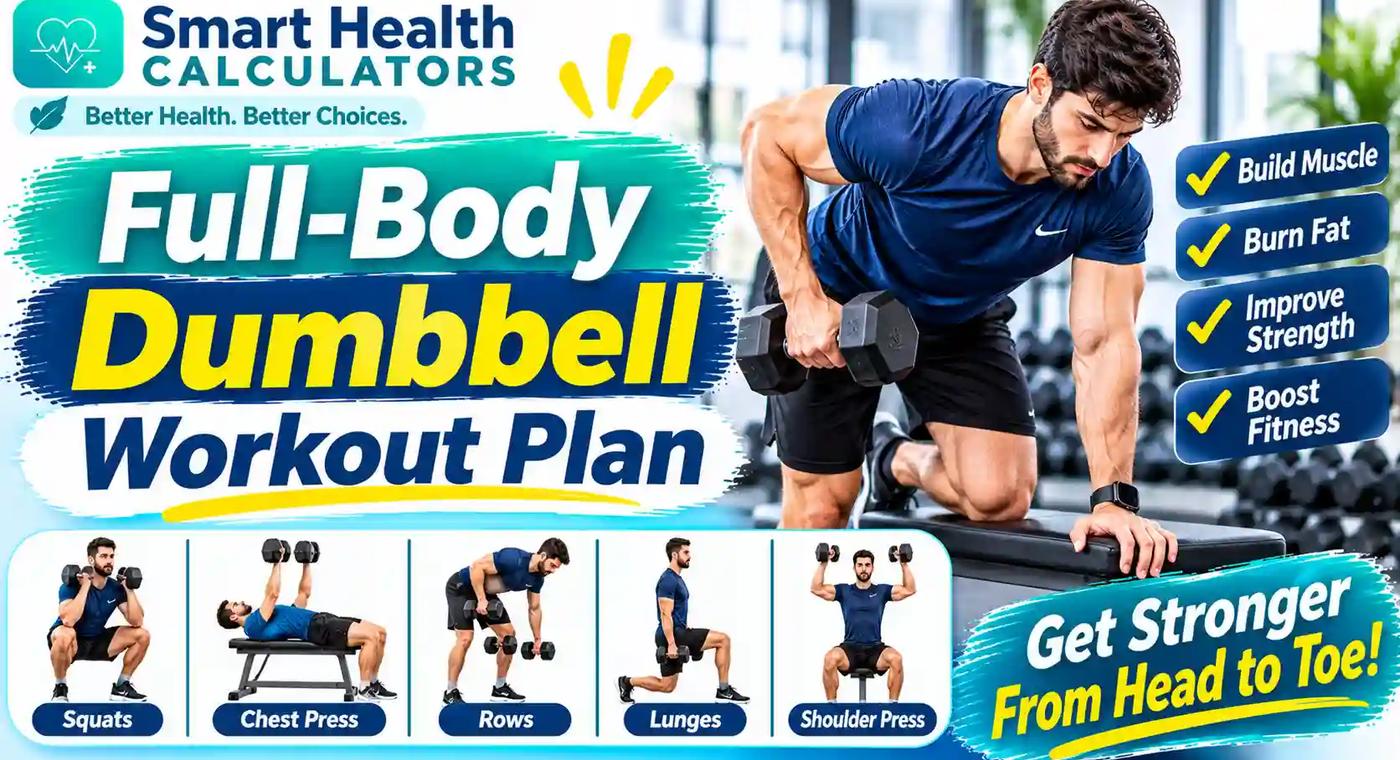
Full-Body Dumbbell Workout Plan
Follow this full-body dumbbell workout plan to build strength in your chest, back, shoulders, arms, legs, and core. Beginner and intermediate options included.
A full-body dumbbell workout trains your legs, chest, back, shoulders, arms, and core in a single session using simple free weights. You can do it at home with one adjustable pair or in a gym. For most beginners, three sessions a week with eight basic exercises is enough to build strength and muscle, as long as you add difficulty gradually and recover well.
Many people assume you need a barbell rack and a full gym to train properly. You don't. Dumbbells let you squat, hinge, press, row, lunge, and curl, which covers every major movement pattern. This guide gives you a complete beginner plan, an intermediate progression, clear form cues, and a weekly schedule you can start this week.
What Is a Full-Body Dumbbell Workout?
A full-body dumbbell workout is a training session where you work all major muscle groups using dumbbells, rather than dedicating each day to one body part. A typical session includes a squat pattern, a hip hinge, a horizontal push, a horizontal pull, an overhead press, a single-leg movement, an arm exercise, and a core exercise.
This style is also called total body training. It sits at one end of the training-structure spectrum. If you want to see how it compares with Push Pull Legs, Upper/Lower, and other approaches, read our guide to workout splits explained.
Why Dumbbells Work So Well
- Accessible: One pair or one adjustable set covers dozens of exercises.
- Balanced: Each arm and leg works independently, which helps expose and reduce side-to-side differences.
- Flexible: You can train at home, in a garage, or in a gym.
- Joint-friendly: Dumbbells move freely, so you can find a path that feels comfortable for your shoulders and wrists.
- Scalable: Heavier dumbbells, more repetitions, slower tempo, or extra sets all increase difficulty.
Why Full-Body Training Is Worth Your Time
Full-body training suits people who want results without living in the gym. Because you train every muscle group each session, you practice the main movements often, which speeds up learning.
The research backs this up. The American College of Sports Medicine (ACSM) published a large 2026 position stand that reviewed 137 systematic reviews covering more than 30,000 participants. It found that resistance training improves muscle strength, size, power, muscular endurance, and aspects of physical function. It also identified training major muscle groups at least twice per week as a useful general frequency.
The CDC physical activity guidelines similarly recommend muscle-strengthening activities that involve all major muscle groups on at least two days per week for adults.
Full-body training does that efficiently. Three weekly sessions hit every muscle three times.
Benefits Beyond Muscle
- Stronger bones and joints with consistent resistance training
- Better everyday function, like carrying groceries or climbing stairs
- Improved body composition when paired with sensible nutrition
- A simple, repeatable routine that is easy to stick with
Results depend on consistency, nutrition, sleep, training history, and individual circumstances. No plan guarantees a fixed amount of muscle or fat change in a set number of days.
Equipment: What You Actually Need
You need less than you think.
- A pair of dumbbells: Fixed or adjustable. Adjustable dumbbells save space and let you change weight quickly.
- A bench or sturdy chair (optional): Handy for presses and rows, but you can use the floor.
- A mat (optional): Helps with floor work and planks.
Single Dumbbell or Two?
You can train your whole body with a single dumbbell using goblet squats, one-arm rows, and single-arm presses. Two dumbbells make bilateral exercises easier and let you load the legs more heavily. Both approaches work. If you have limited space or budget, start with what you have.
How to Choose the Right Dumbbell Weight
Pick a weight that lets you complete every repetition with controlled technique and leave a few repetitions in reserve, meaning you could do about two to four more clean reps if you had to. If you can't control the weight, it's too heavy. If the last rep feels easy, it's too light.
Different exercises need different loads. Your legs are far stronger than your shoulders, so expect a heavier dumbbell for squats than for lateral raises. Many beginners need two sizes at first.
The Best Dumbbell Exercises for Each Major Muscle Group
Here are the movements this plan uses, with simple form cues.
Legs and Glutes
Goblet squat. Hold one dumbbell vertically against your chest. Stand with feet slightly wider than shoulder width. Sit down between your hips, keep your chest tall, and push through your whole foot to stand. This trains the quadriceps and gluteus maximus and is easy to learn.
Dumbbell Romanian deadlift (RDL). Hold the dumbbells in front of your thighs. Push your hips back with a slight knee bend, keeping the weights close to your legs. Lower until you feel a stretch in your hamstrings, then drive your hips forward. Keep your back flat throughout.
Dumbbell reverse lunge. Step one foot back and lower until both knees bend comfortably. Push through the front foot to return. Reverse lunges are often easier on the knees than forward lunges.
Chest
Dumbbell floor press. Lie on your back with knees bent, holding dumbbells over your chest. Lower your elbows until your upper arms lightly touch the floor, then press back up. The floor limits shoulder range of motion, which makes it a friendly option for beginners.
Back
Bent-over dumbbell row. Hinge forward with a flat back and let the dumbbells hang. Pull your elbows toward your hips and squeeze your shoulder blades together. Lower with control. This works the latissimus dorsi and upper back.
Shoulders
Dumbbell shoulder press. Hold the dumbbells at shoulder height, palms facing forward or slightly inward. Press overhead without arching your lower back. Brace your core as you lift.
Arms
Dumbbell biceps curl. Keep your elbows near your sides. Curl the weights up, pause, and lower slowly. Avoid swinging.
Core
Plank. Hold a straight line from head to heels with your elbows under your shoulders. Breathe steadily. Planks train core stabilization without spinal movement.
For more exercises you can plug into this plan, browse our full body toning exercises guide.
Complete Beginner Full-Body Dumbbell Workout Plan
This routine is illustrative and intended for generally healthy beginners. Do it three days a week, such as Monday, Wednesday, and Friday, with at least one rest day between sessions.
| Exercise | Sets × Reps | Rest |
|---|---|---|
| Goblet squat | 2 × 10–12 | 60–90 sec |
| Dumbbell Romanian deadlift | 2 × 10–12 | 60–90 sec |
| Dumbbell floor press | 2 × 10–12 | 60–90 sec |
| Bent-over dumbbell row | 2 × 10–12 | 60–90 sec |
| Dumbbell shoulder press | 2 × 8–10 | 60–90 sec |
| Dumbbell reverse lunge | 2 × 8 each leg | 60–90 sec |
| Dumbbell biceps curl | 2 × 10–12 | 45–60 sec |
| Plank | 2 × 20–30 sec | 45–60 sec |
How to Run This Workout
- Warm up for five to eight minutes. See the warm-up section below.
- Do the exercises in the order listed. Big lower-body and compound lifts come first, when you are freshest.
- Choose weights that leave a few repetitions in reserve. You do not need to train to failure as a beginner.
- Rest between sets. Use the rest times above as a guide.
- Finish with a short cool-down. Walk, then stretch lightly.
A session like this usually takes 40 to 50 minutes. If you are short on time, our 30-minute workout plan for busy people shows how to trim a session efficiently.
How Many Sets and Reps Should You Do?
For beginners, two to three sets of 8 to 12 repetitions per exercise is a solid place to start. That range builds both strength and muscle while keeping technique manageable.
The ACSM review cites two to three sets per exercise as a useful strength-oriented prescription. It also identifies roughly 10 or more weekly sets per muscle group as a reference point for higher-volume muscle growth. That figure is a programming reference, not a required minimum for every beginner. Start lower, learn the movements, and add volume gradually.
What About Rest Between Sets?
Rest 60 to 90 seconds for most exercises. Heavy compound lifts such as squats and RDLs may benefit from up to two or three minutes as you get stronger. Shorter rest suits arm and core work.
How Long Should a Full-Body Dumbbell Workout Take?
Most sessions take 40 to 60 minutes including warm-up. If you only have 30 minutes, drop to five or six exercises and keep rest tight.
Intermediate Progression: What to Do After 8 to 12 Weeks
When the beginner plan feels comfortable, you are ready to increase demand. Here is a simple progression path.
Step 1: Add a third set. Move most exercises from two sets to three. This raises weekly volume without changing the plan.
Step 2: Add exercises. Introduce extras like lateral raises, triceps extensions, or a single-arm row to spread work across more muscles.
Step 3: Increase weight. Once you can hit the top of your rep range on every set with good form, move up a small increment.
Step 4: Slow the tempo. Lowering the weight in three seconds increases time under tension without needing heavier dumbbells.
Step 5: Try harder variations. Progress from goblet squats to dumbbell front squats, from floor presses to bench presses, and from reverse lunges to Bulgarian split squats.
Sample Intermediate Day
- Dumbbell front squat: 3 × 8–10
- Dumbbell Romanian deadlift: 3 × 8–10
- Incline or flat dumbbell bench press: 3 × 8–10
- Single-arm dumbbell row: 3 × 10 each arm
- Seated dumbbell shoulder press: 3 × 8–10
- Walking lunges: 3 × 10 each leg
- Dumbbell lateral raise: 2 × 12–15
- Dumbbell triceps extension: 2 × 10–12
- Plank or farmer's carry: 2 rounds
If you want to move into a more advanced structure later, our guide to the 5-day workout split for muscle growth shows what a higher-frequency plan looks like.
Progressive Overload: How to Keep Getting Stronger
Progressive overload means gradually increasing the demand on your muscles over time. Without it, your body has no reason to adapt.
You can progress in several ways, and weight is only one of them:
- Add repetitions within your target range.
- Add a set.
- Increase the weight by the smallest available jump.
- Slow the lowering phase of each rep.
- Improve range of motion or control.
- Shorten rest periods slightly.
Can You Get Stronger Without Increasing Dumbbell Weight?
Yes, especially if you only own light dumbbells. Add reps, slow your tempo, pause at the hardest point, use single-limb variations, or shorten rest. These methods raise difficulty without buying new equipment. The American Heart Association describes free weights, including dumbbells, as valid resistance training equipment and notes that gradually increasing resistance, repetitions, or sets supports continued strength gains.
Track Your Progress
Write down the weight, sets, and reps for each session. Small improvements add up, and a record stops you from guessing. The monthly workout planner to track progress is a handy template, and the workout planner tool helps you organize your week.
Weekly Schedule: How Often to Train
Three days a week works well for most beginners.
- Monday: Full-body workout
- Tuesday: Rest or light walking
- Wednesday: Full-body workout
- Thursday: Rest or light walking
- Friday: Full-body workout
- Weekend: Rest, or an easy walk or bike ride
How Often Should You Do a Full-Body Dumbbell Workout?
Two to four times a week suits most people. Two sessions meet the general guideline for muscle-strengthening activity. Three sessions give extra practice and volume. Four is possible for intermediates who manage volume carefully, but it is not required.
Should You Do Dumbbell Workouts Every Day?
Daily full-body training is usually not ideal, because muscles need time to recover between hard sessions. If you want to train more often, alternate focus, such as upper-body and lower-body days, or keep some days light.
Warm-Up and Cool-Down
A warm-up raises your temperature, lubricates your joints, and rehearses the movements you are about to do.
A Simple Five-Minute Warm-Up
- March or jog in place for two minutes.
- Do ten bodyweight squats.
- Do ten hip hinges with no weight.
- Do ten arm circles in each direction.
- Do one light set of your first exercise.
Cool-Down
Walk slowly for a couple of minutes, then stretch gently. Cool-downs are optional, but many people feel better after a few minutes of easy movement.
Recovery: Where Muscle Actually Grows
You do not build muscle during the workout. You build it afterward, during recovery. Three habits matter most.
- Sleep. Aim for seven to nine hours as an adult. See our guide on how many hours of sleep you need for details.
- Protein. Adequate daily protein supports repair. Learn how much in this guide to protein per day, and see our muscle gain diet plan for food ideas.
- Hydration and food. Training on low fuel hurts performance. Use the calorie intake planner to set a realistic target, and read about how much water to drink before a workout.
How Long Should You Rest Between Workouts?
At least 24 to 48 hours before training the same muscles hard again. Beginners often need the full 48 hours at first.
Can You Build Muscle With Dumbbells Alone?
Yes. Muscle responds to mechanical tension, effort, and progression. It does not care whether the load comes from a barbell, a machine, or a dumbbell. As long as you train close enough to the point of fatigue, apply progressive overload, eat enough protein and calories, and recover, dumbbells can build muscle effectively.
The limitation is practical, not physiological. You may eventually outgrow the heaviest dumbbells you own, especially for legs. At that point you can use single-leg variations, slower tempos, and higher repetition ranges. For a deeper look at the whole process, read how to build muscle.
Can You Lose Body Fat With Dumbbell Exercises?
Resistance training can support fat loss by helping you maintain muscle while you eat in a calorie deficit, but your diet drives most of the change in body weight. Combine lifting with sensible nutrition and some cardio. Our guide on cardio and strength training explains how to balance both.
Safety First: Technique, Pain, and Medical Clearance
Good technique protects you and makes the workout more effective.
- Start light. Learn the movement before you load it.
- Control the lowering phase. Do not drop the weights.
- Keep a neutral spine during squats, hinges, and rows.
- Do not train to failure as a beginner. Leave a few reps in reserve.
- Breathe steadily. Avoid holding your breath for long periods.
- Clear the space around you, and rack the dumbbells carefully.
What Should You Do If You Feel Pain?
Muscle burn and mild soreness are normal. Sharp, pinching, or lasting joint pain is not. Stop the exercise, try a lighter or easier variation, and if the pain persists, speak to a doctor or physiotherapist. If you feel chest pain, dizziness, or unusual shortness of breath, stop and seek medical advice right away.
Who Should Check With a Professional First?
People with heart or lung conditions, high blood pressure, recent surgery, pregnancy, joint injuries, or other significant medical issues should talk to a healthcare provider before starting. If you are pregnant, see our article on lifting weights while pregnant and pregnancy workouts at home.
Are Dumbbell Workouts Suitable for Older Adults?
Yes, in many cases. Resistance training can help preserve strength and function with age. The National Institute on Aging offers guidance on strength exercises for older adults. Start with light weights, chair-supported exercises if needed, and professional guidance when you have health concerns.
Common Mistakes to Avoid
- Going too heavy too soon. Poor form raises injury risk and cuts muscle activation.
- Skipping legs. Lower-body training builds the largest muscles and supports everything else.
- Rushing reps. Slow, controlled movement works muscles better than swinging.
- Never progressing. Doing the same workout forever stops producing results.
- Ignoring recovery. Poor sleep and under-eating undermine your effort.
- Changing programs weekly. Give a plan 8 to 12 weeks before judging it. Our article on workout planning mistakes that slow results covers more traps.
Real-World Examples
The home beginner. A busy office worker buys one pair of adjustable dumbbells and follows the three-day beginner plan. For the first month, they focus on form and pick weights that feel easy. By week eight, they have added a third set to most exercises and increased the weight on squats and RDLs. They did not chase soreness. They tracked numbers.
The returning lifter. Someone coming back after several months away starts with lighter loads than before and rebuilds technique. Within a few weeks, they move to the intermediate version with three sets per exercise.
The small-space trainer. A student in a tiny apartment owns a single dumbbell. They use goblet squats, one-arm rows, single-arm presses, and RDLs, slow the tempo, and add reps each week. Constraints did not stop progress, because they used progressive overload in other ways.
The theme repeats: consistency and gradual progression matter more than perfect equipment.
Why Choose Smart Health Calculators for Your Fitness Journey
A good plan is easier to follow when you know your numbers. Smart Health Calculators offers free tools and plain-language guides that help you plan training, nutrition, and recovery together.
You can learn more on the Why Choose Smart Health Calculators page, estimate your baseline energy needs with the BMR calculator, or check your composition with the body fat estimator. If you want a structure for the weeks ahead, the beginner weekly workout plan and the guide to structuring a workout plan from beginner to advanced pair well with this article.
Where to Learn More: Free and Paid Resources
Free, reputable resources:
- American College of Sports Medicine (ACSM)
- CDC physical activity guidelines for adults
- National Institute on Aging strength training guidance
- World Health Organization physical activity guidance
- PubMed for peer-reviewed resistance-training research
Paid options:
- A certified personal trainer for technique checks and a customized plan (see personal trainer benefits and cost)
- Coaching apps with exercise videos and progress tracking
- Physiotherapy or sports medicine consultations if you have injuries
Frequently Asked Questions
Can I build muscle with a full-body dumbbell workout?
Yes. Dumbbells provide enough resistance to build muscle when you train with good form, progress gradually, eat enough protein, and recover well. Results depend on consistency, nutrition, sleep, and training history.
How often should I do a full-body dumbbell workout?
Two to three times per week suits most beginners, with at least one rest day between sessions. Intermediates can train up to four times a week if they manage volume and recovery.
What dumbbell weight should beginners start with?
Choose a weight that lets you finish every rep with controlled form and leave a few reps in reserve. Expect to use different weights for different exercises, since legs are stronger than shoulders.
Can I train my entire body with just two dumbbells?
Yes. Goblet squats, Romanian deadlifts, presses, rows, lunges, and curls cover every major muscle group. Progress by adding reps, sets, tempo changes, or heavier dumbbells over time.
Is a 30-minute dumbbell workout effective?
Yes, if you keep rest short and focus on five or six compound exercises. A 30-minute session can build strength and muscle, especially for beginners.
How many sets and reps should I do for muscle growth?
Beginners do well with two to three sets of 8 to 12 reps per exercise. As you advance, you can increase weekly volume. Research cites roughly 10 or more weekly sets per muscle as a reference for higher-volume growth, though it is not mandatory for beginners.
Conclusion:
A full-body dumbbell workout is one of the simplest and most flexible ways to get stronger. Eight exercises, three days a week, and steady progression can carry a beginner for months. The details matter less than showing up, using good form, and gradually asking more of your muscles.
Here is your action plan:
- Pick a pair of dumbbells you can control for 10 to 12 reps.
- Schedule three non-consecutive days this week.
- Follow the beginner table, starting with two sets per exercise.
- Write down your weights and reps after each session.
- After 8 to 12 weeks, add a set or a heavier weight and move to the intermediate version.
Ready to plan your training, calories, and recovery in one place? Explore advanced tools at Smart Health Calculators, or contact the team.
Medical Disclaimer
This article is for general education only. It is not medical advice, diagnosis, treatment, prescription guidance, or a replacement for professional healthcare. Speak with a qualified healthcare professional for personal medical concerns, symptoms, pregnancy concerns, mental health crisis, medication questions, or before making major health changes.