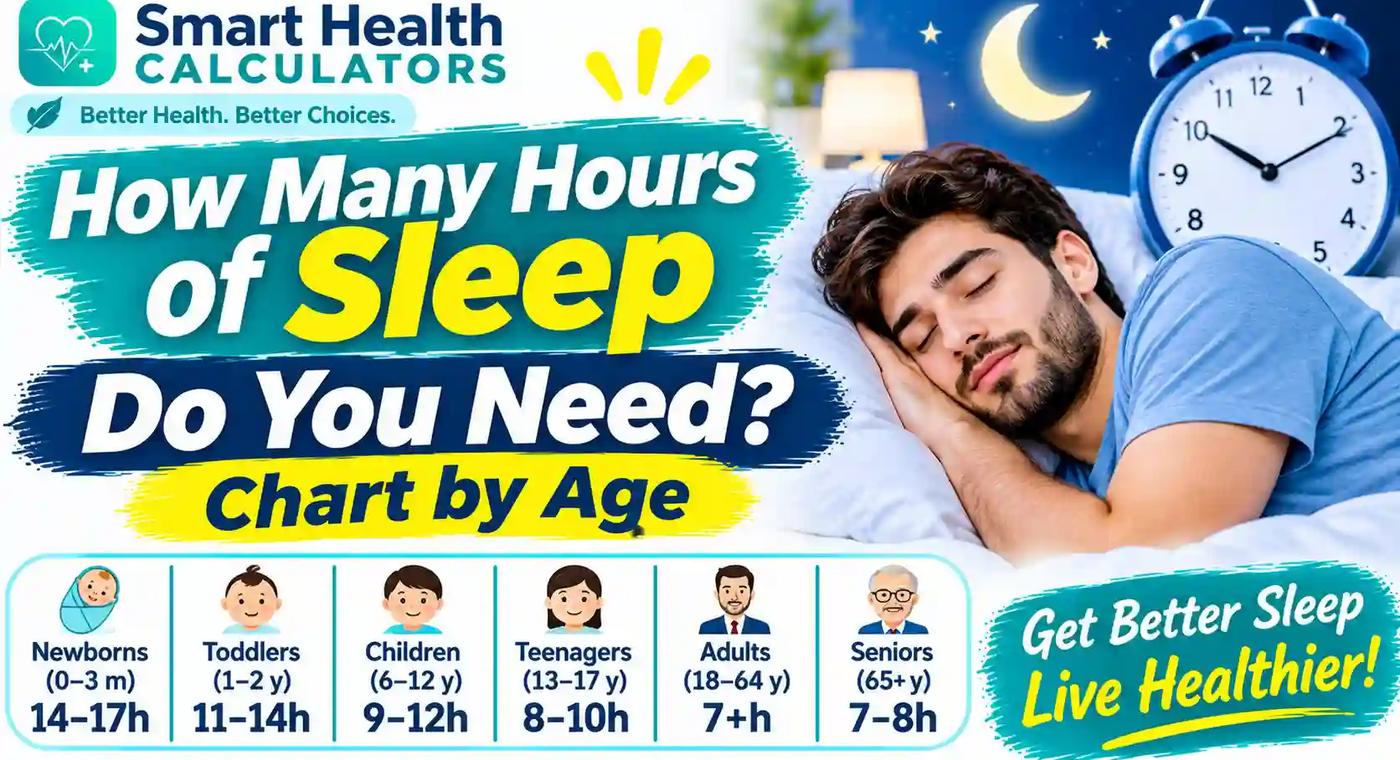
How Many Hours of Sleep Do You Need? Chart by Age
Find out how many hours of sleep you need by age, from babies to adults over 65. See the sleep chart, risks of too little sleep and tips for better rest.
Most adults need at least 7 hours of sleep per night. Teenagers generally need 8 to 10 hours, and school-age children need 9 to 12 hours. Babies need the most, up to 17 hours a day including naps.
Needs vary from person to person. Consistent, good-quality sleep supports physical health, memory, concentration and mood.
Recommended Hours of Sleep by Age (Reference Chart)
This chart follows the CDC's age-based sleep recommendations, which draw on guidance from the American Academy of Sleep Medicine (AASM). The figures are for total sleep in a 24-hour period. For babies and toddlers, that includes naps.
| Age group | Recommended sleep per 24 hours |
|---|---|
| Newborns (0–3 months) | 14–17 hours |
| Infants (4–12 months) | 12–16 hours (including naps) |
| Toddlers (1–2 years) | 11–14 hours (including naps) |
| Preschoolers (3–5 years) | 10–13 hours (including naps) |
| Teenagers (13–17 years) | 8–10 hours |
| Adults (18–60 years) | 7 or more hours |
| Adults (61–64 years) | 7–9 hours |
| Adults (65 and older) | 7–8 hours |
A note on different sources: The National Sleep Foundation (NSF) uses slightly different age bands. For example, it lists 9–11 hours for school-age children, while the CDC lists 9–12. Neither is wrong. They are different expert panels drawing lines in slightly different places, so treat each table as a range, not an exact rule.
Newborn sleep is a topic of its own. Our guide to baby sleep at 1 to 3 months covers what is typical in the first weeks.
How Many Hours of Sleep Do Adults Need?
The AASM and Sleep Research Society consensus statement recommends that adults regularly sleep 7 or more hours per night for good health. That is a minimum, not a precise target.
Several large health agencies, including the CDC and the National Heart, Lung, and Blood Institute, use the same "seven or more" framing. Many people thrive on 7 to 9 hours.
Is 7 hours of sleep enough?
For most adults, yes. Seven hours sits at the lower end of the recommended range, and large studies link it with good outcomes. If you wake up refreshed, stay alert through the afternoon and do not rely on caffeine to function, seven hours is probably working for you.
Is 8 hours of sleep necessary?
No. Eight hours is a popular benchmark, but it is not a medical requirement. Some adults feel their best at 7 hours. Others need 8 or 9. The right amount is the one that lets you function well without an alarm dragging you out of deep sleep.
Is 6 hours of sleep enough?
For most adults, regularly sleeping 6 hours falls short of the recommendation. Some people feel fine on it, but research suggests many underestimate how impaired they are. One striking finding from sleep-restriction studies is that people who are chronically under-rested often rate themselves as "fine" while their test performance keeps slipping.
A very small share of people carry rare gene variants that allow shorter sleep without ill effects. That is unlikely to describe you. If you are considering a 6-hour routine, test your assumption honestly. Track your energy, mood and focus for two weeks, and compare it with a week of 7.5 to 8 hours.
Sleep Needs for Children and Teenagers
Young people need far more sleep because their brains and bodies are building at speed.
Babies and toddlers
Total sleep drops gradually from the newborn stage to age two, and daytime naps shrink as nighttime sleep consolidates. Sleep regressions at around four and nine months are common and usually temporary.
Preschoolers (3 to 5 years)
They need 10 to 13 hours, including naps. Many drop the daytime nap at some point in this window. A predictable bedtime routine helps more than any single trick.
School-age children (6 to 12 years)
Nine to 12 hours is the CDC range. Homework, screens and early school starts often squeeze sleep in this group. Children who sleep too little may become irritable or hyperactive rather than visibly tired, which parents often misread.
Teenagers (13 to 17 years)
Teens need 8 to 10 hours, but many get far less. Part of the reason is biological: during adolescence, the body clock shifts later, so falling asleep at 9 p.m. feels almost impossible. Early school start times then collide with that natural shift.
CDC survey data from middle and high school students have shown that a majority report getting less than the recommended amount for their age. Practical help for families includes keeping phones out of the bedroom, dimming lights an hour before bed and keeping wake-up times consistent on weekends.
Do Older Adults Need Less Sleep?
Slightly, according to the guidelines. Adults over 65 are advised to aim for 7 to 8 hours, a touch below the range for younger adults.
What changes more clearly is the pattern of sleep:
- Sleep often becomes lighter and more fragmented.
- People wake up more often during the night.
- The body clock tends to shift earlier, so evening sleepiness and early waking become common.
- Deep sleep takes up a smaller share of the night.
So an older adult may need nearly as much rest as a younger one but struggle to get it in one unbroken block. Short daytime naps can help, as long as they are brief and early enough not to eat into nighttime sleep.
If an older person suddenly sleeps much more or much less than usual, or seems unusually confused or drowsy, it is worth a medical check. Changes like these can signal health problems, medication effects or sleep disorders.
Why Your Sleep Need Is Personal
Guidelines are population averages. Your own requirement is shaped by several things.
Genetics. Some families are naturally shorter or longer sleepers.
Chronotype. A chronotype is your natural tendency toward earlier or later sleep timing. "Larks" feel sharpest in the morning, and "owls" in the evening. Forcing an owl into a 5 a.m. schedule can produce chronic sleep loss, even with a full eight hours in bed.
Health conditions. Illness, pain, depression, anxiety, thyroid problems and sleep disorders can raise or distort your sleep need.
Activity level. Heavy training, physical jobs and recovery from injury often increase the need for rest.
Life stage. Pregnancy, new parenthood, menopause and shift work all change sleep. Our guide on sleep during pregnancy and the article on sleeping positions during pregnancy cover the first of these.
How to find your personal number
Try this simple two-week experiment:
- Pick a fixed wake-up time and keep it every day, including weekends.
- Go to bed when you feel sleepy, not at a rigid hour.
- After a few days, note when you naturally fall asleep and whether you wake before the alarm.
- Rate your energy, mood and focus on a 1-to-10 scale each afternoon.
- Adjust your bedtime earlier by 15 minutes every few days until the afternoon crash disappears.
Where your energy stays steady without caffeine, you are close to your real need. You can also try the Sleep Quality Checker to see how your current habits score.
How Sleep Works: Cycles, Stages and Why They Matter
Hours in bed are only part of the picture. Sleep moves in cycles of roughly 90 minutes, and each cycle includes lighter sleep, deeper slow-wave sleep and rapid eye movement (REM) sleep.
- Light sleep is the doorway into the night and makes up a large share of total sleep.
- Deep (slow-wave) sleep supports physical recovery and is heavier in the first half of the night.
- REM sleep is linked with dreaming, memory processing and emotional regulation, and it lengthens in the second half of the night.
This is why cutting your sleep short by an hour or two is not a minor trade. You tend to lose a disproportionate amount of REM sleep, because it concentrates in the early-morning hours. For a clear breakdown, read our guide on REM sleep vs deep sleep.
If you want to time your bedtime to your cycles, the sleep cycle calculator guide shows how. It can help, but do not treat a calculator as a precise measurement of your brain. Cycle length varies from person to person and from night to night.
Sleep Quantity vs Sleep Quality: Which Matters More?
Both matter, and they interact. Eight hours of fragmented, restless sleep does not equal eight hours of solid sleep.
Quality markers include:
- Sleep latency: how long you take to fall asleep. Most healthy adults fall asleep within about 10 to 20 minutes. Learn more in our guide to sleep latency.
- Sleep efficiency: the share of time in bed that you actually spend asleep.
- Sleep continuity: how often you wake, and how easily you drift back.
- How you feel: refreshed, or foggy and heavy?
If you sleep long hours but wake exhausted, quality is the likely culprit. Common causes include sleep apnea, alcohol, a noisy or hot bedroom, irregular schedules and stress. Check the signs of poor sleep quality if this sounds familiar.
What Happens When You Do Not Sleep Enough?
Even a single short night can affect you the next day. You are likelier to feel sleepy and irritable and less productive, and your risk of a car crash rises.
Over time, regularly sleeping less than 7 hours is associated with a higher risk of several health problems. Research and public health agencies, including the National Heart, Lung, and Blood Institute, link chronic short sleep with:
- Obesity and weight gain
- Type 2 diabetes
- High blood pressure and heart disease
- Weakened immune response
- Poorer memory and concentration
- Mood problems, including anxiety and depression
These are associations from large studies, not guarantees. Many factors overlap, and short sleep is often both a cause and a symptom of other problems. The honest takeaway is that consistently short sleep raises risk, and improving it is one of the more accessible ways to protect your health.
Signs you may not be getting enough sleep
- You need an alarm and still hit snooze repeatedly
- You feel groggy for more than 30 to 60 minutes after waking
- You depend on caffeine to get through the day
- You fall asleep within minutes of sitting down in the afternoon
- You are forgetful, irritable or struggling to focus
- You oversleep dramatically on weekends
If several apply, you likely carry some sleep debt. Our sleep debt calculator guide shows how to estimate it. The link between sleep and mood is also covered in how stress affects sleep quality and the sleep, stress and mental health connection.
Can You Sleep Too Much?
Yes, but the picture is more nuanced than "more than 9 hours is bad."
Studies often find that people who regularly sleep very long hours have higher rates of health problems. Researchers generally cannot say that long sleep causes those problems. Often the long sleep is a symptom of something else, such as depression, sleep apnea, thyroid disease, chronic illness or medication effects.
Some healthy people, especially teens, young adults recovering from sleep loss, and athletes in heavy training, naturally sleep 9 hours or more. That can be normal.
When to pay attention: if you regularly sleep 10 or more hours and still feel exhausted, or if your need for sleep suddenly increases, speak to a doctor. Persistent daytime sleepiness is worth evaluating, particularly if you snore, which is a classic sign of sleep apnea. If you are diagnosed, our guide to how a CPAP machine works explains the most common treatment.
Can You Catch Up on Lost Sleep on Weekends?
Partly, but not completely.
Extra sleep on a free weekend can ease short-term fatigue and sleepiness. But research suggests that one weekend does not fully reverse the effects of a week of short sleep, particularly on metabolism and attention. Large swings between weekday and weekend schedules can also cause "social jet lag," where you feel like you have flown across time zones every Monday.
A better way to recover from sleep debt
- Add 30 to 60 minutes to your sleep each night for a week or two, not one huge sleep-in.
- Keep your wake-up time fairly steady. Move bedtime earlier instead of oversleeping.
- Use short naps (20 to 30 minutes, before mid-afternoon) to take the edge off.
- Protect the final hour before bed from screens and stressful tasks.
A real example: someone who sleeps 5.5 hours on weeknights and 9 hours on weekends averages about 6.5 hours overall, but the sharp swings still disrupt their body clock. Moving to a steady 7 hours on most nights typically feels better than the "binge and crash" pattern, even though the weekly total is similar.
Do Naps Count Toward Your Daily Sleep?
For babies and toddlers, yes. The age chart includes naps. For adults, naps help with alertness but do not fully replace nighttime sleep.
Keep adult naps short, ideally 20 to 30 minutes, and avoid late-afternoon naps if you struggle to fall asleep at night. Longer naps can leave you groggy, a state called sleep inertia.
Do You Need More Sleep After Exercise?
Often, yes, particularly after hard training. Sleep is when much of your recovery happens. Athletes in heavy training blocks often benefit from extra sleep and sometimes from a short nap.
The relationship works both ways. Regular exercise tends to improve sleep quality, helping many people fall asleep faster and sleep more deeply. Just avoid very intense sessions right before bed if they leave you wired. Our Workout Planner can help you build a routine that leaves room for recovery, and the sleep and weight loss link is worth knowing too.
Sleep Needs for Shift Workers and Night Owls
Shift work is hard on the body clock. Working at night means trying to sleep when your biology is geared for alertness. Many shift workers struggle to get enough total sleep, and their sleep is often lighter and more broken.
Practical steps that help:
- Use blackout curtains and a cool, quiet room for daytime sleep
- Keep the same sleep window on workdays and days off where possible
- Get bright light during your "morning" (your shift start) and avoid it before sleep
- Limit caffeine in the second half of your shift
- Plan a short nap before a night shift if you can
For more on staying healthy on odd hours, read how to stay fit while working night shifts.
How to Get the Sleep You Need
Knowing your number is the easy part. These habits help you actually reach it.
Build a consistent schedule
Wake up at the same time daily. This one habit anchors your body clock more than any supplement or gadget. A predictable nighttime routine tells your brain it is time to wind down.
Set up your bedroom
Aim for cool, dark and quiet. A fan or white noise machine can help mask sound. Keep the bed for sleep.
Manage light and screens
Dim the lights in the evening and get daylight early in the day. Our healthy morning routine guide shows how morning light supports night sleep.
Watch caffeine, alcohol and big meals
Caffeine can linger in your system for many hours. Alcohol may make you drowsy but fragments sleep and reduces REM. Heavy meals close to bedtime can cause discomfort.
Calm your mind
Racing thoughts are a leading reason people cannot fall asleep. Try six relaxation techniques to reduce stress or the 5-minute breathing exercises. If burnout is draining you, see burnout and sleep.
Consider supplements carefully
Some people try magnesium for sleep. The evidence is modest, and it is not right for everyone, especially people with kidney problems or on certain medications. Read about magnesium for sleep and talk to a clinician first.
For a full toolkit, our sleep hygiene guide goes deeper.
Do Sleep Trackers Help?
Wearables and apps can reveal useful trends, such as bedtime consistency and total time asleep. They are not diagnostic tools. Consumer devices estimate sleep stages using movement and heart rate, and they can be wrong, sometimes substantially.
A fair way to use one: watch the patterns over weeks, not single nights. If a tracker makes you anxious about your score, stop looking at it. Worrying about sleep can itself keep you awake. A simple sleep diary, with bedtime, wake time and a morning energy rating, is often just as informative.
When to See a Doctor About Sleep
Seek medical advice if you:
- Regularly struggle to fall asleep or stay asleep for more than a few weeks
- Feel very sleepy during the day despite spending enough time in bed
- Snore loudly, gasp or stop breathing during sleep, per a partner's report
- Have restless or uncomfortable sensations in your legs at night
- Act out dreams, sleepwalk or have unusual behavior at night
- Notice mood changes, such as persistent low mood or anxiety, alongside poor sleep
Chronic insomnia often responds well to cognitive behavioral therapy for insomnia (CBT-I), which many specialists consider a first-line treatment. A sleep specialist may also recommend a sleep study if a disorder like sleep apnea is suspected.
If you also worry about stress or low mood, the Mental Health Checker is a gentle place to start.
Sleep and Your Overall Health Age
Sleep is one of the strongest levers on how old your body behaves. Chronic short sleep is linked with faster biological aging markers, such as worse metabolic health and higher inflammation. The good news is that improving sleep consistency can help reverse some of that over time.
Curious where you stand? Try the Health Age Calculator, then read our guide on how to lower biological age for habits that move the needle.
Why Choose Smart Health Calculators
If you are wondering why choose Smart Health Calculators, here is the honest answer. We give you free, easy-to-use tools alongside plain-language guides. We cite recognized medical organizations and we keep our educational content separate from medical advice. You can read our disclaimer or contact us with questions.
Ready for more? Explore advanced tools at Smart Health Calculators, covering sleep, hydration, calories, BMI, workouts and more. You can also book a seat at Advance Free Tools offered by Smart Health Calculators to unlock the full suite.
Frequently Asked Questions
How many hours of sleep do adults need?
Most adults need at least 7 hours of sleep per night, according to the American Academy of Sleep Medicine and the Sleep Research Society. Many adults function best on 7 to 9 hours. Needs vary slightly by age and individual health.
Is 7 hours of sleep enough?
For most adults, yes. Seven hours meets the minimum recommendation. If you wake refreshed and stay alert all day without heavy caffeine use, 7 hours is likely enough for you.
Is 6 hours of sleep enough for a healthy adult?
Usually not. Six hours falls below the recommended minimum for most adults, and regular short sleep is linked with higher health risks. A very small number of people may do well on less, but most people who think they are fine on 6 hours are carrying some sleep debt.
Can you sleep too much?
Yes, though it is often a symptom, not a cause. Regularly sleeping 10 or more hours and still feeling tired may point to depression, sleep apnea or another medical issue. Occasional long sleep after a short week is normal.
How much sleep does a teenager need?
Teenagers aged 13 to 17 need 8 to 10 hours per night. Natural shifts in the teen body clock make early bedtimes hard, so consistent wake times and limited late-evening screen use help.
Do older adults need less sleep?
Slightly. Adults over 65 are advised to get 7 to 8 hours. Their sleep is often lighter and broken up, so they may spend more time in bed to reach that total.
Can you make up for lost sleep on weekends?
Partly. A weekend sleep-in can ease short-term tiredness, but it does not fully reverse the effects of a week of short sleep. Adding 30 to 60 minutes to your sleep each night over a week or two works better.
How many hours of sleep does a baby need?
Newborns (0 to 3 months) need 14 to 17 hours a day, and infants (4 to 12 months) need 12 to 16 hours including naps. Every baby is different, so speak to your pediatrician if you are worried.
Key Takeaways and Your Next Step
- Adults generally need at least 7 hours, and many do best on 7 to 9.
- Teens need 8 to 10 hours, school-age children 9 to 12, and babies up to 17 hours.
- Your personal need is shaped by genetics, chronotype, health and lifestyle.
- Quality counts as much as quantity: how fast you fall asleep, how often you wake and how you feel.
- Chronic short sleep is linked with higher health risks, but you can recover with steady, modest changes.
- Weekend sleep-ins help a little but do not undo a week of short nights.
Your next step: For the next 14 days, keep a fixed wake-up time and note your energy each afternoon. Then check your habits with the Sleep Quality Checker.
Medical Disclaimer
This article is for general education only. It is not medical advice, diagnosis, treatment, prescription guidance, or a replacement for professional healthcare. Speak with a qualified healthcare professional for personal medical concerns, symptoms, pregnancy concerns, mental health crisis, medication questions, or before making major health changes.