3 Planes of Motion Explained: Exercises for Each Plane
The 3 planes of motion: sagittal, frontal and transverse. See how each works, the best exercises for every plane and a beginner routine.
Ask most gym-goers how they train and you'll hear about squats, presses and curls. Almost all of those moves travel in one direction: forward and back. Real life asks for far more. You step sideways off a kerb, twist to grab a bag from the back seat, or swing a cricket bat.
The planes of motion give you a simple map of those directions. Once you can see them, you can read any exercise, spot what your routine is missing and build workouts that feel more like the way you actually move. This guide explains all three planes in plain language, gives you clear exercise examples for each, and finishes with a beginner routine you can start this week. It was prepared by the Smart Health Calculators editorial team using NASM, ACSM, WHO and CDC sources.
What Are the Three Planes of Motion?
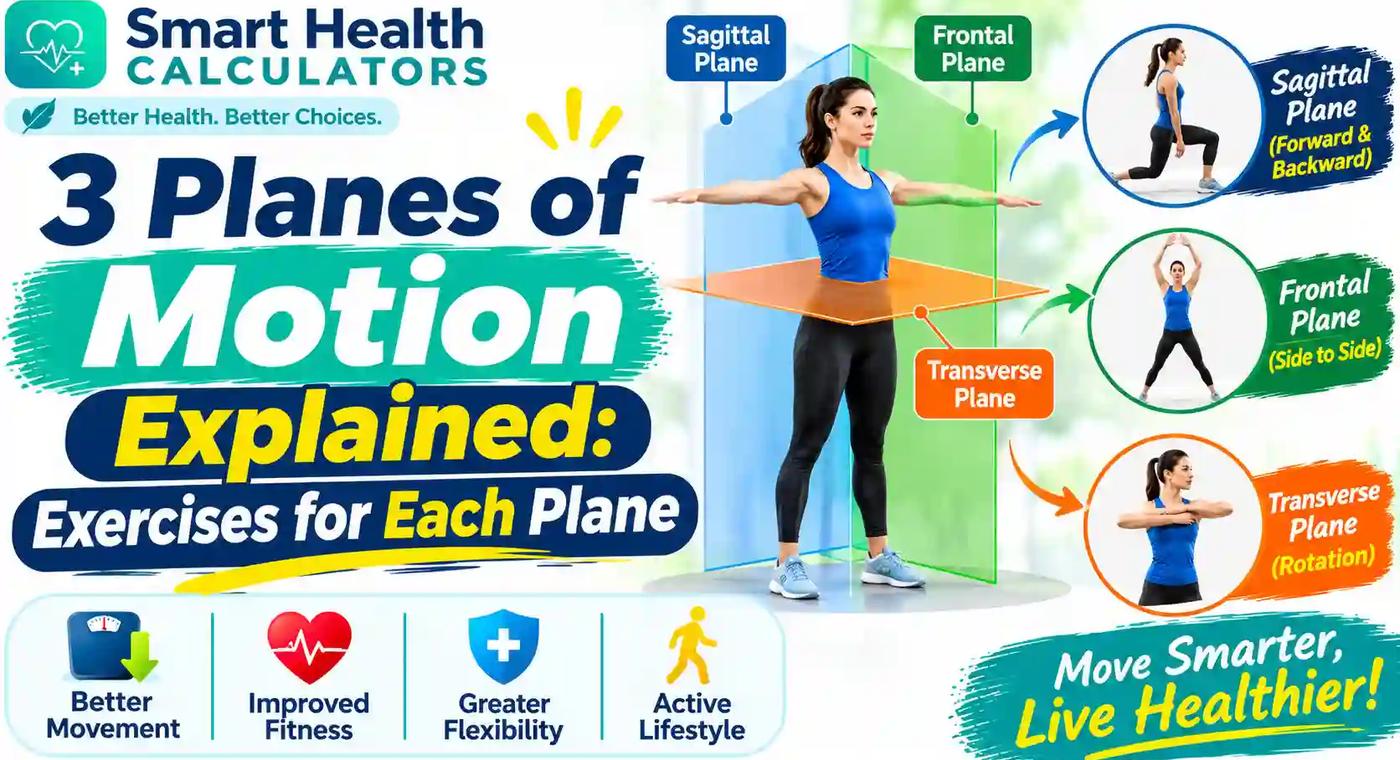
The three planes of motion are the sagittal, frontal and transverse planes. The sagittal plane describes forward-and-backward movement, the frontal plane describes side-to-side movement, and the transverse plane describes rotation. Together they give you a framework for understanding human movement and building varied workouts.
What Are Planes of Motion?
Planes of motion are imaginary flat surfaces that slice through the body and describe the direction a movement travels. Picture a sheet of glass passing through you. If your movement stays parallel to that glass, you're moving in that plane.
All three planes are defined from the anatomical position, which is the standard reference pose: standing upright, facing forward, arms at your sides with palms facing forward. Using one shared starting pose is what lets coaches, physiotherapists and researchers describe movement in the same words.
Two quick vocabulary notes will save you confusion later. The frontal plane is also called the coronal plane, and the transverse plane is sometimes called the horizontal plane. Same planes, different labels.
The planes also connect to the language of joints. Flexion and extension, abduction and adduction, and internal and external rotation are the building blocks, and each belongs mainly to one plane. We'll map them out below.
The Sagittal Plane: Forward and Backward Movement
The sagittal plane divides the body into left and right halves. Movements in this plane travel forward and backward, and the main joint actions are flexion and extension. For most people, this is the plane they train most often.
Joint Actions and Axis
When you bend your elbow in a curb or bend your knee, you're flexing. When you straighten it, you're extending. Sagittal-plane movement rotates around a mediolateral axis, an imaginary line running from one side of the body to the other, like a skewer through your hips.
Sagittal Plane Exercises
| Exercise | Why it fits the sagittal plane |
|---|---|
| Squat | Hips and knees flex and extend as you move up and down |
| Deadlift | The hip hinge moves the torso forward and back |
| Biceps curl | The elbow flexes and extends |
| Forward lunge | The legs travel front and back |
| Triceps pushdown | The elbow extends against resistance |
| Walking and running | Legs swing forward and back |
A caution on labels. Squats are primarily sagittal, not exclusively. While you move up and down, your hips, core and ankles also work to stop your knees from drifting inward and your torso from tilting. NASM makes the same point: the main movement happens in the sagittal plane while the muscles of the core and lower body stabilise the body in the other two.
Why the Sagittal Plane Dominates Gym Training
Most machines and classic barbell lifts are built around forward-and-back movement, and these exercises build strong, simple foundations. There's nothing wrong with them. The issue is only that a program made entirely of sagittal exercises can leave side-to-side and rotational control undertrained.
The Frontal Plane: Side-to-Side Movement
The frontal plane divides the body into front and back halves. Movements here travel side to side, and the key joint actions are abduction (moving a limb away from the midline) and adduction (moving it toward the midline), plus lateral flexion of the spine. Frontal-plane movement rotates around an anteroposterior axis, a line running from front to back through the body.
Frontal Plane Exercises
| Exercise | Joint action |
|---|---|
| Lateral lunge | Hip abduction and adduction |
| Lateral raise | Shoulder abduction |
| Jumping jacks | Abduction and adduction of arms and legs |
| Side shuffle | Repeated side-to-side stepping |
| Side bend | Lateral flexion of the spine |
| Banded side step | Hip abduction against a band |
Notice the side plank. It doesn't look like movement at all, but it trains your trunk to resist a sideways collapse. That's a good example of how a plane can be about control as much as motion.
Why Frontal Plane Training Gets Overlooked
Everyday life contains plenty of sideways demands, from stepping around a puddle to shifting your weight when you turn in a crowded lift. Yet side-to-side work rarely appears in beginner programs. Adding even two frontal exercises a week closes a real gap, and our guide to a 20-minute leg workout for women shows how lateral moves can slot into a short session.
The Transverse Plane: Rotation
The transverse plane divides the body into upper and lower halves. Movement here is rotational, and the main joint actions are internal and external rotation, along with trunk rotation and horizontal shoulder motion. Rotation happens around the longitudinal (vertical) axis, an imaginary pole running from the top of your head to the floor.
Transverse Plane Exercises
| Exercise | What’s happening |
|---|---|
| Cable woodchop | The trunk rotates diagonally against resistance |
| Russian twist | The torso rotates side to side |
| Medicine ball rotational throw | Power generated through hip and trunk rotation |
| Cable rotation | Controlled rotation of the trunk |
| Chest fly and reverse fly | Horizontal shoulder motion |
| Open-book stretch | Thoracic spine rotation |
Two details are worth highlighting. The Pallof press is a favourite among trainers because holding still against a rotational pull is a transverse-plane job even though nothing visibly turns. And the chest fly and reverse fly count as transverse-plane exercises because the arms sweep horizontally across the body.
Rotation in Sport and Daily Life
Any sport with a swing or throw lives in this plane. Think cricket batting, bowling, tennis, golf, javelin and badminton smashes. Daily life uses it too, whenever you turn to look behind you or lift and twist a laundry basket.
A Safety Note on Rotation
Transverse-plane exercises are often described as core work, and they're useful, but don't treat them as an automatic injury shield. Start with slow, controlled versions, keep the load light, and rotate through your hips and upper back instead of cranking the lower back. If you have back pain or a spinal condition, speak to a physiotherapist before adding loaded twisting.
Planes vs Axes: Clearing Up the Confusion
A plane is a flat surface. An axis is a line. Movement happens in a plane and around the axis that sits at a right angle to it. Mixing these up is the most common mistake in articles on this topic, so here is the pairing in one place.
| Plane | Divides the body into | Main movement | Perpendicular axis | Key joint actions |
|---|---|---|---|---|
| Sagittal | Left and right | Forward and backward | Mediolateral | Flexion, extension |
| Frontal (coronal) | Front and back | Side to side | Anteroposterior | Abduction, adduction, lateral flexion |
| Transverse (horizontal) | Top and bottom | Rotation | Longitudinal (vertical) | Internal and external rotation |
A handy memory trick: picture a door. A door swings open and shut around its hinge. The door's path sweeps through a plane, while the hinge is the axis. The hinge never lies in the plane the door moves through; it stands at right angles to it.
For deeper reading on standard anatomical terminology, the International Society of Biomechanics publishes recommendations widely used in research.
Multiplanar Movement: Why Real Exercises Rarely Stay in One Plane
Many exercises combine planes, and even single-plane moves recruit the others for balance. Calling an exercise sagittal, frontal or transverse simply identifies the dominant direction.
Walking is a good case. The legs swing forward and back (sagittal), your weight shifts from foot to foot (frontal), and the pelvis and shoulders counter-rotate (transverse). Nobody would call walking a three-plane workout, but all three planes contribute.
Some exercises are deliberately multiplanar:
| Exercise | Planes involved |
|---|---|
| Cossack squat | Frontal (side lunge) and sagittal (squat) |
| Forward lunge with torso rotation | Sagittal and transverse |
| Step-up, balance, curl to overhead press | Mostly sagittal with frontal and transverse stabilisation |
| Pallof press with arm extension | Sagittal press resisting a transverse pull |
Trainers use these combined moves to challenge coordination in more than one direction at once. They're a nice progression once the single-plane versions feel solid.
Why Train in All Three Planes?
Training in several directions helps you build well-rounded strength, balance and coordination, and it makes your workouts more varied. It mirrors how your body moves in daily life and sport.
NASM describes multiplanar training as a way to build movement competency in multiple directions, and ACE promotes similar ideas. Here's what that looks like in practice.
Better coverage. Different planes load muscles differently. Frontal-plane work calls on the hip abductors and the muscles on the sides of the trunk, while transverse work calls on the obliques and rotators.
Better balance and control. Stepping sideways or turning on one leg demands stability you don't get from a straight squat.
Sport relevance. Cutting, side-stepping, throwing and swinging are all frontal or transverse tasks.
Variety that keeps you consistent. Fresh movements make a routine more interesting, and consistency is what drives results.
What the Evidence Does and Doesn't Say
It's worth being honest here. The concept of planes is an established anatomical framework, but there is no strong evidence that multiplanar training is universally superior to traditional resistance training. Nor does it automatically prevent injury. Think of the planes as a planning tool that helps you notice gaps, not as a magic formula.
The new ACSM Position Stand on resistance training, published in 2026 as the first major update since 2009, makes a related point: for most healthy adults, consistency and effort matter more than a perfect or complicated plan. It also notes that bands, bodyweight and home-based training work well.
Myths and Mistakes to Avoid
A few ideas circulate widely and deserve a gentle correction.
"Every exercise must hit all three planes." No. A bicep curl is a perfectly good sagittal exercise, and you don't need to complicate it. The goal is to cover all three directions across your week, not inside every rep.
"Squats are only sagittal." They're mainly sagittal, with stabilising work in the other planes.
"Rotational exercises always protect your spine." There's no guarantee. Technique, load and your individual history decide how safe they are.
"Plane and axis mean the same thing." They don't. A plane is a surface and an axis is a line at right angles to it.
"Everyone should do the same loads." Adjust exercise difficulty to your fitness level and movement ability. A beginner can do lateral lunges to a shallow depth with no weight, while an experienced lifter might hold dumbbells.
"More complex means better." Often the opposite is true, especially for beginners. Master simple versions first.
A Simple Weekly Structure
Three non-consecutive days is a sensible start. You might do the full session above on Monday, Wednesday and Friday, swapping one exercise each time for variety. For instance, replace lateral lunges with banded side steps, or woodchops with cable rotations.
If you prefer a split, keep the principle the same: make sure each week includes at least a couple of frontal and a couple of transverse exercises. Our beginner weekly workout plan and the guide on how to structure a workout plan from beginner to advanced show how to lay this out across the week.
No Gym? No Problem
All three planes can be trained at home. Bodyweight squats and hip hinges cover the sagittal plane, side lunges and side planks cover the frontal plane, and bodyweight rotations and open-book stretches cover the transverse plane. A resistance band adds options like side steps and Pallof presses. See our beginner home workout plan with no equipment for a ready-made starting point, or the 30-minute workout plan for busy people if time is tight.
Fitting This Into Official Activity Guidelines
The planes help you choose which exercises to do. Health guidelines tell you how much activity to aim for overall.
The World Health Organization recommends that adults aged 18 to 64 do 150 to 300 minutes of moderate-intensity aerobic activity a week, or 75 to 150 minutes of vigorous activity, or an equivalent mix. It adds muscle-strengthening activities involving all major muscle groups on two or more days a week. The CDC's adult guidelines match this: 150 minutes of moderate activity plus two days of muscle strengthening.
These guidelines don't say anything about training each anatomical plane, so treat the planes as a way to organise your strengthening days rather than an official requirement.
What the 2026 ACSM Position Stand Adds
For healthy adults, the ACSM summary suggests the following goal-specific approaches:
| Goal | Guidance |
|---|---|
| Strength | Heavier loads around 80% of one-rep max for 2–3 sets per exercise |
| Muscle growth | Higher weekly volume, around 10 sets per muscle group |
| Power | Moderate loads of 30–70% of one-rep max, moving the weight quickly on the lifting phase |
Those are general findings, not rules for every person or every plane. The headline message is encouraging: training all major muscle groups at least twice a week, consistently, matters more than chasing a perfect plan. Our guides on how to build muscle and cardio and strength training together fill in the practical details.
How to Check Your Own Movement Quality
You don't need a lab to learn something about your movement. Film yourself from the front, the side and above (or ask a friend) doing a bodyweight squat, a side lunge and a standing trunk rotation.
From the side, watch whether your torso folds forward excessively. From the front, check whether your knees drift inward during the squat or lunge. During a trunk rotation, notice whether the movement comes from your upper back and hips or only from your lower back. Uneven range between left and right is common and worth tracking over time.
This is a self-check, not a diagnosis. If you notice pain or marked asymmetry, a physiotherapist or certified trainer can assess you properly. A qualified coach is also the best way to get a personalised program, and our article on personal trainer benefits and costs helps you decide whether it's worth it.
Progressions and Regressions
Every exercise should meet you where you are. Here is how to make the common ones easier or harder.
For the lateral lunge, start with a small step to the side and a shallow bend, then add a dumbbell held at the chest, then try a deeper range or a slow tempo. For the woodchop, begin with a light band at hip height, then move to a cable, then a diagonal low-to-high pattern. For the Pallof press, begin kneeling with a light band, progress to standing, then to a staggered or single-leg stance.
Keep one rule in mind: change one variable at a time, whether that's load, range, speed or stance. It's the simplest way to progress without overloading yourself.
Recovery, Hydration and Fuel
Training new directions can leave you with muscles that feel sore in unfamiliar places, especially the hips, sides and obliques. That's normal at first, and it usually settles within a few sessions if you started light.
Support your sessions with enough fluid and food. Our water intake for athletes and how much water before a workout guides cover hydration, while the calorie intake planner and muscle gain diet plan help with fuelling. If your goal is body composition, read about losing fat and gaining muscle together.
Who Should Be Careful?
Most healthy adults can add side-to-side and rotational exercises gradually. Take extra care, and ask a healthcare professional first, if you have back or hip pain, a joint injury, balance problems, osteoporosis, are pregnant or recovering from surgery. Our disclaimer page explains that this content is educational and not a substitute for personal medical advice.
Physical activity that needs moderate effort is safe for most people, but if something feels wrong, stop and get it checked.
Why Choose Smart Health Calculators?
Knowing the theory is one thing; turning it into a plan is another. Why choose Smart Health Calculators? Because we pair clear, source-based explanations with free tools that do the maths for you.
Use the workout planner to lay out your week, then track progress with our monthly workout planner guide. The step counter goal planner and the heart rate zone calculator guide help with your aerobic side, and our list of workout planning mistakes that slow results keeps you out of common traps. You can also explore advanced tools at Smart Health Calculators, or browse more fitness guides on our blog.
Frequently Asked Questions
What are the three planes of motion?
The sagittal, frontal and transverse planes. Sagittal covers forward-and-backward movement, frontal covers side-to-side movement, and transverse covers rotation.
What plane of motion is a squat?
A squat is primarily a sagittal-plane exercise because the hips and knees bend and straighten in a forward-and-back direction. Your core and hips also stabilise you in the frontal and transverse planes.
Are jumping jacks frontal plane movements?
Yes. The arms and legs move away from and toward the midline of the body (abduction and adduction), which happens in the frontal plane.
Is running a sagittal plane movement?
Mostly, yes. The legs swing forward and back. The pelvis and trunk also rotate slightly and shift side to side, so other planes contribute in a supporting role.
Which exercises train the transverse plane?
Cable woodchops, Russian twists, medicine ball rotational throws, cable rotations and horizontal fly movements. Pallof presses train the transverse plane by resisting rotation.
What's the difference between a plane and an axis?
A plane is a flat surface that slices through the body, while an axis is a line a movement rotates around. Each axis sits at right angles to its plane, such as the mediolateral axis for the sagittal plane.
Do I need to train all three planes in every workout?
No. Aim to include all three directions across your week. A single session can focus on one or two planes and still be a good workout.
Can beginners do rotational exercises safely?
Usually yes, if they start light and slow, and rotate through the hips and upper back. Anyone with back pain or a spinal condition should get advice from a physiotherapist first.
Your Next Steps
Start small. This week, pick one frontal exercise and one transverse exercise you haven't tried, and add them to a session you already do. Keep the loads light, move with control and note how each side feels.
Then build from there: plan your week with the workout planner, check your calorie needs with the BMR calculator, and revisit this guide when you want new exercise ideas. If you've got a question about your own routine, contact our team.
Medical Disclaimer
This article is for general education only. It is not medical advice, diagnosis, treatment, prescription guidance, or a replacement for professional healthcare. Speak with a qualified healthcare professional for personal medical concerns, symptoms, pregnancy concerns, mental health crisis, medication questions, or before making major health changes.