Calories in Roti, Rice & Corn: Chart Per 100g
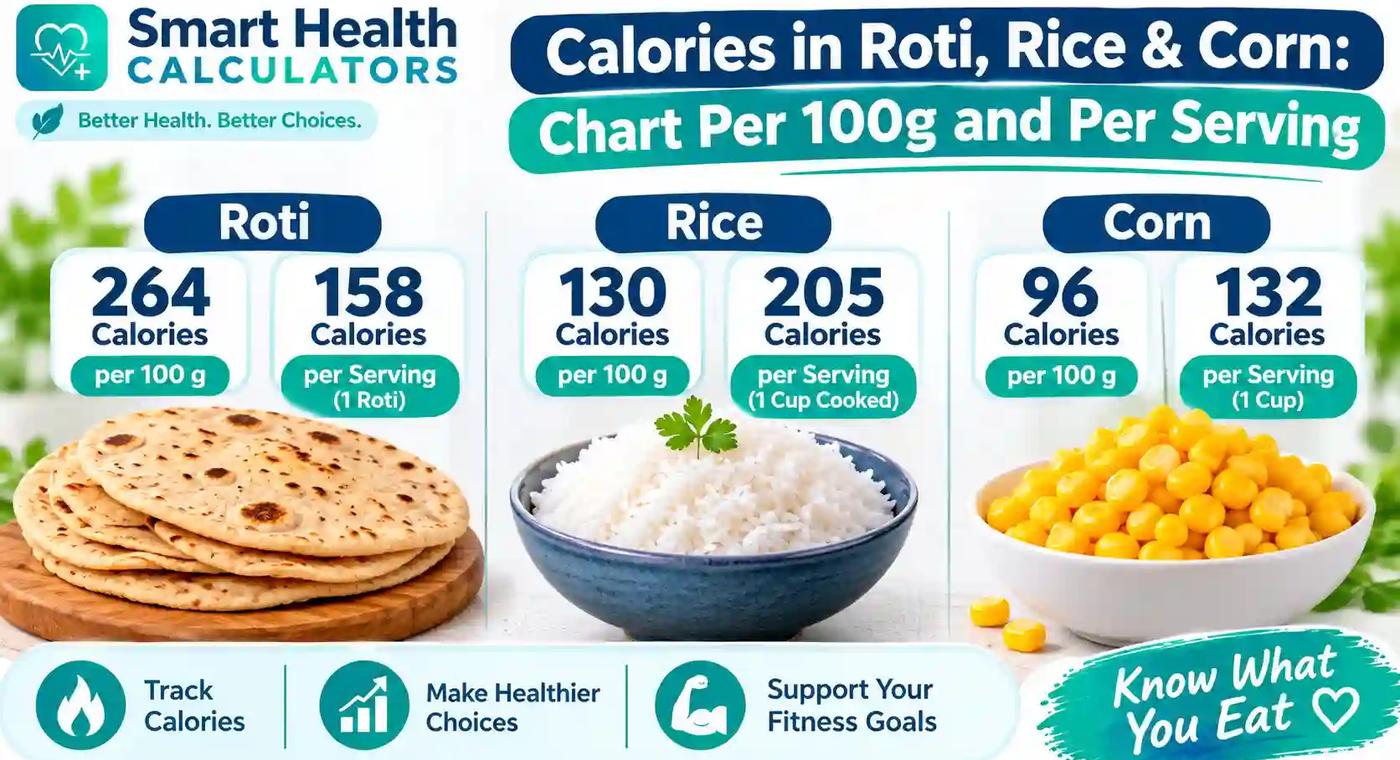
One medium roti has about 135 calories, a cup of cooked rice 205, and a corn cob 100. See the full chart with carbs, protein and fiber per serving.
You're at the dinner table with a roti, a scoop of rice, and a few spoonfuls of corn salad. You open a calorie app, and suddenly you're guessing. Is a roti a "small" or "medium" one? Is a bowl of rice one cup or two? Does the app mean cooked or uncooked?
This guide answers those questions with USDA-based numbers, clear serving sizes, and two charts you can bookmark. It also shows how to adjust for homemade roti, how raw and cooked rice differ, and how butter or ghee changes the total.
Calories in Roti, Rice, and Corn
One medium whole wheat roti (about 40g of flour) has roughly 135 calories. One cup of cooked white rice has about 205 calories. One medium boiled corn cob has about 100 calories. Per 100g of cooked food, roti has about 240 calories, white rice about 130, and boiled sweet corn about 96.
Those per-100g figures look very different, but most of the gap is water. Rice and corn are heavy with it, while roti is a baked dough with far less. That's why comparing by portion is usually more useful than comparing by weight.
The Master Chart: Roti, Rice, and Corn Per 100g
All values are for plain food with no added oil, ghee, butter, or salt. Each row states whether the food is cooked or raw.
| Food (state) | Calories | Protein | Carbs | Fat | Fiber |
|---|---|---|---|---|---|
| Whole wheat flour (raw) | ~340 | 13.2g | 72g | 2.5g | 10.7g |
| Whole wheat roti, homemade (cooked, estimate) | ~240 | ~9g | ~50g | ~1.7g | ~7g |
| White rice, long-grain (raw) | ~365 | 7.1g | 80g | 0.7g | 1.3g |
| White rice, long-grain (cooked) | ~130 | 2.7g | 28g | 0.3g | 0.4g |
| Brown rice, long-grain (cooked) | ~123 | 2.7g | 25.6g | 1.0g | 1.6g |
| Sweet corn, yellow (raw) | ~86 | 3.3g | 19g | 1.4g | 2.0g |
| Sweet corn, yellow (boiled kernels) | ~96 | 3.4g | 21g | 1.5g | 2.4g |
| Corn tortilla | ~218 | 5.7g | 45g | 2.9g | 6.3g |
Most rows come from USDA FoodData Central records. The homemade roti row is my own estimate from whole wheat flour, because no standard database record matches a plain, home-cooked roti exactly. You can check any row in USDA FoodData Central, the official government database behind most nutrition apps.
The Per-Serving Chart: What You Actually Eat
| Serving | Calories | Protein | Carbs | Fiber |
|---|---|---|---|---|
| 1 small roti (25g flour) | ~85 | 3.3g | 18g | 2.7g |
| 1 medium roti (40g flour) | ~135 | 5.3g | 29g | 4.3g |
| 1 large roti (50g flour) | ~170 | 6.6g | 36g | 5.4g |
| ½ cup cooked white rice (~80g) | ~105 | 2.2g | 22g | 0.3g |
| 1 cup cooked white rice (~158g) | ~205 | 4.3g | 44.5g | 0.6g |
| 1 cup cooked brown rice (~195g) | ~215–240 | ~5g | 45–50g | ~3g |
| 1 cup boiled corn kernels (~155g) | ~150 | 5g | 33g | 3.7g |
Numbers are rounded. Your own roti, rice, and corn will vary with size, variety, and cooking method.
How to Read Any Calorie Chart Without Getting Misled
Three details cause most calorie-counting mistakes. Check them before you trust a number.
- Cooked or uncooked? Rice and flour absorb water as they cook, so the same food has very different calories per 100g in each state.
- What's the serving? "One roti" and "one bowl" mean different things to different people. Grams are more reliable than household measures.
- What was added? Ghee, oil, butter, and salt change the total. A plain entry won't include them.
When a source doesn't state any of these, treat its number as a rough guide. That's why every row in the charts above is labeled.
Calories in Roti (Chapati): Size Is Everything
Roti is the hardest of the three foods to pin down, because no two homemade rotis weigh the same. A thin 6-inch chapati and a thick 9-inch family roti can differ by more than double.
The Flour-Weight Method
Water in the dough adds no calories, so the calories in a plain roti come almost entirely from the flour. Whole wheat flour has about 3.4 calories per gram. The formula is:
Roti calories ≈ grams of dry flour × 3.4
Weigh the flour before kneading, then divide by the number of rotis you make. If you use 400g of flour for 10 rotis, each roti has about 40g of flour, or roughly 135 calories.
Roti Calories by Size
Here's how the formula plays out for common sizes:
- Small (6-inch, about 25g flour): around 85 calories, 3.3g protein, 2.7g fiber
- Medium (7–8 inch, about 40g flour): around 135 calories, 5.3g protein, 4.3g fiber
- Large (9-inch, about 50g flour): around 170 calories, 6.6g protein, 5.4g fiber
- Extra-large (restaurant or family-style, about 60g flour): around 205 calories, 7.9g protein, 6.4g fiber
A medium cooked roti typically weighs 55–60g. If you only have a kitchen scale and a finished roti, a 58g roti sits near 135 calories.
How Many Calories Are in Two Rotis?
Two medium whole wheat rotis come to roughly 270 calories, 58g of carbohydrates, 10–11g of protein, and about 8–9g of fiber. For many people that's a typical dinner portion. Three would be about 405 calories.
Roti With Ghee, Oil, or Butter
Plain is the baseline. Fat changes the picture quickly.
- A thin smear of ghee or butter (about 1 teaspoon): roughly 40–45 calories
- 1 tablespoon of ghee or butter: about 100–120 calories
- Paratha: often made with several teaspoons of fat in and on the dough, so it can easily land at 200–300+ calories depending on size and fat used
- Roti cooked directly on a dry tawa or flame: no added fat
A roti brushed with ghee is no problem for most diets. It just needs to be in the log. For tracking basics, see our guide on how to count calories.
Homemade Roti vs Packaged Chapati
Packaged chapati often contains added oil, salt, and sometimes preservatives or refined flour, so its calories per 100g tend to run higher than a dry-cooked homemade roti. Commercially prepared plain chapati is often listed at roughly 297 calories per 100g, compared with about 240 for the homemade estimate above. If you buy frozen or packaged roti, trust the label over any generic chart.
Whole Wheat Roti vs Refined Flour
Whole wheat flour (atta) keeps the bran and germ, which gives it more fiber (about 10.7g per 100g) than refined white flour (about 2.7g per 100g). Calories are similar, so the difference shows up in fiber, micronutrients, and how filling the roti feels. Our guides on dietary fiber intake and high-fiber foods explain why that matters.
Roti vs Naan vs Tortilla
Naan is usually richer, at roughly 310 calories per 100g, because it's made with refined flour, yogurt, and often oil or butter. A restaurant naan also weighs around 90g, so a single piece lands near 260 calories, almost double a medium roti.
A flour tortilla runs about 300–320 calories per 100g, which means an 8-inch one is roughly 150 calories. A corn tortilla is the lightest per piece at about 57 calories for a 6-inch one, though its density per 100g (about 218) is close to roti's.
Calories in Rice: White, Brown, Basmati, and Jasmine
Rice is the staple where the raw-versus-cooked question matters most. A cup of raw rice and a cup of cooked rice are very different amounts of food.
Cooked Rice Calories Per 100g
- White, long-grain: about 130 calories, 2.7g protein, 28g carbs, 0.4g fiber
- Brown, long-grain: about 123 calories, 2.7g protein, 25.6g carbs, 1.6g fiber
- Brown, medium-grain: about 111 calories, 2.6g protein, 23g carbs, 1.8g fiber
- Basmati and jasmine: roughly 120–150 calories, depending on brand and how much water was used
Basmati and jasmine don't have one universal value, because different brands cook with different amounts of water. For those two, follow the nutrition label on your packet.
Calories in One Cup of Cooked Rice
One cup of cooked white rice (about 158g) provides roughly 205 calories, 4.3g of protein, 44.5g of carbohydrates, and almost no fat. One cup of cooked brown rice (about 195g) provides about 215–240 calories, depending on the grain length, with around 3g of fiber.
Notice that a cup of brown rice can have a bit more energy than a cup of white. A cup of brown rice weighs more, and the per-100g values are close. The real difference is fiber and micronutrients, not a big calorie saving.
A Bowl of Rice: Why Sizes Vary
A "bowl" is not a unit. A small cereal bowl might hold 150g of cooked rice. A restaurant plate often holds 300g or more. Here's roughly how that translates for cooked white rice:
- Small serving (½ cup, ~80g): about 105 calories
- Standard (1 cup, ~158g): about 205 calories
- Home bowl (~200g): about 260 calories
- Large restaurant portion (~300g): about 390 calories
- Biryani or pulao plate, rice only (~350g): about 455 calories
Rice in a biryani also carries oil, ghee, and meat fat, so the plate total will be higher.
Raw Rice vs Cooked Rice Calories
Raw white rice has about 365 calories per 100g. Cooked white rice has about 130. Same grain, different amounts of water.
When rice cooks, it absorbs water and swells to roughly 2.7–3 times its raw weight. So:
- 100g raw rice is about 365 calories and turns into about 280g cooked.
- 100g cooked rice comes from about 36g raw.
- Calories don't change in the pot. Only the weight does.
That's the same principle behind our article on chicken breast calories raw vs cooked, where chicken loses water and rice gains it.
Should I Count Rice Before or After Cooking?
Both methods work if you pair them with the matching database entry.
- Weigh dry rice and log "rice, raw." This is the most consistent method, since you don't depend on how much water your rice absorbed.
- Weigh cooked rice and log "rice, cooked." This works well for leftovers and restaurant meals.
The mistake to avoid is weighing cooked rice and logging it as raw. A 200g portion would appear as 730 calories instead of about 260.
White Rice vs Brown Rice
Brown rice runs about 111–123 calories per 100g cooked, against 130 for white. It keeps the bran and germ, so it delivers more fiber (1.6–1.8g versus 0.4g) and more minerals, with a chewier, nuttier texture. White rice is softer, lighter, and easier to digest for some people.
Neither is automatically "good" or "bad," and both fit a balanced diet. For the Harvard School of Public Health's view of whole grains, see The Nutrition Source on whole grains.
Meal-Prep Rice Example
Say you cook 300g of dry white rice for the week.
- Total calories: 300 × 3.65 ≈ 1,095 calories
- Cooked weight: about 840g
- Split into 6 equal portions, each is 140g cooked, about 182 calories
No guesswork. The raw total sets the calories, and the cooked weight just tells you how to split it.
Calories in Corn: Boiled, Raw, and On the Cob
Corn sits between a vegetable and a grain, which is part of why people struggle to place it in a meal plan. Nutritionally, sweet corn is a starchy vegetable. It has less starch and fewer calories than rice or roti.
Sweet Corn Calories Per 100g
- Raw sweet corn: about 86 calories
- Boiled kernels, no salt or butter: about 96 calories
- Protein: around 3.3–3.4g
- Fiber: around 2.0–2.4g
Cooking sweet corn slightly increases the calories per 100g because boiling softens the kernel and removes a little moisture, but the difference is small.
Calories in One Corn Cob
A medium ear of boiled sweet corn provides roughly 100 calories, which is about 100g of edible kernels, with 3–4g of protein and 2–3g of fiber. Ears vary widely. A small cob might be 70–80 calories, and a large one can pass 130.
The cob itself isn't eaten, so weigh the kernels or use an ear-sized entry to avoid counting the core.
Boiled vs Steamed vs Roasted Corn
Cooking method barely moves the needle:
- Raw: about 86 calories per 100g
- Boiled or steamed (plain): about 96, with steaming keeping a bit more flavor and water-soluble nutrients
- Roasted or grilled (plain): about 100–110, since some moisture loss concentrates calories slightly
- Buttered or street-style with butter, mayo, cheese, or masala: 150–250+ depending on the toppings
Toppings do the real damage. One tablespoon of butter adds about 100 calories, so a corn on the cob with butter can double the calories of the plain ear.
Corn Kernels vs Corn on the Cob
Calories per 100g are the same, but the portion size isn't. A cup of loose kernels (about 155g) delivers about 150 calories and goes quickly when you're snacking. A cob takes longer to eat, which slows you down.
Corn Tortillas and Cornmeal
Corn tortillas are made from nixtamalized corn flour (masa), which is much denser than fresh kernels. At about 218 calories per 100g, they sit close to roti, though each tortilla is smaller. A single 6-inch tortilla is around 57 calories.
Roti vs Rice vs Corn: Which Has More Calories?
It depends on how you compare them.
Per 100g of Cooked Food
Roti (~240) is higher than rice (~130), which is higher than boiled corn (~96). That's a ranking by density. Roti has less water, so each gram carries more calories.
Per Typical Portion
At a typical dinner portion, two medium rotis (about 270 calories) have more than one cup of cooked white rice (about 205). Brown rice sits around 215–240 per cup. A medium corn cob has the fewest at about 100, but it's also a much smaller serving.
Per Gram of Dry Ingredient
Here's an angle few charts mention. Compare the dry ingredients: whole wheat flour has about 340 calories per 100g, and raw white rice has about 365. They're nearly identical.
The difference at the table comes from how much water each food holds and how big your portion is, not from rice being "fattening" or roti being "light."
Which Has More Carbohydrates, Roti or Rice?
Per typical portion, two rotis (58g) have more carbs than a cup of rice (44.5g). Per 100g cooked, roti has about 50g and rice about 28g. Roti also carries much more fiber, which is why it tends to feel more filling.
Which Has More Protein and Fiber?
Whole wheat roti wins on both. Two rotis give you about 10–11g of protein and 8–9g of fiber, compared with about 4g and 0.6g for a cup of white rice. Corn lands in between. For protein-focused meals, see the most protein-rich foods ranked and our guide on how much protein you need per day.
Is Corn Healthier Than Rice?
Corn offers more fiber and fewer calories per 100g than white rice, plus some carotenoids like lutein. White rice is easier to eat in larger quantities and is gentler on sensitive stomachs. "Healthier" depends on your goal, your portion, and what else is on the plate. A mix of staples is usually a stronger approach than relying on one.
Glycemic Index, Fiber, and How Full You Feel
Calories are only part of the story. Two foods with equal calories can behave differently after you eat them.
What Glycemic Index Tells You
The glycemic index (GI) ranks how quickly a carbohydrate food raises blood sugar. Values depend on the variety, how long it's cooked, and what you eat it with, so there's no single number for "rice" or "roti."
General patterns:
- Whole wheat roti is typically gentler than refined flour flatbreads because of its fiber.
- Basmati rice tends to rank lower than jasmine or sticky rice varieties.
- Brown rice is typically a little lower than white rice.
- Sweet corn generally sits in the lower-to-medium range.
- Cooled and reheated rice develops more resistant starch, which can lower its impact on blood sugar.
If you're managing blood sugar for a medical reason, work with a registered dietitian or doctor rather than relying on a chart. The Academy of Nutrition and Dietetics has a directory of professionals.
Fiber and Fullness
Fiber slows digestion and adds bulk. Of the three foods here, whole wheat roti packs the most per serving, brown rice and corn follow, and white rice has the least. Pairing white rice with vegetables, lentils, or yogurt can offset that.
Portion Control: How to Measure Roti, Rice, and Corn Accurately
You don't need to weigh every meal forever. A short calibration period teaches your eye what a real portion looks like.
A Simple Weighing Routine
- Roti: weigh the dry flour before kneading and divide by the number of rotis. Or weigh one finished roti and match it to the size guide above.
- Rice: weigh dry rice, or weigh cooked rice and use a cooked-rice entry.
- Corn: weigh the kernels without the cob, or count a cob as about 100 calories.
- Fat: measure ghee, oil, or butter with a teaspoon, not a free pour.
Hand and Plate Estimates
If you don't have a scale:
- One cup of cooked rice is roughly a tight fist.
- A ½ cup serving is about half that, or a cupped palm.
- A medium roti is about the size of a small side plate, with a thickness of about 2–3 mm.
These are estimates, so treat them as a starting point. The FDA's guide to the Nutrition Facts label explains how serving sizes work on packaged foods, including the difference between a serving and a portion.
Building a Balanced Plate
The U.S. MyPlate guidance suggests filling about half your plate with fruits and vegetables, with the rest split between grains and protein. The Dietary Guidelines for Americans encourage making at least half of your grains whole grains, which supports choosing whole wheat roti and brown rice for at least some meals. Check the current edition for exact wording.
For ready-made structures, our whole foods diet guide and DASH diet overview show how staples like these fit into a full day.
Real-World Examples
Example 1: A Typical Pakistani or Indian Home Dinner
Ayesha eats two medium rotis, half a cup of rice, and half a cup of boiled corn in a salad.
- 2 rotis: ~270 calories
- ½ cup cooked rice: ~105 calories
- ½ cup corn: ~75 calories
- Total staples: about 450 calories
Curries, dal, and yogurt come on top. She'd log them separately.
Example 2: The Restaurant Rice Surprise
Omar orders chicken biryani and assumes the rice is "one cup." The plate holds about 350g of cooked rice.
- Rice alone: 350g × 1.30 ≈ 455 calories
- Oil, ghee, and meat fat add more
He's not overeating by any normal standard. He's just underestimating a portion that's more than twice what he logged.
Example 3: The Roti Tracker
Nadia makes 8 rotis from 480g of flour.
- 480g ÷ 8 = 60g of flour per roti
- 60 × 3.4 ≈ 205 calories per roti
Her rotis are extra-large. If she'd logged them as "1 roti = 100 calories" in an app, she'd be undercounting by half at every meal.
Example 4: The Weekend Corn Snack
Sam buys street-style corn on the cob with butter, lime, and chili.
- Plain cob: ~100 calories
- Butter, about 1 tablespoon: ~100 calories
- Total: roughly 200 calories
A reasonable snack. It just isn't the 100 calories the plain-corn entry would suggest.
Are Roti, Rice, and Corn Good for Weight Management?
No staple food causes weight gain or weight loss by itself. Your total calorie intake over time, your activity, sleep, and medical factors matter far more than any single food.
What staples can do is help or hinder portion control:
- High-fiber choices (whole wheat roti, brown rice, corn) tend to be more filling per calorie.
- Refined and fried versions (naan, fried rice, buttered corn) make it easier to overshoot.
- Portion awareness matters more than which grain you choose.
If you want to know how many calories you need in the first place, start with the BMR calculator and our TDEE calculator guide. Then read recommended calorie intake per day and calorie intake vs. calories burned to set a realistic target. The CDC's healthy weight resources and the NIDDK offer additional guidance. For a broader plan, see our weight loss strategies.
Sometimes the plan isn't working even though the numbers look right. Our article on why your diet is not working covers the common reasons.
Common Mistakes When Counting Staple Food Calories
- Logging cooked rice against a raw entry, or the reverse
- Assuming every roti is "one roti" regardless of size
- Forgetting ghee, oil, butter, or masala
- Counting the corn cob's weight instead of the kernels
- Using a user-created app entry with no source
- Mixing grams, cups, and "bowls" in the same day
- Treating a number from one site as universal without checking if it's cooked or raw
One habit fixes most of these: log what you weighed, in the state you weighed it.
Tools to Make Calorie Tracking Easier
You don't have to do this math from scratch every day.
- Set a daily target with the calorie intake planner.
- Turn that target into a meal structure with the diet plan generator.
- Learn how to split calories between carbs, protein, and fat in the macro calculator guide.
- Use the MyFitnessPal macro calculator walkthrough if you track in an app.
- Read the calorie calculator guide for the fundamentals.
- If budget is a concern, staples like these are the core of a low-budget diet plan.
Why Choose Smart Health Calculators?
Charts like this one tell you what's in your food. Applying them to your own body and goals is the next step, and that's where Smart Health Calculators helps.
- Free tools built for real decisions: calorie planning, BMR, body fat, hydration, workouts, and more in one place
- Guides that explain the math: each tool has supporting articles so you understand the result, not just the number
- Practical, source-aware content: we point to USDA, FDA, and public health sources rather than guessing
- Clear limits: our disclaimer states that our tools support education and planning, not medical diagnosis
You can read more about us or explore advanced tools at Smart Health Calculators to build a full plan around the foods you actually eat.
Ready for the next step? Book a seat at Advance Free Tools offered by Smart Health Calculators, and turn this chart into a complete nutrition routine.
Frequently Asked Questions
How many calories are in one roti?
A medium whole wheat roti (about 40g of flour) has roughly 135 calories. Small ones are about 85 calories, and large ones about 170. Add about 40–45 calories for each teaspoon of ghee or oil.
How many calories are in one cup of cooked rice?
One cup of cooked white rice (about 158g) has roughly 205 calories. One cup of cooked brown rice has about 215–240 calories, depending on the grain.
How many calories are in one medium corn cob?
A medium boiled corn cob has about 100 calories. A small one is around 70–80 calories, and a large one can exceed 130. Butter adds about 100 calories per tablespoon.
Is roti lower in calories than rice?
It depends on the portion. Per 100g, roti has more calories (about 240 versus 130) because rice is mostly water. At a typical meal, two rotis (about 270 calories) have more than one cup of rice (about 205 calories).
Does brown rice have fewer calories than white rice?
Slightly fewer per 100g (about 111–123 versus 130), but a cup of brown rice often has similar or higher calories because it weighs more. The bigger difference is fiber, which is higher in brown rice.
How many calories are in 100 grams of cooked rice?
About 130 calories for cooked white long-grain rice, and about 111–123 for cooked brown rice.
Should I count rice calories before or after cooking?
Either works, as long as the database entry matches. Weighing dry rice is more consistent. If you weigh cooked rice, use a cooked-rice entry.
Does adding butter increase corn calories?
Yes. A plain medium cob is about 100 calories, and one tablespoon of butter adds roughly 100 more.
Which has more carbohydrates, roti or rice?
Two medium rotis have about 58g of carbohydrates, compared with about 44.5g in one cup of cooked white rice. Roti also has far more fiber.
Is corn healthier than rice?
Corn has fewer calories per 100g and more fiber than white rice. Neither is universally healthier. Portion size, preparation, and the rest of your plate matter more.
Conclusion:
Roti, rice, and corn aren't "good" or "bad." They differ in density, fiber, and portion habits. A medium roti is about 135 calories, a cup of cooked white rice about 205, and a boiled corn cob about 100. The rest depends on how much you actually eat and what you add.
Do this next:
- Weigh your flour or rice once and work out your own roti size and rice portion.
- Use the matching entry (raw or cooked) in your tracking app.
- Log ghee, oil, and butter as separate items.
- Pick whole grains like whole wheat roti and brown rice for some meals to boost fiber.
- Set a daily target with the calorie intake planner, then build meals around it with the diet plan generator.
- Check labels on packaged chapati, tortillas, and frozen corn, since they differ from homemade.
Medical Disclaimer
This article is for general education only. It is not medical advice, diagnosis, treatment, prescription guidance, or a replacement for professional healthcare. Speak with a qualified healthcare professional for personal medical concerns, symptoms, pregnancy concerns, mental health crisis, medication questions, or before making major health changes.