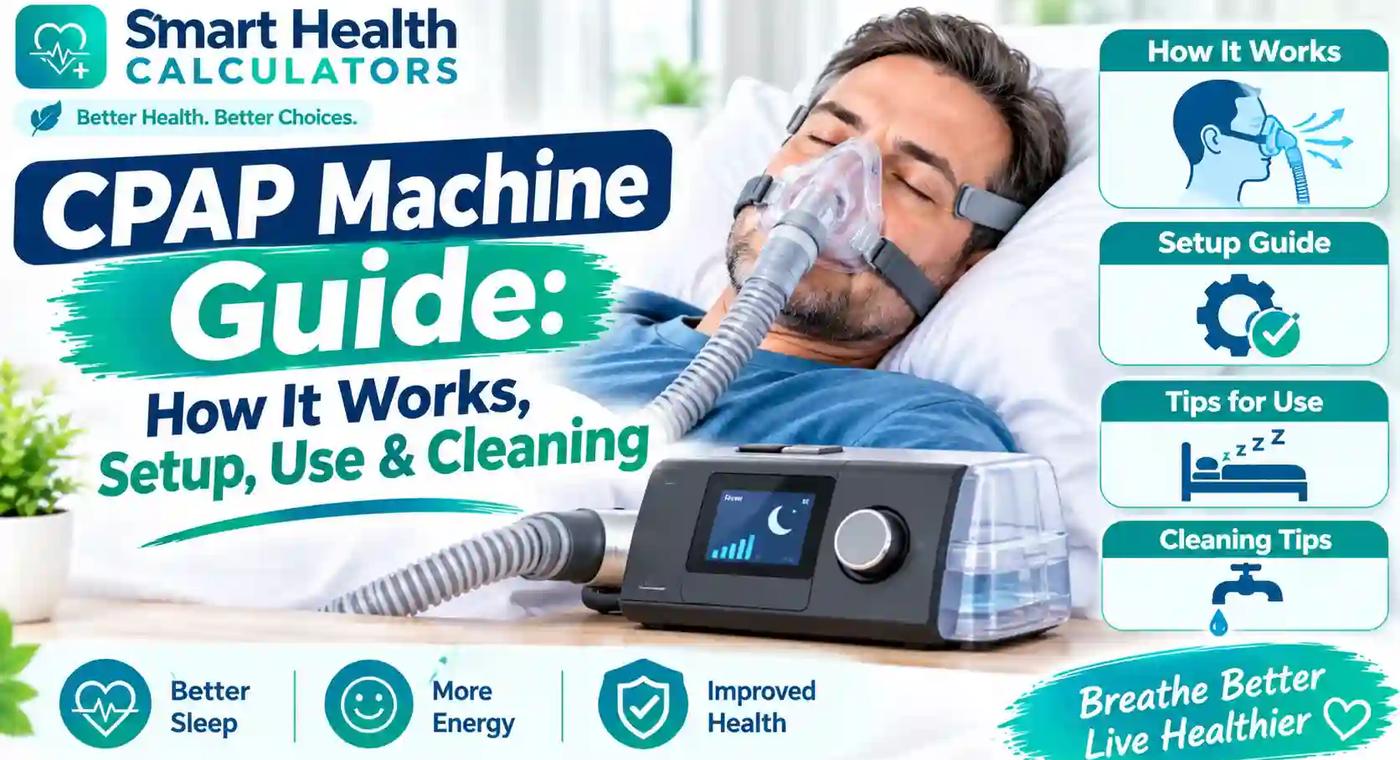
CPAP Machine Guide: How It Works, Setup, Use & Cleaning
New to CPAP? Learn how a CPAP machine works, how to set it up, choose a mask, clean it, and fix leaks, dry mouth, and other common problems.
You wake up exhausted after a full night in bed. Your partner says you snore, and sometimes stop breathing. A sleep study confirms obstructive sleep apnea, and your doctor prescribes a CPAP machine. Then you unbox a device with a mask, a hose, and a water tank, and you wonder how anyone sleeps in that.
This guide explains what CPAP is, how it works, who needs it, how to set it up and use it step by step, how to clean it, and how to solve the common problems that make people quit. Your pressure settings and equipment must come from your clinician, so use this guide to understand the process, not to replace their advice. For a wider look at sleep, you can also try our Sleep Quality Checker.
What Is a CPAP Machine and How Does It Work?
A CPAP (continuous positive airway pressure) machine delivers a steady flow of pressurized air through a hose and mask to keep your upper airway open while you sleep. This reduces the breathing pauses caused by obstructive sleep apnea. The air does not add oxygen. It works like an air splint that stops the throat from collapsing.
The short answers:
- Who needs it? People diagnosed with obstructive sleep apnea, usually after a sleep study, and prescribed PAP therapy by a clinician.
- Do I need a prescription? In most countries, yes. The pressure must be set for you.
- How long should I use it? As many hours of sleep as you can, every night. Ask your clinician about your target. Insurers may set their own minimums.
- Does it cure sleep apnea? No. It controls breathing events while you use it.
- Is it the same as an oxygen machine? No. CPAP pushes room air, not extra oxygen.
What Is Sleep Apnea, and Why Does CPAP Help?
Obstructive sleep apnea (OSA) happens when the muscles and tissues at the back of your throat relax during sleep and block the airway. Breathing pauses (apneas) or becomes shallow (hypopneas), your oxygen can dip, and your brain briefly wakes you to restart breathing. You usually don't remember these awakenings, but they fragment your sleep.
Common signs include loud snoring, gasping at night, morning headaches, daytime sleepiness, trouble concentrating, and a dry mouth. Sleep apnea is also linked with high blood pressure, so if you have one condition, read our guides on high blood pressure symptoms, causes and treatment and how to lower blood pressure naturally.
The National Heart, Lung, and Blood Institute (NHLBI) explains that CPAP uses mild air pressure to keep the airways open during sleep. The American Academy of Sleep Medicine recommends that PAP treatment be based on an objective diagnosis of sleep apnea, followed by monitoring of how well the treatment works and how much you use it.
How Sleep Apnea Is Diagnosed
Doctors diagnose sleep apnea with a sleep study:
- Polysomnography (PSG): an overnight test in a sleep lab that records breathing, oxygen, heart rhythm, and sleep stages.
- Home sleep apnea test (HSAT): a simpler device you use at home, suited to some adults with a high chance of moderate to severe obstructive sleep apnea.
The key measurement is the apnea-hypopnea index (AHI), the number of breathing events per hour of sleep. Your clinician interprets it and decides whether CPAP is appropriate. Do not buy a machine and guess your own settings.
How Does a CPAP Machine Work?
Think of the machine as a quiet, small blower connected to a mask.
- The machine draws in room air through a filter.
- It pressurizes the air to the level your clinician prescribed, measured in centimeters of water pressure (cmH2O).
- The air travels through the tubing to your mask.
- The mask delivers the air to your nose, or your nose and mouth.
- The steady pressure acts as an air splint, holding the soft tissues of your throat open so air can pass.
- Small vents in the mask let the air you breathe out escape.
Because the pressure is continuous, your airway stays open on both the in-breath and the out-breath. Many machines also include features such as a ramp (starts at low pressure and rises slowly while you fall asleep) and expiratory pressure relief (lowers pressure slightly as you breathe out for comfort).
What CPAP Does Not Do
- It does not provide extra oxygen.
- It does not permanently fix the airway.
- It only works on the nights you use it.
Main Parts of a CPAP Machine
Knowing the parts makes setup and cleaning much easier.
- Machine (flow generator): the unit with the motor and display.
- Mask (interface): the part that sits on your face.
- Headgear: straps that hold the mask in place.
- Tubing: the hose connecting machine to mask. Some are heated to reduce condensation.
- Humidifier chamber: a water tank that warms and moistens the air.
- Air filter: keeps dust and pollen out of the airflow.
- Power supply and, for some models, a data card or app that records your use.
Types of CPAP Masks
Mask fit is the biggest factor in comfort. The right style depends on how you breathe, how you sleep, and what your face shape is.
Nasal Pillows
Small soft inserts sit at the entrance of your nostrils. They are light, leave your field of view open, and often suit people who feel claustrophobic or sleep with glasses on or a book in hand. Some people find the airflow too direct.
Nasal Masks
A small cushion covers the nose. They suit many sleepers, work well at higher pressures, and sit comfortably for side sleepers. They need you to keep your mouth closed or use a chin strap if you breathe through your mouth.
Full Face Masks
A cushion covers the nose and mouth. These suit people who breathe through their mouth, have frequent nasal blockage, or need higher pressures. They are bulkier and can leak more if poorly fitted.
How to Choose
- Mouth breather? A full face mask is often the starting point.
- Side sleeper? Look for a low-profile nasal or pillows design.
- Claustrophobic? Try nasal pillows.
- Facial hair or sensitive skin? Ask a fitting specialist about cushion materials and styles.
Most suppliers and sleep clinics will fit you with a mask and let you swap if it doesn't work. Your clinician or a trained technologist can help.
Which Type of PAP Machine Do You Need?
The word "CPAP" is often used as a general term, but there are related devices. Your clinician chooses.
- CPAP: delivers one fixed pressure all night.
- APAP (auto-adjusting): adjusts the pressure within a range as your needs change during the night.
- BiPAP (bilevel): delivers a higher pressure when you breathe in and a lower pressure when you breathe out. It is used for some people who need more support or have other breathing conditions.
- ASV (adaptive servo-ventilation): a specialized device for certain central or complex sleep apnea problems.
These are prescribed for different needs, so don't switch between them on your own. If a device feels wrong, tell your clinician rather than changing it yourself.
How to Set Up a CPAP Machine
Always follow your device's manual first, because details differ between models. The steps below cover the common process.
Step 1: Choose a Good Spot
Place the machine on a stable surface near your bed, at or below head level. Keep it away from heat sources, and leave space around it for air intake.
Step 2: Fill the Humidifier
Use the water type your manufacturer recommends. Many manufacturers advise distilled water to reduce mineral buildup. Don't overfill, and never run the machine with water above the maximum line.
Step 3: Connect the Tubing
Attach one end of the tubing to the machine's air outlet and the other end to the mask. If you have heated tubing, connect the electrical end too.
Step 4: Check the Filter
Make sure the filter is in place and clean. A missing filter lets dust into the machine.
Step 5: Plug In and Check the Settings
Plug the machine into power. Your clinician or supplier normally sets the prescribed pressure. Don't change your pressure settings unless your prescriber tells you to.
Step 6: Set Comfort Features
Ask your clinician about ramp time, humidity level, and tubing temperature. These are often adjustable without changing your treatment pressure.
How to Use a CPAP Machine Step by Step
Once everything is set up, a nightly routine takes a few minutes.
- Wash your face so oils don't break the mask seal.
- Check the water level and the tubing connections.
- Adjust the headgear loosely. Put the mask on, then tighten the straps evenly and only as much as needed. Over-tightening causes marks and leaks.
- Lie in your usual sleep position and turn the machine on.
- Breathe normally. Let the air come to you. Fighting it makes it feel stronger.
- Use the ramp feature if you have one, so the pressure rises while you drift off.
- If the mask leaks, sit up, loosen the straps slightly, reseat the cushion, and retighten gently.
- In the morning, remove the mask, turn off the machine, and empty the water chamber.
Tips for Your First Nights
- Wear the mask for short periods while awake, watching TV or reading, before bedtime.
- Start with a small goal, such as using it for part of every night, and build up.
- Keep a simple log of how long you used it and what bothered you, and share it with your care team.
- Don't give up after one bad night. Most people need a few weeks to adjust.
How Many Hours Should You Use CPAP Each Night?
The best answer is: every time you sleep, including naps. CPAP only works while you wear it.
In the United States, Medicare has a coverage rule often described as using the machine at least four hours a night on 70% of nights during a 30-day period in the first three months. That is an insurance requirement, not a medical target for everyone. More use usually means better control of symptoms, and your clinician can tell you what is right for you. Check the current rules on the CMS website and the Medicare CPAP coverage page, because requirements vary by country and insurer.
Benefits of CPAP Therapy
When used consistently, CPAP can help many people with obstructive sleep apnea. Possible benefits include:
- Fewer breathing pauses during sleep
- Less snoring
- Better sleep quality and less daytime sleepiness
- Improved concentration and mood
- Support for heart and blood pressure health when sleep apnea is a contributing factor
How much benefit you get depends on your health, how well the mask fits, and how consistently you use it. Pair it with healthy habits such as better sleep hygiene, a calming nighttime routine, and attention to your weight, since weight can affect sleep apnea. You can check your baseline with the BMI Calculator, and read about signs of poor sleep quality.
How Do You Know If CPAP Is Working?
Your machine likely records data that you and your clinician can review, either on a memory card or through an app. Common numbers include:
- Usage hours: how long you used it each night
- AHI: the estimated number of breathing events per hour while you wore it
- Mask leak: how much air escapes around the mask
- Pressure: the pressure delivered
Sometimes the numbers look fine but you still feel tired, or the other way around. Share both the data and how you feel with your clinician. Don't try to interpret or chase a perfect AHI number on your own.
Common CPAP Side Effects and Problems
Most problems have simple fixes. Always involve your care team if they persist.
Mask Leaks
- Check that the cushion is seated and not folded.
- Adjust the headgear so it's snug, not tight.
- Replace a worn cushion.
- Ask about a different mask size or type.
Dry Mouth or Dry Nose
- Raise the humidity setting, or use heated tubing.
- If you breathe through your mouth, ask about a full face mask or a chin strap.
- Keep the water chamber filled with the recommended water.
Stuffy or Runny Nose
Heated humidity often helps. If congestion persists, talk to your clinician before using any medicine.
Skin Irritation or Red Marks
- Loosen the straps slightly.
- Clean the cushion daily.
- Ask about cushion liners or a different mask.
Feeling Bloated (Swallowing Air)
Some people swallow air with CPAP, which causes bloating. Tell your clinician, since pressure adjustments or a different device may help.
Noise
Modern machines are quiet. A louder sound may mean a leak, a loose hose, or a dirty filter.
Claustrophobia or Trouble Falling Asleep
- Practice wearing the mask while awake.
- Use the ramp feature.
- Try nasal pillows or a lower-profile mask.
- Use relaxation techniques, such as the ones in our 6 relaxation techniques and 5-minute breathing exercises guides. Our Mental Health Checker can help if anxiety is a barrier. If you feel anxious about appointments, read how to cope with anxiety before a health checkup.
When to Call Your Clinician
Call if you have severe nasal problems, chest discomfort, persistent bloating, ongoing leaks you can't fix, or symptoms that return despite using CPAP regularly.
How to Clean and Maintain a CPAP Machine
Cleaning keeps the equipment safe and working. Always follow your manufacturer's instructions, since they vary by model.
Daily
- Empty the humidifier chamber and let it air dry.
- Wipe the mask cushion with a mild, unscented cleaner or the cleaning wipes your manufacturer recommends.
Weekly
- Wash the mask, headgear, tubing, and humidifier chamber in warm water with mild dish soap.
- Rinse well and let everything air dry out of direct sunlight.
Filters and Replacement
- Check the filter regularly and clean or replace it as your manual says.
- Replace the mask cushion, mask, headgear, tubing, and chamber on the schedule your manufacturer recommends. Schedules differ by model, so check your manual.
What to Avoid
The U.S. Food and Drug Administration warns that some ozone- and UV-based CPAP cleaning devices have not been shown to be safe and effective, and advises following the manufacturer's cleaning instructions. Read the FDA's guidance on CPAP cleaning devices. Avoid harsh chemicals, scented products, and bleach unless your manufacturer says they are safe.
Water matters too. Dirty or stagnant water can grow germs, so empty the tank each day. Also stay hydrated yourself, using our Water Intake Calculator and daily water intake guide.
A Worked Example: Getting Used to CPAP in the First Month
This is an illustrative scenario, not medical advice.
The situation: Omar, age 52, has moderate obstructive sleep apnea. His sleep study led to a CPAP prescription, and he struggled during the first week because the full face mask leaked and he kept waking up.
What he did:
- He called his supplier and asked for a refit, and switched to a nasal mask that suited his side sleeping.
- He wore the mask for an hour in the evening while watching TV, to get comfortable.
- He used the ramp feature and raised the humidity because his mouth felt dry.
- He cleaned the cushion daily and replaced a worn one.
- He kept a simple log and shared it with his sleep clinic at his follow-up.
What he noticed: After a few weeks he used the machine most of the night, snoring dropped, and mornings felt clearer. Some nights were still rough, so he kept in touch with his clinic.
The lesson: Getting comfortable is a process. Small fixes, plus honest follow-up, make the difference between quitting and succeeding.
Special Situations
Traveling with a CPAP Machine
Most CPAP machines can be carried on flights, and many people bring them as medical devices. Pack the machine in a carry-on, bring the power adapter, and check airline and security guidance before you fly. Consider distilled water for the destination, and ask your supplier about travel models. Always confirm current rules with your airline.
Pregnancy
Sleep problems can change in pregnancy. If you are pregnant and suspect sleep apnea, talk to your doctor. Our guides on sleep during pregnancy and sleeping positions during pregnancy offer general background.
Weight and Lifestyle
Excess weight can contribute to sleep apnea, and weight loss may reduce its severity for some people, though it doesn't replace treatment unless your clinician says so. See our weight loss strategies and Calorie Intake Planner. If you have a history of disordered eating, talk to a healthcare professional before using calorie tools. Alcohol and sedatives can worsen sleep apnea, so ask your doctor about them.
Sleep Position
Sleeping on your back can make apnea worse for some people. Ask your clinician whether position adjustments might help alongside CPAP.
CPAP vs. Other Sleep Apnea Treatments
CPAP is a common first-line treatment, but it isn't the only option. Your clinician may discuss:
- Oral appliances that reposition the jaw, often used for mild to moderate cases or if CPAP isn't tolerated
- Positional therapy for apnea that mainly occurs on your back
- Weight management as part of a broader plan
- Surgery or implanted devices for selected patients
- Treating nasal congestion that makes CPAP harder
Never stop CPAP without talking to your doctor. If you can't tolerate it, they can usually adjust the mask, pressure, or approach.
Common Mistakes to Avoid
- Changing your pressure settings yourself. Only your prescriber should.
- Using the machine only part of the night. Use it for all sleep, including naps.
- Over-tightening the mask. It causes marks and leaks.
- Skipping cleaning. It shortens equipment life and can irritate your airways.
- Using unapproved cleaning devices. The FDA warns about some ozone and UV products.
- Giving up after a few bad nights. Adjustment takes time.
- Ignoring symptoms that return. Tell your clinician.
- Using the wrong water. Follow the manufacturer's guidance.
- Replacing parts too rarely. Worn cushions leak.
- Quitting without medical advice. Untreated sleep apnea carries real health risks.
Why Choose Smart Health Calculators
Health searches often land on pages that either scare you or sell you something. Smart Health Calculators tries to do better.
- Free tools for sleep, BMI, water, calories, and more
- Plain-language guides that match each tool
- Safety-first advice that spells out when to see a professional
- Source-based claims tied to recognized health organizations
Learn more on our About page, browse the health blog, or contact us with questions or corrections. Please also read our disclaimer.
Explore Advanced Tools at Smart Health Calculators on the tools page, including the Sleep Quality Checker, Health Age Calculator, and Workout Planner. For more on sleep, read about REM sleep vs. deep sleep, how stress affects sleep quality, burnout and sleep, magnesium for sleep, and sleep latency.
Frequently Asked Questions
What is a CPAP machine and what does it do?
A CPAP machine delivers a steady stream of pressurized air through a mask to keep your upper airway open during sleep. It reduces the breathing pauses caused by obstructive sleep apnea.
How does continuous positive airway pressure work?
The machine draws in room air, pressurizes it to your prescribed level, and sends it through a hose to your mask. The pressure acts like an air splint that stops the throat from collapsing.
Who needs a CPAP machine?
People diagnosed with obstructive sleep apnea, typically after a sleep study, and prescribed PAP therapy by a clinician. Some people with other breathing disorders may need related devices.
Is CPAP effective for sleep apnea?
It is a widely used and effective treatment when used consistently. It controls breathing events while you use it, but it doesn't cure the condition.
Do I need a prescription for a CPAP machine?
In most countries, yes. Your pressure settings must be based on your diagnosis and your clinician's prescription.
Can I stop using CPAP once I feel better?
Not without medical advice. Feeling better usually means the treatment is working. Stopping can bring symptoms back.
Can I use CPAP if I breathe through my mouth?
Often yes. A full face mask, or a nasal mask with a chin strap, may help. Ask your clinician or mask fitter.
What are the common side effects of CPAP?
Dry mouth or nose, mask leaks, skin irritation, nasal congestion, and bloating from swallowing air. Most can be managed with a better fit, humidity changes, or equipment adjustments.
Why does my CPAP mask leak?
Common causes include a poor fit, a worn cushion, straps that are too loose or too tight, facial hair, or a mask that doesn't suit your sleeping position. Refit or replace the mask.
Should I use distilled water in my CPAP humidifier?
Many manufacturers recommend distilled water to reduce mineral buildup. Check your device manual for its specific guidance.
How do I know if my CPAP therapy is working?
Look at your symptoms, such as sleepiness and snoring, and at the machine's data on usage, leaks, and AHI. Review both with your clinician.
What happens if I skip CPAP for one night?
Your breathing events and symptoms are likely to return that night. One missed night isn't an emergency, but regular use gives the best results.
Is a CPAP machine the same as an oxygen machine?
No. CPAP pushes pressurized room air to keep your airway open. It does not add oxygen unless your clinician separately prescribes supplemental oxygen.
Can I travel with my CPAP machine?
Usually yes. Carry it as a medical device in your cabin bag, bring the adapter, and check your airline and security rules before you go.
When should I replace my CPAP mask and accessories?
Follow your manufacturer's schedule, which differs by model. Replace parts sooner if they are worn, cracked, or leaking.
Key Takeaways and Next Steps
CPAP can change how you sleep and feel, but it works best with proper fitting, regular use, and support from your care team.
- Get a proper diagnosis and a prescription from a clinician.
- Understand the machine: pressurized air keeps your airway open while you sleep.
- Get the right mask, since fit decides comfort.
- Use it every time you sleep, and build up gradually.
- Clean it as the manufacturer instructs, and avoid unapproved cleaning devices.
- Fix problems early rather than quitting.
- Never change your pressure or stop treatment without your clinician's advice.
What to do next:
- Book a follow-up with your sleep clinic if you are struggling.
- Start a simple log of usage hours, leaks, and symptoms.
- Check your sleep habits with the Sleep Quality Checker.
- Review your hydration and weight basics with the Water Intake Calculator and BMI Calculator.
Medical Disclaimer
This article is for general education only. It is not medical advice, diagnosis, treatment, prescription guidance, or a replacement for professional healthcare. Speak with a qualified healthcare professional for personal medical concerns, symptoms, pregnancy concerns, mental health crisis, medication questions, or before making major health changes.