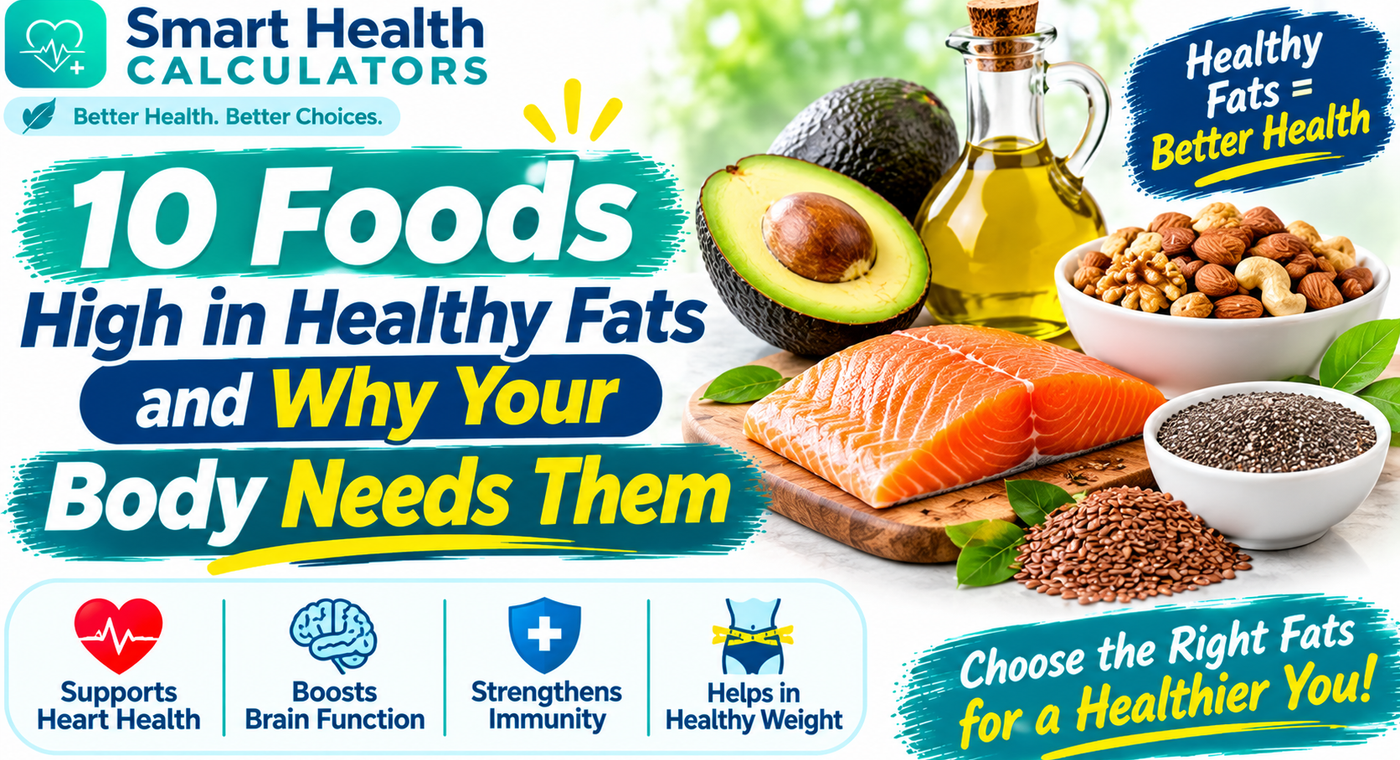
10 Foods High in Healthy Fats and Why Your Body Needs Them
Discover 10 foods high in healthy fats, from avocado and walnuts to salmon and chia. See serving sizes, omega-3 content and how much fat you need daily.
For years, "fat" was treated as a dirty word on food labels. Then people started noticing that the healthiest eating patterns in the world, from Mediterranean kitchens to coastal fishing communities, are full of olive oil, nuts and oily fish.
The truth sits in the middle. Your body can't function without dietary fat, but the type and amount matter far more than the word on the packet. This guide walks you through ten foods high in healthy fats, what each one gives your body, how much you need each day, and how to fit them into real meals without overshooting your calories. It was written by the Smart Health Calculators editorial team using WHO, NIH, AHA and USDA sources.
Which Foods Are Highest in Healthy Fats?
The best foods for healthy fats are avocado, extra virgin olive oil, walnuts, almonds, salmon, sardines, chia seeds, flaxseeds, pumpkin seeds and peanut butter. They supply mostly unsaturated fats, including the essential omega-3 and omega-6 fatty acids your body can't make.
The World Health Organization advises choosing unsaturated fats from fish, avocado, nuts and oils like olive, canola and sunflower in place of saturated and trans fats.
What Are Healthy Fats?
Healthy fats are the unsaturated fats found mainly in plant foods and oily fish. They come in two families: monounsaturated fats, such as the oleic acid in olive oil and avocado, and polyunsaturated fats, which include the omega-3 and omega-6 fatty acids.
Chemically, all fats are triglycerides, which are three fatty acid chains attached to a glycerol backbone. What separates "healthy" from "unhealthy" is the shape of those chains. Unsaturated fats have one or more double bonds, which keeps them liquid at room temperature. Saturated fats have none, which is why butter and ghee turn solid.
Two points keep the label honest. First, healthy doesn't mean low in calories. Every gram of fat provides about 9 calories, more than double the 4 calories in a gram of protein or carbohydrate. Second, no single food protects you from disease. What counts is the overall pattern of what you eat.
Why Does Your Body Need Dietary Fat?
Your body needs dietary fat for energy, for building cell membranes, for absorbing vitamins A, D, E and K, and for getting two essential fatty acids it can't manufacture. Without enough fat in your diet, these jobs start to suffer.
Energy and Storage
Fat is the most concentrated fuel you eat. During low-intensity activity and rest, your body leans heavily on fat metabolism, and it stores any surplus energy in fat tissue for later.
Cell Structure and the Brain
Every cell is wrapped in a membrane built largely from fatty acids. The brain is especially rich in them, and DHA, an omega-3 fatty acid, is a major structural component of brain and eye tissue. This is one reason omega-3 intake is emphasized during pregnancy and early childhood.
Vitamin Absorption
Vitamins A, D, E and K are fat-soluble, which means they dissolve in fat rather than water. If you eat a carrot or a salad with no fat at all, you absorb noticeably less of those vitamins. A drizzle of olive oil or a handful of seeds on the plate solves that problem.
Essential Fatty Acids
Linoleic acid (an omega-6) and alpha-linolenic acid, or ALA (an omega-3), are called essential because the body can't make them. The NIH Office of Dietary Supplements explains that you must get ALA from food, and that converting ALA into EPA and DHA happens only in very small amounts.
Hormones and Inflammation Signalling
Fatty acids also feed into the signalling molecules that help regulate hormones and the inflammatory response. This is a complex area of research, so treat claims that one food "cures inflammation" with healthy suspicion. What the evidence supports is that overall dietary fat quality matters for cardiovascular and metabolic health.
Healthy Fats vs Unhealthy Fats
The simplest rule is to replace saturated and trans fats with unsaturated fats rather than just adding more fat on top. Both the WHO and the American Heart Association make this same recommendation.
| Fat type | Typical sources | Effect on LDL cholesterol | General advice |
|---|---|---|---|
| Monounsaturated | Olive oil, avocado, almonds, peanuts | Lowers when replacing saturated fat | Choose often |
| Polyunsaturated (omega-3 and omega-6) | Fatty fish, walnuts, seeds, sunflower and canola oil | Lowers when replacing saturated fat | Choose often |
| Saturated | Butter, ghee, fatty meat, cream, palm and coconut oil | Can raise LDL | Limit |
| Trans | Some fried and packaged baked foods | Raises LDL, lowers HDL | Avoid industrial trans fat |
Notice that ghee and coconut oil sit in the "limit" row. They aren't poisonous, but they are rich in saturated fat, and swapping some of them for olive, canola or sunflower oil is a practical way to follow the guidance.
10 Foods High in Healthy Fats
The serving figures below are approximate and rounded, drawn from USDA data and NIH tables. Exact values change with variety, brand and preparation, so check USDA FoodData Central for the food you actually buy.
1. Avocado
Avocado is one of the few fruits rich in fat, and most of that fat is monounsaturated. A standard serving of about one third of a medium avocado (50 g) provides roughly 80 calories, 8 g of fat and 3 g of fiber.
Because the fat comes packaged with fiber and potassium, avocado keeps you full without feeling heavy. Mash it on whole wheat toast, slice it into salads, or blend a spoonful into a smoothie for creaminess. Watch the portion if weight management is a goal, since a whole avocado carries around 240 calories.
2. Extra Virgin Olive Oil
Extra virgin olive oil is the signature fat of the Mediterranean diet, and it's mostly monounsaturated oleic acid. One tablespoon gives about 120 calories and 13 to 14 g of fat.
It works best when you use it as a replacement. Swap it for butter or ghee on vegetables, lentils and bread rather than adding it on top of your usual cooking fat. For high-heat frying, many cooks prefer a more heat-stable oil, and for everyday dressings and low-to-medium cooking, extra virgin is an excellent choice.
3. Walnuts
Walnuts stand out among nuts for their omega-3 content. According to NIH figures, one ounce (about 14 halves) delivers roughly 2.6 g of ALA, which already covers more than the daily adequate intake for women of 1.1 g.
They also provide protein and fiber. Eat them as a snack, crush them over oats, or toss them into yogurt. Remember that ALA from plants is not nutritionally identical to the EPA and DHA found in fish, a point we cover below.
4. Almonds
Almonds supply mostly monounsaturated fat along with vitamin E, an antioxidant that is itself fat-soluble. One ounce (about 23 almonds) has roughly 14 g of fat, only about 1 g of it saturated, plus about 6 g of protein and 3 g of fiber.
A small handful as a mid-afternoon snack is an easy habit. If you prefer a lower-effort option, unsweetened almond butter spread on fruit or toast does the same job. Raw or dry-roasted almonds are better than candied or heavily salted versions.
5. Salmon
Salmon is a top source of the long-chain omega-3s EPA and DHA. A 3-ounce cooked portion of farmed Atlantic salmon provides roughly 1.8 g of EPA and DHA combined, according to NIH data, though wild salmon and different species vary.
The NIH lists salmon, herring, sardines and trout among the fish higher in EPA and DHA and lower in mercury. Baking, grilling or steaming preserves the fat better than deep frying. Two portions of oily fish a week is a common public health suggestion, and a lot of people find that far easier to achieve with canned fish.
6. Sardines
Sardines deliver a lot of omega-3 for a small price. A 3-ounce drained portion offers about 0.74 g of DHA and 0.45 g of EPA, so around 1.2 g combined.
Canned sardines are shelf-stable, affordable and available almost everywhere, and eating the small soft bones adds calcium. Mash them on toast with lemon, fold them into a pasta, or serve them with chopped onion and chilli. Mackerel is a close cousin and works in the same way.
7. Chia Seeds
Chia seeds are a plant powerhouse for ALA. One ounce (about two tablespoons) provides roughly 5 g of ALA and close to 10 g of fiber.
They absorb liquid and turn gel-like, which makes them ideal for puddings, overnight oats and smoothies. Soak them first, because eating a spoonful dry and then drinking little water can be uncomfortable. Start with one teaspoon if you're not used to a lot of fiber.
8. Flaxseeds
Flaxseed is among the richest plant sources of ALA, with about 2.4 g in one tablespoon of whole seed and about 7.3 g in a tablespoon of flaxseed oil.
The key detail is that whole flaxseeds often pass through you undigested. Buy them ground, or grind them fresh at home, and store them in the fridge since the oils go rancid quickly. Stir a tablespoon into porridge, yogurt or dough for roti and paratha.
9. Pumpkin Seeds
Pumpkin seeds provide unsaturated fats alongside magnesium, zinc and protein. An ounce gives roughly 13 to 14 g of fat and about 150 calories, though the exact figures vary with whether the seeds are shelled and roasted.
They're an easy upgrade to salads, soups and trail mixes. Choose unsalted versions to keep sodium in check.
10. Peanut Butter
Peanut butter provides mostly unsaturated fat plus plant protein. Two tablespoons (about 32 g) contain roughly 16 g of fat, about 7 g of protein and around 190 calories.
Read the label. The best jars list peanuts and perhaps a pinch of salt, while the worst add sugar and hydrogenated oils. Spread it on whole wheat bread, stir it into oatmeal or pair it with banana for a balanced snack.
Nutrition at a Glance
Here is a quick side-by-side of the ten foods. Values are rounded approximations per the stated serving.
| Food | Serving | Calories (approx.) | Total fat (approx.) | Standout nutrient |
|---|---|---|---|---|
| Avocado | 50 g (⅓ medium) | 80 | 8 g | Fiber, monounsaturated fat |
| Extra virgin olive oil | 1 tbsp | 120 | 13–14 g | Oleic acid |
| Walnuts | 1 oz | 185 | 18 g | ALA (about 2.6 g) |
| Sardines (canned) | 3 oz drained | 150–170 | 8–9 g | EPA + DHA (about 1.2 g) |
| Chia seeds | 1 oz | 135–140 | 9 g | ALA (about 5 g), fiber |
| Pumpkin seeds | 1 oz | 150 | 13–14 g | Magnesium |
| Peanut butter | 2 tbsp | 190 | 16 g | Plant protein |
Not All Omega-3s Are the Same
This is where many articles go wrong, so it's worth a clear explanation. Walnuts, chia and flaxseed supply ALA. Salmon, sardines and mackerel supply EPA and DHA. Your body can turn some ALA into EPA and DHA, but the NIH notes that conversion is limited.
| Omega-3 type | Main food sources | Notes |
|---|---|---|
| ALA | Walnuts, chia, flaxseed, canola oil | Essential. Adequate intake is 1.6 g/day for men and 1.1 g/day for women. |
| EPA and DHA | Salmon, sardines, mackerel, trout | No official intake set, but linked with heart and brain health. |
For vegetarians, ALA-rich foods are valuable, and algal oil supplements are a plant-based route to DHA and EPA. If you eat fish, aiming for oily fish once or twice a week is a sensible way to cover EPA and DHA.
The FDA's guidance, as reported by the NIH, is to keep EPA and DHA combined to no more than 3 g a day, including up to 2 g from supplements. If you take blood thinners or have a medical condition, talk to a doctor before using fish oil capsules.
How Much Healthy Fat Do You Need Each Day?
Most adults do well getting about 20 to 35% of daily calories from fat, which is the range used in many national dietary guidelines. On a 2,000-calorie day, that works out to roughly 44 to 78 g of fat.
The WHO takes a slightly different line. Its guidance says adults can limit total fat to 30% or less of energy to help prevent unhealthy weight gain, which equals about 67 g on 2,000 calories. It also advises keeping saturated fat under 10% (about 22 g) and trans fat under 1% of energy.
The American Heart Association sets a stricter heart-health target of under 6% of calories from saturated fat, or about 13 g on 2,000 calories.
These figures aren't interchangeable, so don't blend them. The WHO's 30% is a conditional ceiling aimed at weight control, and Harvard's Nutrition Source has criticised the 30% limit, arguing that the type of fat matters more than the total. The AHA's 6% is a more cautious saturated-fat target for cardiovascular health.
Your own number depends on your age, activity level and energy needs. To find your calorie baseline first, use our calorie intake planner, and read our recommended calorie intake guide to understand the range. Our macro calculator guide then shows how to split those calories between fat, protein and carbohydrates.
Healthy Fats for Heart and Brain Health
Replacing saturated fat with unsaturated fat is one of the best-supported dietary swaps for heart health. The AHA states that monounsaturated and polyunsaturated fats can lower LDL cholesterol when they take the place of saturated fats.
Notice the wording: in place of. Adding a daily handful of nuts to a diet already heavy in fried food and butter won't achieve the same effect. Pairing healthy fats with fiber-rich foods is where the real benefit shows. Our guides to high-fiber foods and the DASH diet show how to build that pattern, and our list of best drinks for heart health rounds it out. If blood pressure is your concern, read how to lower blood pressure naturally.
For the brain, the strongest evidence centres on DHA's role in development and on overall dietary pattern. If you're curious about supplements, our article on brain health supplements explains what is and isn't proven.
Healthy Fats and Weight Management
Fat is calorie-dense, so portion size decides whether these foods help or hinder your weight goals. A tablespoon of olive oil has about as many calories as a small banana and a slice of bread combined.
That said, fat slows digestion and adds satisfaction, which can help you feel full longer. The trick is to treat healthy fats as a measured part of the plate, such as a thumb of nut butter or a quarter of an avocado, rather than something to pour freely.
If you're working on weight, our weight loss strategies guide gives the broader context, and the TDEE calculator guide helps you set a realistic calorie target. If results have stalled, see why your diet is not working. For muscle goals, our muscle gain diet plan explains how fats fit alongside protein, and our protein-rich foods ranking covers foods that deliver both.
How to Add Healthy Fats to Everyday Meals
The easiest approach is to build them into meals you already eat, one swap at a time.
At breakfast, stir ground flaxseed or chia into porridge or yogurt, or top whole wheat toast with avocado or peanut butter. At lunch, add a handful of walnuts or pumpkin seeds to a salad and dress it with olive oil and lemon. At dinner, bake salmon or serve sardines on whole grain bread, and cook vegetables in olive oil instead of butter or ghee. For snacks, almonds with fruit or a small spoon of nut butter works well.
If you cook South Asian food at home, small changes go a long way. Use a little less ghee in dal, cook with sunflower, canola or olive oil more often, and add ground flax to chapati dough. Peanuts, sesame seeds, sunflower seeds and locally available fish such as mackerel and sardines are affordable ways to hit your targets. Our guide to calories in roti, rice and corn shows how those staples fit around your fats, and a low-budget diet plan proves you don't need expensive superfoods.
Pakistan's national Dietary Guidelines for Better Nutrition also address cooking oils and sources of omega-3 and omega-6, and are a useful regional reference.
If you'd like a structured plan, our diet plan generator builds a menu around your calorie needs, and the free diet plan generator guide explains how to use it well.
Common Mistakes When Eating High-Fat Foods
A few errors come up again and again. The first is adding without swapping. Healthy fats help most when they replace saturated and trans fats, not when they pile on top of them. The second is ignoring portions. Nuts and oils are easy to over-pour, and a "handful" varies a lot between people, so use a measuring spoon or a small bowl for a week to calibrate.
The third is trusting the front of the package. Granola, flavoured nut butters and trail mixes can carry added sugar and refined oils. The fourth is using raw flaxseed and expecting results, since whole seeds often pass straight through. The fifth is treating fish oil capsules as a free pass. Food first is a sound principle, because fish and plant sources also bring protein, minerals and fiber.
Who Should Be Careful?
Some people need individual advice. If you have high triglycerides, a history of heart disease, a nut or fish allergy, a fat-absorption condition, or you're pregnant, breastfeeding or taking blood-thinning medication, check with a doctor or registered dietitian before making big changes. Pregnant women should also follow local advice on fish choices because of mercury.
Our disclaimer page explains that this content is educational and not a substitute for personal medical advice.
Why Choose Smart Health Calculators?
Nutrition guidance is easy to find and hard to personalise. That's where tools help. Why choose Smart Health Calculators? Because our calculators turn general guidelines into numbers for your body, and our articles are written from named scientific sources and updated when guidance changes.
Start with the BMR calculator and BMI calculator to understand your baseline, and use the body fat estimator to track body composition more meaningfully. If you want a broader picture, our guide to the best free health calculators compares what's available. You can also explore advanced tools at Smart Health Calculators or browse more nutrition guides on our blog.
Frequently Asked Questions
What are the 10 foods highest in healthy fats?
Avocado, extra virgin olive oil, walnuts, almonds, salmon, sardines, chia seeds, flaxseeds, pumpkin seeds and peanut butter are among the best. They supply mostly monounsaturated and polyunsaturated fats.
Why does your body need healthy fats?
Fat provides energy, builds cell membranes, helps absorb vitamins A, D, E and K, and supplies essential fatty acids the body can't make. The brain and nervous system also rely on fatty acids such as DHA.
What is the difference between healthy and unhealthy fats?
Healthy fats are unsaturated and found in plants and oily fish. Unhealthy fats are trans fats and, in large amounts, saturated fats from butter, ghee, fatty meat and palm or coconut oil, which can raise LDL cholesterol.
Which food has the most omega-3?
Flaxseed oil has the most ALA per serving, at about 7.3 g per tablespoon. Among foods giving EPA and DHA directly, oily fish such as salmon, herring and sardines lead.
How much healthy fat should adults eat daily?
Many guidelines suggest 20 to 35% of calories from fat, roughly 44 to 78 g on a 2,000-calorie diet. The WHO advises 30% or less for preventing unhealthy weight gain, and the AHA suggests under 6% of calories from saturated fat.
Can healthy fats cause weight gain?
Yes, if they push your total calories above what you burn. Fat contains about 9 calories per gram, so portions matter even for healthy foods.
Are olive oil and avocado better than butter?
For heart health, yes. The AHA recommends replacing saturated fats like butter with unsaturated fats such as olive oil, because that swap can lower LDL cholesterol.
Your Next Steps
You don't need to overhaul your diet to benefit from healthy fats. Pick two or three swaps this week: olive oil instead of ghee for vegetables, a handful of walnuts instead of a packaged snack, and oily fish or sardines once or twice. Keep portions measured, and watch the overall calories.
To turn this into a plan that fits your body, calculate your daily calories with our calorie intake planner, then generate a menu with the diet plan generator.
Medical Disclaimer
This article is for general education only. It is not medical advice, diagnosis, treatment, prescription guidance, or a replacement for professional healthcare. Speak with a qualified healthcare professional for personal medical concerns, symptoms, pregnancy concerns, mental health crisis, medication questions, or before making major health changes.