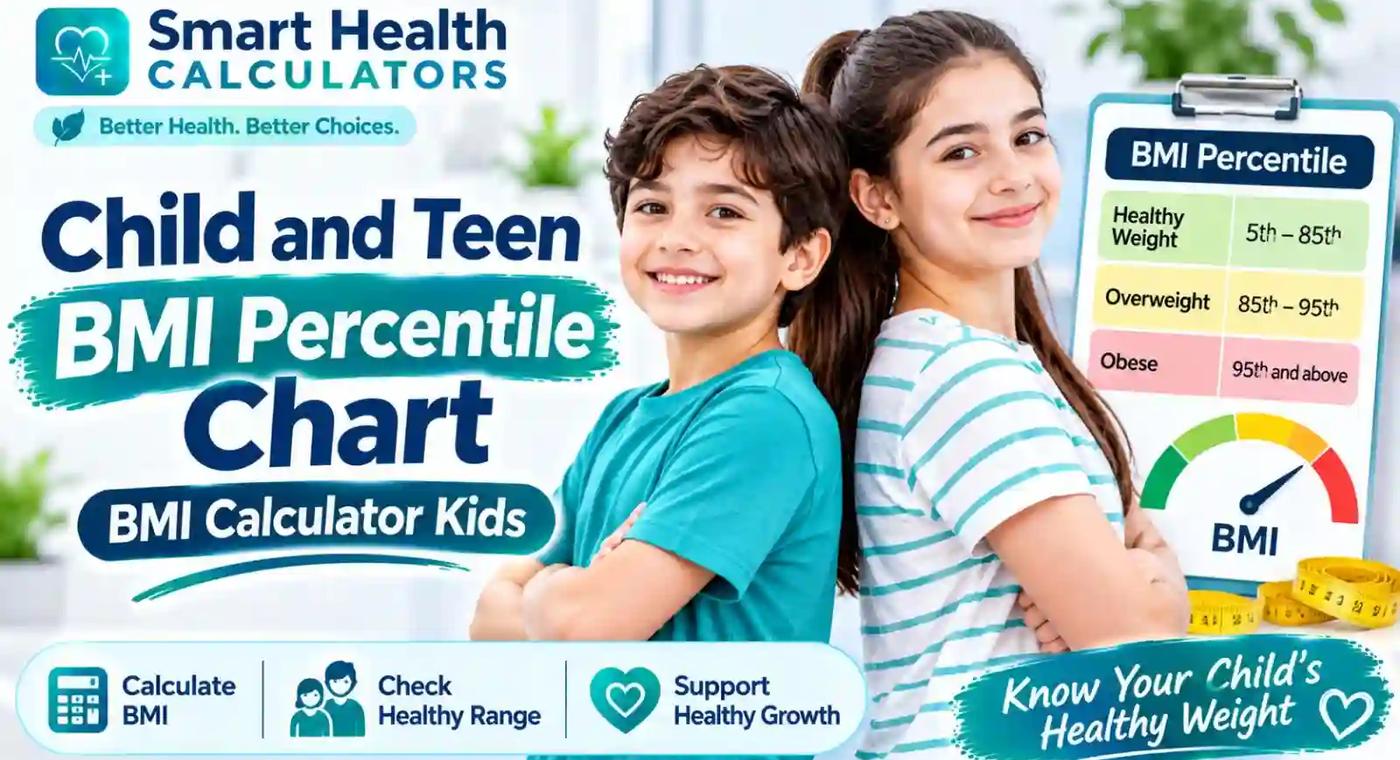
Child and Teen BMI Percentile Chart
How child and teen BMI percentiles work by age and sex, what the 5th, 85th, and 95th percentile categories mean, and when to talk to a pediatrician.
A child's BMI is calculated from height and weight, then compared with other children of the same age and sex to produce a percentile. That percentile, not the raw BMI number, tells you whether a child's weight is in the underweight, healthy, overweight, or obesity range. For ages 2 to 19, the CDC treats the 5th to below 85th percentile as healthy weight.
Parents often type a child's numbers into an adult BMI calculator and get a confusing result. Adult cut-offs do not work for growing bodies. This guide explains how pediatric BMI really works, how to calculate it, how to read the percentile chart, where CDC and WHO differ, and when a result is worth raising with a pediatrician.
This article is general education, not medical advice. A calculator result is a screening step, never a diagnosis.
What Is a Child BMI Percentile?
Body mass index (BMI) is a number that relates weight to height. For children and teens, that number is plotted on a growth chart for their exact age and sex. The resulting percentile shows how their BMI compares with a reference group of children.
For example, a child at the 60th percentile has a BMI higher than about 60 out of 100 children of the same age and sex in the reference data. It does not mean they are 60 percent of anything, and it does not mean 60 is a "score" to improve.
BMI, BMI Percentile, and BMI Z-Score: What's the Difference?
- BMI: The number from the formula, such as 17.2.
- BMI percentile: Where that number ranks against children of the same age and sex.
- BMI z-score: The distance from the reference average, measured in standard deviations. Clinicians and WHO references often use this.
Each describes the same measurement in a different way. For a quick family check, the percentile is the easiest to understand.
Why Children Are Not Judged Like Adults
Adults are classified using fixed BMI ranges. Children are different because their bodies change constantly. Normal BMI shifts as kids grow, and it differs between boys and girls because they develop at different rates. This is why the CDC explains that children's BMI is interpreted using age- and sex-specific percentiles.
To see how adult ranges work for comparison, read what BMI is and why it matters and the guide to the healthy BMI range. Do not apply those adult numbers to a child.
How to Calculate BMI for a Child
You need four pieces of information:
- The child's exact age (date of birth helps)
- The child's sex
- Height
- Weight
The BMI Formula
BMI equals weight in kilograms divided by height in meters squared.
If you use pounds and inches, the formula is weight in pounds divided by height in inches squared, multiplied by 703.
Example: A child weighs 32 kg and is 1.35 m tall.
- 1.35 × 1.35 = 1.8225
- 32 ÷ 1.8225 = about 17.6
That BMI of 17.6 means nothing on its own for a child. You must find the percentile for the child's age and sex.
Why a Simple Formula Is Not Enough
The formula gives you BMI. The percentile requires validated reference data, such as the CDC growth-chart parameters or WHO growth references. That is why a proper pediatric calculator asks for age and sex, and why an adult calculator cannot give a meaningful child result.
You can still use the BMI calculator to understand the basic calculation, but use a pediatric tool, or your child's doctor, for the percentile.
Tips for Accurate Measurements
- Measure height without shoes, standing straight against a wall.
- Weigh the child in light clothing, ideally at the same time of day.
- Round carefully. A one-centimeter error can shift BMI noticeably.
- Use the same scale each time you track growth.
CDC BMI Percentile Categories for Ages 2 to 19
The CDC uses these percentile ranges for children and teens aged 2 to 19:
- Underweight: below the 5th percentile
- Healthy weight: 5th percentile to below the 85th
- Overweight: 85th percentile to below the 95th
- Obesity: 95th percentile or higher
- Severe obesity: 120 percent of the 95th percentile, or a BMI of 35 or higher
What Does the 85th Percentile Mean for a Child?
It means the child's BMI is higher than about 85 percent of children the same age and sex. In CDC categories, this is where the overweight range begins. It is a flag to look more closely, not a diagnosis.
What Does the 95th Percentile Mean?
At or above the 95th percentile, the CDC category is obesity. Clinicians then look at the whole picture: growth history, family history, eating and activity patterns, and sometimes blood pressure or lab tests.
What About a Child Below the 5th Percentile?
This is the underweight range. Some children are naturally slim and healthy. Others may have a medical or nutritional reason. A pediatrician can tell the difference by looking at growth over time.
Why BMI Percentile Changes as a Child Grows
It is normal for a child's percentile to move. Several reasons explain it:
- Growth spurts: Height can jump before weight catches up, or the reverse.
- Puberty: Timing varies widely, and BMI naturally changes during it.
- Muscle gain: Active children may gain lean mass.
- Measurement differences: Different scales or clothing change readings.
What matters most is the trend. A child who has tracked steadily along one percentile curve for years and suddenly crosses upward or downward deserves a conversation with their doctor. A single reading rarely tells you much. For more on tracking, our guides on normal weight range by height and BMI versus body fat percentage give helpful context.
CDC vs. WHO: Which Growth Reference Should You Use?
Two major references exist, and they are not interchangeable.
CDC Growth Charts
In the United States, CDC growth charts are widely used for children aged 2 to 19. They classify children using percentiles. The CDC also publishes extended BMI-for-age charts for very high BMI values.
WHO Growth Standards and References
WHO child growth standards cover birth to 5 years. For ages 5 to 19, WHO uses a growth reference with BMI-for-age expressed in standard deviations. WHO defines overweight above +1 standard deviation and obesity above +2 standard deviations for school-age children and adolescents.
Why You Should Not Mix Them
A child's category can differ depending on the reference. For example, a CDC percentile cut-off and a WHO standard deviation cut-off are different yardsticks. Always check which reference a calculator uses, and use the one your country or doctor recommends. In the US, the CDC advises WHO standards for children under 2.
If you live outside the US, ask your pediatrician which chart your local health system uses. In Pakistan, many clinicians follow WHO references, though practice can vary, so confirm with your own provider.
Do Boys and Girls Have Different BMI Charts?
Yes. Boys and girls follow different growth patterns, especially around puberty. Girls typically gain body fat earlier in adolescence, and boys often gain muscle and height later. Separate charts for each sex keep comparisons fair.
That is why every reliable child BMI calculator asks for sex. If a tool does not, its percentile cannot be trusted.
How Accurate Are Online BMI Calculators for Children?
A good online calculator can be accurate if it uses validated CDC or WHO reference data, asks for exact age and sex, and handles unit conversion correctly. A poor one may apply adult cut-offs or round ages loosely.
Check these before trusting a result:
- It asks for age and sex.
- It states whether it uses CDC or WHO data.
- It accepts metric and imperial units.
- It shows a percentile, not just a BMI number.
- It includes a clear medical disclaimer.
Even a perfect calculator cannot replace a clinical visit. It cannot see a child's growth history, build, puberty stage, or health conditions.
The Limits of BMI in Growing Children
BMI is a screening tool. It estimates weight relative to height but does not measure body fat directly.
What BMI Can Miss
- Muscular children: A very athletic teen may have a high BMI from muscle, not fat.
- Body shape and fat distribution: Two children with the same BMI can have different health profiles.
- Puberty timing: Early or late developers can fall outside typical percentiles temporarily.
- Family and ethnic differences: Body composition varies between populations.
Can a Child Have a High BMI and Still Be Healthy?
Yes, it can happen, especially with high muscle mass. But a high BMI percentile should still be reviewed by a clinician, who can check other measures and decide whether anything needs attention.
Can BMI Identify Obesity in Teens?
It can screen for it, but BMI alone does not diagnose obesity or health risk. Doctors consider growth trends, physical examination, family history, and sometimes lab tests. For comparison with other measures, see the guide on waist-to-height ratio and whether BMI is accurate.
How Often Should Parents Check a Child's BMI?
For most children, checking BMI at routine pediatric visits is enough. The American Academy of Pediatrics recommends that children and adolescents aged 2 to 18 have their BMI assessed at least once a year in clinical settings in the US.
At home, measuring every few months is plenty if you want to track growth. Weighing a child weekly is not helpful and can create unhealthy attention on numbers. Keep the focus on habits, not scores.
When Should You Talk to a Doctor?
Consider speaking with a pediatrician if:
- BMI is below the 5th percentile or at or above the 85th
- The percentile has changed sharply across visits
- Your child has sudden weight gain or loss without a clear reason
- They show signs of unusual fatigue, extreme thirst, or other symptoms
- You are worried about eating habits, body image, or restricting food
- There is a family history of diabetes, heart disease, or high cholesterol
Do not put a child on a diet, restrict food, or label their body based on a calculator result. Safe, family-based changes guided by a professional work better and protect a child's relationship with food.
If you are concerned about a child's emotional wellbeing around weight or appearance, speak with a pediatrician or qualified mental health professional.
Healthy Habits for Growing Children
If your doctor suggests lifestyle changes, the emphasis is usually on the whole family, not one child.
- Regular meals and balanced portions rather than strict rules
- Plenty of vegetables, fruit, and whole foods. See the guides on whole foods diet and high fiber foods
- Enough water through the day, using the water intake calculator or the daily water intake guide
- Daily physical activity that the child enjoys
- Good sleep. See how many hours of sleep people need and these tips on sleep hygiene
- Limited screen time. Read how screen time affects mental health
Avoid adult weight-loss tactics for children. Do not use crash diets, fasting, or calorie counting without medical advice.
Real-World Examples
Example 1: The steady grower. A 9-year-old girl has been around the 40th percentile at every checkup. At 10, she is at the 45th. This is normal variation. No action is needed.
Example 2: The upward trend. A 7-year-old boy moved from the 60th to the 80th to the 90th percentile over two years. No single reading is alarming, but the trend is worth discussing with his pediatrician, who can look at growth, activity, and sleep.
Example 3: The athletic teen. A 15-year-old boy plays competitive sports and has a BMI percentile in the overweight range, but has low body fat and good fitness. His doctor uses extra information to conclude his weight is healthy. This shows why BMI is only a first step.
Example 4: The slim child. An 8-year-old is at the 3rd percentile but has always followed that curve, eats well, and is active. The doctor confirms normal growth.
Why Choose Smart Health Calculators for Family Health Tracking
Numbers are easier to understand when they are explained clearly. Smart Health Calculators provides free tools and plain-language guides so families can understand measurements before talking to a clinician.
You can learn more on the Why Choose Smart Health Calculators page, try the BMI calculator and ideal weight calculator, or use the health age calculator for adults in your household. Our tools are for information only and never replace professional care. For more guides, browse the Smart Health Calculators blog.
Where to Learn More: Reliable Sources
Use official sources when interpreting a child's growth:
- CDC: Child and Teen BMI Calculator
- CDC: About Child and Teen BMI
- CDC Growth Charts
- WHO Child Growth Standards
- WHO BMI-for-age (5 to 19 years)
- American Academy of Pediatrics: Obesity Clinical Practice Guideline
- NHS: Child growth and weight
For a paid option, a pediatric dietitian or pediatrician can provide personalized assessment, especially when a child has a medical condition.
Frequently Asked Questions
What is a normal BMI percentile for a child?
For ages 2 to 19, the CDC treats the 5th percentile to below the 85th percentile as the healthy weight range. Percentiles compare a child with others of the same age and sex.
How do I calculate BMI for my child?
Divide weight in kilograms by height in meters squared, then find the percentile for your child's age and sex using a pediatric calculator or growth chart. The raw BMI number alone is not enough.
Is children's BMI different from adult BMI?
Yes. Children's BMI is interpreted using age- and sex-specific percentiles because their bodies are still growing. Adult cut-offs should not be applied to children.
What does a BMI above the 95th percentile mean?
In CDC categories, it falls in the obesity range. It is a screening result, not a diagnosis. A pediatrician will consider growth history, family history, and other health information.
Can a muscular teenager have a high BMI percentile?
Yes. BMI does not separate muscle from fat, so a very athletic teen may have a high percentile without excess body fat. A clinician can assess further.
How often should children's BMI be checked?
At least once a year at routine pediatric visits for ages 2 to 18, according to American Academy of Pediatrics guidance. Home checks every few months are usually enough if you want to track growth.
Conclusion:
A child's BMI percentile is a useful starting point, not a verdict. It works best when you track it over time, use the right reference for your child's age and sex, and discuss unusual results with a doctor.
Here is what to do next:
- Measure your child's height and weight accurately, with the same method each time.
- Use a pediatric calculator that asks for age and sex and states whether it uses CDC or WHO data.
- Note the percentile category, and look at the trend, not one reading.
- If the result is below the 5th or at or above the 85th percentile, or the trend changes sharply, book a pediatrician visit.
- Focus on family habits like balanced meals, activity, sleep, and positive talk about bodies, rather than diets.
Ready to explore more health tools? Explore advanced tools at Smart Health Calculators, or contact the team.
Medical Disclaimer
This article is for general education only. It is not medical advice, diagnosis, treatment, prescription guidance, or a replacement for professional healthcare. Speak with a qualified healthcare professional for personal medical concerns, symptoms, pregnancy concerns, mental health crisis, medication questions, or before making major health changes.