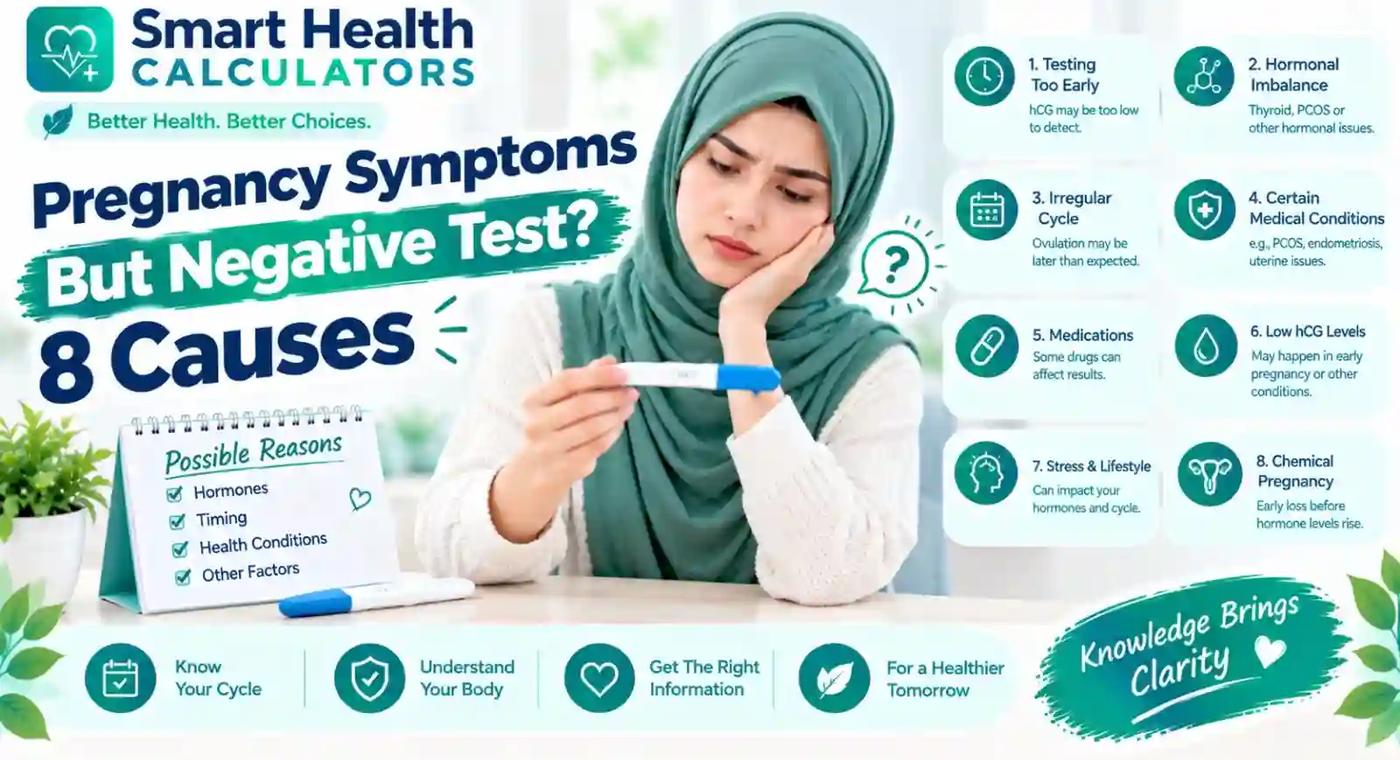
Pregnancy Symptoms but Negative Test? 8 Causes
Feel pregnant but your test is negative? Learn the 8 most common causes, how to retest correctly, and which warning signs need a doctor.
You feel queasy every morning. Your breasts are sore, you're more tired than usual, and your period is late. So you take a test, and it shows one line.
That mismatch between what your body says and what the test says is confusing, and it's more common than most people realize. A negative result doesn't always close the question, and pregnancy-like symptoms don't always mean pregnancy.
This guide explains the eight most common reasons it happens, how to retest properly, and which warning signs mean you should stop waiting and get medical help.
Medical information last reviewed: October 30, 2026. Pregnancy-test instructions, product sensitivity, and clinical guidance may change. This article is for education and does not replace advice from a qualified healthcare professional.
Can You Have Pregnancy Symptoms but a Negative Test?
Yes. You can have pregnancy-like symptoms and still get a negative home pregnancy test. Testing too early, late ovulation, diluted urine, or a test-use problem can all produce a false negative. PMS, hormonal shifts, PCOS, thyroid conditions, and stress can also cause symptoms that feel like early pregnancy.
If pregnancy is still possible, follow the test instructions, retest after a few days, and ask a clinician about a blood hCG test. Severe or one-sided pelvic pain, shoulder-tip pain, fainting, dizziness, or heavy bleeding needs urgent medical assessment.
Table of Contents
- How pregnancy tests actually work
- Why symptoms and test results can disagree
- The 8 causes, explained
- Ectopic pregnancy and early pregnancy loss: the safety section
- How to retest correctly
- When to see a doctor
- Symptom comparison table
- FAQs
- Final takeaway and next steps
How Pregnancy Tests Actually Work
Home pregnancy tests don't detect pregnancy directly. They detect a hormone called human chorionic gonadotropin (hCG) in your urine.
Your body starts producing hCG after a fertilized egg implants in the uterine lining. Before implantation, there is no hCG to find. Right after implantation, the amount is tiny, and it rises over the following days.
That timing explains most confusing results. A test can only report what is already in your urine at that moment. If hCG hasn't climbed high enough yet, the test shows negative even though a pregnancy may be developing.
According to the Office on Women's Health, testing too early can miss a pregnancy because hCG levels increase over time. The same guidance notes that first-morning urine may improve detection.
Tests also differ in sensitivity. Some detect lower hCG concentrations than others, which is why two brands can give different answers on the same day. Your hCG levels by week chart shows how quickly the hormone normally rises and why a few days can change a result.
Why Symptoms and Test Results Can Disagree
Two separate things are happening in your body, and they run on different clocks.
Symptoms come from hormones such as progesterone and estrogen. These rise after ovulation whether or not you're pregnant. Progesterone alone can cause breast tenderness, bloating, tiredness, and mood changes.
The test only responds to hCG, which exists only after implantation.
So the same hormone wave that causes "pregnant" feelings in every cycle can also appear in a non-pregnant luteal phase. If you'd like background on that stage of your cycle, read our guide to the luteal phase.
Symptoms can't confirm pregnancy, and one negative result can't always rule it out. You need to consider timing, test quality, and your own cycle.
The 8 Causes Behind Pregnancy Symptoms but a Negative Test
1. Testing Too Early
This is the most common reason, by a wide margin.
hCG may not have reached a level your test can detect. Many people test the day they suspect something, which is often several days before a missed period. At that stage, a pregnancy can exist while the test still shows nothing.
Think of it like checking whether bread has risen after five minutes. The process has started, but there's nothing to see yet.
What to do: If your period hasn't arrived, wait a few days and test again. Use the test your package describes as most sensitive for early use, and read the instructions for how many days before a missed period it claims to work.
Our pregnancy tests guide explains how to choose a test and what to expect at different timings.
2. Late Ovulation or Late Implantation
Cycle day 14 is an average, not a rule. If you ovulated later than you assumed, everything shifts.
Conception happens after ovulation, and implantation follows days later. A pregnancy that began late in your cycle will produce detectable hCG later than you expected. So you may reach your "expected" period date with no positive test, yet still be pregnant.
This is especially common if your cycles are irregular, if you recently traveled, were ill, or were under stress. All of these can delay ovulation.
What to do: Track ovulation signs rather than relying on a calendar alone. Our guide to ovulation signs and how to track ovulation and the fertility window calculator can help you estimate when conception could realistically have happened.
If you're unsure of the date, try the pregnancy calculator or read how to calculate your conception date.
3. Diluted Urine
Urine concentration affects how much hCG is present per drop. If you drink a lot of water before testing, your urine becomes more diluted and the hormone becomes harder to detect.
This matters most in very early pregnancy, when hCG is already low.
Practical tips:
- Test with first-morning urine when possible.
- Avoid large amounts of fluid in the hours before testing.
- Don't restrict fluids to an unhealthy degree. Moderation is enough.
If you test late in the day after drinking plenty of water, a negative result is less reliable than one from concentrated morning urine.
4. Test Sensitivity or Expiration
Not every test works equally well. Different brands detect different hCG concentrations, and the exact sensitivity should be listed in the product information or package insert.
Expired or poorly stored tests can also fail. Heat, humidity, and damaged packaging can affect the chemistry on the strip.
Check before you trust a result:
- The expiry date printed on the box and foil pouch
- Whether the pouch was sealed and undamaged
- Whether the test was stored somewhere hot or damp
We cover this in detail in our article on whether pregnancy tests expire.
5. Incorrect Test Use or Reading the Result at the Wrong Time
Small mistakes can change the outcome. Common ones include:
- Holding the strip in urine for the wrong length of time
- Using too little urine
- Reading the result before or after the time window in the instructions
- Misreading a faint line
Reading a test too late can also cause confusion, because evaporation lines can appear and look like a result when they aren't one.
Always follow the instructions that came with your specific test. Set a timer and read the result inside the stated window only.
If you ever see a result that doesn't match your situation in the other direction, our article on false positive pregnancy tests explains those cases too.
6. PMS and Normal Hormonal Fluctuations
Premenstrual syndrome and early pregnancy overlap more than most people expect. Both can bring:
- Breast tenderness
- Fatigue
- Bloating
- Mild cramping
- Mood changes
- Food cravings or changes in appetite
Because progesterone rises after ovulation in every cycle, your body can feel "pregnant" even when it isn't. Many people misread normal PMS as pregnancy for exactly this reason.
If this sounds familiar, our comparison of PMS vs pregnancy symptoms breaks down the subtle differences.
7. Hormonal or Reproductive Conditions (PCOS and Thyroid Disorders)
Some health conditions affect ovulation and periods and can cause symptoms that resemble pregnancy.
Polycystic ovary syndrome (PCOS) can cause irregular or missed periods because ovulation doesn't happen on a predictable schedule. The NHS overview of PCOS describes irregular periods as one of its main features.
Thyroid disorders can change menstrual cycles and cause fatigue, weight changes, and mood shifts.
Two cautions matter here. First, having PCOS or a thyroid condition doesn't automatically explain a negative test. Second, you shouldn't self-diagnose or start treatment based on symptoms alone. If your cycles are repeatedly irregular, a clinician can run the right tests.
8. Stress, Illness, and Other Cycle Disruptions
Your menstrual cycle responds to what's happening in the rest of your life. Stress, rapid weight change, intense exercise, poor sleep, and illness can all delay ovulation or a period.
When ovulation is delayed, your period is late for a reason unrelated to pregnancy. Stress can also produce nausea, tiredness, and appetite changes.
Some people also experience symptoms strongly connected to anxiety about pregnancy, whether from hoping for it or fearing it. That doesn't make symptoms imaginary. Physical sensations are real even when the cause isn't pregnancy.
Gentle ways to bring your stress down include the tips in our guide to natural ways to reduce stress. If the waiting itself feels overwhelming, see coping with anxiety before a health checkup, or try the mental health checker.
Quick Summary of the 8 Causes
| Cause | Why it creates a negative test with symptoms | |
|---|---|---|
| 1 | Testing too early | hCG hasn’t reached a detectable level yet |
| 2 | Late ovulation or implantation | The real timeline is later than you assumed |
| 3 | Diluted urine | Lower hCG concentration in the sample |
| 4 | Test sensitivity or expiry | The kit may miss low hCG or fail entirely |
| 5 | Incorrect use or timing | Errors affect the reading |
| 6 | PMS and normal hormones | Progesterone mimics pregnancy signs |
| 7 | PCOS or thyroid conditions | Irregular cycles and overlapping symptoms |
| 8 | Irregular cycles and overlapping symptoms | Delayed ovulation, late period, similar symptoms |
Ectopic Pregnancy and Early Pregnancy Loss: The Safety Section
Most cases of "symptoms but a negative test" turn out to be harmless. A few are not, and you should know the difference.
Ectopic Pregnancy
An ectopic pregnancy happens when a fertilized egg implants outside the uterus, most often in a fallopian tube. It can become dangerous and needs prompt assessment.
A negative home urine test does not safely rule it out if you have concerning symptoms. Diagnosis usually involves clinical assessment, blood hCG tests, and an ultrasound. The NHS page on ectopic pregnancy lists its symptoms and explains what to do.
Urgent Warning Signs
Seek emergency care immediately if you have:
- Severe or one-sided abdominal or pelvic pain
- Pain at the tip of your shoulder
- Fainting, dizziness, or feeling very weak
- Heavy vaginal bleeding
- Pain together with a positive or recent pregnancy test
Don't wait to retest if these appear.
Early Pregnancy Loss and Biochemical Pregnancy
A biochemical pregnancy is a very early loss, shortly after implantation. hCG may rise briefly and then fall, so a test can show a faint positive and later a negative. It can feel confusing, and it is usually not caused by anything you did.
If you've had a faint line followed by bleeding, or you're worried about a loss, a clinician can offer support and confirm what happened. Our guide to implantation bleeding helps you tell implantation spotting apart from a period.
How to Retest Correctly
Retesting is only useful if you do it well. Follow this approach:
- Check the box first. Confirm the expiry date and read the instructions fully.
- Wait a few days. If your period hasn't started, retesting after several days gives hCG time to rise. Follow your test's instructions on timing, since advice varies by product.
- Use first-morning urine. It's the most concentrated sample of the day.
- Limit fluids beforehand. You don't need to dehydrate yourself, just avoid drinking a lot right before.
- Use a timer. Read the result only within the stated window.
- Consider a second brand. A different test with higher sensitivity can help if you suspect an early pregnancy.
A Simple Example
Say your cycle is usually 28 days, but this month you ovulated around day 19 after a stressful week. Your period is expected on day 28, and you test that morning. It's negative.
But conception, if it happened, would have been roughly nine days earlier than your test, and implantation later still. Retesting about a week later would give a far more accurate picture than the day-28 test.
That's why a late-cycle ovulation can make a calendar-based test date misleading.
When a Blood Test Makes Sense
A blood test measures hCG directly and can detect lower amounts than urine tests. A clinician may suggest one if:
- Your period is late and repeated home tests are negative
- Your symptoms continue
- You have pain or bleeding
- You've had previous ectopic pregnancy or fertility concerns
Blood results need interpretation, since one number rarely tells the full story. MedlinePlus offers a clear patient overview of how pregnancy tests work.
When to See a Doctor
Book an appointment if any of these apply:
- Your period is late and you've had two or more negative tests several days apart
- Symptoms continue or worsen
- Your cycles are repeatedly irregular
- You've missed several periods in a row
- You have pelvic pain or unusual bleeding
- You're anxious and want clarity
See a clinician urgently for severe pain, fainting, shoulder-tip pain, or heavy bleeding, as covered above.
Organizations such as ACOG and the Mayo Clinic provide patient guidance on testing and early pregnancy. For UK clinical standards on early pregnancy assessment, see NICE.
Early Pregnancy Symptoms vs Look-Alike Symptoms
Symptoms alone are a weak guide. This table shows how much they overlap:
| Symptom | Early pregnancy | PMS | Other possible cause |
|---|---|---|---|
| tenderness | Common | Common | Hormonal shifts |
| Fatigue | Common | Common | Stress, poor sleep, thyroid |
| Nausea | Common | Less common | Digestive upset, stress |
| Bloating | Common | Common | Digestive issues |
| Cramping | Mild, possible | Common | Ovulation, cysts |
| Late period | Yes | no | PCOS, stress, thyroid |
| Frequent urination | Common | Rare | Infection, fluid intake |
If you want to compare symptoms in more detail, read about the first signs of pregnancy, see how symptoms change in pregnancy symptoms by trimester, or take a look at our Am I Pregnant? guide.
And for a broader look at what a negative result means, see our article on what a negative pregnancy test means. It explains how to interpret results, while this guide focuses on why your symptoms and result don't match.
Practical Tips While You Wait
Waiting is hard. A few habits make it easier and your results more accurate:
- Track your cycle. Note ovulation signs, symptoms, and period dates. Our period calculator helps you estimate your next period.
- Keep a short symptom log. Write down changes day by day so you can show a clinician.
- Avoid testing every few hours. It adds stress and doesn't improve accuracy.
- Skip unproven remedies. Don't take herbs or supplements to "bring on" a period.
- Take care of the basics. Sleep, balanced meals, and gentle movement support your cycle.
Also remember that can you get pregnant questions often depend on timing. Understanding your fertile window helps you read symptoms with more realistic expectations.
Why Choose Smart Health Calculators
We build tools and guides to help you understand your body without jargon. Why choose Smart Health Calculators? Our content is written in plain language, reviewed against recognized medical sources, and designed to tell you what to do next rather than leave you guessing.
Our free calculators cover cycles, pregnancy timing, hydration, nutrition, and mental wellbeing. Explore Advanced Tools at Smart Health Calculators to track your health in one place.
Frequently Asked Questions
Can I have pregnancy symptoms and still get a negative test?
Yes. Symptoms come from hormones such as progesterone, which rise every cycle. Tests detect hCG, which appears only after implantation. Testing too early, late ovulation, or diluted urine can all lead to a negative result alongside symptoms.
Does a negative test mean I'm definitely not pregnant?
Not always. A negative result is more reliable the later you test, especially after a missed period. An early negative can be a false negative, so retest after a few days or ask about a blood hCG test.
How long should I wait before retesting?
Many people retest after a few days, and sooner if a test's instructions say so. Waiting gives hCG time to rise. Check your specific test's guidance, since advice varies, and see a clinician if your period stays late.
Can drinking too much water affect a pregnancy test?
Yes. Large amounts of fluid can dilute urine and lower the hCG concentration per sample. First-morning urine is usually the most reliable for early testing.
Can stress cause a late period and nausea?
It can. Stress can delay ovulation, which delays your period, and it can also cause nausea and fatigue. It doesn't automatically explain a negative test, though, so confirm with retesting if pregnancy is possible.
Can PCOS or thyroid problems cause pregnancy-like symptoms?
They can contribute to missed periods and symptoms such as fatigue. They don't prove why your test is negative, so a clinician should assess recurring irregular cycles.
Can an ectopic pregnancy cause a negative urine test?
It's possible, and a negative home test doesn't rule one out if you have pain or bleeding. Severe, one-sided pain, shoulder-tip pain, or fainting needs urgent medical care.
When should I take a blood pregnancy test?
Consider one if your period is late with repeated negative home tests, if symptoms continue, or if you have pain or bleeding. A clinician will decide the best timing and interpret the result.
Final Takeaway and Next Steps
Pregnancy symptoms with a negative test is usually a timing or hormone story, not a mystery. The most likely explanations are testing too early, late ovulation, diluted urine, or normal PMS.
Here's your simple action plan:
- Wait a few days and retest with first-morning urine.
- Check the test for expiry and read the instructions closely.
- Track your cycle so you know when ovulation likely happened.
- Book a visit if your period stays late or tests keep coming back negative.
- Go urgently for severe pain, fainting, shoulder-tip pain, or heavy bleeding.
Your symptoms are real, and so is your need for a clear answer. Use the right tools, give your body the time it needs, and get medical help when something doesn't add up.
Ready for the next step? Book a seat at Advance Free Tools offered by Smart Health Calculators and explore our free health tools to track your cycle and plan with confidence.
Medical Disclaimer
This article is for general education only. It is not medical advice, diagnosis, treatment, prescription guidance, or a replacement for professional healthcare. Speak with a qualified healthcare professional for personal medical concerns, symptoms, pregnancy concerns, mental health crisis, medication questions, or before making major health changes.