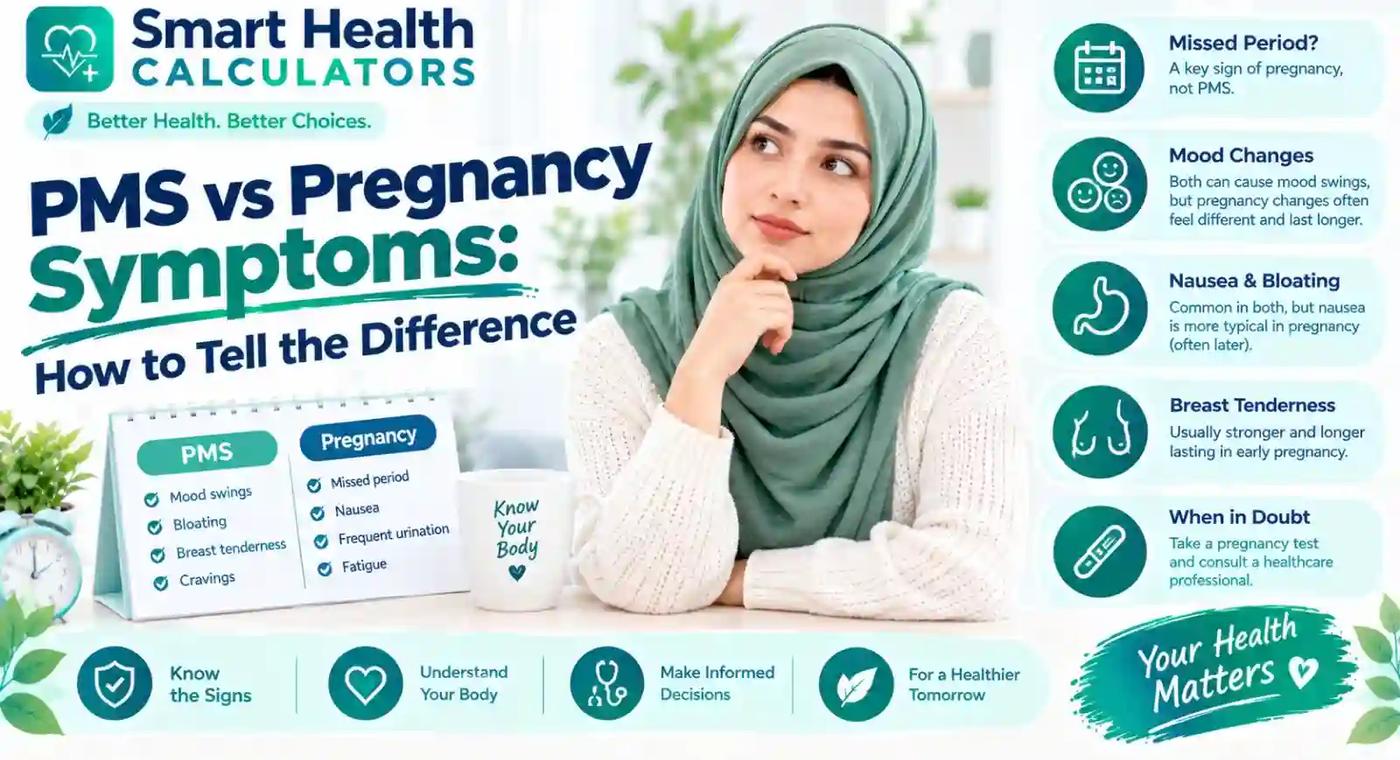
PMS vs Pregnancy Symptoms: Key Differences and When to Test
Compare PMS vs pregnancy symptoms, including cramps, breast tenderness, fatigue, and spotting. Learn when to take a pregnancy test and when to seek medical care.
This guide covers which symptoms overlap, which patterns point one way or the other, when a test will give a reliable answer, and which signs mean you should get care quickly. It's educational, not a diagnosis.
PMS and early pregnancy can cause the same symptoms: breast tenderness, fatigue, bloating, cramps, and mood changes. The most reliable early sign of pregnancy is a missed period, and a pregnancy test is the only way to confirm it. PMS symptoms usually ease once your period starts. Pregnancy symptoms don't, and your period doesn't arrive.
PMS vs Early Pregnancy at a Glance
Use this table as a starting point. It describes common patterns, not rules. Plenty of people don't match them.
| Symptom | More typical of PMS | More typical of early pregnancy |
|---|---|---|
| Period | Arrives on schedule, then symptoms fade | Late or missed |
| Breast changes | Tender or heavy, eases when bleeding starts | Tender, tingling, or fuller; keeps going past your expected period date |
| Cramps | Often stronger, can build before the period | Often milder, pulling, or on and off |
| Nausea | Less common | More common, can start from around week 6 |
| Fatigue | Tired in the days before a period | Deeper tiredness that doesn’t lift |
| Bleeding | Full period flow | Light spotting, sometimes pinkish or brown |
| Smell and taste | Little change | Strong aversions, heightened smell, metallic taste |
| Urination | No change | More frequent trips to the bathroom |
| Mood | Irritability, sadness, anxiety that lifts when the period starts | Mood swings that continue |
No single row confirms anything. What matters is the whole pattern and, above all, the timing.
What Is PMS, and Why Does It Feel Like Pregnancy?
The cycle behind both
Your menstrual cycle has two broad halves. In the first half (the follicular phase), the body builds toward ovulation. After ovulation, the follicle becomes the corpus luteum, which releases progesterone. This is the luteal phase, which commonly lasts about 12 to 14 days. You can see where you are in your own cycle with our guide to ovulation signs and how to track ovulation.
If the egg isn't fertilized, progesterone and estrogen drop, the uterine lining sheds, and your period begins. If it is fertilized and implants, the body keeps progesterone high and begins making human chorionic gonadotropin (hCG).
So in the week before a period, you and a very early pregnancy can have nearly identical hormone profiles. The difference is what happens next.
What PMS is
PMS refers to physical and emotional symptoms that show up in the luteal phase and settle shortly after your period begins. ACOG describes PMS as a pattern that repeats from cycle to cycle, and that recurring, predictable timing is one of its defining features. The Office on Women's Health and Mayo Clinic list common symptoms, including:
- Breast tenderness
- Bloating
- Fatigue
- Headaches
- Food cravings or appetite changes
- Mood swings, irritability, or low mood
- Trouble sleeping
- Lower back or abdominal cramping
A more severe form: PMDD
Some people experience premenstrual dysphoric disorder (PMDD), a severe form of premenstrual mood symptoms that can seriously disrupt work and relationships. If your premenstrual mood changes feel overwhelming, or you ever have thoughts of harming yourself, please talk to a clinician, or contact local emergency services or a crisis line right away. This isn't something to push through alone.
The Symptoms That Overlap (and the Subtle Differences)
Here's the symptom-by-symptom breakdown. Think of the "differences" below as clues, not proof.
Breast tenderness
Both PMS and early pregnancy can make breasts sore, swollen, or heavy. The NHS notes that breasts may feel larger and tender in early pregnancy, just as they might before a period.
How it may differ:
- PMS soreness tends to peak just before your period and fade within a few days of bleeding starting.
- Pregnancy-related changes often keep going past your expected period date. Some people notice tingling, visible veins, or darker areolas.
Fatigue
Hormone shifts can make you tired in both situations. Progesterone has a sedating effect, and in early pregnancy your body is also working hard on a new task.
How it may differ: PMS tiredness usually lifts when your period arrives. Pregnancy fatigue often feels heavier and more persistent, like you could nap at any time. If tiredness is dragging on with no obvious cause, look at sleep and stress too. Our sleep quality checker and guide to how stress affects sleep quality can help you rule those in or out.
Cramping
Cramping before a period is classic PMS. But mild cramping can also happen in early pregnancy, as the uterus begins to change.
How it may differ:
- PMS cramps often build and then ease once bleeding starts.
- Early pregnancy cramping tends to be milder, more of a pulling or twinge, and it may come and go.
Cramping alone can't tell you which it is. And severe or one-sided pain is a different matter entirely (see the safety section below).
Nausea
Feeling queasy before a period can happen, but it's less common. Nausea is one of the more noticeable early pregnancy signs. The NHS says morning sickness for most people starts around six weeks after their last period, so earlier than that it's less typical, though some people notice queasiness sooner.
Nausea has many other causes, such as stress, certain medications, dehydration, and stomach bugs, so don't jump to conclusions. Staying hydrated matters either way, and our water intake calculator and signs you're not drinking enough water are good starting points.
Mood swings
Both can make you weepy, irritable, or anxious. PMS mood shifts typically ease when your period starts. In pregnancy, they may continue because hormone levels stay high.
If mood is your main concern, a self-check can help you see patterns. Try our mental health checker or the mental health self check-in guide. These are awareness tools, not diagnostic ones.
Bloating
Bloating happens in both, thanks to progesterone slowing digestion. It's one of the least helpful symptoms for telling them apart.
Food cravings and aversions
PMS often brings cravings, especially for sweet or salty foods. Early pregnancy can bring cravings too, but also food aversions, where foods you normally like suddenly turn you off, and heightened sensitivity to smells. If coffee smells awful this week and you love coffee, that's a notable change worth noting.
Spotting and bleeding
Light spotting can happen before a period starts. It can also occur around implantation, which typically happens about 6 to 12 days after ovulation, though timing varies. Implantation spotting, when it happens, is usually light and short. Many pregnant people never notice it, and many people who spot aren't pregnant.
The NHS notes that light bleeding or spotting can be a sign of pregnancy, but spotting alone is never proof. Heavy bleeding is a different situation.
Frequent urination and other changes
Needing to pee more often is more typical of pregnancy than PMS, as is a stronger sense of smell or a metallic taste. Headaches, backache, and changes in vaginal discharge can occur with both.
Why Timing Is the Best Clue
If you remember one thing from this guide, make it this: symptoms can't tell you, but timing can.
Here's a sample timeline for a 28-day cycle with ovulation around day 14. Your own cycle may be shorter, longer, or irregular.
| Cycle | happening |
|---|---|
| Day 1 | First day of your last period |
| Day 14 | Ovulation (approximately) |
| Days 20 to 26 | Implantation may occur if the egg was fertilized |
| Days 21 to 28 | Luteal phase: PMS symptoms or early pregnancy symptoms can both appear |
| Day 28 | Period due |
| Day 29 or later | Missed period, which is the strongest early clue |
Reading the pattern
- If your period arrives and symptoms fade within a few days, it was most likely PMS.
- If your period is late and your symptoms continue or intensify, test.
- If you have unusually timed or unfamiliar symptoms, such as nausea, aversions, or frequent urination you don't normally get, note them down and test at the right time.
Not sure where you are in your cycle? Our fertility window calculator guide and pregnancy calculator can help you estimate dates. If you're trying to work out when conception might have occurred, see how to calculate your conception date.
Can You Have Pregnancy Symptoms Before a Missed Period?
Yes, some people do. Since hormone changes begin soon after implantation, symptoms like tender breasts, fatigue, or queasiness can show up before your period is due.
But it works the other way too. Plenty of people feel nothing at all in early pregnancy, and plenty of people feel "very pregnant" and aren't. Both are normal. The lack of symptoms doesn't rule pregnancy out, and the presence of symptoms doesn't confirm it.
For a deeper walk-through of the earliest changes, see our guide to the first signs of pregnancy, and for what comes later, pregnancy symptoms by trimester.
When to Take a Pregnancy Test
This is the question that matters most, and the answer depends on your cycle.
What the official guidance says
The NHS advises that most pregnancy tests are reliable from the first day of a missed period. If you don't know when your next period is due, test at least 21 days after the last time you had unprotected sex. Some very sensitive tests can be used before a missed period, though their reliability that early is lower.
How pregnancy tests work
Home tests detect hCG in urine. After implantation, hCG rises over the following days. Test too early, and there may not be enough hCG yet to detect, which can give a false negative. MedlinePlus explains that urine and blood tests both look for hCG, and that testing too early can miss it.
False positives are much less common, but can occur with certain fertility medications or early pregnancy loss.
Practical testing tips
- Follow the instructions on your specific test. Sensitivity differs from brand to brand.
- Test with first-morning urine if you're testing early. It's typically more concentrated, though most tests work any time of day.
- Read the result within the stated time window. Reading it late can produce misleading marks.
- Don't rely on one very early test. If it's negative but your period doesn't arrive, test again in a few days.
- Check the expiry date on the box.
A worked example
Say your cycle is usually 28 days, and your last period began on October 1.
- Your period is due around October 29.
- Testing on October 22 would be very early. A negative may mean nothing.
- Testing on October 29 or 30 (first day of a missed period) gives a much more reliable reading.
- If it's still negative and your period hasn't started by around November 3, test again, or see a clinician.
Unsure of your due date? Our pregnancy due date and trimesters guide walks through how dating works once you do get a positive result.
What a Negative or Positive Result Means
If your test is positive
A positive result on a home test is highly likely to be correct. The next steps:
- Contact your doctor, midwife, or a local clinic to confirm and talk through next steps. Many health services recommend doing this soon after a positive result.
- Check with a clinician before continuing any medications or supplements.
- Look after yourself while you wait for your appointment. Rest, hydrate, and eat what you can tolerate. Our guides to pregnancy water intake and sleep during pregnancy may help.
Wondering how far along you are? Try the pregnancy weeks to months guide and the guide to how many weeks full-term pregnancy lasts.
If your test is negative but your period hasn't come
A negative test with a late period is common and has several possible explanations:
- You tested too early.
- Your cycle is longer than usual this month, so ovulation happened later.
- Stress, illness, travel, or major changes in sleep or weight have shifted your cycle.
- Hormonal contraception changes, or recently stopping it, can alter your pattern.
- Underlying conditions such as polycystic ovary syndrome (PCOS) or thyroid problems can affect cycles.
The NHS advice is to retest in a few days if your period still hasn't arrived. If it's been a while and tests are still negative, or if your cycles are often irregular, it's reasonable to see a clinician. A blood test can measure hCG more precisely, and a clinician can look for other causes.
PMS, Pregnancy, or Something Else?
A fair number of people discover it's neither. These other explanations can mimic both:
- Stress and poor sleep. Both can cause fatigue, irritability, bloating, and late periods. See our natural ways to reduce stress and the sleep, stress and mental health connection.
- Hormonal contraception changes. Starting, stopping, or switching methods can cause breast tenderness, spotting, nausea, and irregular bleeding.
- Medication side effects. Some medicines cause nausea, fatigue, or cycle changes. Don't stop any medicine without talking to your prescriber.
- Ovulation symptoms. Mid-cycle cramping and spotting can happen around ovulation, well before PMS or implantation.
- Thyroid issues, PCOS, or other hormonal conditions.
- Dehydration or digestive problems. These can create nausea and bloating on their own.
- Early pregnancy loss. Some pregnancies end very early, sometimes before a person knows they were pregnant. This can look like a late, heavier period.
If something feels off, it's worth checking in with a professional rather than guessing.
Warning Signs: When to Get Medical Help
Most early pregnancy discomfort is mild and normal. But some symptoms need prompt attention, especially if there's any chance you could be pregnant.
Safety note: Seek urgent medical care if you have severe or one-sided pelvic or abdominal pain, shoulder pain, fainting or marked dizziness, or heavy vaginal bleeding, particularly when pregnancy is possible.
ACOG's ectopic pregnancy guidance lists warning signs including sharp abdominal or pelvic pain, shoulder pain, weakness, and dizziness. An ectopic pregnancy, where the embryo implants outside the uterus, can be dangerous and needs urgent evaluation.
Call emergency services or go to an emergency department if:
- Pain is severe, sudden, or one-sided
- You feel faint, weak, or have a racing heart
- You're soaking through a pad in an hour
- You have shoulder-tip pain along with pelvic pain
Also see a clinician soon if you've had a positive test and develop bleeding with cramps, or if you have a late period with ongoing symptoms and repeated negative tests.
How to Track Your Symptoms (and Why It Helps)
If you often wonder "PMS or pregnant?", a simple log can answer it over time.
What to track
- First day of each period and how long the cycle lasted.
- Symptoms and their timing, rated from mild to severe.
- Basal body temperature (BBT), if you chart it. BBT usually rises after ovulation and stays elevated. If it stays raised for well beyond your usual luteal phase, that can hint at pregnancy, but it isn't a diagnosis.
- Cervical mucus changes, if you track them.
- Sleep, stress, and diet, since these affect cycles and symptoms.
- Test dates and results.
What you'll learn
After two or three cycles, you'll know your normal. You might notice, for example, that your breast tenderness starts five days before your period, every time, and fades on day two. Then if a month comes where it keeps going, that's a useful signal. A log is also something concrete to show your clinician if you ever need to discuss severe PMS symptoms or cycle problems.
For an overview of tools that can support this, see our guides to free health calculators and the best free health calculators.
Access to Testing and Care Around the World
Where you live affects how you can get a test or advice, so here's a quick, general note.
- United Kingdom: Pregnancy tests are sold in pharmacies and supermarkets, and the NHS says some places provide free tests, including some GP practices and sexual health services.
- United States, Canada, Australia, and similar countries: Home tests are sold over the counter at pharmacies, and clinics and primary-care providers can run urine or blood tests.
- Pakistan, India, and elsewhere: Home tests are generally available at pharmacies, and gynecologists and primary-care clinics can confirm results with blood tests or ultrasound.
Availability, cost, and privacy norms differ, so check with a local pharmacist or healthcare provider you trust.
Why Choose Smart Health Calculators
If you're trying to make sense of your cycle, there's no shortage of noise online. Here's what we try to do differently.
- We keep claims tied to recognized health sources and say clearly where symptoms can't give a definite answer.
- We build free tools, like the pregnancy calculator, designed to help you estimate and plan, not diagnose.
- We link related guides together so you can follow a topic from first question to next step.
You can read more about Smart Health Calculators, or explore advanced tools at Smart Health Calculators. If you have a question or correction, contact us.
Frequently Asked Questions
What is the main difference between PMS and pregnancy symptoms?
The biggest difference is what happens to your period. PMS symptoms fade once your period starts. In pregnancy, your period doesn't arrive and symptoms continue. Many individual symptoms overlap, so a test is the only way to confirm.
Can PMS symptoms feel exactly like early pregnancy?
Yes. Breast tenderness, fatigue, bloating, cramps, and mood changes can all happen in both, because the same hormones are involved. That overlap is why symptoms alone can't tell them apart.
Is breast tenderness a sign of pregnancy or PMS?
It can be either. PMS tenderness usually eases when bleeding starts. Pregnancy tenderness often continues past your expected period date and may come with tingling or darker areolas.
Can you have pregnancy symptoms before a missed period?
Some people do, because hormone changes begin after implantation. Others feel nothing until later. Symptoms before a missed period are possible but not reliable.
When should I take a pregnancy test?
The NHS says most tests are reliable from the first day of a missed period. If you don't know when your period is due, test at least 21 days after unprotected sex. Very sensitive tests may work earlier, but a negative result that early isn't definitive.
Can a pregnancy test be negative if I'm pregnant?
Yes, especially if you test too early. hCG needs time to build up. If your period doesn't come, retest in a few days or see a healthcare provider.
Is light spotting a period or a sign of pregnancy?
It could be either, or neither. Spotting can occur before a period, around ovulation, around implantation, or from other causes. It's not proof of pregnancy. If it comes with severe pain or becomes heavy, seek medical care.
Does a missed period always mean pregnancy?
No. Stress, illness, weight changes, contraception changes, PCOS, thyroid conditions, and other factors can delay or skip periods. A test helps rule pregnancy in or out.
Can early pregnancy cause cramps like period cramps?
Yes, mild cramping can occur in early pregnancy. But severe, sharp, or one-sided pain is not typical and needs prompt medical attention.
Which symptoms need urgent care?
Severe or one-sided pelvic pain, shoulder pain, fainting or marked dizziness, and heavy bleeding. These can signal serious conditions such as ectopic pregnancy, particularly when pregnancy is possible.
Key Takeaways and Next Steps
- PMS and early pregnancy overlap a lot. Breast tenderness, fatigue, cramps, bloating, and mood changes can happen in both.
- Timing is your best clue. If your period comes and symptoms fade, it was probably PMS. If your period is late, test.
- Test at the right time. From the first day of a missed period, or at least 21 days after unprotected sex if you're unsure of your dates. Retest if negative and your period still hasn't come.
- Spotting and cramps alone prove nothing. Treat them as clues, not conclusions.
- Know the red flags. Severe or one-sided pain, shoulder pain, fainting, or heavy bleeding need urgent care.
What to do next:
- Write down your last period's start date and your usual cycle length.
- Work out your expected period date with the pregnancy calculator.
- Pick your test date, and have a test ready.
- Keep a short symptom log for the next few days.
- If the result is positive, or your period is very late with negative tests, book an appointment with a clinician.
Looking for more tools and guides? Browse all Smart Health Calculators tools, read more in the health blog, or start with our overview of health calculators.
Medical Disclaimer
This article is for general education only. It is not medical advice, diagnosis, treatment, prescription guidance, or a replacement for professional healthcare. Speak with a qualified healthcare professional for personal medical concerns, symptoms, pregnancy concerns, mental health crisis, medication questions, or before making major health changes.