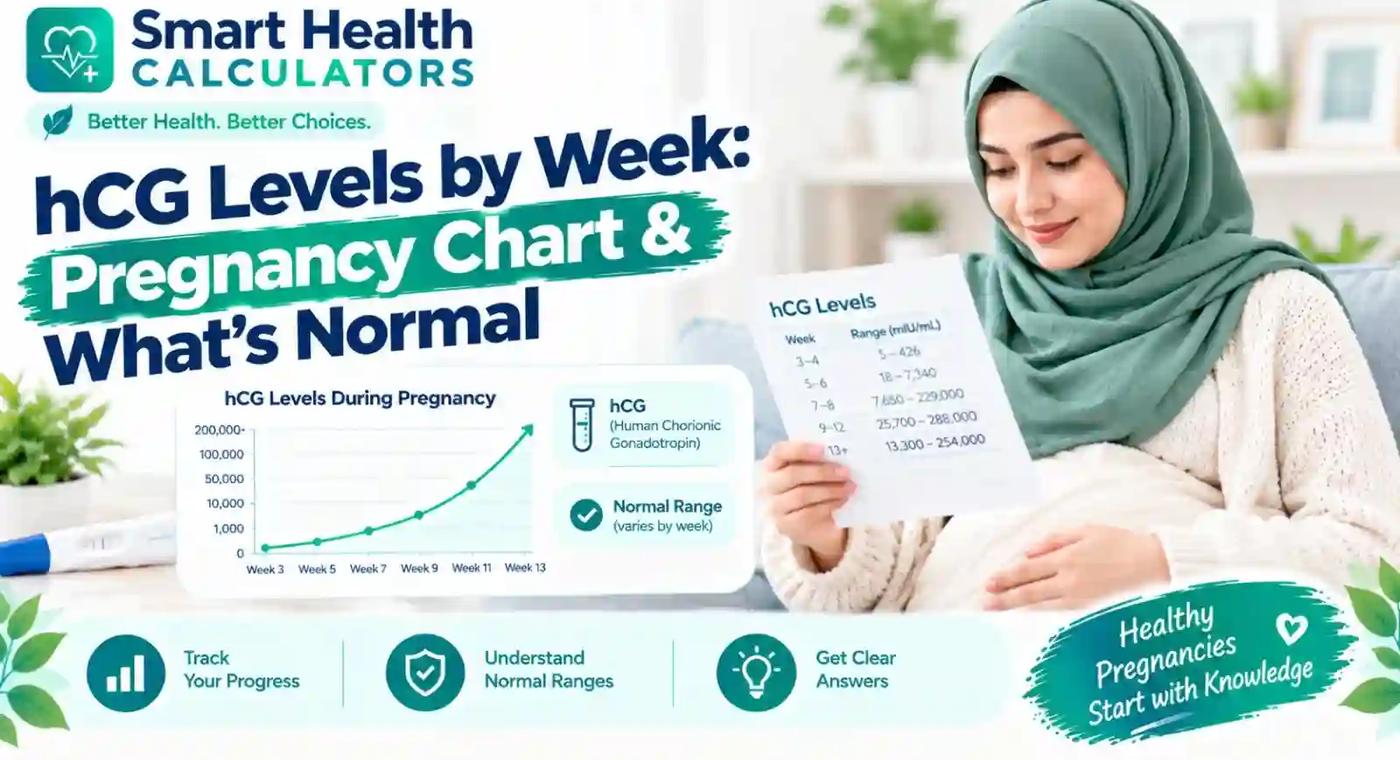
hCG Levels by Week: Pregnancy Chart, Normal Ranges
Explore hCG levels by week with a pregnancy chart, normal ranges, and testing tips. Learn how hCG changes and when to consult a healthcare professional.
This guide gives you a week-by-week hCG chart from a named medical source, explains how to read it, and covers the questions people ask most. Why do healthy pregnancies show such different numbers? Does hCG really have to double every 48 hours? Can a high or low result tell you anything on its own?
One theme runs through everything below: the range is wide, and the trend matters more than any single number.
Human chorionic gonadotropin (hCG) rises quickly in early pregnancy, peaks at roughly 8 to 11 weeks from the last menstrual period, and then falls and levels off. Normal values at any given week span a very wide range, so one result can't confirm or rule out a healthy pregnancy. Clinicians look at repeated tests over time, together with symptoms and ultrasound.
hCG Levels by Week: The Pregnancy Chart
This chart uses example reference ranges published by MedlinePlus, the U.S. National Library of Medicine's patient resource. Values are in milli-international units per milliliter (mIU/mL) and are counted in weeks from the first day of your last menstrual period (LMP).
| Weeks from LMP | Example hCG range (mIU/mL) |
|---|---|
| Not pregnant | Less than 5 |
| 3 weeks | 5 to 72 |
| 4 weeks | 10 to 708 |
| 5 weeks | 217 to 8,245 |
| 6 weeks | 152 to 32,177 |
| 7 weeks | 4,059 to 153,767 |
| 8 weeks | 31,366 to 149,094 |
| 9 weeks | 59,109 to 135,901 |
| 10 weeks | 44,186 to 170,409 |
| 12 weeks | 27,107 to 201,165 |
| 14 weeks | 24,302 to 93,646 |
| 15 weeks | 12,540 to 69,747 |
| 17 weeks | 8,240 to 51,793 |
| 18 weeks | 9,649 to 55,271 |
Source: MedlinePlus Medical Encyclopedia, "HCG blood test, quantitative." MedlinePlus notes that normal ranges can vary slightly among laboratories.
Please read this first: hCG levels vary widely between pregnancies and laboratories. This chart provides general reference information and cannot diagnose pregnancy viability, miscarriage, or ectopic pregnancy. Your healthcare professional can interpret your results in context and decide whether repeat blood tests or an ultrasound are needed. Severe or sudden abdominal pain, shoulder pain, faintness, or weakness during a possible pregnancy needs urgent medical care, not another hCG test.
Why I'm not blending charts
If you search online, you'll find several hCG charts that don't agree. That isn't a mistake. Different labs use different assays, different dating conventions, and different populations.
For example, the OHSU laboratory lists its own reference range for the 4-to-5-week window of 75 to 2,600 mIU/mL, while the MedlinePlus chart above gives separate ranges for 4 and 5 weeks. Both are legitimate. The practical rule is to compare your result to the reference range printed on your own lab report, because that's the one your clinician will use.
What Is hCG, and Why Is It Measured?
Human chorionic gonadotropin (hCG) is a hormone made by cells that will become the placenta, called trophoblast cells. It's often called "the pregnancy hormone" because a pregnancy test is looking for it.
What hCG does
In early pregnancy, hCG signals the corpus luteum (the structure left behind after ovulation) to keep producing progesterone. That progesterone maintains the uterine lining and supports the pregnancy until the placenta takes over hormone production later in the first trimester.
When it first appears
hCG production starts after the embryo implants in the uterine lining. MedlinePlus notes that hCG can appear in blood and urine as early as about 10 days after conception. Levels then climb steeply in the weeks that follow.
Why doctors measure it
A quantitative hCG blood test (also called a beta-hCG test) is used to:
- Confirm a pregnancy when a home test is unclear
- Track how levels change over time in early pregnancy
- Help evaluate bleeding or pain in early pregnancy
- Help investigate suspected ectopic pregnancy or early pregnancy loss
- Monitor hCG falling back to baseline after a pregnancy ends
- Check for certain non-pregnancy conditions that can raise hCG
How Pregnancy Weeks Are Counted on an hCG Chart
This trips up more people than any other detail, so it's worth getting right.
LMP dating vs conception dating
Most charts count weeks from the first day of your last menstrual period, not from the day you conceived. By that method, a pregnancy is already about two weeks along on the day of ovulation and conception.
So if your cycle is a textbook 28 days, you'd be about 4 weeks pregnant on the day your period is due.
A quick example
Suppose your last period began on September 1. Today is October 29. That's 58 days, or 8 weeks and 2 days by LMP dating.
Now suppose you ovulated late, on day 21 instead of day 14. Your embryo is a week younger than the LMP math suggests, and your hCG will look "low" for the week on the chart even though nothing is wrong. This is one of the most common reasons for results that don't match.
Tools to get your dates right
- Use our pregnancy calculator to convert your LMP into gestational weeks and an estimated due date.
- Read how dating works in our guide to pregnancy due dates and trimesters.
- If you know when conception happened, see how to calculate your conception date.
- If you tracked ovulation, our guide to ovulation signs and tracking explains how that shifts the math.
- To translate weeks into months, see pregnancy weeks to months.
How hCG Changes Through Pregnancy
Think of hCG as a curve with three phases.
Phase 1: The steep climb (about weeks 3 to 8)
After implantation, hCG rises quickly. This is when blood tests and early ultrasounds are most often used together, because the numbers are changing so fast.
Phase 2: The peak (roughly weeks 8 to 11)
Levels reach their highest point around the end of the first trimester's first half. In the MedlinePlus chart, the upper ranges for weeks 8 through 12 sit in the 135,000 to 200,000 mIU/mL territory. Some people feel their pregnancy symptoms, such as nausea, are strongest around this time, though symptoms and hCG don't follow each other perfectly.
Phase 3: The decline and plateau (from about week 12 or so)
After the peak, hCG falls and then settles at a lower level for the rest of the pregnancy. Seeing the numbers drop after week 10 or so is normal and isn't a warning sign. It's what the chart shows: the 14-to-18-week ranges are well below the peak.
If you're curious about what else changes during each stage, see our guide to pregnancy symptoms by trimester.
How to Read Your hCG Result
Step 1: Check the unit and the lab's range
Make sure your result is in mIU/mL (some labs use IU/L, which is numerically the same). Then find the reference range on your report.
Step 2: Match your result to the right week
Use the week from your LMP unless your clinician has re-dated the pregnancy by ultrasound.
Step 3: Remember that "in range" covers a huge span
Look at week 5 on the chart: 217 to 8,245 mIU/mL. That's a spread of nearly forty-fold. Two healthy pregnancies at the same week can have very different numbers.
Step 4: Focus on the trend
A single hCG value is a snapshot. Clinicians usually want two or more values, taken about 48 hours apart in early pregnancy, to see the direction.
A worked example
Here are two hypothetical people, both at 5 weeks by LMP:
| Person A | Person B | |
|---|---|---|
| hCG at 5 weeks | 400 mIU/mL | 6,000 mIU/mL |
| Within the example range (217 to 8,245)? | Yes | Yes |
| Does it tell us who is “doing better”? | No | No |
Both are inside the range. The more useful question is what each person's numbers do over the next few days, and what an ultrasound shows when it's time for one.
Does hCG Have to Double Every 48 Hours?
You'll see "hCG doubles every 48 to 72 hours" repeated everywhere. It's a useful rule of thumb in the very early weeks, but it's an oversimplification.
What's actually true
- In very early pregnancy, hCG often rises rapidly, and for many pregnancies it roughly doubles in a couple of days.
- The rate of rise slows as levels get higher. Past a few thousand mIU/mL, it may take longer than two days to double.
- Once levels approach the peak, they stop doubling at all, and that's normal.
Professional guidance on early pregnancy, including material from the American College of Obstetricians and Gynecologists, has moved away from a rigid doubling rule. Studies of normal pregnancies show that the minimum expected rise over 48 hours is smaller than a full doubling, especially when the starting level is higher. Clinicians weigh the starting value, the pattern, symptoms, and ultrasound findings.
What this means for you
- A rise that's slower than doubling doesn't automatically mean a problem.
- A rise that looks "perfect" doesn't guarantee a healthy pregnancy.
- A plateau or fall in early pregnancy deserves a conversation with your clinician, who will decide what to do next. It's not something to decide alone.
If you're tracking results, don't panic over a single ratio. Write down the date, time, and value of each result and share the whole sequence with your clinician.
What Does a Low hCG Level Mean?
"Low" can mean several things, and most of them aren't dramatic.
Common reasons a number looks low for the week
- Dating is off. You ovulated later than assumed, so you're not as far along as the calendar says. This is the most common explanation.
- It's simply early. The test was done soon after implantation.
- You're in the lower part of the normal range. Many healthy pregnancies live there.
Less common reasons
- Early pregnancy loss, including a biochemical pregnancy (a very early loss, detected only by a test)
- An ectopic pregnancy, where the embryo implants outside the uterus
- A pregnancy of unknown location (PUL), a term used when a pregnancy test is positive but no pregnancy can yet be seen on ultrasound
What to do about it
Don't interpret one low number on your own. Your clinician is likely to:
- Repeat the blood test after about 48 hours.
- Compare the two values.
- Arrange an ultrasound if appropriate.
For many people, a "low" first result followed by a good rise turns out to be fine. For others, the follow-up shows something that needs care. Either way, repeat testing and ultrasound give far better answers than a single number.
What Does a High hCG Level Mean?
A result above the range for your week isn't a diagnosis either.
Possible explanations
- Dating error. You may be further along than you think.
- Normal variation. Some healthy pregnancies run high.
- Multiple pregnancy. Twins or more can produce more hCG, because there's more placental tissue.
- Molar pregnancy (a rare abnormal growth of placental tissue) and certain other conditions can cause very high levels.
- Fertility treatment. If you've had an hCG trigger shot, injected hCG can linger in the blood for days and affect early readings.
Can high hCG mean twins?
It can, but it can't tell you. Average levels are higher in twin pregnancies, but the ranges overlap heavily with singleton pregnancies. Plenty of people with twins have unremarkable numbers, and plenty of people with a single baby have high ones. Only an ultrasound can tell how many embryos there are.
hCG Levels vs Ultrasound: How They Work Together
hCG is a hormone measurement. Ultrasound is a picture. Early in pregnancy, clinicians use both, because each fills in what the other can't.
What each one tells you
| hCG blood test | Transvaginal ultrasound | |
|---|---|---|
| What it measures | Hormone concentration | Pregnancy location and structures |
| Good for | Confirming pregnancy, tracking trends | Showing where the pregnancy is, seeing a gestational sac, yolk sac, and later cardiac activity |
| Limits | Can’t show location or viability on its own | Early on, there may be too little to see |
Why there's no single "magic number"
You may read that a gestational sac should be visible once hCG passes a particular number. Be careful with that idea. Thresholds depend on the equipment, the operator, the pregnancy, and the clinical picture. Professional guidance warns against using one hCG value alone to decide pregnancy location or viability.
If an ultrasound can't see a pregnancy yet and your hCG is rising, your clinician might simply schedule a repeat scan and repeat bloodwork. That's normal and often reassuring.
Blood Tests vs Home Tests
Quantitative vs qualitative
- Qualitative test: tells you yes or no. A home urine test is qualitative.
- Quantitative test: gives the exact number. This is the beta-hCG blood test.
Which detects pregnancy earlier?
Blood tests are generally more sensitive than urine tests, so they can detect pregnancy a little sooner. MedlinePlus lists the non-pregnant reference level as under 5 mIU/mL, while most home tests need a higher concentration in urine to turn positive. Sensitivity differs from brand to brand, so follow the instructions on your test.
What the NHS advises on timing
The NHS says most home pregnancy tests are reliable from the first day of a missed period. If you don't know when your period is due, test at least 21 days after unprotected sex. Very sensitive tests may work earlier, but a negative result that early isn't conclusive.
Why a urine test can be negative while a blood test is positive
Urine tests can be affected by how dilute your urine is and by the time of day. A blood test can pick up a lower concentration. That's why a clinician may order bloodwork if you have symptoms but a negative home test.
If you're not sure whether your symptoms point to pregnancy at all, read our guide to PMS vs pregnancy symptoms and the walk-through of the first signs of pregnancy.
hCG in Special Situations
After IVF or fertility treatment
People who've had IVF often have their hCG checked on a schedule, since the transfer date is known precisely. Dating by transfer date differs from LMP dating, so use the clinic's reference ranges, not a general chart. If you've had a trigger shot containing hCG, an early test may reflect injected hormone rather than pregnancy, so timing matters.
After a pregnancy loss
After a miscarriage or other loss, hCG gradually falls back toward the non-pregnant level. It can take days to weeks, depending on how far along the pregnancy was. Your clinician may check levels until they return to baseline. A test that stays positive for a while afterward is common and doesn't necessarily signal a problem, but it should be followed up as advised.
hCG outside of pregnancy
hCG isn't only a pregnancy hormone. Certain medical conditions can raise it in people who aren't pregnant, and some medications contain hCG. If you have an unexpected positive result with no possible pregnancy, talk to a clinician.
When to Get Medical Help
Most hCG questions can wait for a scheduled follow-up. Some symptoms can't.
Safety note: If pregnancy is possible and you have severe or sudden abdominal or pelvic pain, shoulder pain, fainting or marked dizziness, weakness, or heavy bleeding, seek urgent medical care. Don't wait for another hCG test.
ACOG's guidance on ectopic pregnancy describes sudden severe pain, shoulder pain, and weakness as possible signs of a life-threatening emergency.
Contact your clinician promptly if:
- Your hCG hasn't risen, or has fallen, on repeat testing
- You have bleeding with cramps in early pregnancy
- You have a positive test but a lot of one-sided pain
- You've had a previous ectopic pregnancy and think you may be pregnant again
- A result is flagged outside the range on your lab report and you haven't heard back
Practical Tips for Getting Through the Wait
Waiting for results is stressful. A few things make it easier.
- Write the numbers down. Record the date, time, lab, and value of each test.
- Keep the same lab if you can. Different assays can give slightly different readings, and trends are easier to read from one lab.
- Ask what the clinician wants to see. For example, "When should we repeat this, and what would make you want to see me sooner?"
- Avoid comparing yourself to forums. Anonymous numbers online have no dating, no context, and no lab information.
- Look after the basics. Sleep, hydration, and rest matter more than you'd think during anxious waiting. See our guides to sleep during pregnancy, pregnancy water intake, and natural ways to reduce stress.
- Check in with your mood. Our mental health checker and self check-in guide can help you notice when worry is taking over. They're awareness tools, not diagnoses.
If you're moving beyond the earliest weeks, our guides on how many weeks a full-term pregnancy lasts and 12 weeks pregnant in months may be helpful.
Why Choose Smart Health Calculators
There's a lot of hCG content online, and much of it quotes a chart without telling you where it came from. Here's how we try to do it differently:
- We name the source of the chart and explain where ranges differ.
- We avoid declaring any number "good" or "bad" in isolation.
- We build free tools, like the pregnancy calculator, to help you get dates right.
- We connect related guides so you can follow a topic from first question to next step.
Learn more about Smart Health Calculators, explore advanced tools at Smart Health Calculators, or contact us with questions or corrections. You can also browse our overview of free health calculators.
Frequently Asked Questions
What are normal hCG levels by week of pregnancy?
Normal hCG levels vary widely. Using example ranges from MedlinePlus, levels at 4 weeks from the last menstrual period run from about 10 to 708 mIU/mL, and at 8 weeks from about 31,366 to 149,094 mIU/mL. Always compare your result to the range on your own lab report.
What hCG level indicates pregnancy?
MedlinePlus lists the non-pregnant range as less than 5 mIU/mL. A result above that can indicate pregnancy, though your clinician will interpret it with your dates, symptoms, and repeat testing. Lab and test thresholds differ.
Does hCG need to double every 48 hours?
Not exactly. In very early pregnancy, hCG often rises quickly, but the pace slows as levels climb, and the expected rise depends on the starting value. Clinicians look at the overall pattern, not a rigid 48-hour rule.
Can hCG levels be low in a healthy pregnancy?
Yes. Many healthy pregnancies sit in the lower part of the range, and dating errors can make a normal level look low. A repeat test after about 48 hours is usually more informative than one low value.
Can high hCG levels mean twins?
They can be higher on average with twins, but a high result alone can't confirm it. Ranges overlap heavily, and only an ultrasound can show the number of embryos.
When do hCG levels peak during pregnancy?
Levels generally peak at about 8 to 11 weeks from the last menstrual period, then decline and plateau. The timing varies from person to person.
Do hCG levels decrease after the first trimester?
Yes. After the peak, hCG falls and stays at a lower level for the rest of pregnancy. A drop after week 10 or so is expected, and it's not a sign of a problem by itself.
Can one hCG test tell if a pregnancy is healthy?
No. One result is a snapshot. Clinicians rely on repeat tests, symptoms, and ultrasound to assess an early pregnancy.
What does it mean if hCG levels stop rising?
In early pregnancy, a plateau or a fall can have several explanations, including early pregnancy loss or an ectopic pregnancy. It needs prompt discussion with a healthcare provider, who will decide on next steps.
Can hCG levels detect an ectopic pregnancy?
hCG can't diagnose it alone. Clinicians use hCG trends together with transvaginal ultrasound and symptoms. Sudden severe pain, shoulder pain, fainting, or weakness are emergencies.
How do doctors use hCG with ultrasound?
hCG shows that pregnancy hormone is present and how it's changing. Ultrasound shows where the pregnancy is and what's developing. Together, they give a much clearer picture than either one alone.
Key Takeaways and Next Steps
- The range is wide. Healthy pregnancies at the same week can have very different hCG numbers.
- Trends beat single values. Two or more tests, usually about 48 hours apart in early pregnancy, tell a clearer story.
- Dating matters. Many "low" or "high" results are really dating differences.
- The doubling rule is a rough guide, not a pass-or-fail test.
- hCG and ultrasound work as a team. Neither one alone confirms viability.
- Urgent symptoms come first. Severe pain, shoulder pain, fainting, weakness, or heavy bleeding need immediate care.
What to do next:
- Confirm your gestational age with the pregnancy calculator.
- Find the reference range on your lab report and compare your number to it.
- Write down each result with its date and time.
- Ask your clinician when to repeat the test and what would change the plan.
- Keep the emergency warning signs in mind until you've been seen.
Want more tools and guides? Browse the Smart Health Calculators tools and the health blog.
Medical Disclaimer
This article is for general education only. It is not medical advice, diagnosis, treatment, prescription guidance, or a replacement for professional healthcare. Speak with a qualified healthcare professional for personal medical concerns, symptoms, pregnancy concerns, mental health crisis, medication questions, or before making major health changes.