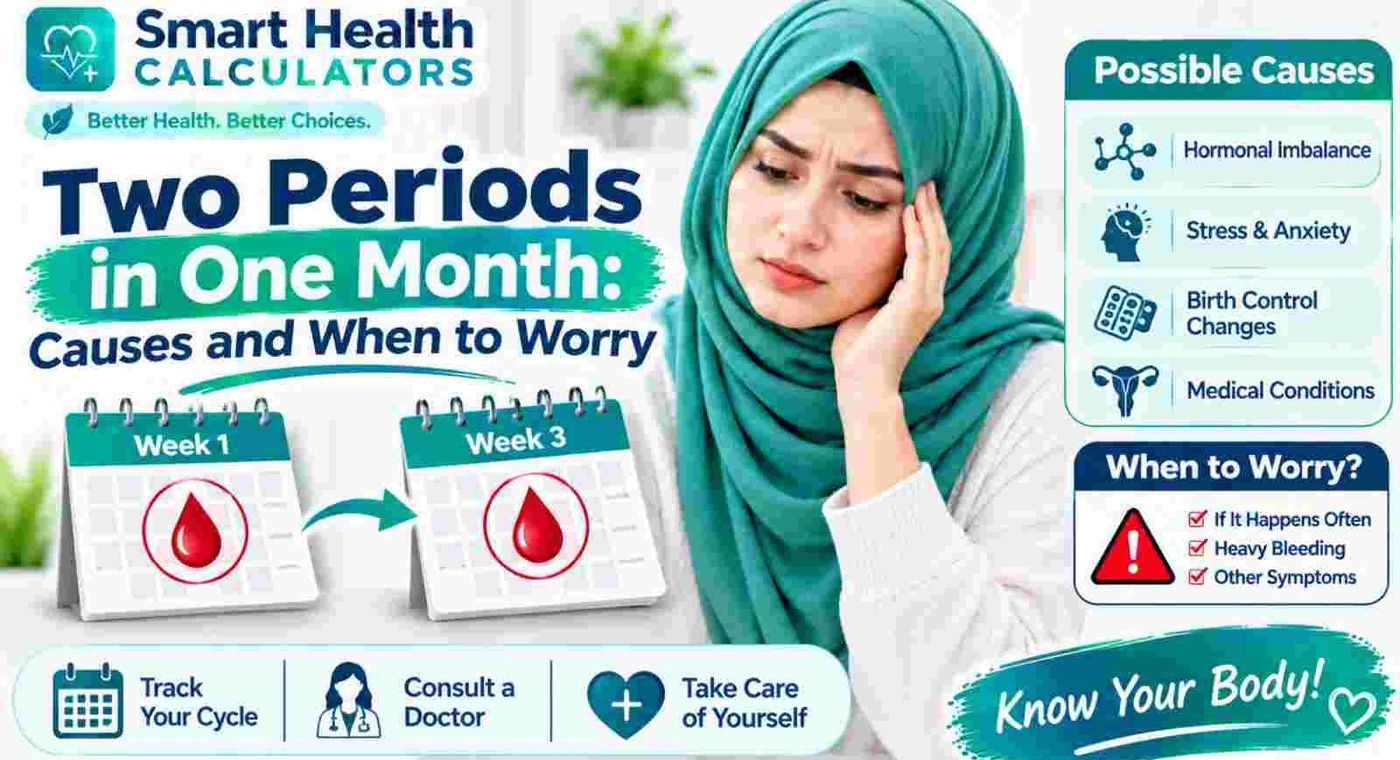
Two Periods in One Month: Causes and When to Worry
Two periods in one month? Learn when it’s normal, causes like hormones, stress and birth control, and warning signs that need a doctor.
You open your period tracker and see two start dates in the same month. Maybe the second bleed was lighter, maybe it was heavier than usual, and maybe you're simply wondering whether to worry.
The honest answer is that it depends on the numbers. Sometimes the explanation is just arithmetic. Other times it points to a hormone shift, a medication effect, pregnancy-related bleeding or a structural problem. This guide helps you work out which situation looks like yours, what to track before a doctor visit, and which signs mean you shouldn't wait.
Is It Normal to Have Two Periods in One Month?
It can be. The key is the gap between the first days of your periods, not how many appear on a calendar page.
Doctors count a menstrual cycle from the first day of one period to the first day of the next. Cleveland Clinic describes a normal cycle as 21 to 35 days, with an average of about 29 days. NI Direct, a UK health service, gives an average of 28 days and says cycles can vary from 24 to 35. The ranges differ slightly by source, and that's normal. Medical bodies don't agree on one exact number.
The calendar-month math
Here is the part most articles skip. Take a perfectly healthy 28-day cycle.
- Period starts January 2.
- Next period starts January 30.
- Both fall in January, which has 31 days.
A 30-day cycle can do it too if your period starts on the 1st (January 1 and January 31). In February, a cycle of 27 days or shorter can produce two starts if the first one lands on the 1st.
So the first question isn't "why two periods?" but "how many days apart were they?" If the gap was 24 to 35 days, you probably just had a short month and a cycle on the short side of normal.
When it isn't just math
If the second bleed came fewer than 21 days after the first one began, medical sources treat that as a frequent-cycle pattern worth looking into. MedlinePlus lists cycles "longer than 35 days or shorter than 21 days" as abnormal, and Healthline defines polymenorrhea as a cycle shorter than 21 days.
One short cycle isn't an alarm. A repeat pattern, or a change from what's normal for you, is more informative.
How the Menstrual Cycle Works
Understanding the machinery makes the causes easier to follow.
Each cycle has two broad halves, with ovulation in the middle.
- Follicular phase. The brain signals the ovaries, and a follicle develops. Estrogen rises and the uterine lining (the endometrium) thickens.
- Ovulation. An egg is released. Our guide to ovulation signs and how to track ovulation explains the physical clues.
- Luteal phase. After ovulation, progesterone rises to stabilize the lining. If there's no pregnancy, hormone levels fall and the lining sheds. That is your period. For more on this stage, see our explainer on the luteal phase.
The follicular phase is the flexible one. It can stretch or shrink depending on stress, illness, travel or hormone changes. The luteal phase tends to be steadier. That's why a "short cycle" is usually a shortened follicular phase, or a cycle where ovulation didn't happen at all.
When ovulation doesn't happen, the lining can keep building under estrogen alone and then shed unpredictably. MedlinePlus describes this as anovulatory uterine bleeding, and it notes the pattern is more common in teenagers and in people approaching menopause.
If you want to see where you are in your own cycle, our period calculator guide and fertility window calculator guide walk through the dates.
Medical Terms You'll See
The vocabulary overlaps, so here's a plain-language key.
| Term | What it means |
|---|---|
| Polymenorrhea | Cycles shorter than 21 days, so periods come unusually often |
| Abnormal uterine bleeding (AUB) | A broad term for bleeding that’s abnormal in timing, length or amount |
| Intermenstrual bleeding | Bleeding between expected periods |
| Breakthrough bleeding | Unscheduled bleeding, often linked to hormonal contraception |
| Spotting | Light bleeding outside your period, usually not enough to need a pad |
| Oligomenorrhea | The opposite problem: periods more than 35 days apart |
Doctors also use the FIGO PALM-COEIN system to sort the causes of abnormal bleeding into structural ones (such as polyps and fibroids) and non-structural ones (such as ovulation problems and coagulation disorders). You don't need to memorize it. It simply explains why a clinician's questions cover both hormones and anatomy.
Common Causes of Getting Your Period Twice
Based on the sources reviewed, the causes fall into five groups. We'll go through each.
Natural cycle variation
Short cycles happen. Some people simply have a 24- or 25-day rhythm, and Healthline notes that sometimes there's no abnormality and the cycle length is just normal for that person. If your cycles have always been around 24 days, two periods in a 31-day month will happen a few times a year.
Hormone changes and ovulation problems
Estrogen and progesterone steer the whole process. NI Direct notes that a hormone imbalance is not unusual for a few years after puberty and again before menopause. If ovulation is skipped or delayed, bleeding can arrive early, late or erratically.
Contraception and medication
Hormonal methods can change bleeding patterns. NHS-linked guidance lists the progestogen-only pill, the contraceptive injection and the intrauterine system among the methods that can affect periods. MedlinePlus lists breakthrough bleeding with oral contraceptives and IUD use among possible causes. Cleveland Clinic adds that irregularity can last up to six months after stopping birth control, and that blood thinners and steroids can also play a role.
Structural and medical conditions
Fibroids, polyps, adenomyosis, pelvic infection, cervical inflammation and endometrial thickening are all on MedlinePlus's list. So are thyroid and pituitary disorders, diabetes, bleeding disorders and polycystic ovary syndrome.
Pregnancy-related bleeding
Bleeding in pregnancy is not a period, even if it looks like one. It can come from implantation, early miscarriage or ectopic pregnancy. That's why the first practical step is often a pregnancy test.
Cause-and-Symptom Table
Use this as a map, not a diagnosis. Many causes overlap.
| Possible cause | Typical clues | Next step |
|---|---|---|
| Normal short cycle | Normal short cycle | Track the dates |
| Anovulatory cycle | Unpredictable timing, flow varies, often in teens or near menopause | Track; see a clinician if it repeats |
| Perimenopause | Changing cycle length, usually in the 40s | Mention age and pattern to your doctor |
| Stress or lifestyle change | Recent upheaval, big weight change, intense exercise | Review habits; see a doctor if it persists |
| Hormonal contraception | Started, stopped or changed method recently | Ask the prescriber; patterns often settle |
| PCOS | Irregular ovulation, sometimes acne or excess hair growth | Evaluation and testing |
| Thyroid problem | Fatigue, weight change, temperature sensitivity | Blood test |
| Fibroids or polyps | Heavy flow, longer periods, bleeding between periods | Pelvic ultrasound |
| Infection | Pain, unusual discharge, fever | Prompt medical care |
| Pregnancy-related | Missed or late period, positive test, cramps | Pregnancy test and medical advice |
Check the pregnancy question first if there's any chance. Our guides to signs of pregnancy, pregnancy tests and negative pregnancy test meaning explain how to read results, and our pregnancy calculator can help with timing.
Hormonal Imbalance and Frequent Periods
"Hormonal imbalance" is a catch-all, so let's be specific.
Estrogen builds the lining, and progesterone steadies and later releases it. If ovulation doesn't occur, progesterone never rises properly, and the lining can shed unpredictably. That can look like a very short cycle, a long one, or a mix of light and heavy bleeds.
Two conditions often come up here.
PCOS. A note on terminology: the NHS page we reviewed now uses the name "polyendocrine metabolic ovarian syndrome (PMOS)," saying it used to be called polycystic ovary syndrome. Both names are in use, so you may see either. PCOS is better known for irregular or infrequent ovulation, so it doesn't mean everyone with it gets two periods in a month. It can cause unpredictable bleeding in either direction.
Thyroid disorders. NHS-linked guidance lists thyroid problems among possible causes of irregular periods, and MedlinePlus includes thyroid and pituitary disorders. A simple blood test is how doctors check.
Don't self-diagnose from a list. If your cycles keep changing, testing beats guessing.
Can Stress Cause Two Periods in One Month?
Stress can affect cycles. NHS-linked guidance names "stress and anxiety" among the causes of irregular periods, and MedlinePlus lists stress alongside exercise and diet changes.
The mechanism is plausible. The brain regions that manage stress also sit upstream of the hormones that drive ovulation. A tough month can delay ovulation, skip it, or shift the timing of the next bleed.
Still, stress shouldn't be the default explanation for bleeding that is heavy, painful or repeated. A doctor needs to rule out the other causes first.
If stress is part of your picture, these may help: our guides on natural ways to reduce stress, how stress affects sleep quality and sleep hygiene, plus the mental health checker.
Weight and exercise
NI Direct lists "extreme weight loss or weight gain" and "too much exercise." Cleveland Clinic adds very low body fat from intense exercise. If you've recently changed your training load or diet, mention it at your appointment. You can check where you stand with our BMI calculator and the healthy BMI range guide.
Perimenopause and Age
In the years before menopause, cycles often become unpredictable. Healthline lists perimenopause among the causes of polymenorrhea. The NHS-linked page puts the start of menopause at usually between 45 and 55.
During this transition, a cycle may shorten before it lengthens. Two periods in a month at 44 doesn't automatically mean something is wrong. But unusual bleeding at any age still deserves a conversation, because other conditions can look the same.
Medical Conditions That Cause Frequent Bleeding
Uterine fibroids and endometrial polyps
These are growths in or on the uterus. They are usually benign. Depending on their position, they can lead to heavy periods, longer periods or bleeding between periods. A pelvic ultrasound can detect them, according to Cleveland Clinic.
Endometriosis and adenomyosis
Endometriosis is on Healthline's list for polymenorrhea and spotting. Adenomyosis appears on MedlinePlus's list. Both often involve pelvic pain along with bleeding changes.
Infections
Pelvic inflammatory disease and cervicitis are listed by MedlinePlus, and Healthline names chlamydia and gonorrhea. These can cause bleeding between periods, often with unusual discharge or pain. They're treatable with antibiotics, which is a good reason not to wait.
Bleeding disorders and other illnesses
MedlinePlus lists bleeding disorders, diabetes, lupus and cirrhosis among the possible contributors. They're less common explanations, but they're why a doctor may order blood work rather than assume it's hormonal.
What about cancer?
It's a fair worry, so here's a calibrated answer. Cleveland Clinic includes uterine and ovarian cancer on its list of conditions linked with irregular periods, and Healthline says it's "very rarely" the reason for frequent cycles. A second period does not mean cancer. Persistent, unexplained or post-menopausal bleeding is the kind of pattern that should always be investigated, which is exactly why you shouldn't ignore it.
Spotting or a Second Period? How to Tell
This is the question behind many searches. Not every second bleed is a period.
| Feature | Likely a period | Likely spotting |
|---|---|---|
| Amount | Needs a pad, tampon or cup | A few drops, a pantyliner is enough |
| Duration | Several days | A day or two |
| Duration | Several days | A day or two |
| Pattern | Builds, peaks, then tapers | Light and inconsistent |
| Color | Bright to dark red | Pink, red or brown |
| Cramping | Often present | Often absent or mild |
A few situations to know about:
- Mid-cycle spotting around ovulation is described by some sources as common, but a doctor should assess repeated bleeding between periods.
- Implantation bleeding is light and may occur around the time a period is expected. Read our guide on implantation bleeding for how it compares with a period.
- Brown blood is typically older blood. Our article on why period blood looks brown covers that in depth.
- Withdrawal or breakthrough bleeding on hormonal contraception isn't the same as a natural period.
If you're also dealing with symptoms that overlap with early pregnancy, our PMS vs pregnancy symptoms guide and pregnancy symptoms but negative test article can help you sort the signals.
When Should You Worry About Frequent Periods?
Most single episodes settle. But some signs mean you should call a clinician soon, and some mean you should get urgent help.
Book an appointment if:
- Your periods are coming more often than once a month, repeatedly. NI Direct lists this as a reason to see a GP.
- Your cycle is shorter than 21 days, again and again.
- You bleed between periods or after sex.
- Your period lasts longer than seven days.
- Your cycles suddenly change after being regular for years. Cleveland Clinic lists sudden irregularity as a reason to call.
- Heavy or prolonged periods have gone on for three or more cycles, a threshold MedlinePlus uses.
- You might be pregnant and are bleeding.
- You have symptoms of anemia: tiredness, dizziness, paleness or breathlessness on exertion. Healthline mentions these.
Get urgent care if:
- You soak a pad or tampon every hour for two to three hours in a row. Both MedlinePlus and Cleveland Clinic give this as a threshold.
- You pass clots larger than a quarter, per Cleveland Clinic.
- You have severe pain, fever or lower abdominal pain.
- You feel faint, weak or light-headed because of the bleeding.
- You have fever, vomiting, diarrhea, fainting or dizziness during a period, which Cleveland Clinic flags as possible toxic shock syndrome symptoms.
- You are pregnant, or think you might be, with heavy bleeding or one-sided pain.
If any of these apply, don't wait for a routine appointment. Anxious about the visit itself? Our article on coping with anxiety before a health checkup offers practical ways to prepare.
How Doctors Diagnose Abnormal Menstrual Bleeding
Knowing what to expect makes the appointment easier.
Step 1: History and tracking. The clinician will ask about cycle dates, flow, pain, medications, contraception, stress, weight changes and sexual history. Cleveland Clinic recommends keeping a record of period dates, flow, cramping and bleeding between periods.
Step 2: Examination. A physical and pelvic exam may follow.
Step 3: Tests. MedlinePlus lists the possibilities:
- Pregnancy test
- Thyroid function tests
- Complete blood count and iron level
- Pap and HPV tests, and urinalysis
- Pelvic ultrasound or sonohysterography
- Hysteroscopy or endometrial biopsy in selected cases
Not everyone needs every test. The point is to separate hormonal, structural, infectious and pregnancy-related causes.
What to bring
- Start dates for your last three to six periods
- A note on how heavy each bleed was and how long it lasted
- A list of medications, supplements and contraception
- Any recent changes in weight, training, sleep or stress
A quick way to record dates is our period calculator guide. Even a phone note works, as long as you log each first day.
Treatment Options for Frequent Periods
Treatment depends on the cause. That's the one thing every source we reviewed agrees on, so nothing here is a recommendation for you personally.
Cleveland Clinic and MedlinePlus describe options such as:
- Hormonal treatments, including birth control pills, patches, injections or a hormone-releasing IUD
- Medicines for heavy bleeding, such as tranexamic acid or anti-inflammatory pain relievers
- Antibiotics if there's an infection
- Thyroid treatment if a thyroid problem is found
- Procedures for structural problems, such as removing polyps or fibroids, endometrial ablation or uterine artery embolization
- Hysterectomy, only as a last resort
MedlinePlus also advises avoiding aspirin if you have bleeding problems. Don't start or stop hormonal medication without talking to a clinician, because the right choice depends on whether you want to become pregnant, your age and the underlying cause.
Lifestyle steps that may help
Lifestyle changes can support treatment, but they aren't a substitute for diagnosis.
- Keep exercise moderate and avoid sudden extremes.
- Make weight changes gradual.
- Protect your sleep.
- Manage stress with techniques you'll actually use.
Our sleep quality checker is a quick way to see whether sleep might be part of the problem.
A Few Real-World Scenarios
Examples help show how this plays out. These are illustrative and not medical cases.
Scenario one: the short month. Priya's cycles are 28 days. Her period starts on March 2 and again on March 30. She has two periods in March and nothing is wrong.
Scenario two: the 19-day gap. Sara's period started on the 3rd. Another bleed arrives on the 22nd and lasts five days. That gap is under 21 days. If it repeats, she should see a clinician and bring her tracked dates.
Scenario three: the new pill. Aisha switched contraceptives six weeks ago and has had light bleeding between periods. That fits breakthrough bleeding, but she should still tell her prescriber, who may adjust the plan.
Scenario four: possible pregnancy. Nadia's period was late, then she had light bleeding. A pregnancy test and a medical check come before assumptions. Her situation isn't a "second period."
How to Track Your Cycle Properly
Good records turn a vague worry into usable information.
- Mark day 1 of every period, meaning the first day of real flow.
- Count the days between day 1 dates. That's your cycle length.
- Note flow as light, medium or heavy, and how many pads or tampons you use.
- Log spotting separately so it doesn't get counted as a period.
- Record symptoms: pain, mood, discharge, headaches.
- Add context: medication changes, illness, travel, stress, exercise.
After three cycles, you'll see your pattern. Cleveland Clinic notes that cycle length varying by more than nine days between cycles counts as irregular, so those records matter.
Our tools can also help with timing around ovulation and conception; see the fertility window calculator guide and the guide to calculating a conception date.
Why Choose Smart Health Calculators
Health questions deserve clear answers and honest limits. Why choose Smart Health Calculators? Our guides are built around plain-language explanations, named sources and tools that help you track your own numbers, without pretending to replace a clinician.
Explore Advanced Tools at Smart Health Calculators to estimate cycle dates, check your BMI, review sleep and more. If you'd like early access to what's coming next, Book a seat at Advance Free Tools offered by Smart Health Calculators.
Frequently Asked Questions
Is having two periods in one month normal?
It can be, if the two start dates are at least 21 to 24 days apart. A 28-day cycle can start on the 2nd and again on the 30th. If the gap is under 21 days, or it keeps happening, see a clinician.
Why am I getting my period twice in one month?
Common reasons include a naturally short cycle, hormonal changes, contraception effects, stress or weight changes, and perimenopause. Structural problems, infections and pregnancy-related bleeding are other possibilities. Tracking your dates helps narrow it down.
Can stress cause two periods in one month?
Stress can affect ovulation and cycle timing. NHS-linked guidance lists stress and anxiety among causes of irregular periods. But heavy, painful or repeated bleeding shouldn't be blamed on stress without a medical check.
Can hormonal imbalance make periods come twice?
Yes, it can. If ovulation is delayed or skipped, the lining may shed unpredictably. Thyroid and pituitary conditions and PCOS can all affect the pattern, and blood tests help sort it out.
Is a period every 15 days normal?
No. A 15-day cycle is shorter than the 21-day lower limit that MedlinePlus and Healthline use. Occasional early bleeds happen, but repeated 15-day gaps should be evaluated.
What does it mean if my period comes twice?
It depends on the gap and the flow. A 24- to 35-day gap with normal flow is usually just calendar overlap. A gap under 21 days, or light bleeding that isn't a true period, may point to a hormonal, structural or other cause.
Can pregnancy cause bleeding twice in one month?
Pregnancy-related bleeding can happen, including implantation bleeding, miscarriage and ectopic pregnancy. It isn't a period. If you could be pregnant, take a test and seek medical advice.
Can PCOS cause frequent menstrual bleeding?
PCOS is better known for irregular or infrequent ovulation, but it can cause unpredictable bleeding. Not everyone with PCOS has frequent periods.
Can thyroid problems cause periods twice a month?
Thyroid problems are listed among possible causes of irregular periods by NHS-linked guidance and MedlinePlus. A thyroid function blood test is the usual check.
Is bleeding two weeks after my period normal?
Occasional light spotting mid-cycle can happen, but repeated bleeding between periods needs a medical review. NHS-linked guidance and NI Direct both advise seeing a GP about bleeding between periods.
Can birth control pills cause frequent periods?
Hormonal contraception can cause breakthrough bleeding, especially in the first months or after changing methods. Tell your prescriber if it continues, because a different option may help.
Does perimenopause cause two periods in one month?
It can. Cycles often shorten and become unpredictable in the years before menopause. Unusual or heavy bleeding still needs evaluation at any age.
How many days between periods is considered normal?
Cleveland Clinic gives 21 to 35 days. NI Direct says 24 to 35. Different sources use slightly different ranges, so what matters most is your own usual pattern.
When is frequent menstrual bleeding dangerous?
Seek urgent care if you soak a pad or tampon every hour for two to three hours, pass large clots, feel faint, have severe pain or fever, or are pregnant with heavy bleeding.
What should I do if my period comes twice monthly?
Count the days between first days of bleeding, note flow and symptoms, rule out pregnancy, and book an appointment if it repeats or any warning sign appears.
Final Takeaways
- Two periods in a calendar month can be normal when your cycle is 30 days or shorter. Count the days between first days of bleeding before you worry.
- A repeated gap under 21 days, bleeding between periods, flow that lasts over seven days or a sudden change in your pattern deserves a medical check.
- The causes range from natural variation and hormones to contraception, structural conditions, infection and pregnancy-related bleeding.
- Test for pregnancy early if there's any chance.
- Track at least three cycles. Dates, flow and symptoms give your doctor something concrete to work with.
Medical Disclaimer
This article is for general education only. It is not medical advice, diagnosis, treatment, prescription guidance, or a replacement for professional healthcare. Speak with a qualified healthcare professional for personal medical concerns, symptoms, pregnancy concerns, mental health crisis, medication questions, or before making major health changes.