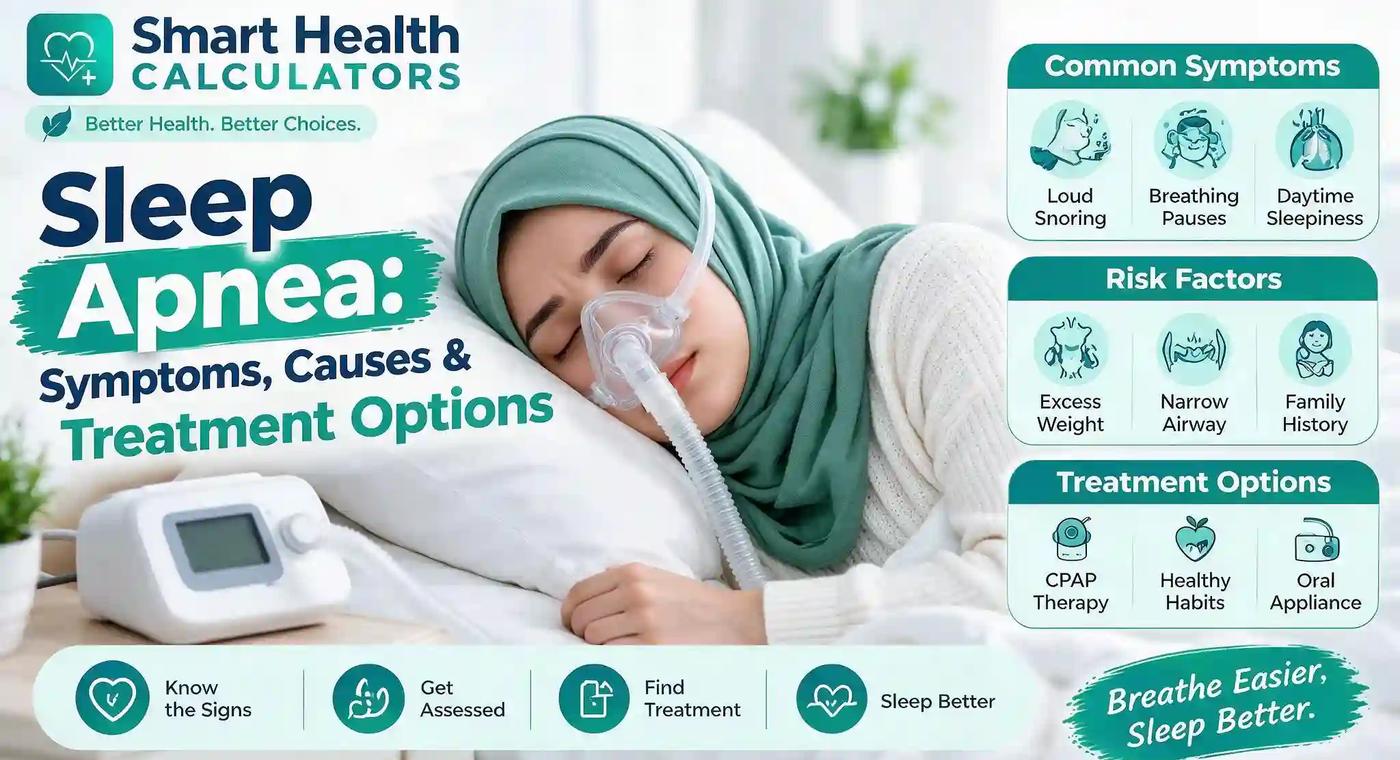
Sleep Apnea: Symptoms, Causes, Diagnosis & Treatment Guide
Snoring, gasping, or tired after a full night’s sleep? Learn the signs of sleep apnea, its causes, how it’s diagnosed, and which treatments work.
You sleep eight hours and wake up feeling like you slept for three. Your partner says you snore, and that sometimes the snoring stops and you seem to stop breathing. Then you gasp, turn over, and start again. You don't remember any of it.
That pattern is often sleep apnea, a common and treatable sleep-related breathing disorder. This guide explains what it is, how to recognize it, what causes it, how doctors diagnose it, how severity is measured, and which treatments work. It also explains when to see a doctor. If you have already been prescribed a machine, our companion guide on how a CPAP machine works and how to use it goes into setup and daily use.
What Is Sleep Apnea?
Sleep apnea is a sleep disorder in which breathing repeatedly stops or becomes very shallow during sleep. The pauses can last several seconds or longer, can happen many times per hour, and often cause loud snoring, fragmented sleep, and daytime tiredness. The most common form is obstructive sleep apnea (OSA), where the throat tissues relax and block the airway.
The short answers:
- Is it serious? Yes, it can be. Untreated sleep apnea is linked with high blood pressure, heart problems, and daytime accidents.
- Can I have it without knowing? Yes. Many people don't remember the awakenings and only learn from a partner or a sleep test.
- Does everyone who snores have it? No. Snoring is common, and many snorers don't have sleep apnea.
- Can it be treated? Yes. Options include CPAP therapy, oral appliances, lifestyle changes, and in some cases surgery or implanted devices.
- Can it be cured? For many people it is managed rather than cured, though treating a cause such as significant excess weight can reduce its severity.
What Happens in Your Body
During sleep, the muscles that hold your airway open relax. In obstructive sleep apnea, they relax too much, and the soft tissue at the back of the throat collapses. Airflow drops or stops, your oxygen level can dip, and your brain briefly wakes you to restart breathing. These brief arousals fragment your sleep, even when you stay in bed all night.
The National Heart, Lung, and Blood Institute describes sleep apnea as repeated breathing interruptions during sleep, and the NHS sleep apnoea guide gives clear, patient-friendly explanations of the same condition.
What Are the Common Symptoms of Sleep Apnea?
Symptoms happen both at night and during the day. Some people have only a few.
Nighttime Symptoms
- Loud, frequent snoring
- Pauses in breathing that a partner notices
- Gasping, choking, or snorting during sleep
- Waking up with a dry mouth or sore throat
- Restless sleep and frequent waking
- Needing to urinate during the night
- Night sweats
Daytime Symptoms
- Excessive daytime sleepiness
- Morning headaches
- Trouble concentrating or remembering things
- Irritability, low mood, or anxiety
- Falling asleep during quiet activities, such as reading or driving
- Reduced interest in sex
Can You Have Sleep Apnea Without Snoring?
Yes. Snoring is a common sign but not a requirement. Some people, including some women and people with central sleep apnea, have fatigue, insomnia-like symptoms, or morning headaches without obvious loud snoring.
Symptoms in Women
Women with sleep apnea are more likely to report fatigue, low energy, morning headaches, mood changes, and trouble sleeping instead of classic loud snoring. That can delay diagnosis, so don't dismiss symptoms because they don't match the stereotype.
Does Every Snorer Have Sleep Apnea?
No. Simple snoring happens when relaxed tissues vibrate, without significant breathing interruptions. The difference matters, and only testing can tell them apart. If snoring comes with witnessed pauses, gasping, or daytime sleepiness, ask your doctor about a sleep evaluation.
Warning Signs That Need Prompt Attention
See a doctor soon if you fall asleep while driving or at work, have chest pain or an irregular heartbeat at night, or have very high blood pressure that is hard to control. Seek emergency care for chest pain, severe shortness of breath, or fainting.
What Causes Sleep Apnea?
Causes depend on the type, but most cases of obstructive sleep apnea involve a narrow or collapsible airway.
Common Causes of Obstructive Sleep Apnea
- Excess weight. Fat deposits around the neck and throat can narrow the airway. Excess weight is a major risk factor, though not the only one.
- Airway anatomy. A naturally narrow throat, large tonsils or adenoids, a thick neck, a recessed chin or small jaw, or a large tongue.
- Muscle tone. Throat muscles relax more with age.
- Nasal blockage. Chronic congestion or a deviated septum can contribute.
- Alcohol and sedatives. They relax the throat muscles further and can worsen apnea.
- Sleeping on your back. Gravity can pull the tongue and soft palate backward.
- Smoking. It irritates and inflames the airway.
Can Thin People Have Sleep Apnea?
Yes. Airway anatomy, age, family history, and nasal problems can cause sleep apnea in people of any weight.
Causes of Central Sleep Apnea
Central sleep apnea is different. The airway is not blocked. Instead, the brain temporarily fails to send the right signals to the breathing muscles. It is more often linked with heart failure, stroke, certain medicines such as opioids, and high altitude.
What Are the Different Types of Sleep Apnea?
There are three main types.
- Obstructive sleep apnea (OSA): the most common type. The airway is physically blocked by relaxed throat tissue while the body keeps trying to breathe.
- Central sleep apnea (CSA): the brain doesn't signal the breathing muscles properly, so effort pauses.
- Mixed (complex) sleep apnea: a combination of obstructive and central events. Some people develop central events when they start CPAP therapy.
Sleep Apnea vs. Snoring vs. Insomnia
- Snoring is noise from vibrating tissue. It can occur with or without apnea.
- Sleep apnea involves actual breathing pauses or reductions.
- Insomnia is difficulty falling or staying asleep, and it can occur alongside sleep apnea, which complicates diagnosis.
Related Conditions with Similar Symptoms
Restless legs syndrome, periodic limb movement disorder, nocturnal asthma, and upper airway resistance syndrome can look like sleep apnea. This is another reason a sleep specialist should evaluate persistent symptoms.
Who Is at Risk of Developing Sleep Apnea?
Risk goes up if you have:
- Overweight or obesity
- A larger neck circumference
- Age over 40, though it affects all ages
- Male sex, although risk in women rises after menopause
- A family history of sleep apnea
- A narrow airway or enlarged tonsils
- Chronic nasal congestion
- Regular alcohol or sedative use
- Smoking
- High blood pressure, type 2 diabetes, heart failure, atrial fibrillation, or stroke history
Sleep apnea is common. A 2025 research estimate suggested that roughly 83.7 million adults in the United States were living with obstructive sleep apnea in 2024. That is a US-specific estimate from one study, not a global number, and figures vary by method, so check current sources before quoting it.
Sleep Apnea in Children
Children can have sleep apnea too, often linked with enlarged tonsils or adenoids. Signs include loud snoring, restless sleep, mouth breathing, bedwetting, behavior or attention problems, and poor school performance. Talk to a pediatrician if you notice these signs. Treatment may involve removing the tonsils and adenoids, among other options.
How Is Sleep Apnea Diagnosed?
Diagnosis starts with your story and ends with a sleep test.
Step 1: Your Symptoms and History
Your doctor asks about snoring, daytime sleepiness, medicines, alcohol, and medical conditions, and may examine your mouth, throat, nose, and neck. They may use screening tools such as the Epworth Sleepiness Scale (which rates daytime sleepiness) and the STOP-Bang questionnaire (which estimates risk). These screen for risk. They don't diagnose sleep apnea on their own.
Step 2: A Sleep Test
The American Academy of Sleep Medicine recommends objective testing for adults, rather than diagnosing based on questionnaires alone. There are two main options:
- Polysomnography (PSG): an overnight study in a sleep lab that records breathing, oxygen level, heart rhythm, brain waves, and muscle activity. It is more detailed and suits people with other medical conditions or complex symptoms.
- Home sleep apnea test (HSAT): a simpler portable device you use at home. It suits some adults with a high likelihood of moderate to severe obstructive sleep apnea and no major other conditions. A normal or unclear result may need follow-up testing in a lab.
What Happens During an Overnight Sleep Study?
You arrive in the evening, and a technologist attaches small sensors to your scalp, face, chest, and finger. You sleep in a private room while equipment records your night. It is painless, though it feels unfamiliar. A sleep physician reads the results.
Understanding Sleep Apnea Severity: Mild, Moderate, and Severe
Doctors measure severity with the apnea-hypopnea index (AHI), the number of apneas (stopped breathing) and hypopneas (reduced breathing) per hour of sleep. Commonly used adult categories, as explained by the NHS, are:
- Normal or minimal: fewer than 5 events per hour
- Mild: 5 to 14 events per hour
- Moderate: 15 to 29 events per hour
- Severe: 30 or more events per hour
An AHI number alone doesn't tell the full story. Symptoms, oxygen levels, other health conditions, and your daily functioning also matter, and a person with mild AHI can feel very unwell. Your doctor interprets the result in context. Some reports also include a respiratory disturbance index (RDI), which counts additional subtle breathing events, and your oxygen saturation during the night.
What Are the Treatment Options for Sleep Apnea?
Treatment depends on the type, severity, your symptoms, and your preferences. Many people use more than one approach.
CPAP Therapy
Continuous positive airway pressure (CPAP) is the most widely used treatment for moderate to severe obstructive sleep apnea. A machine delivers a steady flow of pressurized air through a mask to keep the airway open during sleep. It controls breathing events while you use it, but it doesn't cure the condition. See our full guide on CPAP machines and how to use them, and the NHLBI's CPAP overview.
Related devices:
- APAP: adjusts pressure automatically within a range.
- BPAP (bilevel): uses higher pressure when you breathe in and lower when you breathe out, for people who need extra support.
- ASV: a specialized device for certain central or complex apnea.
Your clinician chooses the device and pressure. Don't change settings yourself.
Common CPAP side effects include dry mouth, mask leaks, skin irritation, and congestion, and most are fixable with a better fit or humidity changes.
Oral Appliances
A custom-fitted mouthpiece, usually made by a dentist trained in sleep medicine, moves the lower jaw forward to keep the airway open. These are often used for mild to moderate obstructive sleep apnea, or for people who can't tolerate CPAP. The American Academy of Dental Sleep Medicine provides clinical standards for this approach. Appliances need professional fitting and follow-up.
Lifestyle Changes
Lifestyle changes support treatment. They are not a substitute for indicated medical care.
- Weight management. For people with overweight or obesity, losing weight can reduce severity and sometimes improve symptoms substantially. Check your baseline with the BMI Calculator, look at waist-to-height ratio, and read our weight loss strategies. The Calorie Intake Planner can help you plan. If you have a history of disordered eating, talk to a healthcare professional before using calorie tools.
- Limit alcohol and sedatives, especially near bedtime.
- Quit smoking.
- Change your sleep position. Sleeping on your side may help if apnea is worse on your back.
- Treat nasal congestion with your doctor's guidance.
- Stay active. Regular exercise helps, even without weight loss. Try the Workout Planner and our beginner home workout plan.
- Build good sleep habits. Read about sleep hygiene and a calming nighttime routine.
Surgery and Implanted Devices
When other treatments fail or aren't suitable, doctors may consider:
- Tissue removal or reshaping in the throat, such as removing tonsils and adenoids, which is especially effective in some children
- Jaw advancement surgery for selected structural problems
- Hypoglossal nerve stimulation, an implanted device that stimulates the tongue muscle to keep the airway open, for selected patients who meet eligibility criteria
Surgery isn't a quick fix, and results vary. Check the current indications for devices with your specialist and the FDA.
Treating Central Sleep Apnea
Treatment targets the underlying cause, such as heart failure or opioid use, and may involve specialized positive airway pressure devices or other therapies. A sleep specialist or cardiologist guides this care.
CPAP vs. Oral Appliance: Which Is Better?
CPAP is generally more effective at reducing breathing events, especially in severe cases. Oral appliances are easier for many people to tolerate and use consistently, so the best treatment is often the one you will actually use. Discuss your options with your clinician.
Can Sleep Apnea Cause Long-Term Health Problems?
Untreated sleep apnea strains the body night after night. Linked conditions include:
- High blood pressure. Repeated oxygen dips and arousals raise stress hormones. Read our guides on high blood pressure symptoms, causes and treatment and how to lower blood pressure naturally.
- Heart disease, atrial fibrillation, heart failure, and stroke.
- Type 2 diabetes and difficulty controlling blood sugar.
- Daytime sleepiness and accidents, including drowsy driving.
- Mood and thinking problems, including depression, anxiety, and poor concentration.
- Pregnancy complications in some cases. See our guides on staying healthy during pregnancy and sleep during pregnancy.
- Complications with surgery and anesthesia.
Association doesn't always mean one condition causes the other, and many people with sleep apnea never develop these problems. Still, treating sleep apnea can reduce symptoms and may help with associated conditions. Avoid quoting exact risk-reduction numbers unless they come from a current, verified source.
How Can You Manage Sleep Apnea Naturally?
Natural strategies support your treatment plan. They don't replace it.
- Aim for a healthy weight if your doctor advises it.
- Avoid alcohol in the hours before bed.
- Sleep on your side if your apnea is worse on your back.
- Keep a regular sleep schedule. See our sleep cycle guide and check yourself with the Sleep Quality Checker.
- Manage stress. Poor sleep and stress feed each other, as explained in how stress affects sleep quality. Try 5-minute breathing exercises and natural ways to reduce stress.
- Stay hydrated. The Water Intake Calculator helps.
- Be careful with supplements. Don't rely on sleep supplements for sleep apnea, and ask your doctor before using them. If you're curious, read about magnesium for sleep and brain health supplements first.
Related guides on rest and recovery include signs of poor sleep quality, REM sleep vs. deep sleep, burnout and sleep, and the sleep debt calculator guide.
A Worked Example: From Tired Mornings to a Diagnosis
This is an illustrative scenario, not medical advice.
The situation: Hamza, age 49, is slightly overweight and works long hours. He wakes with headaches, nods off in meetings, and his wife says he snores and sometimes stops breathing.
What he did:
- He filled out a sleepiness questionnaire and talked to his doctor, who suspected sleep apnea.
- He completed a sleep study, which showed moderate obstructive sleep apnea.
- His doctor prescribed CPAP and discussed weight loss, cutting evening alcohol, and sleeping on his side.
- He struggled with the mask at first, got a refit, and followed up with his sleep clinic.
What he noticed: After a few weeks, his headaches faded, his energy improved, and his wife noticed less snoring. His blood pressure readings were also easier to manage.
The lesson: Diagnosis ended months of guessing, and treatment plus small lifestyle changes made a real difference. Results vary from person to person.
When Should You See a Doctor?
Book an appointment if you have:
- Loud snoring with pauses in breathing, gasping, or choking
- Daytime sleepiness that interferes with work or driving
- Morning headaches that keep returning
- High blood pressure that is hard to control
- Heart rhythm problems or heart failure along with poor sleep
- A child who snores loudly, breathes through the mouth, or struggles in school
Your primary care doctor can start the evaluation and refer you to a sleep specialist. Bring notes from your partner, a list of medicines, and any sleep diary you keep. If medical visits make you nervous, read how to cope with anxiety before a health checkup.
Common Mistakes to Avoid
- Assuming snoring is harmless. It may signal sleep apnea.
- Diagnosing yourself with a quiz or an app. Only a sleep test confirms it.
- Buying a CPAP machine and guessing the settings. A clinician must prescribe the pressure.
- Using alcohol or sleeping pills to sleep. They can worsen apnea.
- Stopping treatment when you feel better. Symptoms usually return.
- Skipping follow-up. Treatment often needs adjustments.
- Waiting for weight loss alone to fix it. Get treated while you work on lifestyle.
- Ignoring daytime sleepiness while driving. Drowsy driving is dangerous.
- Relying on unproven remedies. Check claims with your doctor.
- Assuming it only affects older men. Women, younger adults, and children can have it too.
Why Choose Smart Health Calculators
Health searches often land on pages that scare you or sell you something. Smart Health Calculators tries to do better.
- Free tools for sleep, BMI, water, calories, and more
- Plain-language guides that match each tool
- Safety-first advice that spells out when to see a professional
- Source-based claims tied to recognized health organizations
Learn more on our About page, browse the health blog, or contact us with questions or corrections. Please also read our disclaimer.
Explore Advanced Tools at Smart Health Calculators on the tools page, including the Sleep Quality Checker, Health Age Calculator, and Mental Health Checker.
Frequently Asked Questions
What exactly is sleep apnea?
Sleep apnea is a sleep disorder in which breathing repeatedly stops or becomes shallow during sleep. The most common type, obstructive sleep apnea, happens when throat tissues relax and block the airway.
What are the three main types of sleep apnea?
Obstructive sleep apnea (a blocked airway), central sleep apnea (the brain fails to signal breathing properly), and mixed or complex sleep apnea (a combination of the two).
Is sleep apnea a serious medical condition?
It can be. Untreated, it is linked with high blood pressure, heart problems, stroke, type 2 diabetes, and daytime accidents. It is also very treatable.
Can you have sleep apnea without knowing it?
Yes. Many people don't remember waking up and only learn about it from a partner or a sleep test.
Does everyone who snores have sleep apnea?
No. Many people snore without breathing interruptions. Snoring with gasping, witnessed pauses, or daytime sleepiness should be checked.
Can sleep apnea cause high blood pressure?
It is linked with high blood pressure, and treating sleep apnea may help blood pressure control in some people. Talk to your doctor about both conditions.
Can thin people develop sleep apnea?
Yes. Airway shape, age, family history, nasal problems, and other factors can cause it regardless of weight.
Does sleeping on your back make sleep apnea worse?
For many people, yes. Gravity can let the tongue and soft palate fall backward. Side sleeping can help, but it doesn't replace medical treatment when treatment is indicated.
Can alcohol make sleep apnea worse?
Yes. Alcohol relaxes the throat muscles and can worsen breathing pauses, especially close to bedtime.
Is sleep apnea more common in men or women?
It is diagnosed more often in men, but women are affected too, and risk rises after menopause. Women are more likely to have symptoms other than loud snoring.
Can children develop obstructive sleep apnea?
Yes. It is often linked with enlarged tonsils or adenoids. See a pediatrician if your child snores loudly, breathes through the mouth, or sleeps restlessly.
Can sleep apnea be cured permanently?
Usually it is managed rather than cured. In some people, treating a cause such as significant excess weight or enlarged tonsils can greatly reduce or resolve it, but don't assume you're cured without retesting.
Is CPAP therapy necessary for every patient?
No. CPAP is common for moderate to severe obstructive sleep apnea, but oral appliances, lifestyle changes, surgery, or implanted devices may suit some people better.
What are the common side effects of CPAP treatment?
Dry mouth or nose, mask leaks, skin irritation, nasal congestion, and bloating from swallowing air. Most can be managed with a better fit or humidity adjustments.
Is a home sleep test accurate enough to diagnose sleep apnea?
It can be, for suitable adults with a high likelihood of moderate to severe obstructive sleep apnea. A negative or unclear result may need a follow-up lab study.
When does sleep apnea require surgery?
Usually when other treatments haven't worked or aren't suitable, or when a clear structural problem, such as enlarged tonsils, is the cause. A sleep specialist and surgeon decide together.
Key Takeaways and Next Steps
Sleep apnea is common, often unnoticed, and very treatable.
- Know the signs: loud snoring, witnessed pauses, gasping, morning headaches, and daytime sleepiness.
- Understand the types: obstructive, central, and mixed.
- Get tested, since only a sleep study confirms the diagnosis.
- Know your severity, but remember AHI is only one part of the picture.
- Choose treatment with your clinician: CPAP, oral appliance, lifestyle changes, or surgery.
- Support treatment with healthy habits: weight, alcohol, sleep position, and sleep routine.
- Don't stop or change treatment on your own.
What to do next:
- Take a quick look at your sleep with the Sleep Quality Checker.
- Ask your partner or family to note snoring, pauses, or gasping for a few nights.
- Book an appointment with your doctor and bring your notes.
- If you've been prescribed CPAP, read our CPAP machine guide.
Medical Disclaimer
This article is for general education only. It is not medical advice, diagnosis, treatment, prescription guidance, or a replacement for professional healthcare. Speak with a qualified healthcare professional for personal medical concerns, symptoms, pregnancy concerns, mental health crisis, medication questions, or before making major health changes.